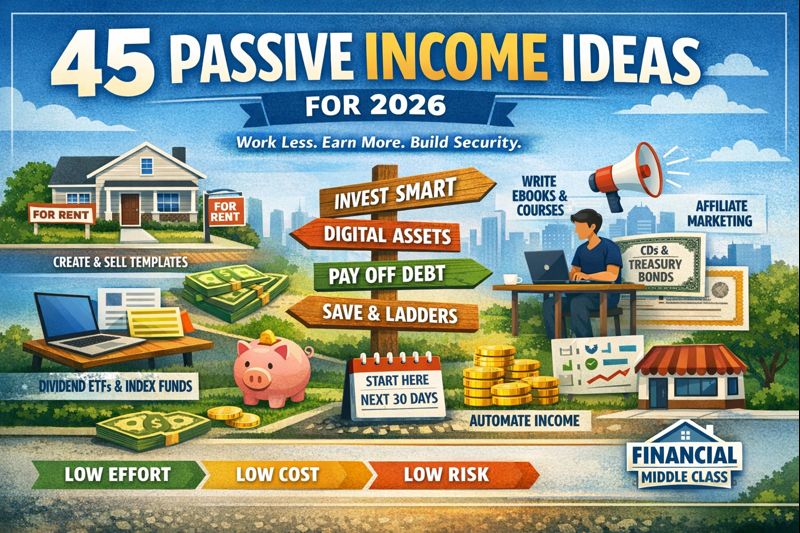
45 Passive Income Ideas [2026]: How to Make More and Work Less
By Article Posted by Staff Contributor
The estimated reading time for this post is 769 seconds
December 21, 2025 — Updated for 2026 with a clearer “start here” roadmap, risk checks, and 30/90-day action plans.
Timeline: What to do first (so this doesn’t stay theoretical)
Week 1: Choose your lane + stop the bleeding
Goal: clarity and cash-flow protection.
- Pick one lane: cash-first, skill-first, or asset-first.
- Automate a starter buffer (even small). Surprise bills love empty accounts.
- If you have high-interest debt, put it on a plan you can repeat.
Weeks 2–4: Build your first “repeatable” stream
Goal: create one thing that can pay more than once.
- Low time: automate investing + move idle cash where it earns.
- Low money: create one template/guide/printable tied to a real problem.
- Low skill: start with boring wins (HYSA/CDs/index fund automation).
Days 30–90: Tighten, systemize, scale (without burning out)
Goal: consistency + simple upgrades.
- Improve what’s working; ignore shiny new ideas.
- Track income/expenses from day one so taxes don’t ambush you.
- Add one small “layer” (bundle, email list, ladder, second channel).
Introduction: Why passive income matters
The middle class doesn’t need another pep talk about “hustle.”
You’re already hustling.
You’re hustling while the mortgage drafts. While the car note hits. While your insurance goes up like it’s training for a marathon.
While you’re doing mental math in aisle five because the total in your cart is not matching the total in your head.
And the part nobody says out loud? It’s not always the big bills that break you. It’s the surprise bills.
The Federal Reserve’s economic well-being data shows many households can cover a small emergency with cash, but plenty still can’t—and that gap is where stress lives.
Meanwhile, household debt keeps climbing; the New York Fed reported total household debt reached $18.59 trillion in Q3 2025.
So when you hear “passive income,” don’t picture Lamborghinis and laptop beaches.
Picture something more grown-up: margin. A little breathing room. A little control. A little less fear.
(Internal link idea: Add a link here to your “Emergency Fund” guide and/or “Zero-Based Budgeting” post.)
What passive income really means in 2026
Most passive income is not money that magically appears while you sleep.
It’s more like meal prep. You work on Sunday so Tuesday doesn’t wreck you.
Passive income usually comes from three places:
- Money you already have (interest, dividends, rent).
- Work you do once that can keep paying (royalties, digital products, licensing).
- Systems you build that don’t need you every day (automated services, semi-hands-off businesses).
And here’s the middle-class catch: you don’t have unlimited time, cash, or patience. So you need options that fit a real life.
Start here: your passive income starting point
Before we throw 45 ideas at you, let’s stop pretending everyone starts from the same place.
Ask yourself four questions:
- Do I have time (even two hours a week)?
- Do I have money (even a small cushion)?
- Do I have a skill people already ask me for?
- Do I need stability, or can I tolerate some risk?
Now pick your lane. One lane. For 90 days.
Best options by starting point (time vs money vs skill)
| If you’re starting with… | Best-fit ideas to start | Avoid for now |
|---|---|---|
| Low time (busy schedule, family load) | auto-investing, HYSA/money market, CD/Treasury ladder, dividend ETF, rent storage/parking | daily posting, heavy customer service, “be your own property manager” |
| Low money (tight budget, rebuilding) | templates/printables, licensing small skills, evergreen content, ethical affiliate content, bank bonuses (carefully) | real estate deals, expensive “automation stacks,” big upfront costs |
| Low skill (or unsure what to sell) | index funds + automation, HYSA/money market, simple “rent what you already have” income | complex trading, building apps, high-ticket coaching you’re not ready to deliver |
Passive income vs “extra jobs”
A lot of people call gig work “passive income” because it sounds better than saying, “I got a second job.”
But they’re not the same thing.
- Active income: you stop working, you stop earning (overtime, delivery apps, hourly freelancing).
- Semi-passive income: you build it, then maintain it (rentals, digital products, evergreen content).
- More passive income: your money does the work (interest, dividends, broad investing).
Sometimes active income is how you survive a season. No shame in that.
But if your goal is “work less,” you eventually have to move from hours-for-dollars into ownership.
The middle-class math (because interest is a bully)
Here’s the part the internet hates: debt can quietly cancel out your “passive income” progress.
Bankrate reported the average credit card interest rate at 19.75% as of December 2025.
So if you’re earning 4% on savings while paying 20% on cards, you’re not investing—you’re running in place.
This order of operations makes sense for a lot of middle-class households:
- Get the employer match (if you have it).
- Stop high-interest bleeding (or put it on a plan you can repeat).
- Build a starter buffer so surprises stop living on plastic.
- Automate investing so progress doesn’t depend on your mood.
- Build one repeatable asset (one thing you create once and can sell more than once).
Not perfect. Practical.
Risk reality check (how not to get wrecked)
“Passive income” can become “passive stress” fast.
- Real estate risk: vacancies, repairs, tenant drama, local rules.
- Digital risk: low sales, platform changes, copycats.
- Market risk: volatility, bad timing, panic selling.
Your job isn’t to eliminate risk. That’s impossible.
Your job is to cap the downside so one bad month doesn’t turn into a bad year.
45 passive income ideas for 2026
Investing income (mostly hands-off)
- Total market index fund (taxable brokerage)
- S&P 500 index fund (broad exposure, big swings)
- Dividend growth ETF (long-term income mindset)
- Bond index fund (stability tool, not a flex)
- Treasury ladder (bills/notes)
- Money market fund (idle cash with purpose)
- REIT index fund (real estate exposure without toilets)
- Preferred stock ETF (income-focused, understand the tradeoffs)
- Covered-call ETF (income now, upside capped)
- Robo-advisor with automatic deposits
- DRIP (dividend reinvestment)
- Simple “3-fund” style portfolio (boring by design)
Retirement moves that create future income
- Max your 401(k) match
- Increase your 401(k) contribution by 1%
- Fund an IRA (Roth or traditional, if eligible)
- Invest your HSA (if you have an eligible plan)
- Use a 529 plan (future debt prevention is wealth, too)
- Build a taxable “bridge” account for flexibility later
2026 contribution limits (quick reminder): 401(k) employee salary deferral limit is $24,500; IRA limit is $7,500 (per IRS updates).
Cash and interest income (middle-class-friendly on purpose)
- High-yield savings account (HYSA)
- CD ladder
- Treasury bill ladder (short-term cash goals)
- I Bonds (inflation-linked savings bonds)
- Municipal bond fund (tax-aware income, depends on your situation)
- Move idle cash into a money market
- Bank account bonuses (carefully—no fees, no games you can’t win)
FDIC national rate data for December 2025 listed the national average savings rate at 0.39%.
If your “savings” earns close to nothing, it’s not savings—it’s parking.
Real estate income without landlord misery
- Rent a room (house hack)
- Rent out garage/storage space
- Rent out a parking spot (near hospitals, downtowns, stadiums)
- Mid-term rentals (travel nurses/corporate stays)
- ADU income (if the math and local rules work)
- Real estate crowdfunding (higher risk, less control)
- REITs (again—because they’re a real option)
- Rent out equipment you already own (tools, camera gear, pressure washer)
- Rent out your car (only if wear/insurance math works)
Digital assets (front-loaded work, repeatable payout)
- Sell templates (Notion, budgets, resumes, checklists)
- Sell printables (planners, chore charts, trackers)
- License stock photos/video
- License music/beats
- Self-publish a short ebook (specific > long-winded)
- Build an evergreen online course (real outcome, not guru fog)
- Affiliate content (recommend tools you actually use)
- YouTube evergreen content (“how-to,” “explained,” “what I wish I knew”)
- Newsletter sponsorships (attention is an asset)
- Build a small subscription tool (a micro-app solves one problem)
Royalties and licensing (the quiet-check category)
- License your intellectual property (designs, photos, curriculum, content)
Quick scorecard: effort, risk, cost, time-to-first-dollar
This is what most people want to know before they commit.
| Idea | Upfront cost | Weekly upkeep | Risk | Time to first dollar |
|---|---|---|---|---|
| HYSA / money market | Low | Very low | Low | Immediate |
| CD/Treasury ladder | Low–Med | Very low | Low | Weeks–months |
| Index fund auto-investing | Low | Very low | Market | Long-term |
| Dividend ETF | Low | Very low | Market | Months–years |
| Rent storage/parking | Low | Low | Low–Med | Days–weeks |
| Rent a room | Med | Med | Med | Weeks |
| Templates/printables | Low | Low | Med | Weeks |
| Affiliate content | Low | Med | Med | Months |
| YouTube evergreen | Low | Med | Med | Months |
| Course | Low–Med | Med | Med | Months |
| Crowdfunded real estate | Med | Very low | Higher | Months–years |
Three real-life paths
Debt-heavy but stable income: “I’m employed but still stressed”
You don’t need more ideas. You need less interest.
Your first passive-income win is usually getting your finances to stop leaking.
- Keep the match if you have it.
- Build a starter emergency fund so surprises stop living on your credit card.
- Pick one repeatable asset: one template, one printable, one evergreen piece of content tied to a real need.
- Skip big-upfront-cost plays until you can breathe.
The goal isn’t “do everything.” It’s “stop being fragile.”
Low savings but high skill: “I’m capable—money just disappears”
You don’t need a second job. You need to sell the result, not the hour.
- Turn what people always ask you for into something reusable: a guide, a template, a mini-course.
- Keep it small enough to finish and clear enough to explain in one sentence.
- Publish evergreen content that points back to it.
You’re not “building a brand.” You’re building a shortcut people will pay for.
Cash cushion but low time: “I’m busy, not broke”
You’re the automation candidate.
- Put idle cash somewhere it actually earns.
- Auto-invest and stop checking it like a mood ring.
- Add a low-drama rental option only if it stays low-drama.
The point of passive income for you is time. Protect it.
The paperwork reality
Side income feels fun until tax time shows up with a clipboard.
If you earn money outside your job, you’ll deal with some version of income tracking, expense tracking, and “wait… do I owe more than I thought?”
You don’t have to become an accountant. You just have to stop pretending the paperwork will do itself.
- Track from day one (income and expenses).
- Use a separate account if you can—clarity is half the battle.
- Set aside a percentage for taxes if income becomes consistent.
The scam filter
If somebody promises guaranteed high returns, little to no risk, or urgency you can feel in your chest—treat it like a smoke alarm.
Ask three questions:
- Who pays me, and why?
- What value am I providing?
- What’s the worst-case outcome—and can I survive it?
Middle-class people don’t need more “opportunities.” They need fewer traps.
Maintenance: the quiet cost of “passive”
Passive income doesn’t mean “no work.” It means “less work later.”
- Investing: consistency and occasional check-ins.
- Digital products: updates, questions, light marketing.
- Rentals: repairs, vacancies, and people being people.
Expect maintenance. Plan for it. Then it doesn’t feel like failure—it feels like ownership.
A 30-day starter plan and a 90-day build plan
Track A: Debt-heavy but stable income
Next 30 days
- Choose a debt plan and automate it.
- Build a starter emergency fund (even if it’s small).
- Create one repeatable asset (template/printable/guide).
Next 90 days
- Improve the asset based on real feedback.
- Add a second version or a simple bundle.
- Keep investing at least up to the match (if available).
Track B: Low savings but high skill
Next 30 days
- Identify the most common “help me with this” request you get.
- Turn it into a paid shortcut (template/guide/video walkthrough).
- Publish one evergreen piece per week pointing to it.
Next 90 days
- Bundle your offer (starter + premium).
- Start a simple email list so you own your audience.
- Add affiliate links only to tools you genuinely use.
Track C: Cash cushion but low time
Next 30 days
- Move idle cash to a higher-earning option (HYSA/money market).
- Auto-invest on payday.
- Choose one low-maintenance add-on (storage/parking/equipment).
Next 90 days
- Ladder CDs or Treasuries for short-term goals.
- Review monthly, not daily.
- If the add-on starts eating your time, cut it. That’s the point.
The best 10 passive income ideas for the middle class
If you’re overwhelmed, good. That means you’re paying attention.
Here are 10 that tend to fit real middle-class lives:
- 401(k) match (if available)
- HYSA/money market for your emergency buffer
- CD or Treasury ladder
- Broad index fund auto-investing
- Dividend growth ETF (long-term)
- Rent storage/parking (low drama when done right)
- Rent out equipment you already own
- Sell one useful template (solve a real problem)
- Evergreen content + ethical affiliate income
- License your work (photos/design/content) if you have it
Pick one. Stay with it for 90 days. Let consistency do what motivation never does.
The truth that hits home
Passive income isn’t about becoming a different person.
It’s about becoming less breakable.
Because the middle-class dream was never “I want to be rich.”
It was always this:
I want one surprise bill to stop having the power to ruin my month.
FAQ
Is passive income actually “passive”?
Mostly, no. It’s usually front-loaded work or money doing work—plus maintenance.
Think “meal prep,” not “magic.” You do the work up front so future weeks cost less energy.
If I’m in credit card debt, should I still invest?
Often: get the employer match, then attack high-interest debt aggressively.
Middle-class reality: paying ~20% interest while chasing smaller returns is treadmill economics. Build a buffer, then build ownership.
What’s the safest way to start?
Start with stability: HYSA/money market, CD/Treasury ladders, and automated broad investing.
Then add one “repeatable” asset (template/guide/evergreen content) when you have breathing room.
How do I avoid scams in 2026?
If it promises high returns with no risk, or can’t explain who pays you and why—walk away.
Legit offers can explain the value, the buyer, the math, and the downside in plain English.
Do I need an LLC before I start?
Not usually on day one.
Start simple: track income/expenses, use a separate account, and upgrade structure when income is consistent.

RELATED ARTICLES
How Wealth Is Passed Across Generations in the United States: Mechanisms, Evidence, and the Policy Debate
How wealth passes between generations—trusts, taxes, and the debate. Get the facts, figures, and tradeoffs. Read now.
The S&P 7,000: How Wall Street Disconnects from Main Street
S&P 7,000 can rise while wages, benefits, and towns fall behind. See why the market isn’t the economy—read now.
Leave Comment
Cancel reply
Gig Economy
American Middle Class / Feb 18, 2026
How Wealth Is Passed Across Generations in the United States: Mechanisms, Evidence, and the Policy Debate
How wealth passes between generations—trusts, taxes, and the debate. Get the facts, figures, and tradeoffs. Read now.
By FMC Editorial Team
American Middle Class / Feb 16, 2026
The S&P 7,000: How Wall Street Disconnects from Main Street
S&P 7,000 can rise while wages, benefits, and towns fall behind. See why the market isn’t the economy—read now.
By MacKenzy Pierre
American Middle Class / Feb 16, 2026
The “Resilient Consumer” Is Real—But So Is the Interest Bill
Credit card balances are rising as savings fall. See what it means—and the 30/60/90 plan to escape 25% APR debt.
By Article Posted by Staff Contributor
American Middle Class / Feb 09, 2026
What To Do If You Get Fired With an Outstanding 401(k) Loan
Fired with a 401(k) loan? Avoid taxes, offsets, and deadline traps with this step-by-step checklist. Read now.
By Article Posted by Staff Contributor
American Middle Class / Feb 09, 2026
The Real Math of Money in Relationships
Split finances without resentment. Any couple, any income ratio. Use the worksheet + rules—start today.
By Article Posted by Staff Contributor
American Middle Class / Feb 03, 2026
Investing or Paying Off the House?
Invest or pay off your mortgage? See a $500k example with today’s rates, dividends, and peace-of-mind math—then choose your plan.
By Article Posted by Staff Contributor
American Middle Class / Jan 30, 2026
Gold, Silver, or Bitcoin? Start With the Job—Not the Hype
Gold, silver or Bitcoin? Learn what each is for—and how to size it—before you buy. Read the framework.
By Article Posted by Staff Contributor
American Middle Class / Jan 29, 2026
Florida Homeowners Pay the Most in HOA Fees
Florida HOA fees are surging. See what lawmakers changed, what’s next, and how to protect your budget—read before you buy.
By Article Posted by Staff Contributor
American Middle Class / Jan 29, 2026
Why So Many Homebuyers Are Backing Out of Deals in 2026
Why buyers are backing out of home deals in 2026—and how to avoid costly surprises. Read the playbook before you buy.
By Article Posted by Staff Contributor
American Middle Class / Jan 28, 2026
How Money Habits Form—and Why “Self-Control” Is the Wrong Villain
Learn how money habits form—and how to rewire spending and saving using behavioral science. Read the framework and start today.
By FMC Editorial Team
Latest Reviews
American Middle Class / Feb 18, 2026
How Wealth Is Passed Across Generations in the United States: Mechanisms, Evidence, and the Policy Debate
How wealth passes between generations—trusts, taxes, and the debate. Get the facts, figures, and tradeoffs....
American Middle Class / Feb 16, 2026
The S&P 7,000: How Wall Street Disconnects from Main Street
S&P 7,000 can rise while wages, benefits, and towns fall behind. See why the market...
American Middle Class / Feb 16, 2026
The “Resilient Consumer” Is Real—But So Is the Interest Bill
Credit card balances are rising as savings fall. See what it means—and the 30/60/90 plan...