
Understand Financial Stressors — and Know How to Cope with Them
By Article Posted by Staff Contributor
The estimated reading time for this post is 584 seconds
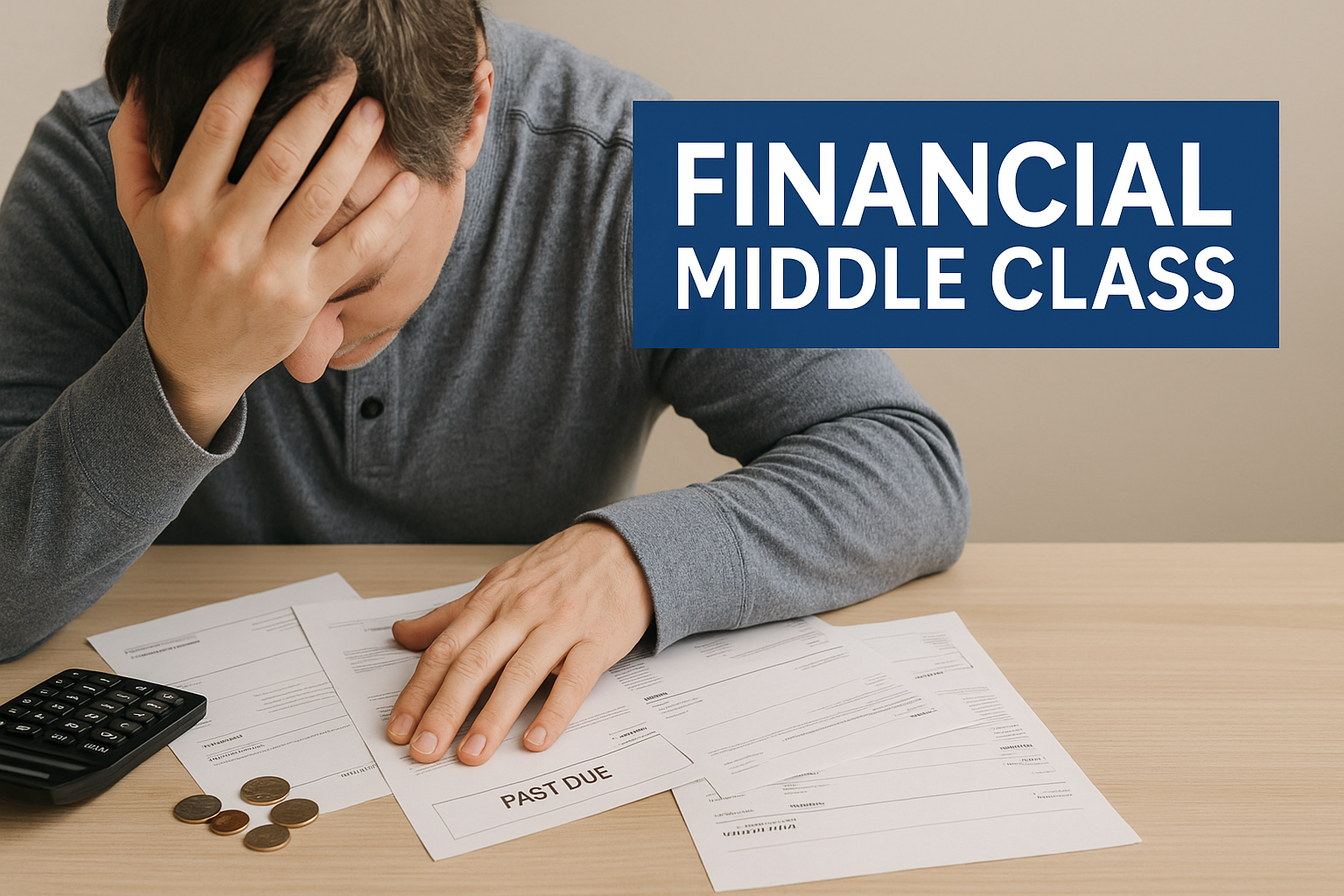
Too many of you are stressed about money and think it’s because you “just need to budget better.” That’s not the full story.
You’re living through an economy where housing is expensive, groceries never went back down, debt is pricier, and incomes aren’t moving fast enough. That’s not a character flaw. That’s math.
So let’s stop pretending the problem is that you bought a sandwich. Let’s name the real financial stressors squeezing middle-class households right now — and then build a playbook to respond, not panic.
I’m going to walk you through three things:
- what financial stress actually is (and isn’t),
- what’s really causing it for working and middle-class Americans right now, and
- how to cope — both financially and emotionally — without tapping out.
Financial Middle Class • Quick Stress Check
In the last 30 days, have you…
- Delayed paying a bill because cash was too tight?
- Checked your bank app multiple times a day?
- Worried about an unexpected $300–$500 expense?
- Argued about money at home?
If you said “yes” to 2 or more, you’re not bad with money — you’re under financial stress.
© Financial Middle Class
1. What Financial Stress Really Is
Financial stress is what happens when the money going out is too close to (or more than) the money coming in — and you don’t have a cushion.
It shows up like this:
- You’re checking your bank app way too often.
- Every unexpected bill (car repair, school fee, copay) ruins your whole week.
- You delay opening mail because it might be a bill.
- You argue about money at home even when nothing “big” happened.
That’s not you being dramatic. That’s your nervous system responding to real financial exposure. You know that if one thing goes wrong — hours cut, kid gets sick, car breaks down — there’s nothing to catch you. That’s financial stress.
Let me say this clearly: you’re not crazy, the economy is expensive. You can be doing a lot “right” and still be strained.
2. The Four Budget Bullies
There are four money categories right now doing most of the damage to the middle class. If you don’t identify them, you start cutting in the wrong places (like kids’ activities or the rare dinner out) and still feel broke.
1. Housing
Rent and mortgages became bullies.
- Rents jumped in a lot of markets.
- Home prices never really corrected the way people hoped.
- Mortgage rates stayed higher than the “free money” era.
So housing is now taking 30–40% of income for a lot of households. When shelter takes that much, everything else becomes tight. That’s stress.
2. Groceries & Household Essentials
You saw it yourself: prices went up… and then stayed there. Even when the news said “inflation is slowing,” your cart total didn’t. That creates this feeling of, “I’m working, but I can’t stretch it.”
3. Debt in a High-Rate World
Credit-card balances at 20%+ are different from credit-card balances at 12%. Same balance, different pain. Add buy-now-pay-later for basics and maybe a personal loan from 2022, and suddenly debt is a monthly bill, not a tool.
4. No Emergency Cushion
This one is sneaky. You might be current on everything, but if you have no cash cushion, you live in constant “what if” mode:
- What if I get sick?
- What if the car goes?
- What if I lose my job?
That “what if” is a stressor all by itself. It makes small problems feel like big problems.
3. Why the Middle Class Feels It So Much
You’d think higher earners or lower earners would report more money stress. A lot of times, it’s actually the middle.
Why?
- You have fixed bills. Mortgage/rent, car to get to work, insurance, internet for kids’ homework — none of that is optional.
- You’re expected to “do it all.” Save for retirement, help aging parents, pay student loans, fund kids’ activities, maybe even help grown kids. That’s a lot of directions for one paycheck.
- Your lifestyle is tied to your location. If you live in a growth market (Florida, Carolinas, Texas metros), housing, insurance, and even utilities have crept up. You can’t just “relocate” every time landlords increase rent.
- There’s an expectations gap. You did what America told you to do — college, job, house — but the numbers don’t feel like the American Dream. That mismatch creates frustration and shame.
So no, you’re not bad with money. You’re in a high-cost economy trying to live a middle-class life on wages that didn’t keep up.
4. Coping Step 1: Lower the Actual Stressors
This is where most “money advice” gets annoying — it tells you to stop buying coffee. I’m not doing that. I want you to make high-impact moves that actually create breathing room.
A. Do a 30-Minute Payment Triage
Grab your bank statement or credit-card app. List everything that leaves your account in a month. Then mark each line as:
- Must pay (housing, car to get to work, utilities, insurance)
- Should pay (debt, phone, subscriptions you use)
- Can pause / downgrade / cancel
Your goal is not to “be perfect.” Your goal is to free cash this month. If you can free even $150–$300, that’s money you can aim at debt or savings — which reduces stress.
B. Attack the Highest-Stress Debt First
Not always the highest interest — the highest stress.
For most people, that’s the credit card that never seems to go down or the one that’s close to the limit. Paying one of those down gives you emotional relief because you see movement.
If you can consolidate to a lower rate, do it. If you can transfer to a 0% offer and actually pay it during the promo, do it. This isn’t about being “fancy,” it’s about making progress visible.
C. Make Housing Less Painful (Even Temporarily)
- Can you negotiate the lease?
- Can you move within the same city to a cheaper unit?
- Can you take in a roommate for 6–12 months to rebuild savings?
- If you own and you’re struggling, can you call the servicer early and ask about hardship or temporary relief?
Housing is the biggest line item, so any move here matters more than cutting Netflix.
D. Start an “Oh Crap” Fund — Even Tiny
I don’t care if it’s $25 a week. Put it in a separate savings space, name it “Emergency” and do not touch it.
Why? Because knowing you have something turns random events (flat tire) back into what they are: inconveniences, not disasters. That lowers stress.
Financial Middle Class • Emergency Fund Starter
Step 1: Write down your average monthly essential bills (housing, utilities, car, food).
Monthly essentials: $ ______
Step 2: Pick a starter goal (1 month is great, 2 months is better).
Starter emergency goal: $ ______
Step 3: Divide your goal by 12 to get a monthly savings target.
Example: $1,200 ÷ 12 = $100/month → about $25/week.
Small, automatic contributions reduce financial stress more than one big lump sum. © Financial Middle Class
E. Income-Up Strategy
We have to be real: in 2025, expense-cutting alone won’t fix everyone’s stress. Some of you need a temporary income surge:
- weekend shifts,
- short-term freelance,
- monetizing a real skill (hair, tutoring, food, rides),
- or asking for overtime.
You don’t have to do it forever — just long enough to wipe out a bill that’s choking your cash flow. One extra $400–$600 month for 3–4 months can kill a small card or rebuild the emergency fund.
5. Coping Step 2: Reduce the Emotional Load
Money stress isn’t just about dollars. It’s also about how often you let money yell at you.
Here’s how to quiet it down.
A. Stop “Constant Checking.”
Pick a money day and a money time — say, Sunday at 5pm for 30 minutes.
That’s when you look at balances, schedule bills, and make decisions.
Why? Because checking your account 9 times a day doesn’t make more money appear. It just keeps your nervous system on high alert.
B. Name the Real Fear
“Money” is too big. What are you actually afraid of?
- “I’m afraid I can’t pay rent if I miss work.”
- “I’m afraid of the car breaking.”
- “I’m afraid of losing my job.”
Once you name it, you can build a plan around that (extra rent in savings, car repair sinking fund, upskilling/job search). Vague fears can’t be solved. Specific ones can.
C. Loop in the Household
Hiding bills from your spouse/partner/kids doesn’t reduce stress — it multiplies it. If money is tight, everyone needs to know the rules:
- “We’re cutting eating out for 60 days.”
- “We’re paying off this card first.”
- “We’re rebuilding savings to $1,000, then we relax.”
Shared plan = shared burden = less stress.
D. Use Low-Cost Mental Health Supports
Financial stress and mental health are linked. If your job has an EAP, use it. If your community has low-cost counseling, use it. If your faith community has benevolence or bill-pay assistance, ask. Coping isn’t just working more — it’s getting support so you don’t burn out.
6. Let’s Talk Systems — Because It’s Not All on You
I’d be lying if I said, “Just budget and everything will be fine.” No, some of this is structural.
- Housing supply is tight.
- Child care is high.
- Health insurance has big deductibles.
- Credit products are designed to keep balances revolving.
So part of coping is refusing to internalize a structural problem as a personal failure. You’re doing money in a system that pushes costs onto households. That doesn’t mean you’re powerless — it means don’t add shame to an already tight budget.
What helps at the systems level?
- automatic emergency savings through payroll,
- local property-tax relief and utility-bill help,
- fair-chance underwriting instead of punishing thin credit,
- and actual affordable housing where the jobs are.
You may not pass legislation tomorrow, but you can take advantage of the supports that exist in your city or county. A $150 utility credit is real money.
7. Your 7-Day Financial Stress Reset
Let’s make this practical. Here’s a one-week plan you can literally drop into an article or teach in a workshop.
Day 1: List every bill and auto-draft. Mark must/should/can pause.
Day 2: Call/visit 1–2 providers to negotiate or downgrade (phone, streaming, insurance).
Day 3: Open or separate an emergency savings bucket. Automate $25–$50/week.
Day 4: Pick the debt you will attack first. Set the extra payment.
Day 5: Have the money talk with your household. Show the plan.
Day 6: Look for 1 temporary income boost you can start this month.
Day 7: Set your weekly “money time” on the calendar.
By the end of 7 days, you haven’t fixed the whole economy — but you’ve reduced uncertainty, which is what your nervous system wanted.
Financial Middle Class • 7-Day Financial Stress Reset
- Day 1: List every bill & auto-draft. Label: must / should / pause.
- Day 2: Call one provider (phone, internet, insurance) to lower or downgrade.
- Day 3: Open or separate an emergency bucket; auto-save $25–$50/week.
- Day 4: Pick the debt you will attack first and set the extra payment.
- Day 5: Share the money plan with your household.
- Day 6: Identify 1 temporary income boost for this month.
- Day 7: Schedule your weekly 30-minute “money time.”
Designed for working & middle-class households • Financial Middle Class
8. Final Word
You’re not imagining it. Money really is tighter.
But you’re also not helpless.
If you:
- reduce the biggest stressors (housing, high-APR debt),
- rebuild even a small cushion,
- contain how often money can bother you,
- and bring your household into the plan,
…you can get out of panic mode and back into progress mode.
Financial stress doesn’t always mean you’re broke — sometimes it just means your money has no job and no buffer. Give it both.


RELATED ARTICLES
Cash Strategy: Put Every Dollar in the Right Place
Your checking account, emergency fund, short-term savings, and investments should not be managed the same way. This cash strategy helps assign every dollar to the right financial job.
Best HYSA: How to Choose Beyond the Highest APY
A competitive interest rate matters, but it is only one part of choosing a high-yield savings account. Compare insurance, fees, access, transfer speed, and promotional conditions.
Leave Comment
Cancel reply
Gig Economy
Business / Aug 08, 2026
The Missing Middle in Black Entrepreneurship
Black entrepreneurship has expanded dramatically. The next challenge is helping more Black-owned businesses move from self-employment to employer firms and sustainable scale.
By FMC Editorial Team
Personal Finance / Aug 01, 2026
Cash Strategy: Put Every Dollar in the Right Place
Your checking account, emergency fund, short-term savings, and investments should not be managed the same way. This cash strategy helps assign every dollar to the right...
By Article Posted by Staff Contributor
Personal Finance / Aug 01, 2026
Best HYSA: How to Choose Beyond the Highest APY
A competitive interest rate matters, but it is only one part of choosing a high-yield savings account. Compare insurance, fees, access, transfer speed, and promotional conditions.
By Article Posted by Staff Contributor
Personal Finance / Aug 01, 2026
High-Yield Savings vs. CDs, Treasury Bills, and Other Safe Places for Cash
High-yield savings accounts are excellent for accessible cash, but they are not always the best choice. Compare HYSAs, CDs, Treasury bills, money market accounts, and I...
By Article Posted by Staff Contributor
American Middle Class / Aug 01, 2026
High-Yield Savings Accounts: A Safer Home for Your Cash
A high-yield savings account can pay several times the national savings rate while keeping qualified deposits federally insured. Here is how it works, what to watch...
By Article Posted by Staff Contributor
Real Estate / Jul 30, 2026
Mortgage Lock-In Is Freezing the Housing Market
Millions are trapped by 3% mortgages. Learn how mortgage lock-in worsens affordability—and why homeowners are renovating instead.
By FMC Editorial Team
Real Estate / Jul 26, 2026
Is South Florida More Expensive Than New York? The Complete 2026 Relocation Guide
Is South Florida more expensive than New York? Compare housing, taxes, insurance and 104 municipalities before you move.
By Article Posted by Staff Contributor
Personal Finance / Jul 25, 2026
The Time Value of Life Experiences: What Compound Interest Leaves Out,
Money compounds, but life experiences do too. Explore what compound interest leaves out—and how to balance saving with living.
By MacKenzy Pierre
American Middle Class / Feb 18, 2026
How Wealth Is Passed Across Generations in the United States: Mechanisms, Evidence, and the Policy Debate
How wealth passes between generations—trusts, taxes, and the debate. Get the facts, figures, and tradeoffs. Read now.
By FMC Editorial Team
American Middle Class / Feb 16, 2026
The S&P 7,000: How Wall Street Disconnects from Main Street
S&P 7,000 can rise while wages, benefits, and towns fall behind. See why the market isn’t the economy—read now.
By MacKenzy Pierre
Latest Reviews
Business / Aug 08, 2026
The Missing Middle in Black Entrepreneurship
Black entrepreneurship has expanded dramatically. The next challenge is helping more Black-owned businesses move from...
Personal Finance / Aug 01, 2026
Cash Strategy: Put Every Dollar in the Right Place
Your checking account, emergency fund, short-term savings, and investments should not be managed the same...
Personal Finance / Aug 01, 2026
Best HYSA: How to Choose Beyond the Highest APY
A competitive interest rate matters, but it is only one part of choosing a high-yield...