
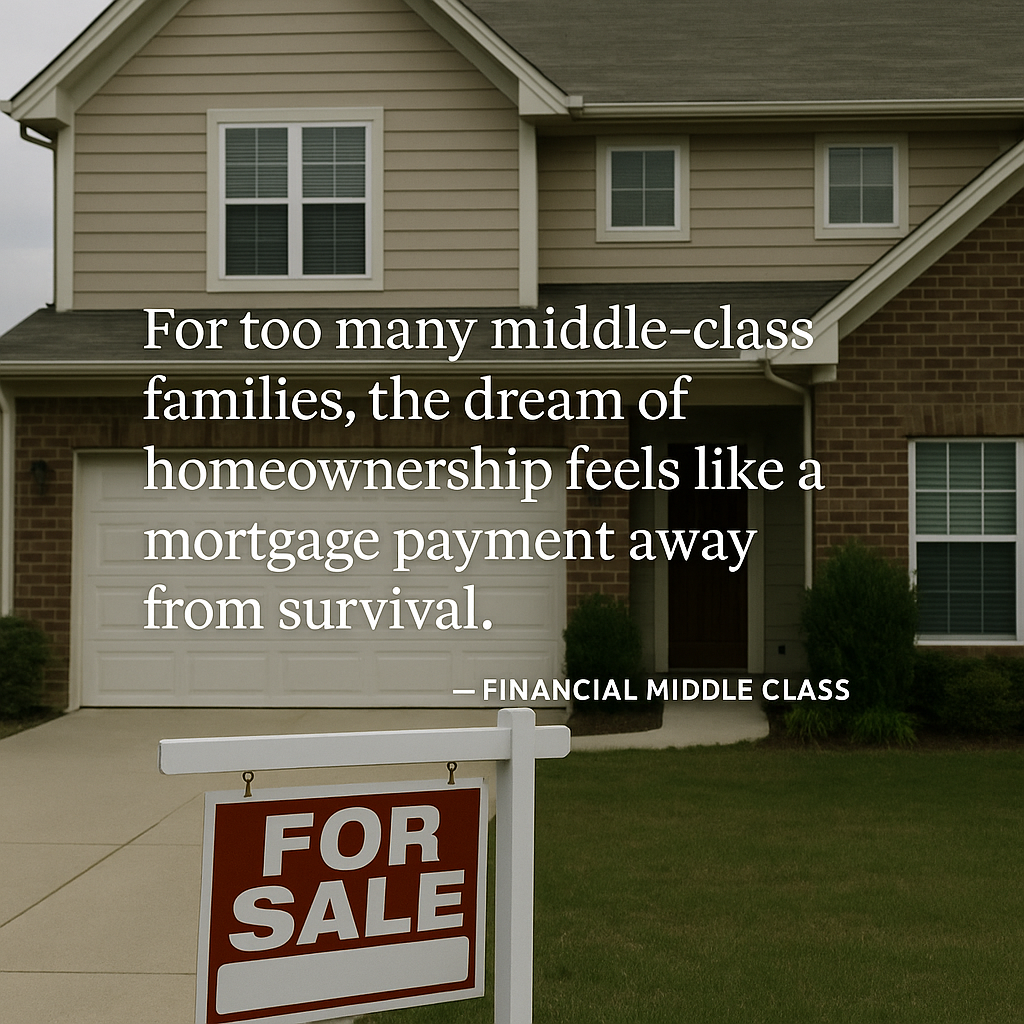
🏠 The House That Built (and Broke) the Middle Class: How Much Home Should Americans Really Buy
By MacKenzy Pierre
The estimated reading time for this post is 418 seconds
You can tell a lot about someone’s economic standing by their mortgage application. The size of the down payment. The type of loan. The number of incomes it takes to qualify. But in today’s America, those numbers don’t just show financial discipline — they reveal how far the middle class will stretch just to be considered middle class.
The median home price in America now hovers around $450,000. That number alone doesn’t sound unreasonable until you pair it with the median household income — roughly $75,000. In simple math, that’s a price-to-income ratio of six-to-one, double what used to be considered “affordable.” The message is clear: homeownership still defines success, but achieving it now means flirting with financial exhaustion.
The Dream That Outgrew the Paycheck
Once upon a time, buying a home was the surest path to wealth. After World War II, the GI Bill turned homeownership into the bedrock of the American middle class. You worked hard, saved a little, and bought a modest house. It appreciated, your mortgage stayed fixed, and your wealth grew quietly with time.
That equation no longer works. Housing prices have detached from wages. The mortgage interest deduction that once rewarded ownership now benefits those at the top. Property taxes rise faster than paychecks. The home — once the simplest investment — has turned into the most leveraged bet most Americans ever make.
Yet, for many, it’s still the only ticket to be seen as “middle class.” That’s the paradox: homeownership is both the badge and the burden.
Down Payments Don’t Tell the Whole Story
Putting down 20% used to signal that you’d arrived financially. Today, it might just mean you had help.
According to the National Association of Realtors, about one in four first-time buyers — roughly 25% — receive a gift or loan from family or friends to cover part of their down payment. Among younger buyers under 30, that number jumps to nearly 40%, based on Redfin data.
This shift exposes a deeper truth: many new homeowners aren’t climbing the ladder through income alone — they’re being lifted up by family wealth. That doesn’t make the accomplishment less meaningful, but it does blur the line between earned and inherited middle-class status.
And the divide isn’t just generational; it’s racial. Research shows about 35% of White households have received significant financial gifts or inheritances, compared to only 13% of Black households. In other words, the ability to “get help” with a down payment isn’t evenly distributed. It’s another reflection of America’s long-running wealth gap — one that homeownership was supposed to fix, not magnify.
When you buy a home with less than 20% down, you don’t just take on a mortgage — you take on an extra bill called private mortgage insurance, or PMI. It sounds harmless until you realize what it actually does. PMI doesn’t protect you. It protects the lender.
You’re paying monthly premiums to insure someone else’s risk. The bank still collects its interest and fees, the investors still earn their yield, and you’re the one footing the bill for the safety net. It’s a quiet cost that middle-class borrowers accept because they have to — like a tax you pay to access the American Dream.
PMI can easily add half a percent to a percent and a half to your loan amount each year. That’s hundreds a month — thousands over time — for a policy that never benefits you directly. It’s not wealth-building; it’s wealth delaying. And those with family help skip it entirely. They walk straight into equity, while everyone else rents stability through an insurance premium that protects everyone but them.
And that’s the quiet divide inside the middle class: some own homes because they earned them; others because they borrowed the appearance of stability.
Location: The Invisible Class Divider
A $450,000 house doesn’t mean the same thing everywhere. In Charlotte, it gets you a backyard and a two-car garage. In San Francisco, it gets you an entry-level condo and a headache. Both homeowners are technically “middle class,” but only one has breathing room left in their budget.
Geography defines class as much as income. A teacher couple in Texas might live comfortably in a home half that price, while a single professional in Boston earning six figures can barely keep up with rent. The American Dream has a ZIP-code problem — and pretending it doesn’t is part of why the middle class keeps falling for the same illusion.
The Two-Income Illusion
Here’s another illusion: affordability based on two paychecks.
Most lenders approve loans assuming both borrowers’ incomes will continue indefinitely. It’s become so common that many households can’t even qualify without combining salaries. The Bureau of Labor Statistics reports that about two-thirds of U.S. families with children now rely on both parents working full time. In high-cost regions — places like California, New York, and the Pacific Northwest — the percentage is even higher because one income alone rarely clears the affordability bar.
That means many modern mortgage applications are built on fragile math. The deal only works as long as both incomes stay intact. One layoff, one illness, one maternity leave — and suddenly, that “manageable” payment becomes a crisis.
The new middle class isn’t just working harder; it’s working riskier. The old rule of thumb — spend no more than 28% of income on housing — has been quietly replaced by “whatever gets approved.” That’s not stability; that’s betting your family’s future on uninterrupted employment.
House Poor Nation
Being “house poor” used to be a warning. Now, it’s practically the default setting. Roughly one in three homeowners spends more than 30% of their income on housing — the official definition of being cost-burdened. Add insurance, maintenance, and property taxes, and that number jumps even higher.
The tragedy is hidden in the monthly routine. Many homeowners do build equity, but too many don’t — especially those who stretched too far, bought in overheated markets, or put almost nothing down. National data shows around 2% to 3% of mortgaged homes are seriously underwater, meaning the loan balance exceeds the home’s value by at least 25%. In some states, like Louisiana, that figure climbs above 10%.
For new buyers who entered during recent price spikes, it’s even riskier — roughly one in ten of those who bought in the last year saw their home values dip below what they owe. When that happens, a house stops being a wealth-builder and becomes a cage. You can’t sell, can’t refinance, and can’t walk away without wrecking your credit.
A home is supposed to give you security, not suffocate your cash flow. Yet too many Americans have traded flexibility for granite countertops and mistaken leverage for stability.
Class Identity vs. Financial Reality
Homeownership used to be proof of financial progress. Now it’s often a performance — a way to show belonging even when the math doesn’t support it. Drive through any suburb and you’ll see it: new SUVs in the driveway, freshly built homes, and quiet anxiety behind every closed door.
Middle-class America has become experts at looking stable while living leveraged. They’ve mistaken debt for success and square footage for wealth. The truth is simpler: owning a home doesn’t elevate your class; managing your cash flow does.
Right-Sizing the Dream
The solution isn’t to abandon homeownership — it’s to right-size it. A smart middle-class buyer knows that the goal isn’t the biggest home you can afford; it’s the one that leaves room for everything else — savings, investing, and breathing.
Financial guardrails still matter:
- Keep housing costs under 28% of gross income.
- Don’t buy if it takes both paychecks to qualify.
- Have at least 3–6 months of reserves post-closing.
- Choose homes that fit your lifestyle, not your ego.
Renting isn’t failure. Waiting isn’t losing. Stretching beyond your means to prove something is.
Build Wealth or Buy Walls
The question isn’t whether you can buy a home. It’s whether you should — and how much is too much. The American middle class can’t afford to keep measuring success by the size of a mortgage statement.
A house can build your net worth — or bury it under property taxes, repairs, and false pride. The difference is whether you own it, or it owns you.

Senior Accounting & Finance Professional|Lifehacker|Amateur Oenophile

RELATED ARTICLES
Why Paying Off Debt Can Lower Your Credit Score—and Why That Isn’t Always Bad
Paying off a loan or closing a credit card can sometimes lower your credit score. Learn how zero-balance accounts, credit utilization, and installment loans affect your FICO score—and why financial progress matters more than maximizing every point.
The Problem With “Good Debt”
Mortgages, student loans, and business financing are often called good debt. But borrowing for the right reasons doesn't guarantee financial success. Explore how interest, hidden fees, limited savings, and unequal homeownership opportunities can turn supposedly good debt into a lasting...
Leave Comment
Cancel reply
Gig Economy
American Middle Class / Oct 23, 2026
Why Paying Off Debt Can Lower Your Credit Score—and Why That Isn’t Always Bad
Paying off a loan or closing a credit card can sometimes lower your credit score. Learn how zero-balance accounts, credit utilization, and installment loans affect your...
By Article Posted by Staff Contributor
American Middle Class / Oct 22, 2026
The Problem With “Good Debt”
Mortgages, student loans, and business financing are often called good debt. But borrowing for the right reasons doesn't guarantee financial success. Explore how interest, hidden fees,...
By MacKenzy Pierre
American Middle Class / Oct 16, 2026
The American Middle Class’s Guide to the 2026 Midterm Ballot Measures
The 2026 midterm elections will put major housing and tax proposals before American voters. From Florida's homestead exemptions to Massachusetts zoning reform and California's affordable housing...
By Article Posted by Staff Contributor
Personal Finance / Oct 14, 2026
FICO Finally Has Competition. Will Homebuyers Get a Better Deal?
For decades, FICO dominated mortgage credit scoring. Now VantageScore 4.0 is challenging that dominance. Discover how new rules from federal housing regulators could affect mortgage approvals,...
By Article Posted by Staff Contributor
American Middle Class / Oct 13, 2026
Selling Affordability Through Installments
Americans are increasingly buying based on what they can afford each month rather than what something actually costs. From buy now, pay later services to longer...
By Article Posted by Staff Contributor
American Middle Class / Oct 12, 2026
Fair Capitalism: We Don’t Need to Abolish Capitalism. We Need to Fix It.
Fair capitalism means preserving entrepreneurship and profits while ensuring working Americans share more meaningfully in the prosperity they help create.
By MacKenzy Pierre
American Middle Class / Oct 12, 2026
The Sunday Scaries: How Financial Independence Can Help You Reclaim Your Weekend
The Sunday Scaries can begin long before Monday morning. Building emergency savings, lowering monthly expenses, and increasing financial independence may help you reclaim your weekend.
By Article Posted by Staff Contributor
Business / Aug 08, 2026
The Missing Middle in Black Entrepreneurship
Black entrepreneurship has expanded dramatically. The next challenge is helping more Black-owned businesses move from self-employment to employer firms and sustainable scale.
By FMC Editorial Team
Personal Finance / Aug 01, 2026
Cash Strategy: Put Every Dollar in the Right Place
Your checking account, emergency fund, short-term savings, and investments should not be managed the same way. This cash strategy helps assign every dollar to the right...
By Article Posted by Staff Contributor
Personal Finance / Aug 01, 2026
Best HYSA: How to Choose Beyond the Highest APY
A competitive interest rate matters, but it is only one part of choosing a high-yield savings account. Compare insurance, fees, access, transfer speed, and promotional conditions.
By Article Posted by Staff Contributor
Latest Reviews
American Middle Class / Oct 23, 2026
Why Paying Off Debt Can Lower Your Credit Score—and Why That Isn’t Always Bad
Paying off a loan or closing a credit card can sometimes lower your credit score....
American Middle Class / Oct 22, 2026
The Problem With “Good Debt”
Mortgages, student loans, and business financing are often called good debt. But borrowing for the...
American Middle Class / Oct 16, 2026
The American Middle Class’s Guide to the 2026 Midterm Ballot Measures
The 2026 midterm elections will put major housing and tax proposals before American voters. From...