
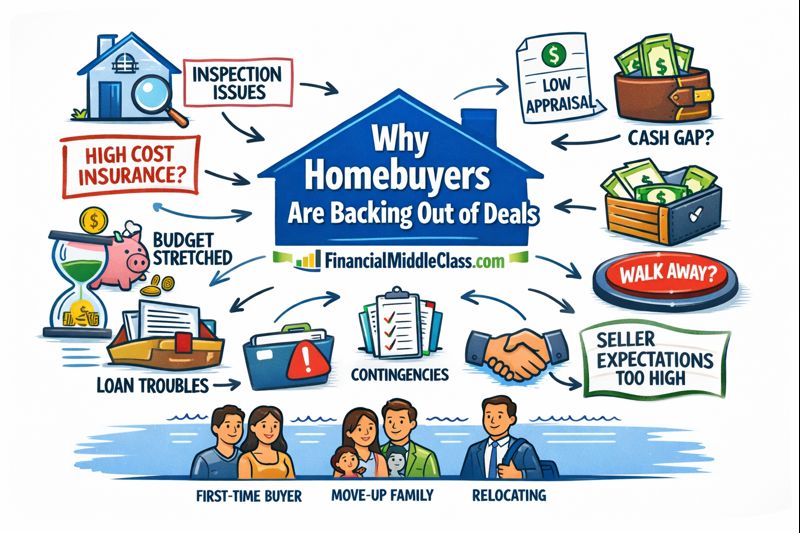
Why So Many Homebuyers Are Backing Out of Deals in 2026
By Article Posted by Staff Contributor
The estimated reading time for this post is 795 seconds
Why So Many Homebuyers Are Backing Out of Deals in 2026
Last updated: January 28, 2026
Key takeaways
- Most cancellations aren’t “cold feet.” They’re payment shock once the all-in monthly cost becomes real.
- Insurance can change a deal by itself—quote it early, not at the finish line.
- Inspections and appraisals are the two biggest reality checks. Know what’s negotiable vs what’s a walk-away.
- Deadlines matter. If you cancel, do it inside contingency windows and document everything.
- A home that removes your breathing room isn’t stability—it’s a bill with a front porch.
The moment the deal turns real
There’s a moment in the homebuying process when your brain stops daydreaming and starts doing triage.
You’ve done the showings. You’ve uploaded the same documents three times. You’ve pictured your life in the place—your mornings, your routines, the relief of finally having something that’s yours.
Then the real numbers arrive.
Not the listing price. The all-in monthly payment. The insurance quote that changes the deal. The inspection report that turns “charming” into “expensive.” The appraisal that comes in low and forces a new math problem.
That’s when a purchase stops feeling like a milestone and starts feeling like a risk.
So some buyers do the thing people love to judge: they walk.
In December 2025, over 40,000 U.S. home-purchase agreements were canceled—about 16.3% of homes that went under contract that month, the highest December rate in Redfin’s records dating back to 2017.
The cancellation era is mostly one thing: payment shock
Rates are lower than the worst of last year, but “better” still isn’t “cheap.” Freddie Mac’s weekly survey showed the 30-year fixed mortgage averaged 6.09% as of January 22, 2026.
And here’s what buyers keep learning the hard way: the mortgage payment is only the headline.
The full monthly cost—principal, interest, taxes, insurance, PMI, HOA—doesn’t always hit with full force until you’re already under contract. That’s when people realize they weren’t shopping for a home. They were shopping for a monthly obligation with moving parts.
Redfin estimated the median U.S. monthly housing payment dipped to $2,413 during the four weeks ending January 11, 2026. That’s “down,” but it’s still a heavy line item for most middle-class households.
Where deals actually die: the homebuying pressure points
Most cancellations happen at predictable checkpoints. Not because someone suddenly changed their mind about the backsplash.
Offer accepted
The excitement phase. Deadlines start, but many buyers still haven’t seen the final all-in payment.
Inspection period
The house gets examined. Repair costs, safety issues, and seller refusal to credit can break the deal here.
Appraisal
The bank checks reality. A low appraisal forces new math: renegotiate, cover the gap, or cancel within contingency.
Underwriting
Income, debts, and bank statements get verified. Documentation delays and DTI surprises show up here.
Insurance + escrow finalized
The “real” monthly payment lands. Insurance quotes, escrow, and tax estimates can move the bill by hundreds.
Final walkthrough
Last look before closing. New damage, incomplete repairs, or last-minute surprises can trigger a clean exit.
Buyers aren’t flaking. They’re reacting to new information at the moments when the contract allows it—or when the numbers stop making sense.
What buyers expect vs what hits them
This is the whiplash. People think they’re buying a home. Then they realize they’re buying a monthly obligation that can change after closing.
| What you expect | What you actually get |
|---|---|
| “A mortgage I can handle” | A bundled monthly bill (P&I + taxes + insurance + PMI + HOA) |
| “A home that needs a little love” | A home that needs cash, fast |
| “Fixed rate = predictable life” | Insurance hikes, tax changes, escrow adjustments |
| “Fair price” | An appraisal that may disagree |
| “Stability” | A commitment that punishes you if you have no margin |
That gap—expectation versus reality—is where deals crack.
Three buyers, same problem
1) The first-time buyer (mid-30s, finally saved a down payment)
They can handle the mortgage… until taxes, PMI, and insurance turn the payment into something bigger than their comfort zone. They realize they’d be buying a home and losing their breathing room at the same time.
2) The move-up family (kids, daycare, a car payment, “we need space”)
They aren’t reckless. They’re fully loaded already. Their budget isn’t empty space; it’s a tight schedule of bills. When the inspection shows roof risk and HVAC risk in the same sentence, they see the first year of ownership coming for their savings.
3) The relocator (new job, new city, new costs)
They didn’t know the local tax bill. They didn’t anticipate HOA dues. They assumed insurance would be manageable. Then the quote arrives—and the deal no longer fits the life they already have.
Different situations. Same reality: the all-in cost is higher than expected.
The all-in payment: the parts buyers underestimate
The full monthly cost usually includes:
- Principal + interest
- Property taxes
- Homeowners insurance
- PMI (if you’re under 20% down)
- HOA/condo fees (if applicable)
- Maintenance reserve (because repairs are not theoretical)
Quick gut-check: If the payment only works when nothing goes wrong, it doesn’t really work.
This is why buyers back out late. They don’t discover one new cost. They discover the stack.
Insurance isn’t a footnote anymore. It can be the deal-breaker.
For years, insurance was treated like a checkbox. Now it can change the entire monthly payment.
Consumer Federation of America found that from 2021 to 2024, premiums for a typical homeowner rose by about $648 on average—roughly a 24% increase—reaching about $3,303 per year by 2024.
So buyers go under contract thinking the payment works—then the insurance quote lands and the numbers shift. And because you must have coverage to close, insurance isn’t optional. It’s a gate.
If the quote is bad enough, the buyer doesn’t “think about it.” They cancel.
Inspections are scaring buyers straight—and that’s not a bad thing
During the frenzy years, people waived inspections like risk didn’t exist. That mood has changed. Buyers want the truth.
But an inspection report is not a panic button. It’s a sorting system. The middle-class move is triage: what’s a deal-breaker, what’s negotiable, and what’s annoying but manageable.
| Usually a walk-away (or major renegotiation) | Often fixable (credit/repair/price adjustment) |
|---|---|
| Foundation issues with structural impact | Minor electrical fixes (GFCI, outlets, switches) |
| Active roof failure / widespread leaks | Small plumbing leaks / fixtures |
| Unsafe electrical panel / severe wiring issues | Cosmetic wear and minor repairs |
| Significant mold from ongoing moisture | Localized mold with clear remediation plan |
| Sewer line collapse / major failure | Drainage improvements / grading |
| HVAC failure + no credits + tight budget | Aging HVAC with credits/price reduction |
Walking doesn’t mean you’re picky. Sometimes it means you’re paying attention.
Appraisal gaps: the quiet contract killer
You agree to $450,000. The appraisal comes in at $435,000. The lender lends against the appraisal—not your contract price.
Now you’re choosing between bringing cash to cover the gap, getting the seller to reduce price, meeting in the middle, or canceling if your appraisal contingency allows it.
A lot of buyers don’t have “extra gap cash.” They have savings meant for reserves, moving, and not living one emergency away from debt.
So the appraisal doesn’t just test value. It tests whether this deal is financially safe.
Sellers are still talking like it’s 2021. Buyers are living in 2026.
Some sellers still expect waived inspections, no credits, and clean appraisals. Buyers are looking at higher borrowing costs than the old era, higher insurance costs, and higher repair costs.
That mismatch—seller expectations versus buyer capacity—creates more cancellations. It’s not drama. It’s math.
In a market where buyers feel they have some options again, more people are willing to say no to bad terms.
Earnest money and contingencies: how to walk without getting burned
Earnest money is your “I’m serious” deposit. Whether you keep it depends on your contract and deadlines.
Most buyers are protected by contingencies such as inspection, appraisal, and financing (and sometimes insurance, depending on the contract and market).
The most common way buyers lose leverage isn’t emotion—it’s missing a deadline or failing to document properly.
If you cancel, do it cleanly:
- Know your contingency dates
- Put it in writing
- Reference the contract terms, not feelings
- Keep the paper trail simple and professional
- If it’s messy, consult a real estate attorney before you make it final
Note: This is practical self-protection, not legal advice.
The buyer playbook: negotiate like an adult
Most buyers don’t need hype. They need language.
Repairs (safety/structure)
Script: “Based on the inspection findings, we’re requesting repairs for items impacting safety, structure, and major systems (roof/HVAC/electrical/plumbing). We’re open to licensed contractor receipts or an equivalent credit at closing.”
Credit instead of repairs (control the work)
Script: “We’d prefer a seller credit so we can manage the scope and quality of the work after closing. Our requested credit reflects contractor estimates.”
Low appraisal
Script: “The appraisal came in at $X. We’re requesting a price adjustment to the appraised value (or a compromise) to proceed. If we can’t reach agreement, we’ll exercise the appraisal contingency.”
Insurance shock
Script: “Our insurance quotes materially change the monthly payment beyond what we can sustain. If we can’t restructure terms, we’ll cancel within the contingency timeframe.”
A clean cancellation
Script: “Thank you for your cooperation. We’re terminating the contract under the contingency provisions within the allowed timeframe. Please confirm receipt and next steps for the earnest money release.”
Buy now or wait: a rubric that respects real life
Buy is more reasonable when:
- You’ll still have 3–6 months of reserves after closing (more if your income is variable)
- The payment still works if taxes or insurance rise
- You’re not relying on overtime/bonuses to survive the base bill
- The inspection risk is manageable (or you negotiated credits)
- Your job/income is stable enough that you won’t live in fear of one bad month
Wait—or slow down—when:
- The payment leaves no margin
- You’re draining most savings just to close
- One repair would push you onto credit cards
- Insurance is uncertain or hard to bind
- You feel pressured to “win” more than you feel prepared to own
Owning should not require you to live tight every month.
If you back out, what to do next (without spiraling)
Backing out can feel like failure. It’s not. But you need a plan.
- Name the real deal-breaker (insurance, inspection, appraisal, payment). That becomes your filter next time.
- Shop for the all-in payment, not the list price.
- Quote insurance early, before you get attached.
- Treat reserves like part of the down payment, because they are.
- Adjust expectations instead of stretching risk (location, home type, timing).
The goal isn’t just to buy. It’s to buy without sacrificing your stability.
FAQ
Will I lose earnest money if I cancel?
Not necessarily. It depends on your contract and whether you cancel within the deadlines. Miss the window and the leverage changes fast.
Should I waive inspection to compete?
If the only way to compete is to ignore risk, that’s not competition. That’s gambling.
What if my insurance jumps after closing?
That’s why margin matters. If the payment only works under perfect conditions, it’s fragile by design.
Is a low appraisal always a deal-breaker?
No. It’s a renegotiation point. It becomes a deal-breaker when the gap requires cash you don’t have or the seller won’t move.
How much cash should I keep after closing?
Enough that the first repair doesn’t become debt. Homes test new owners early.
Quick question
What was your “deal-breaker moment”—inspection, insurance, appraisal, or the all-in payment? Drop it in the comments (and what you wish you’d known sooner).
The bottom line
People keep saying the housing market is “stabilizing” because rates have eased and some costs have cooled.
But stability isn’t a headline. It’s a feeling.
Stability is buying a home without needing everything to go perfectly. It’s knowing your payment won’t ambush you later. It’s having enough margin that a surprise doesn’t become a crisis.
The reason so many buyers are backing out isn’t because they’re flaky. It’s because they’re finally treating this decision like what it is: a long-term obligation that can either support your life—or squeeze it.
Breathing room is the whole point.


RELATED ARTICLES
Cash Strategy: Put Every Dollar in the Right Place
Your checking account, emergency fund, short-term savings, and investments should not be managed the same way. This cash strategy helps assign every dollar to the right financial job.
Best HYSA: How to Choose Beyond the Highest APY
A competitive interest rate matters, but it is only one part of choosing a high-yield savings account. Compare insurance, fees, access, transfer speed, and promotional conditions.
Leave Comment
Cancel reply
Gig Economy
Business / Aug 08, 2026
The Missing Middle in Black Entrepreneurship
Black entrepreneurship has expanded dramatically. The next challenge is helping more Black-owned businesses move from self-employment to employer firms and sustainable scale.
By FMC Editorial Team
Personal Finance / Aug 01, 2026
Cash Strategy: Put Every Dollar in the Right Place
Your checking account, emergency fund, short-term savings, and investments should not be managed the same way. This cash strategy helps assign every dollar to the right...
By Article Posted by Staff Contributor
Personal Finance / Aug 01, 2026
Best HYSA: How to Choose Beyond the Highest APY
A competitive interest rate matters, but it is only one part of choosing a high-yield savings account. Compare insurance, fees, access, transfer speed, and promotional conditions.
By Article Posted by Staff Contributor
Personal Finance / Aug 01, 2026
High-Yield Savings vs. CDs, Treasury Bills, and Other Safe Places for Cash
High-yield savings accounts are excellent for accessible cash, but they are not always the best choice. Compare HYSAs, CDs, Treasury bills, money market accounts, and I...
By Article Posted by Staff Contributor
American Middle Class / Aug 01, 2026
High-Yield Savings Accounts: A Safer Home for Your Cash
A high-yield savings account can pay several times the national savings rate while keeping qualified deposits federally insured. Here is how it works, what to watch...
By Article Posted by Staff Contributor
Real Estate / Jul 30, 2026
Mortgage Lock-In Is Freezing the Housing Market
Millions are trapped by 3% mortgages. Learn how mortgage lock-in worsens affordability—and why homeowners are renovating instead.
By FMC Editorial Team
Real Estate / Jul 26, 2026
Is South Florida More Expensive Than New York? The Complete 2026 Relocation Guide
Is South Florida more expensive than New York? Compare housing, taxes, insurance and 104 municipalities before you move.
By Article Posted by Staff Contributor
Personal Finance / Jul 25, 2026
The Time Value of Life Experiences: What Compound Interest Leaves Out,
Money compounds, but life experiences do too. Explore what compound interest leaves out—and how to balance saving with living.
By MacKenzy Pierre
American Middle Class / Feb 18, 2026
How Wealth Is Passed Across Generations in the United States: Mechanisms, Evidence, and the Policy Debate
How wealth passes between generations—trusts, taxes, and the debate. Get the facts, figures, and tradeoffs. Read now.
By FMC Editorial Team
American Middle Class / Feb 16, 2026
The S&P 7,000: How Wall Street Disconnects from Main Street
S&P 7,000 can rise while wages, benefits, and towns fall behind. See why the market isn’t the economy—read now.
By MacKenzy Pierre
Latest Reviews
Business / Aug 08, 2026
The Missing Middle in Black Entrepreneurship
Black entrepreneurship has expanded dramatically. The next challenge is helping more Black-owned businesses move from...
Personal Finance / Aug 01, 2026
Cash Strategy: Put Every Dollar in the Right Place
Your checking account, emergency fund, short-term savings, and investments should not be managed the same...
Personal Finance / Aug 01, 2026
Best HYSA: How to Choose Beyond the Highest APY
A competitive interest rate matters, but it is only one part of choosing a high-yield...