
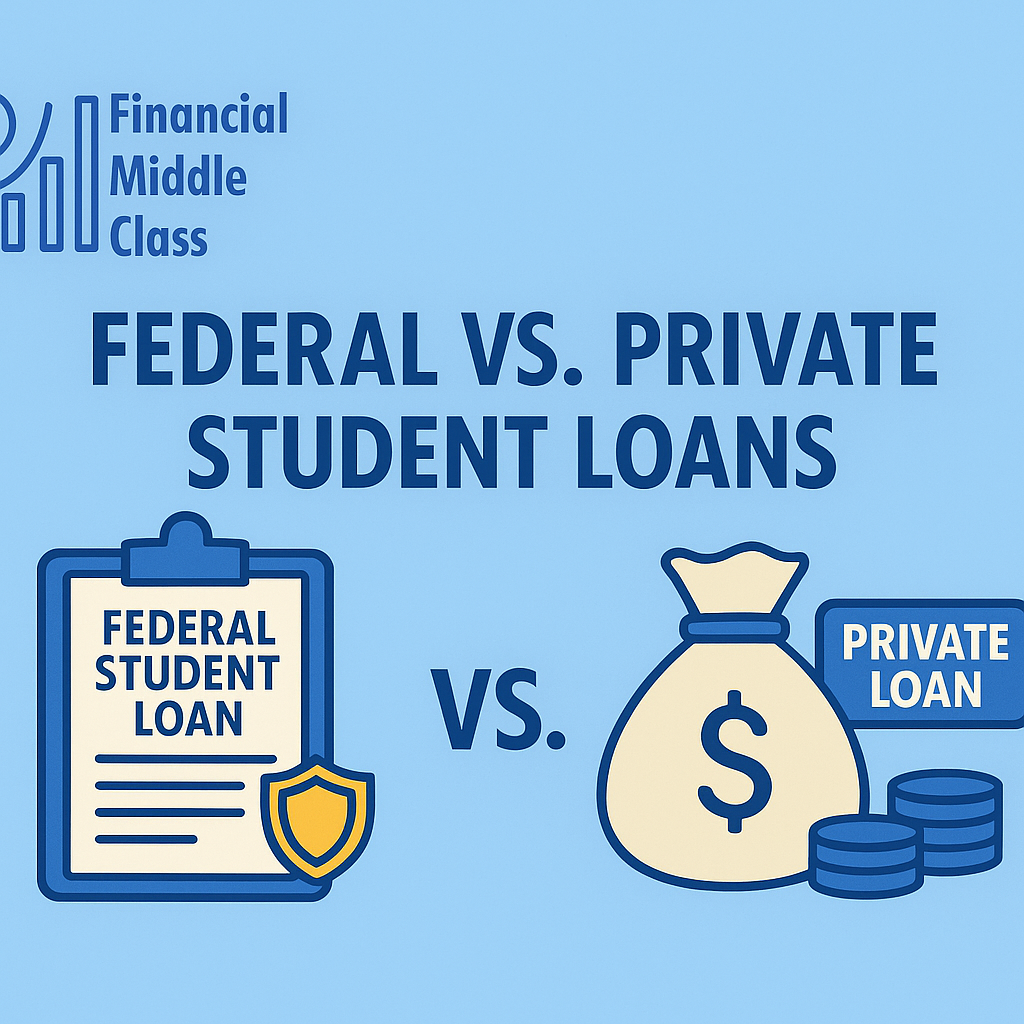
Federal or private student loans? Here’s what the difference is.
The estimated reading time for this post is 626 seconds
Reality Check
If you’re the first in your family to go to college, you don’t just pick a major—you pick a financing model. And that choice follows you longer than the dorm furniture. For too many people in the Financial Middle Class, it’s the difference between graduating into breathing room or stepping into a monthly bill that eats the raise you worked so hard to earn. The pitch sounds the same—money for school—but federal and private student loans live on different planets. One is built with guardrails; the other is built with underwriting.
Let’s make this plain, in the voice of people who’ve had to budget the last week of the month: choose the loan that gives you options when life zigzags. That’s the real difference.
he Historical Context: How we got here
A generation ago, grants covered more of college. Sticker prices were lower, and “aid” meant help you didn’t repay. Over time, tuition rose faster than wages, and loans filled the gap. Today, federal loans still make up the vast majority of education debt in America—roughly nine out of ten student-loan dollars are federal—with the remainder coming from private lenders like banks and fintechs.
Policy makers designed federal loans as a public program: fixed interest rates, income-based payment options, and targeted forgiveness for public-service workers. Private loans grew as a market product: rates and terms based on credit and underwriting. And here’s a detail that matters in real life: most undergraduate private loans require a co-signer, often a parent or grandparent—meaning the risk doesn’t just sit with the student. It spreads to the household.
The Current Trap: Same “student loan,” totally different safety net
Federal loans: the built-in cushions
- Fixed interest rates set annually by law for new borrowers; your rate doesn’t float. (For 2025–26, undergraduate Direct Loans carry a fixed rate; grad and PLUS loans are higher, all fixed for the life of each loan.)
- Income-Driven Repayment (IDR) options that cap payments to a slice of your income and offer eventual forgiveness after many years of qualifying payments.
- Public Service Loan Forgiveness (PSLF) for qualifying public and nonprofit workers after 120 qualifying payments.
- Grace periods, deferment/forbearance options when money gets tight (e.g., the standard six-month grace after leaving school).
- Discharge protections in cases like death or total and permanent disability (and other narrow circumstances).
Yes, federal loans also come with origination fees—roughly ~1% on Direct Subsidized/Unsubsidized and ~4% on PLUS—a cost many borrowers don’t expect. But in exchange, you’re buying flexibility.
Private loans: underwriting first, flexibility second
- Rates vary by lender and credit profile; they can be fixed or variable (and variable can rise). Typical advertised ranges stretch from low single digits to the high teens.
- Credit check required; most undergrads need a co-signer to qualify or to access lower rates. Cosigning transfers lender risk into family risk.
- Fewer built-in protections: some private lenders offer forbearance, interest-rate reductions for autopay, or temporary hardship options, but there’s no federal IDR or PSLF, and terms vary by contract. Read the fine print like your name depends on it—because it does.

Answer a few questions. We’ll recommend a path that respects middle-class cash flow.
Behavioral & Economic Lens: Why we choose the loan we later regret
When college deadlines hit, families default to speed and certainty: “Who can approve this week?” Private lenders market slick portals and instant decisions. Federal aid, by contrast, requires the FAFSA and sometimes patience. That timing mismatch nudges stressed families toward the fast door, even if it’s the more expensive one.
There’s also the signal vs. substance problem. A low headline rate on a private loan feels like a win—until you factor in a variable rate that can reset, the absence of IDR, and a co-signer on the hook. Meanwhile, federal loans don’t always “feel” generous in the moment—origination fee, bureaucratic language—but they carry the safety valves that protect your future cash flow. The middle class works harder than ever just to stand still; the loan with more exits is worth more than the one with a glossy APR.
Hidden Costs / Consequences: What you don’t see on the offer screen
- Rate risk (private variable loans): If your private loan is variable, your monthly payment can climb with interest rates. Federal loans don’t do this; the rate is fixed.
- The family balance sheet: About nine in ten private undergraduate dollars involve a co-signer. Missed payments can bruise the co-signer’s credit or trigger collections that pull both of you into stress.
- Opportunity cost of losing federal protections: Once you go private—either by borrowing private from the start or by refinancing federal into private—you give up income-based repayment, PSLF eligibility, and federal forbearance programs. That’s a one-way door.
- Fees and capitalization: Federal loans charge upfront origination fees; many private lenders don’t—but private interest can capitalize aggressively after forbearance or while in school, depending on terms. Ask how and when unpaid interest gets added to principal.
- Grace-period differences: Federal loans typically offer a six-month grace period; private lenders may offer less—or require payment while you’re in school.
- Household stress transfer: A private loan with a parent co-signer converts your tuition bill into intergenerational credit risk. We see it in the data and we feel it at the kitchen table.
Federal vs. Private at a Glance (keep this mental checklist)
- Rate type: Federal = fixed; Private = fixed or variable (credit-based).
- Repayment relief: Federal = IDR + PSLF + standardized grace/deferment; Private = lender-specific, contract-dependent.
- Eligibility: Federal doesn’t use a credit score for undergrad Direct Loans; Private requires credit/DTI, often a co-signer.
- Loan caps: Federal undergrad annual limits generally $5,500–$12,500 (aggregate caps apply); graduate up to $20,500 in Direct Unsubsidized before looking at PLUS. Private limits hinge on cost of attendance and underwriting.
- Fees: Federal loans charge origination fees (≈1% Direct; ≈4% PLUS). Most private loans advertise no origination fee, but watch other costs.
Data Points Worth Your Attention
- Scale: Americans owe trillions in student debt, and while private loans are a smaller slice, they are still substantial—on the order of $130–$150 billion outstanding. That’s a lot of household balance sheets tied to variable policies and contracts.
- Cosigners: ~92% of private undergraduate borrowing involves a cosigner. That’s not a footnote; it’s a system design choice that uses the family’s credit to price the loan.
- Borrowing trends: The Federal Reserve notes shifts in who borrows and how much; fewer young adults report education debt than a few years ago, but the cost pressure is still real for those who do.
Solutions / Guardrails: How to decide like a pro (without acting like a bank)
1) Exhaust federal options first.
File the FAFSA—even if you think you won’t get grants. Federal loans are about optionality and downside protection, not just the rate. If you’ll work in public service, PSLF is a long runway worth preserving.
2) If you must go private, lock the variables you can.
- Prefer fixed rates if your budget is tight and your income path is uncertain.
- Compare at least three lenders and check true APR (not teaser rate).
- Confirm in-school payment policy, grace period, hardship forbearance length, and interest capitalization rules.
- Ask about autopay discounts and whether they stack (0.25% is common).
3) Read the cosigner section like it’s a mortgage.
- What does it take to release the cosigner (on-time payments for X months? credit review?)
- What triggers a cosigner auto-default (death, bankruptcy, missed payment)?
- Put in writing who will pay if money gets tight. Family peace is worth more than 50 basis points.
4) Keep your exit ramps.
If you’re choosing private because the headline rate is lower today, imagine two futures: one where your income jumps, one where it stalls. In the bad-case world, federal IDR and PSLF are life preservers; private contracts rarely are. You can always refinance federal into private later if your risk profile improves. You can’t go back the other direction.
5) Borrow less than the award letter says you “can.”
Your goal isn’t to maximize loan approval; it’s to minimize future fixed costs. Every $1,000 you don’t borrow is freedom you don’t have to buy back later.
6) Mind the fees and the math.
Federal origination fees are real; build them into your total cost. For private loans, look for prepayment penalties (ideally none) and ask exactly when unpaid interest gets capitalized. A clean amortization table beats a clever sales pitch.
7) Align degree ROI with repayment risk.
If you’re headed into a lower-paying field with high social value (teaching, social work, nonprofit), it’s another reason to stick with federal and keep PSLF on the table. That’s not ideology; that’s a cash-flow match.
FAQs in the Real World (quick hits)
“Are federal loans always cheaper?”
Not always on the rate, but often cheaper on risk. Fixed rates, IDR, PSLF, standardized hardship options—those features can be worth more than 1–2% of APR over a long horizon.
“Will a private lender let me pay based on income?”
Some offer short-term relief, but no true federal-style IDR with eventual forgiveness. If income volatility is part of your life (it is for a lot of us), that matters.
“What about grace periods?”
Federal Direct loans usually give you six months after leaving school. Private lenders vary: some interest-only, some immediate payment, some grace. Confirm it. In writing.
“How much can I borrow?”
Federal undergrads typically $5,500–$12,500 per year depending on year in school and dependency; grads up to $20,500 in Direct Unsubsidized (PLUS exists above that). Private loans hinge on your credit and cost of attendance.
The Financial Middle Class Bottom Line
Owning a home doesn’t elevate your class; managing your cash flow does. Same with college debt. The affordable loan isn’t the one that approves fastest or quotes the lowest teaser rate—it’s the one that lets you breathe when life doesn’t go to plan. Federal loans are built with that oxygen in mind. Private loans can work if the numbers are tight, your income path is strong, and your household can shoulder the risk. But don’t confuse speed with safety. The difference between wealth and debt is how much room you leave yourself to breathe.
College can expand your options—or your obligations. Pick the loan that respects uncertainty. That’s not just good financing. That’s how the middle class stays free enough to move.


Pingback: PMI Exit Plan: How to Remove PMI and Reclaim Cash Flow - FMC