
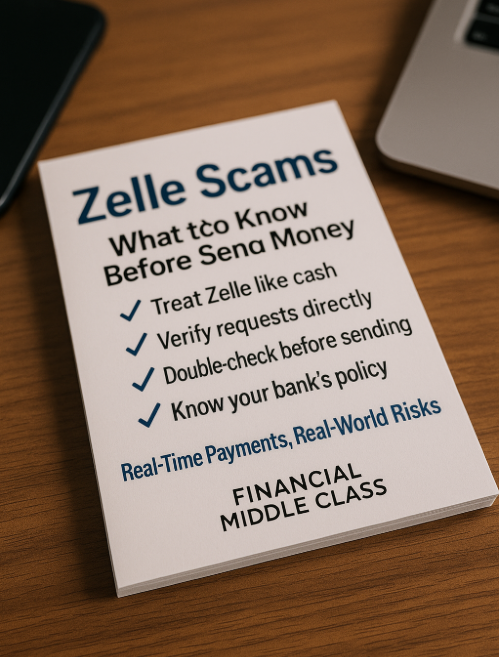
Zelle Scams and Real-Time Payments: What You Need to Know Before You Send Money
By Article Posted by Staff Contributor
The estimated reading time for this post is 408 seconds
The $500 that vanished in seconds
You sell a couch. The buyer says they’ll Zelle you $500. A notification pops up—money received! You help load the couch. Two hours later, the payment is gone and your bank won’t reverse it because you authorized the transfer. That “instant” convenience? It cuts both ways.
Real-time payments like Zelle are now woven into daily life, but consumer protections didn’t keep pace. If you use Zelle (or any instant P2P), you need to know how it started, why banks push it, why some opt out, and exactly how to use it without getting burned.
What is Zelle, really? (No, it isn’t a wallet)
Zelle is the bank industry’s built-in person-to-person (P2P) payment network. Unlike Venmo or PayPal, Zelle doesn’t hold a balance—payments move straight from one bank account to another, usually within minutes, using your email or phone as an “address.” Zelle is run by Early Warning Services (EWS), a company co-owned by seven big banks (Bank of America, Capital One, JPMorgan Chase, PNC, Truist, U.S. Bank, Wells Fargo).
How the money actually moves: Many Zelle transfers post near-instantly for the recipient, while settlement can occur over ACH or, in some bank pairings, via true instant rails like The Clearing House’s RTP (e.g., Bank of America & PNC). Either way, once the recipient is enrolled, you typically can’t cancel.
Why Zelle was created (and why it took off)
Zelle launched in 2017 (rebranding from “clearXchange”) as the banks’ answer to Venmo/PayPal—a way to keep P2P payments inside bank apps and accounts instead of letting fintech wallets own the relationship. That’s also why it’s embedded directly in thousands of bank apps rather than as a freestanding wallet.
TL;DR on the strategy:
- Keep deposits and engagement in bank apps (not third-party wallets).
- Offer “instant” P2P without card interchange fees.
- Compete with Venmo/Cash App on speed/convenience, but inside a bank-owned network.
Why some banks participate—and some don’t
Most do. By 2025, 2,200+ banks and credit unions connected Zelle directly in their apps. (Zelle’s standalone app was shut down on March 31, 2025, so enrollment now runs through participating institutions.)
Why banks join: customer demand (“send money now” is table stakes), higher app engagement/retention, and a bank-owned alternative to fintech wallets. EWS markets tangible benefits—more profitable and stickier customers for FIs offering Zelle.
Why some don’t: integration cost/complexity, fraud exposure and dispute workload, and less control over network rules. Trade press and credit-union posts cite these concerns, and some community institutions have publicly said “no thanks.”
Changing risk posture: Large banks are adding friction in risky contexts. Example: Chase began blocking or slowing Zelle payments tied to social-media marketplace interactions in 2025. That’s a signal—banks see social channels as high-risk for Zelle scams
Is Zelle “real-time” and how is it different from FedNow or RTP?
- Zelle: a consumer-facing network owned by banks; immediate posting for enrolled recipients; settlement may ride ACH or, in some pairings, instant RTP rails. Irreversible once the recipient is enrolled.
- RTP (The Clearing House): a real-time settlement rail that some Zelle banks use behind the scenes.
- FedNow: a Federal Reserve instant payment rail launched July 20, 2023, giving all banks/credit unions access to true instant settlement 24/7/365. It’s infrastructure, not a consumer app.
The protections question (and why scams keep winning)
Zelle markets itself as safe—and EWS points to ~99.9%+ of transactions without a fraud/scam report—but the remaining fraction still translates into big dollar losses given Zelle’s scale. Regulators and state AGs have taken aim at how banks handle disputes and scams on the network.
Regulation E basics in plain English
- If someone else moved money from your account without your authorization (e.g., account takeover), Reg E generally requires your bank to investigate and reimburse eligible losses.
- If you authorized the transfer—even if you were tricked (an “authorized push payment” scam)—Reg E usually doesn’t require reimbursement under current rules.
Recent enforcement and scrutiny:
- CFPB lawsuit (Dec 2024) against three Zelle owner banks over “widespread” fraud handling; the case put industry practices under a spotlight. New York’s AG separately sued EWS in Aug 2025, alleging $1B+ in scam losses since launch. (EWS counters that >99.95% of transactions are fraud- or scam-free.)
Common Zelle scams (and how they hook smart people)
- “Pay-yourself” bank-impersonation: “We detected fraud—send a Zelle transfer to yourself to lock your account.” It routes to the crook.
- Marketplace bait: A too-good-to-be-true listing or “buyer” who pressures you to accept Zelle for purchase protection that doesn’t exist.
- “Family in trouble” (imposter): “Mom, I smashed my phone—send money to this number now.”
- Romance/investment hybrid: Weeks of grooming, then an “urgent” transfer.
Remember: Zelle does not offer purchase protection—use it like cash, only with people you know and trust.
Practical guardrails: Use Zelle safely (and confidently)
Before you ever send
- Lock down your phone & number. Use a strong device passcode and turn on your bank’s strongest sign-in protections (biometrics + app-based 2FA).
- Rename contacts you Zelle often (“Aunt Maria – Zelle”) to avoid look-alike numbers.
- Set alerts for Zelle activity and low balances in your banking app.
Every time you send
- Triple-check the recipient “address.” One digit off = money gone. If the other person is not enrolled, you can usually cancel before they enroll.
- Never follow links in texts/DMs claiming to be your bank. If you get a “fraud” call, hang up and dial the number on the back of your card.
- Avoid social-media marketplace payments via Zelle; even big banks are adding blocks/delays there for a reason.
When to avoid Zelle
- Paying strangers for goods/services, deposits, tickets, pets, or rentals.
- High-pressure, “urgent” requests.
- Anything that would normally include purchase protection—use a credit card instead.
FAQ for diligent readers
Can I cancel a Zelle payment?
Only if the recipient hasn’t enrolled yet. Once enrolled, payments can’t be reversed.
What are the limits?
Limits vary by bank—commonly hundreds to several thousand dollars per day; check your bank’s Zelle page. (With the now-retired standalone Zelle app, non-bank users were generally capped at about $500/week.)
Is there a fee?
Banks typically don’t charge consumers to send/receive with Zelle inside their apps. Some banks charge small business users per transaction.
What if I used the wrong number or got scammed?
Act immediately:
- Contact your bank’s fraud team and freeze Zelle access.
- Change your online banking password and device 2FA.
- File reports with the FBI’s IC3, the FTC, and (if the bank response is lacking) the CFPB complaint portal—bring screenshots, timestamps, and the recipient’s info
Why can’t I enroll anymore in the Zelle app?
Because the standalone Zelle app was discontinued on March 31, 2025. To use Zelle, you must enroll through a participating bank or credit union. If your institution doesn’t offer Zelle, choose a different method or consider switching banks.
Why banks like Zelle—and what that means for you
Zelle keeps you inside your bank’s ecosystem (good for retention) and lets money move fast without card processing fees. But speed + finality means you must be the last line of defense—especially on purchases, where Zelle offers no purchase protection.
Action plan: A safer payments checklist
- Use Zelle only for friends/family or trusted small businesses you know personally.
- Pause 30 seconds before sending—re-read the phone/email.
- Prefer credit cards for purchases (strongest dispute rights).
- Keep your number secure (SIM-swap PIN with your carrier).
- If anything feels off—don’t send. Pick a different method.
Related Reads:
- The Hidden Cost of Overdraft: Why Middle-Class Americans Still Pay Billions
- Wells Fargo, Bank of America, and the History of Bank Scandals
- Financial Literacy in America: Why 73% of Adults Struggle With Basic Money Questions
- Are Big Banks Designed Against You?
Tailored Call-to-Action
Audit your last 90 days of payments. Where did you use Zelle? Were any to strangers or for goods? Move those scenarios to a credit card starting today. If your bank lacks strong alerts and security controls, consider one that does.


RELATED ARTICLES
Cash Strategy: Put Every Dollar in the Right Place
Your checking account, emergency fund, short-term savings, and investments should not be managed the same way. This cash strategy helps assign every dollar to the right financial job.
Best HYSA: How to Choose Beyond the Highest APY
A competitive interest rate matters, but it is only one part of choosing a high-yield savings account. Compare insurance, fees, access, transfer speed, and promotional conditions.
1 Comment
Leave Comment
Cancel reply
Gig Economy
Business / Aug 08, 2026
The Missing Middle in Black Entrepreneurship
Black entrepreneurship has expanded dramatically. The next challenge is helping more Black-owned businesses move from self-employment to employer firms and sustainable scale.
By FMC Editorial Team
Personal Finance / Aug 01, 2026
Cash Strategy: Put Every Dollar in the Right Place
Your checking account, emergency fund, short-term savings, and investments should not be managed the same way. This cash strategy helps assign every dollar to the right...
By Article Posted by Staff Contributor
Personal Finance / Aug 01, 2026
Best HYSA: How to Choose Beyond the Highest APY
A competitive interest rate matters, but it is only one part of choosing a high-yield savings account. Compare insurance, fees, access, transfer speed, and promotional conditions.
By Article Posted by Staff Contributor
Personal Finance / Aug 01, 2026
High-Yield Savings vs. CDs, Treasury Bills, and Other Safe Places for Cash
High-yield savings accounts are excellent for accessible cash, but they are not always the best choice. Compare HYSAs, CDs, Treasury bills, money market accounts, and I...
By Article Posted by Staff Contributor
American Middle Class / Aug 01, 2026
High-Yield Savings Accounts: A Safer Home for Your Cash
A high-yield savings account can pay several times the national savings rate while keeping qualified deposits federally insured. Here is how it works, what to watch...
By Article Posted by Staff Contributor
Real Estate / Jul 30, 2026
Mortgage Lock-In Is Freezing the Housing Market
Millions are trapped by 3% mortgages. Learn how mortgage lock-in worsens affordability—and why homeowners are renovating instead.
By FMC Editorial Team
Real Estate / Jul 26, 2026
Is South Florida More Expensive Than New York? The Complete 2026 Relocation Guide
Is South Florida more expensive than New York? Compare housing, taxes, insurance and 104 municipalities before you move.
By Article Posted by Staff Contributor
Personal Finance / Jul 25, 2026
The Time Value of Life Experiences: What Compound Interest Leaves Out,
Money compounds, but life experiences do too. Explore what compound interest leaves out—and how to balance saving with living.
By MacKenzy Pierre
American Middle Class / Feb 18, 2026
How Wealth Is Passed Across Generations in the United States: Mechanisms, Evidence, and the Policy Debate
How wealth passes between generations—trusts, taxes, and the debate. Get the facts, figures, and tradeoffs. Read now.
By FMC Editorial Team
American Middle Class / Feb 16, 2026
The S&P 7,000: How Wall Street Disconnects from Main Street
S&P 7,000 can rise while wages, benefits, and towns fall behind. See why the market isn’t the economy—read now.
By MacKenzy Pierre
Latest Reviews
Business / Aug 08, 2026
The Missing Middle in Black Entrepreneurship
Black entrepreneurship has expanded dramatically. The next challenge is helping more Black-owned businesses move from...
Personal Finance / Aug 01, 2026
Cash Strategy: Put Every Dollar in the Right Place
Your checking account, emergency fund, short-term savings, and investments should not be managed the same...
Personal Finance / Aug 01, 2026
Best HYSA: How to Choose Beyond the Highest APY
A competitive interest rate matters, but it is only one part of choosing a high-yield...
Pingback: Financial Literacy in America: A National Crisis - FMC