
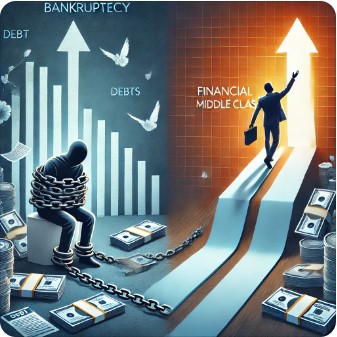
Is Bankruptcy the Right Move for You?
By Article Posted by Staff Contributor
The estimated reading time for this post is 439 seconds
Bankruptcy is often considered a last resort, a drastic measure for those struggling under the weight of unmanageable debt. In fact, according to a recent study, over 60% of Americans would find it difficult to cover a $1,000 emergency expense, highlighting just how common financial hardship can be.
But the question remains: is it worth it? To truly understand the value (or detriment) of bankruptcy, you need to look beyond the surface-level stigma and evaluate how it might impact your financial future, both positively and negatively.
What Does Bankruptcy Actually Do?
Bankruptcy is a legal process that allows individuals or businesses to discharge certain debts, giving them a financial reset. In the U.S., the most common types of bankruptcy for individuals are Chapter 7 and Chapter 13.
- Chapter 7 Bankruptcy: Often called “liquidation bankruptcy,” this option wipes out most unsecured debts, like credit cards and medical bills. It’s the quicker route but may require selling off assets.
- Chapter 13 Bankruptcy: Known as “reorganization bankruptcy,” this allows you to keep assets while setting up a repayment plan that typically lasts three to five years. It’s often suited for people with regular income who want to catch up on missed payments.
The Pros of Filing for Bankruptcy
- Immediate Relief: Bankruptcy offers something called an automatic stay. The minute you file, creditors have to stop harassing you with calls, wage garnishments, or pending lawsuits. It’s like getting an immediate breather when you’re drowning.
- Debt Discharge: Depending on your situation, bankruptcy can either wipe away most of your unsecured debts or set you up with a manageable repayment plan. This helps you clear the slate and start fresh.
- Fresh Financial Start: Bankruptcy may damage your credit initially, but ironically, it could be what you need to rebuild. Many filers find they’re able to get new credit within a year or two—often with better financial habits after the experience.
The Cons of Filing for Bankruptcy
- Credit Impact: Filing for bankruptcy will stay on your credit report for up to 10 years, depending on the type you file. It will certainly cause a significant drop in your credit score, and lenders will see you as high-risk during this period.
- Not All Debts Are Discharged: Bankruptcy does not wipe out student loans, recent tax debts, child support, or alimony. If these are the debts you’re struggling with, bankruptcy might not be a magic wand.
- Emotional and Social Stigma: Declaring bankruptcy can carry a heavy emotional toll. There’s a lingering social stigma around it, and it can feel like admitting failure. But the reality is, bankruptcy exists as a tool—not a badge of shame—to get people back on their feet.
- Loss of Assets: In Chapter 7 bankruptcy, some of your assets may be sold off to repay creditors. If you own a home or a car outright, you could lose it unless you qualify for certain exemptions.
When Should You Consider Bankruptcy?
- When You’re in Overwhelming Debt: If your debts are so overwhelming that you see no feasible way to pay them off in five years, bankruptcy might be a necessary option.
- When Creditors Are Relentless: If your wages are being garnished or creditors are threatening lawsuits, bankruptcy might provide the immediate relief you need.
- When You Need to Protect Assets: Chapter 13, in particular, is worth considering if you have valuable assets you don’t want to lose, like a home. The repayment plan may help you catch up and avoid foreclosure.
Alternatives to Bankruptcy
Before diving headfirst into bankruptcy, consider other debt relief options like debt settlement, credit counseling, or debt consolidation loans. These options won’t tank your credit score in the same way, and they might still give you some relief, albeit without the fresh start bankruptcy offers.
Chapter 13 Means Test Calculation
The Chapter 13 means test is used to determine whether you qualify for Chapter 13 bankruptcy and how much you will need to pay in your repayment plan. The test assesses your disposable income after accounting for reasonable and necessary expenses. Here’s how it works:
- Calculate Your Current Monthly Income: This is your average income over the past six months before filing for bankruptcy. It includes wages, salary, and other sources of income. For example, if you earned $3,000 per month over the past six months, your current monthly income would be $3,000.
- Deduct Allowed Expenses: These expenses include necessities like housing, utilities, transportation, and food. The IRS provides guidelines for reasonable expenses, and anything beyond that might be considered excess. For instance, if your monthly rent is $1,200, utilities are $300, and other allowed expenses add up to $800, your total allowed expenses would be $2,300.
- Determine Disposable Income: After subtracting your allowed expenses from your monthly income, the remaining amount is your disposable income. Using the example above, if your income is $3,000 and your allowed expenses are $2,300, your disposable income would be $700. This amount will determine your monthly payment in the repayment plan.
If your disposable income is above a certain threshold, you may be required to create a repayment plan that lasts five years. If it is lower, you may qualify for a shorter plan.
The Chapter 13 means test is used to determine whether you qualify for Chapter 13 bankruptcy and how much you will need to pay in your repayment plan. The test assesses your disposable income after accounting for reasonable and necessary expenses. Here’s how it works:
- Calculate Your Current Monthly Income: This is your average income over the past six months before filing for bankruptcy. It includes wages, salary, and other sources of income.
- Deduct Allowed Expenses: These expenses include necessities like housing, utilities, transportation, and food. The IRS provides guidelines for reasonable expenses, and anything beyond that might be considered excess.
- Determine Disposable Income: After subtracting your allowed expenses from your monthly income, the remaining amount is your disposable income. This amount will determine your monthly payment in the repayment plan.
If your disposable income is above a certain threshold, you may be required to create a repayment plan that lasts five years. If it is lower, you may qualify for a shorter plan.
Chapter 7 Means Test Calculation and Worksheet
For more detailed guidance, you can access a Chapter 7 means test worksheet online here. This resource will help you gather the necessary information and complete the process accurately.
The Chapter 7 means test is used to determine whether you qualify for Chapter 7 bankruptcy. The test is designed to ensure that only those who truly need debt relief can file for Chapter 7 and have their debts discharged. The means test has two main parts:
- Median Income Comparison: First, you compare your current monthly income to the median income for a household of your size in your state. If your income is below the median, you automatically qualify for Chapter 7.
- Disposable Income Analysis: If your income is above the median, you must complete a more detailed means test calculation. This involves subtracting allowed expenses from your monthly income to determine your disposable income. If your disposable income is low enough, you may still qualify for Chapter 7.
Chapter 7 Means Test Worksheet
To complete the Chapter 7 means test, you’ll need to gather financial documents and complete a worksheet that breaks down your income and expenses. Here are the steps:
- Income Information: Gather pay stubs, tax returns, and other proof of income for the past six months.
- Expense Information: List all necessary expenses, such as rent, utilities, food, medical costs, and transportation. Use IRS guidelines to determine which expenses are allowed.
- Calculate Disposable Income: Subtract your allowed expenses from your monthly income to determine if you have enough disposable income to repay creditors.
If your disposable income is minimal, you are likely to pass the means test and qualify for Chapter 7 bankruptcy. If not, you may need to consider Chapter 13 or another form of debt relief.
Is It Worth It?
The answer depends on your specific situation. If you are buried in credit card debt and other unsecured loans, with no realistic ability to repay, bankruptcy could be worth the credit hit for the chance to rebuild.
On the other hand, if your debts are primarily non-dischargeable or manageable with a stringent budget, bankruptcy may not offer much relief.
Bankruptcy isn’t for everyone, but for some, it could be the bridge they need to cross from financial chaos to stability. Take Sarah, for example: after accumulating over $50,000 in credit card debt due to medical expenses, she decided to file for Chapter 7 bankruptcy.
Within a year, she was able to start rebuilding her credit and even saved enough for an emergency fund—something she never thought possible before filing. It’s not an easy decision, but it is a tool—and sometimes, a well-used tool is the best way to build a stronger foundation for the future.


RELATED ARTICLES
Cash Strategy: Put Every Dollar in the Right Place
Your checking account, emergency fund, short-term savings, and investments should not be managed the same way. This cash strategy helps assign every dollar to the right financial job.
Best HYSA: How to Choose Beyond the Highest APY
A competitive interest rate matters, but it is only one part of choosing a high-yield savings account. Compare insurance, fees, access, transfer speed, and promotional conditions.
Leave Comment
Cancel reply
Gig Economy
Business / Aug 08, 2026
The Missing Middle in Black Entrepreneurship
Black entrepreneurship has expanded dramatically. The next challenge is helping more Black-owned businesses move from self-employment to employer firms and sustainable scale.
By FMC Editorial Team
Personal Finance / Aug 01, 2026
Cash Strategy: Put Every Dollar in the Right Place
Your checking account, emergency fund, short-term savings, and investments should not be managed the same way. This cash strategy helps assign every dollar to the right...
By Article Posted by Staff Contributor
Personal Finance / Aug 01, 2026
Best HYSA: How to Choose Beyond the Highest APY
A competitive interest rate matters, but it is only one part of choosing a high-yield savings account. Compare insurance, fees, access, transfer speed, and promotional conditions.
By Article Posted by Staff Contributor
Personal Finance / Aug 01, 2026
High-Yield Savings vs. CDs, Treasury Bills, and Other Safe Places for Cash
High-yield savings accounts are excellent for accessible cash, but they are not always the best choice. Compare HYSAs, CDs, Treasury bills, money market accounts, and I...
By Article Posted by Staff Contributor
American Middle Class / Aug 01, 2026
High-Yield Savings Accounts: A Safer Home for Your Cash
A high-yield savings account can pay several times the national savings rate while keeping qualified deposits federally insured. Here is how it works, what to watch...
By Article Posted by Staff Contributor
Real Estate / Jul 30, 2026
Mortgage Lock-In Is Freezing the Housing Market
Millions are trapped by 3% mortgages. Learn how mortgage lock-in worsens affordability—and why homeowners are renovating instead.
By FMC Editorial Team
Real Estate / Jul 26, 2026
Is South Florida More Expensive Than New York? The Complete 2026 Relocation Guide
Is South Florida more expensive than New York? Compare housing, taxes, insurance and 104 municipalities before you move.
By Article Posted by Staff Contributor
Personal Finance / Jul 25, 2026
The Time Value of Life Experiences: What Compound Interest Leaves Out,
Money compounds, but life experiences do too. Explore what compound interest leaves out—and how to balance saving with living.
By MacKenzy Pierre
American Middle Class / Feb 18, 2026
How Wealth Is Passed Across Generations in the United States: Mechanisms, Evidence, and the Policy Debate
How wealth passes between generations—trusts, taxes, and the debate. Get the facts, figures, and tradeoffs. Read now.
By FMC Editorial Team
American Middle Class / Feb 16, 2026
The S&P 7,000: How Wall Street Disconnects from Main Street
S&P 7,000 can rise while wages, benefits, and towns fall behind. See why the market isn’t the economy—read now.
By MacKenzy Pierre
Latest Reviews
Business / Aug 08, 2026
The Missing Middle in Black Entrepreneurship
Black entrepreneurship has expanded dramatically. The next challenge is helping more Black-owned businesses move from...
Personal Finance / Aug 01, 2026
Cash Strategy: Put Every Dollar in the Right Place
Your checking account, emergency fund, short-term savings, and investments should not be managed the same...
Personal Finance / Aug 01, 2026
Best HYSA: How to Choose Beyond the Highest APY
A competitive interest rate matters, but it is only one part of choosing a high-yield...