
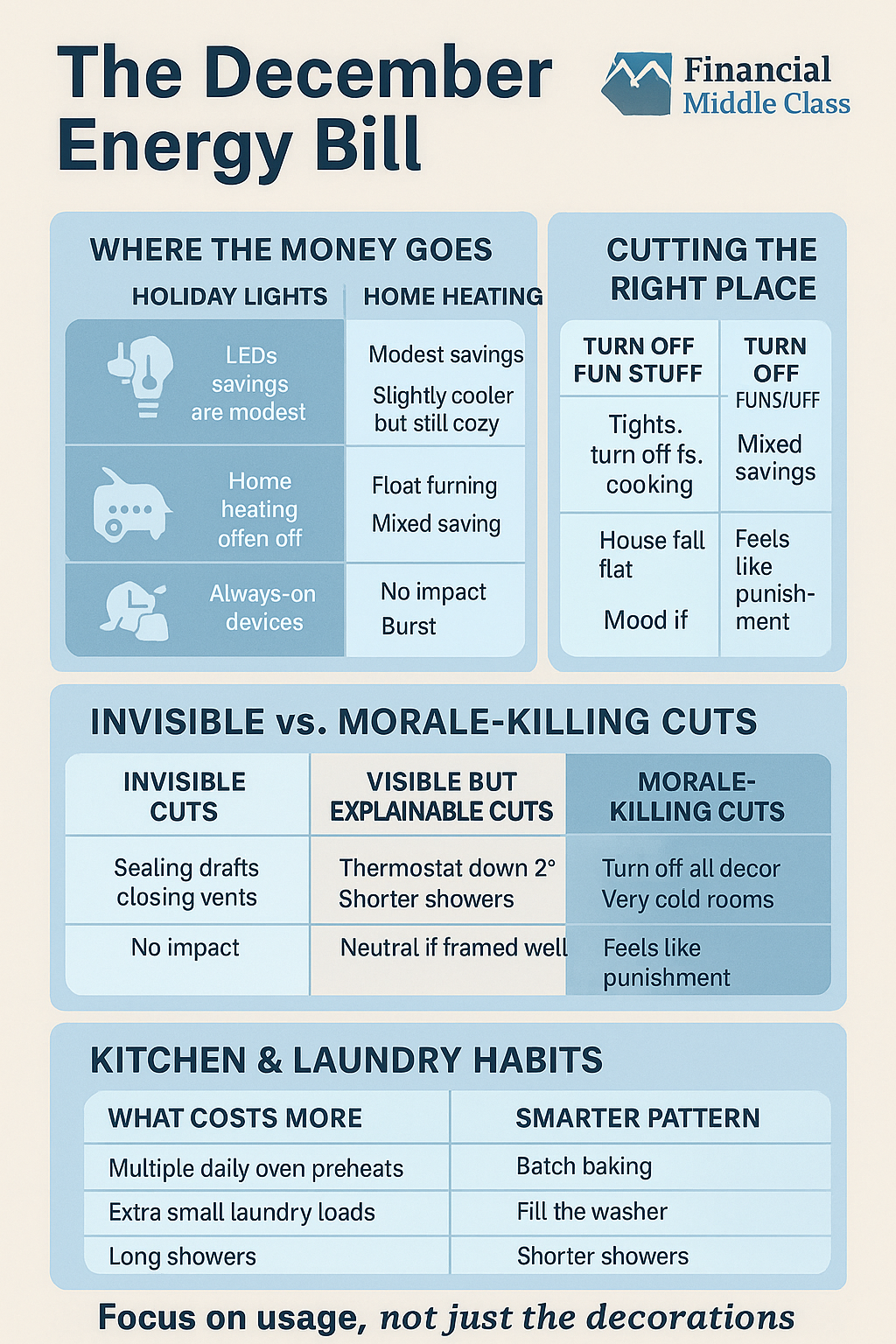
The December Energy Bill: Heat, lights, and inflated utility bills—practical cuts that don’t kill the vibe.
By Article Posted by Staff Contributor
The estimated reading time for this post is 581 seconds
The December Energy Bill
Heat, lights, and inflated utility bills—practical cuts that don’t kill the vibe.
The answer isn’t to sit in the dark and eat cold food. You don’t need a miserable, candlelit austerity Christmas to be responsible. You need to know where the money is actually going, what cuts move the needle, and what’s just guilt masquerading as savings.
Let’s pull the holiday vibes and the hard numbers into the same room.
Where Your December Energy Money Actually Goes
Most people underestimate some parts of their usage and wildly overestimate others.
The big energy hogs in December are almost always:
- Heating (or cooling, depending on your climate)
- Hot water
- Major appliances (oven, dryer, dishwasher)
The stuff we obsess over—like whether the tree lights are on for an extra hour—matters, but not nearly as much as you think compared to running the heat a few degrees higher all day.
Here’s a simple side-by-side way to think about it:
| Category | What Feels Big Emotionally | What Usually Costs More in Reality |
|---|---|---|
| Holiday lights | “The whole house is lit up, that must be expensive.” | LED strings and timers are relatively cheap per hour of use |
| Home temperature | “Two degrees can’t make that much difference.” | Heating is often 40–50%+ of winter energy usage |
| Oven / cooking | “I’m just baking a little more, that can’t be it.” | Frequent baking and roasting adds up, especially with older ovens |
| Laundry & dishes | “The machine is running in the background; I barely notice it.” | Hot water and dryer cycles quietly chew through kWh or gas |
| Always-on devices | “TVs and chargers don’t seem like a big deal.” | Individually small, but constant draw adds up month after month |
Once you see that clearly, you stop obsessing over the wrong things. You focus on the handful of levers that give you a real drop in the bill without turning your house into a cave.
Heat vs Holiday Glow: Cutting in the Right Places
If you want to cut your December bill, you’re usually better off nudging the thermostat than unplugging the tree.
But you also don’t want to freeze your family for the sake of a $20 savings. The sweet spot is comfort with intention: you target waste, not warmth.
Here’s how that tradeoff really looks:
| Turn Down the Heat a Bit | Turn Off All the Fun Stuff | |
|---|---|---|
| What changes | Thermostat down 2–3°F during waking hours; more at night with blankets | No tree lights, no outdoor lights, minimal cooking, few hot showers |
| Impact on bill | Often meaningful in cold climates; heating is a big slice | Mixed; some savings, but often smaller than you think |
| Impact on mood | Slightly cooler, but still cozy with layers | House feels flat, kids notice, “holiday” feels like any other week |
| Realistic to sustain? | Yes, if the whole family is on board | Usually not; people rebel and stop doing it |
The point isn’t to pretend small things never matter. It’s to admit that some cuts get you 80% of the benefit with 20% of the sacrifice. That’s where a middle-class household should start.
The December Utility Check-In: Two Columns, Honest Answers
Before you start unplugging everything and snapping at people to close the fridge, do a quick check-in. Fill out two mental columns:
| Question | Practical Column (Hard Numbers) | Emotional Column (What You’re Afraid Of) |
|---|---|---|
| “What was my bill this time last year?” | Pull last December’s statement or app history | “I don’t want to see how bad it was.” |
| “What’s different this year?” | More people home? Colder? Higher rates? New appliances? | “Everything feels more expensive; I feel out of control.” |
| “What can’t I realistically change?” | Size of your home, your climate, your basic work schedule | “I wish I could just move or install solar tomorrow.” |
| “What can I tweak without making us miserable?” | Thermostat, water temperature, timers, usage patterns | “I’m worried the kids will feel punished or I’ll look ‘cheap.’” |
This is the real tension: you’re trying to manage a bill without broadcasting scarcity to your family. That’s where framing and small, smart moves come in.
Smart Cuts That Don’t Kill the Vibe
You can think of December energy decisions in three buckets: invisible cuts, visible but explainable cuts, and cuts that damage morale. You want to maximize the first two and avoid the third.
| Bucket | Examples | How It Feels at Home |
|---|---|---|
| Invisible cuts | Sealing drafts, using door snakes, closing vents in unused rooms, smart power strips | Nobody really notices; house simply feels more comfortable |
| Visible but explainable cuts | Thermostat down a couple degrees, shorter showers, running full loads only | Kids might ask why; easy to frame as “team effort” or “eco-smart” |
| Morale-killing cuts | No lights at all, very cold rooms, shaming people for normal use | Feels like punishment; holiday mood tanks |
Start with the invisible cuts. They improve comfort and cost at the same time. Then decide as a family how far you’re willing to go on the visible ones.
Instead of “We’re broke, turn everything off,” try, “Energy is expensive this month. Let’s make a few smart moves so we can keep the stuff that really matters.”
A Simple “December Energy” Decision Tree
You don’t need to become an energy auditor. You just need a basic decision path for any change you’re considering.
Think of it like this:
| Step / Question | If YES | If NO |
|---|---|---|
| 1. Does this change target a big usage category (heat, hot water, major appliances)? | Go to Q2. | It’s a small win; do it only if it doesn’t cause drama. |
| 2. Will this noticeably hurt comfort or mood? | Go to Q3. | Do it. This is prime territory (e.g., sealing drafts, better use of thermostat). |
| 3. Can I frame this as a family “smart move,” not punishment? | Explain the “why” and set a clear limit (e.g., “2 degrees down, blankets out”). | If you can’t explain it without shame, reconsider; look for smaller or different cuts. |
| 4. Does this change save enough to be worth the friction? | Keep it for now and review next month’s bill. | Drop it; focus on a different lever that offers more savings for less resentment. |
That tree keeps you from going hard on things that save pennies while burning goodwill.
Holiday Lights and Decorations: Where to Draw the Line
Let’s talk honestly about lights.
Are they the biggest problem on your bill? Usually not. Can they matter? Sure, especially with older incandescent strands running all night. But modern LEDs on timers are closer to “symbolic” expenses than budget wreckers.
Here’s how to think about it:
| Setup | Cost / Tradeoff Reality | Middle-Class Move |
|---|---|---|
| Old incandescent strands, on all night | Higher draw; leaving them on 8+ hours nightly will show up more | Replace a few each year with LEDs; use timers to shut off overnight |
| LED strands on timers | Much lower draw per hour | Keep them; focus cuts elsewhere |
| Giant inflatable displays | Bigger bump, especially if multiple are running constantly | Keep one statement piece or time-limit when it’s on |
| Whole-house dark to “save” | Some savings but heavy mood cost | Overkill unless you’re in a real emergency |
You’re allowed to keep some glow. The key is intentionality: timers, LEDs, and a choice about how many hours per night feel worth paying for.
Kitchens, Laundry, and Showers: Where Habits Quietly Drive the Bill
If you want to get serious about that December bill without turning into a dictator, the low-drama place to focus is how and when you use energy-heavy stuff.
Side by side:
| Area | Typical Holiday Use Pattern | Smarter Pattern That Still Feels Normal |
|---|---|---|
| Oven | Multiple preheats per day, small batches, door opened often | Batch baking, fewer preheats, use smaller appliances when possible |
| Laundry | Many small loads, extra “just in case” washing | Full loads only, cold water when possible, hang-dry some items |
| Dishwasher | Half-full cycles after every gathering | Full loads, air-dry option, run at off-peak times if rates vary |
| Showers | Longer “it’s cold out” showers for everyone | Agree on a reasonable time; kids first, set a family norm |
You’re not banning comfort. You’re cutting mindless waste.
The conversation at home matters more than the exact settings. “We’re all going to be a bit more mindful this month so we can afford X without stressing about the bill,” lands a lot better than, “Turn that off; you’re costing me money.”
The Emotional Side of the December Bill (And How to Talk About It)
Part of why the December bill hits so hard is that it doesn’t show up in isolation. It lands on top of holiday spending, travel costs, and the mental load of “Did I give my family enough?”
So when you see a bigger number than you like, your brain doesn’t just think, “Hmm, usage up.” It goes to, “I’m failing. I can’t keep up. I’m bad with money.” That shame makes it harder to make rational changes.
Here’s a healthier way to frame it for yourself and your household:
| Old Story | Better Story |
|---|---|
| “We’re terrible with money; look at this bill.” | “Energy is more expensive and we’re home more. Let’s make a few smart changes.” |
| “Nobody respects how hard I work to pay this.” | “I need to share the real numbers so we can be a team about it.” |
| “We can’t have nice holidays without going broke.” | “We can have warmth and lights; we just can’t waste energy where it doesn’t add joy.” |
You’re not lying about reality. You’re choosing a frame that leads to action instead of paralysis.
Putting It All Together: A December Energy Plan That Respects Your Life
You don’t need a spreadsheet and a decade-long retrofit plan to get control of December. You need a one-page plan that fits your actual life.
Think of it like this:
| Piece of the Plan | Example You Might Use |
|---|---|
| Target bill change | “I want this December’s bill within $X of last year, not $100 higher.” |
| Thermostat rule | “Daytime: 68°F. Night: 65°F with blankets. No random cranking to 75.” |
| Lights rule | “Tree and front lights on from 5–10 p.m., LEDs only, timers set.” |
| Hot water rule | “Shorter showers, full loads for laundry and dishes only.” |
| Communication script | “Energy is expensive. We’re making a few smart moves so we can still enjoy the fun stuff without worrying about the bill.” |
If you want to go one step further, you can screenshot or print your utility usage graph and make it a little scoreboard: “Team [Your Family Name] vs. the Energy Bill.” Kids will often get weirdly into beating last year’s number if you present it as a challenge instead of a scolding.
The goal isn’t a perfect, minimalist December. The goal is a month where your utility bill feels like something you chose, not something that ambushed you.
You deserve warmth and light without dread. That’s what a few honest decisions and small, smart cuts can buy you.


RELATED ARTICLES
The American Middle Class’s Guide to the 2026 Midterm Ballot Measures
The 2026 midterm elections will put major housing and tax proposals before American voters. From Florida's homestead exemptions to Massachusetts zoning reform and California's affordable housing initiatives, explore the potential effects on homeowners, renters, first-time buyers, and middle-class finances.
FICO Finally Has Competition. Will Homebuyers Get a Better Deal?
For decades, FICO dominated mortgage credit scoring. Now VantageScore 4.0 is challenging that dominance. Discover how new rules from federal housing regulators could affect mortgage approvals, borrowing costs, and financial opportunities for American homebuyers—and why a higher credit score doesn't...
Leave Comment
Cancel reply
Gig Economy
American Middle Class / Oct 16, 2026
The American Middle Class’s Guide to the 2026 Midterm Ballot Measures
The 2026 midterm elections will put major housing and tax proposals before American voters. From Florida's homestead exemptions to Massachusetts zoning reform and California's affordable housing...
By Article Posted by Staff Contributor
Personal Finance / Oct 14, 2026
FICO Finally Has Competition. Will Homebuyers Get a Better Deal?
For decades, FICO dominated mortgage credit scoring. Now VantageScore 4.0 is challenging that dominance. Discover how new rules from federal housing regulators could affect mortgage approvals,...
By Article Posted by Staff Contributor
American Middle Class / Oct 13, 2026
Selling Affordability Through Installments
Americans are increasingly buying based on what they can afford each month rather than what something actually costs. From buy now, pay later services to longer...
By Article Posted by Staff Contributor
American Middle Class / Oct 12, 2026
Fair Capitalism: We Don’t Need to Abolish Capitalism. We Need to Fix It.
Fair capitalism means preserving entrepreneurship and profits while ensuring working Americans share more meaningfully in the prosperity they help create.
By MacKenzy Pierre
American Middle Class / Oct 12, 2026
The Sunday Scaries: How Financial Independence Can Help You Reclaim Your Weekend
The Sunday Scaries can begin long before Monday morning. Building emergency savings, lowering monthly expenses, and increasing financial independence may help you reclaim your weekend.
By Article Posted by Staff Contributor
Business / Aug 08, 2026
The Missing Middle in Black Entrepreneurship
Black entrepreneurship has expanded dramatically. The next challenge is helping more Black-owned businesses move from self-employment to employer firms and sustainable scale.
By FMC Editorial Team
Personal Finance / Aug 01, 2026
Cash Strategy: Put Every Dollar in the Right Place
Your checking account, emergency fund, short-term savings, and investments should not be managed the same way. This cash strategy helps assign every dollar to the right...
By Article Posted by Staff Contributor
Personal Finance / Aug 01, 2026
Best HYSA: How to Choose Beyond the Highest APY
A competitive interest rate matters, but it is only one part of choosing a high-yield savings account. Compare insurance, fees, access, transfer speed, and promotional conditions.
By Article Posted by Staff Contributor
Personal Finance / Aug 01, 2026
High-Yield Savings vs. CDs, Treasury Bills, and Other Safe Places for Cash
High-yield savings accounts are excellent for accessible cash, but they are not always the best choice. Compare HYSAs, CDs, Treasury bills, money market accounts, and I...
By Article Posted by Staff Contributor
American Middle Class / Aug 01, 2026
High-Yield Savings Accounts: A Safer Home for Your Cash
A high-yield savings account can pay several times the national savings rate while keeping qualified deposits federally insured. Here is how it works, what to watch...
By Article Posted by Staff Contributor
Latest Reviews
American Middle Class / Oct 16, 2026
The American Middle Class’s Guide to the 2026 Midterm Ballot Measures
The 2026 midterm elections will put major housing and tax proposals before American voters. From...
Personal Finance / Oct 14, 2026
FICO Finally Has Competition. Will Homebuyers Get a Better Deal?
For decades, FICO dominated mortgage credit scoring. Now VantageScore 4.0 is challenging that dominance. Discover...
American Middle Class / Oct 13, 2026
Selling Affordability Through Installments
Americans are increasingly buying based on what they can afford each month rather than what...