
Mortgage Rates Slip Toward 2025 Lows: Should You Wait for a Fed Cut or Lock In Now?
By Article Posted by Staff Contributor
The estimated reading time for this post is 396 seconds
If you’ve been watching mortgage rates the past couple of years, you probably feel like you’re riding in the back of a car with a driver who can’t decide which lane to be in.
First they were near 3%. Then they shot toward 7–8%. Now the headlines say “rates near year-to-date lows,” and the Fed is talking about more rate cuts.
So what do you actually do with that as a middle-class homebuyer or homeowner? Wait for lower. Lock what you can. Or give up and stay put?
Let’s walk through the moving parts in plain English.
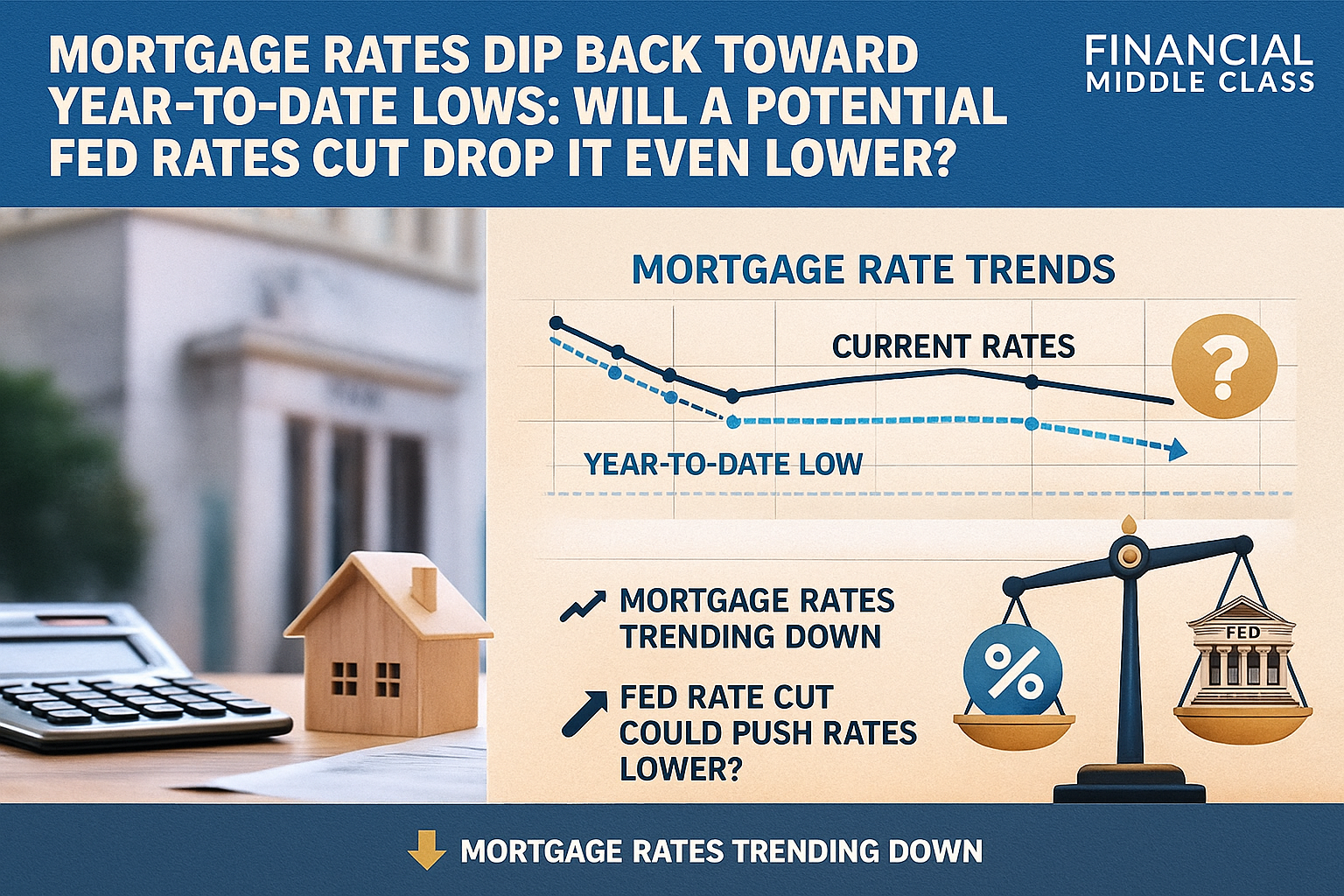
Where mortgage rates are right now
As of early December 2025:
- The average 30-year fixed mortgage rate is around 6.19%, down from 6.23% the week before and lower than about 6.7% a year ago
- Rates have been hovering in a narrow band around 6.2–6.3% since the fall, near their lows for the year.
So no, this is not the 3% era. But it’s also not the 7.5% punch in the gut we saw not long ago.
Meanwhile, the Federal Reserve has:
- Cut its benchmark rate twice already (September and October), and
- Is widely expected to cut again in December, which would bring the federal funds rate down into the 3.5–3.75% range — the lowest in nearly three years.
The natural instinct is to think: If the Fed cuts again, mortgage rates must fall, right?
Not so fast.
The uncomfortable truth: The Fed does not control your mortgage rate
The Fed sets short-term interest rates — what banks charge each other overnight. That strongly affects:
- Credit cards
- Personal loans
- HELOCs
- Savings account rates
But fixed mortgage rates move mostly with the 10-year Treasury yield and broader bond markets, not directly with the Fed’s overnight rate.
Lenders price mortgages off what investors demand for mortgage-backed securities. Historically, 30-year mortgage rates sit roughly 1.5–2 percentage points above the 10-year Treasury yield.
So what actually drives your rate?
- Expectations about inflation
- Expectations about future Fed moves
- Investor appetite for safe assets like Treasuries
- Overall economic fear or optimism
That’s why we’ve seen this weird pattern lately:
- In September 2025, mortgage rates dropped to a three-year low right before the Fed cut rates — and then ticked up afterward.
- Investors “priced in” the Fed’s move ahead of time by buying bonds and pushing yields (and mortgage rates) down.
So yes, Fed cuts matter. But often the market moves in anticipation of the cut, not after the press conference.
Will a Fed cut push rates much lower from here?
Let’s look at what forecasters are actually saying instead of what social media threads hope:
- Fannie Mae’s economic outlook projects mortgage rates around 6.4% at the end of 2025 and 5.9% by the end of 2026.
- Other forecasts see average mortgage rates around 6.3% in 2026, not some magical return to 3%.
Translation:
We may drift down into the high-5% range over time if the economy cooperates. But the odds of going back to 2–3% anytime soon are slim.
That matters for your decision. Waiting might shave off half a point. Waiting for 3% is probably waiting forever.
What a small rate drop actually means in dollars
Let’s put real numbers behind this. Say you’re eyeing a $400,000 mortgage on a 30-year fixed loan.
Monthly principal + interest (rounded):
- At 6.2% → about $2,450
- At 5.7% → about $2,320
- At 5.0% → about $2,150
So dropping from 6.2% to 5.7% saves you roughly $130 a month.
Dropping from 6.2% to 5.0% saves about $300 a month.
Those are meaningful numbers for a middle-class budget. But notice the scale:
- A 0.5% drop is “nice but not life-changing.”
- A 1–1.5% drop is “this actually changes whether we can breathe.”
That’s why your starting point matters. A homeowner stuck at 7.5% has more to gain from waiting than a buyer already choosing between 6.1% and 6.3%.
For buyers: Should you wait or lock?
Ask yourself three practical questions:
1. Are you ready to move, or just Zillow-browsing?
If you’re seriously house-hunting — you’ve saved the down payment, know your price range, and your lease ends in a few months — then trying to time 0.25% changes in rates is usually a distraction.
Home prices and inventory matter just as much as rates. Forecasts for 2026 show:
- Only modest national price increases (around 1–2%),
- Slightly better affordability as wages catch up, but
- Big regional differences: some Sunbelt markets softening, some Northeast / Midwest metros still climbing.
A slightly lower rate six months from now doesn’t help if:
- You’re forced to sign another 12-month lease, or
- Prices in your target neighborhood climb faster than rates fall.
2. How tight is your monthly budget at today’s rates?
Run the numbers with your lender:
- If today’s rate gives you a payment that’s tight but survivable, and you’re buying a home you genuinely want to stay in, locking can make sense.
- If today’s rate gives you a payment that already feels like a stretch, hoping for a small rate drop is not a fix. That’s a signal you may need to lower your price point or wait.
3. Do you have a plan if rates don’t fall?
There’s a real risk in “we’ll just wait for 5%.”
If inflation flares back up or the economy surprises on the upside, rates can climb again. Investors have already baked a lot of optimism into current yields.
For most middle-class buyers, a healthier mindset is:
“Can I buy a home I like and comfortably afford at today’s rate — and then refinance later if we get lucky?”
If yes, you have options. If no, the problem isn’t just the Fed. It’s the gap between local home prices and your income.
For current homeowners: When does a refi make sense?
There are three broad groups right now:
- You locked in around 3% in 2020–2021.
Do not touch that loan unless you absolutely have to. You’re holding a winning lottery ticket. - You bought or refinanced at 6–7%+ in the last couple of years.
You’re the most likely winner if rates keep drifting down. A rough rule of thumb:- A refi starts to make sense when you can cut your rate by about 1 percentage point and plan to stay in the home long enough to recoup closing costs.
- You’re somewhere in the middle (4–5% from an older mortgage).
Today’s rates don’t help you. You might refinance if we ever see low-5s or high-4s again, but that’s not the base case in most forecasts.
And remember: your credit score, debts, and income still drive the actual rate you get, not just what the headlines say.
What you can do right now, regardless of what the Fed does
You can’t control the 10-year Treasury. But you can tighten up your own side of the equation:
- Clean up your credit.
Paying your credit cards down below 30% of their limit can improve your score and cut your rate more than another Fed move would. - Shop more than one lender.
Different lenders price risk differently. The spread between lenders can easily be 0.25–0.5 percentage points for the same borrower. - Ask about points and lender credits.
Sometimes paying extra at closing to “buy down” the rate makes sense. Sometimes it doesn’t. Run the math over how long you realistically plan to stay. - Tighten your budget before you buy.
Less monthly debt (cars, cards, personal loans) means more room in your debt-to-income ratio, which can qualify you for better rates or more options.
This is the unglamorous part, but it’s the part you actually own.
The bottom line: Stop chasing perfect timing
It’s tempting to treat the housing market like a meme stock: “I’ll buy at the bottom.”
That mindset is how people end up frozen for years.
Here’s the reality for a middle-class family:
Mortgage rates will go up and down, but your real question is simpler: Can you lock a rate that lets you live, save, and sleep at night in a home that fits your life?
The Fed doesn’t answer that.
Only your numbers do.


RELATED ARTICLES
The American Middle Class’s Guide to the 2026 Midterm Ballot Measures
The 2026 midterm elections will put major housing and tax proposals before American voters. From Florida's homestead exemptions to Massachusetts zoning reform and California's affordable housing initiatives, explore the potential effects on homeowners, renters, first-time buyers, and middle-class finances.
FICO Finally Has Competition. Will Homebuyers Get a Better Deal?
For decades, FICO dominated mortgage credit scoring. Now VantageScore 4.0 is challenging that dominance. Discover how new rules from federal housing regulators could affect mortgage approvals, borrowing costs, and financial opportunities for American homebuyers—and why a higher credit score doesn't...
Leave Comment
Cancel reply
Gig Economy
American Middle Class / Oct 16, 2026
The American Middle Class’s Guide to the 2026 Midterm Ballot Measures
The 2026 midterm elections will put major housing and tax proposals before American voters. From Florida's homestead exemptions to Massachusetts zoning reform and California's affordable housing...
By Article Posted by Staff Contributor
Personal Finance / Oct 14, 2026
FICO Finally Has Competition. Will Homebuyers Get a Better Deal?
For decades, FICO dominated mortgage credit scoring. Now VantageScore 4.0 is challenging that dominance. Discover how new rules from federal housing regulators could affect mortgage approvals,...
By Article Posted by Staff Contributor
American Middle Class / Oct 13, 2026
Selling Affordability Through Installments
Americans are increasingly buying based on what they can afford each month rather than what something actually costs. From buy now, pay later services to longer...
By Article Posted by Staff Contributor
American Middle Class / Oct 12, 2026
Fair Capitalism: We Don’t Need to Abolish Capitalism. We Need to Fix It.
Fair capitalism means preserving entrepreneurship and profits while ensuring working Americans share more meaningfully in the prosperity they help create.
By MacKenzy Pierre
American Middle Class / Oct 12, 2026
The Sunday Scaries: How Financial Independence Can Help You Reclaim Your Weekend
The Sunday Scaries can begin long before Monday morning. Building emergency savings, lowering monthly expenses, and increasing financial independence may help you reclaim your weekend.
By Article Posted by Staff Contributor
Business / Aug 08, 2026
The Missing Middle in Black Entrepreneurship
Black entrepreneurship has expanded dramatically. The next challenge is helping more Black-owned businesses move from self-employment to employer firms and sustainable scale.
By FMC Editorial Team
Personal Finance / Aug 01, 2026
Cash Strategy: Put Every Dollar in the Right Place
Your checking account, emergency fund, short-term savings, and investments should not be managed the same way. This cash strategy helps assign every dollar to the right...
By Article Posted by Staff Contributor
Personal Finance / Aug 01, 2026
Best HYSA: How to Choose Beyond the Highest APY
A competitive interest rate matters, but it is only one part of choosing a high-yield savings account. Compare insurance, fees, access, transfer speed, and promotional conditions.
By Article Posted by Staff Contributor
Personal Finance / Aug 01, 2026
High-Yield Savings vs. CDs, Treasury Bills, and Other Safe Places for Cash
High-yield savings accounts are excellent for accessible cash, but they are not always the best choice. Compare HYSAs, CDs, Treasury bills, money market accounts, and I...
By Article Posted by Staff Contributor
American Middle Class / Aug 01, 2026
High-Yield Savings Accounts: A Safer Home for Your Cash
A high-yield savings account can pay several times the national savings rate while keeping qualified deposits federally insured. Here is how it works, what to watch...
By Article Posted by Staff Contributor
Latest Reviews
American Middle Class / Oct 16, 2026
The American Middle Class’s Guide to the 2026 Midterm Ballot Measures
The 2026 midterm elections will put major housing and tax proposals before American voters. From...
Personal Finance / Oct 14, 2026
FICO Finally Has Competition. Will Homebuyers Get a Better Deal?
For decades, FICO dominated mortgage credit scoring. Now VantageScore 4.0 is challenging that dominance. Discover...
American Middle Class / Oct 13, 2026
Selling Affordability Through Installments
Americans are increasingly buying based on what they can afford each month rather than what...