
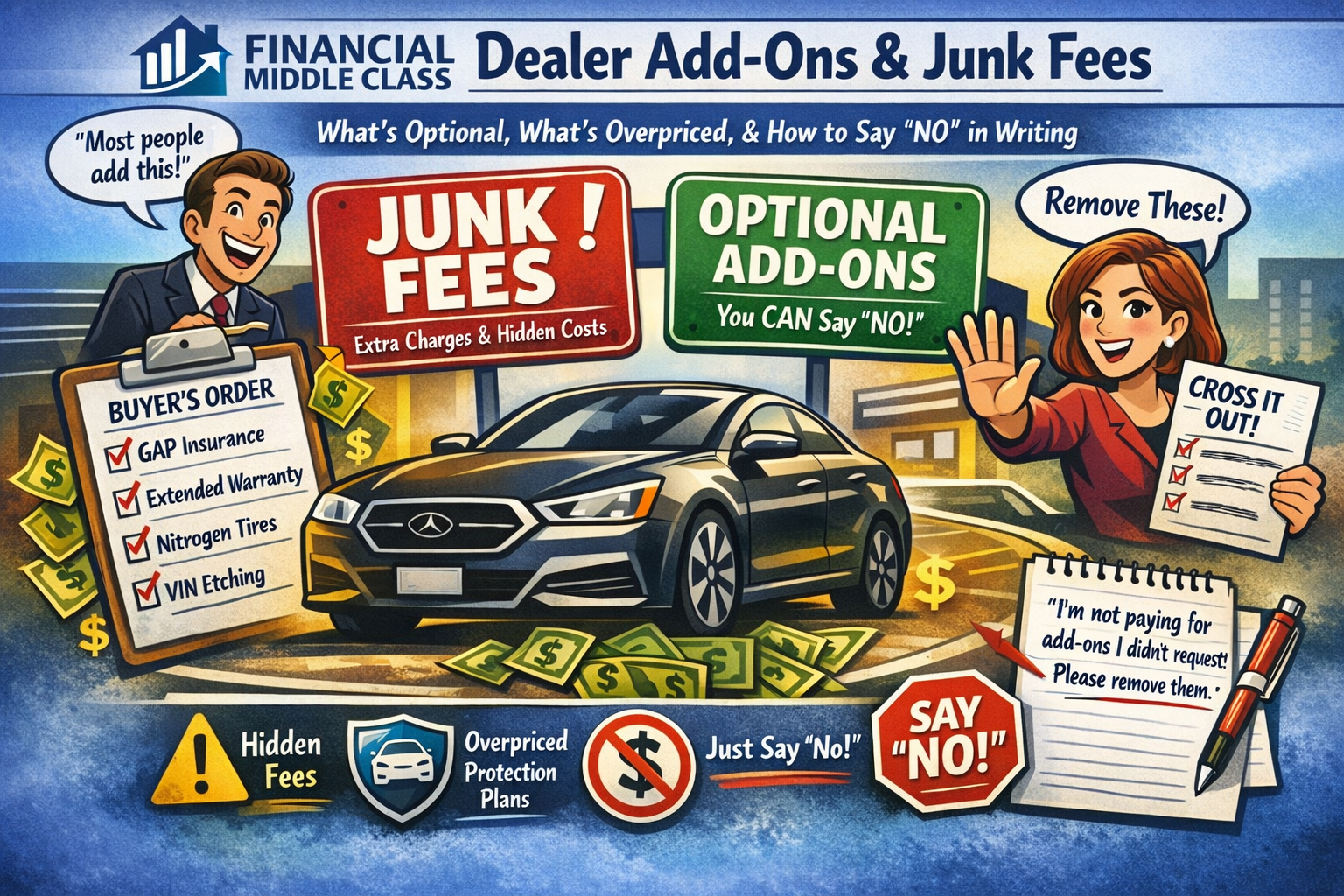
Dealer Add-Ons and “Junk Fees”
By Article Posted by Staff Contributor
The estimated reading time for this post is 431 seconds
What’s optional, what’s overpriced, and how to say “no” in writing—before the paperwork makes the decision for you
The car deal doesn’t usually fall apart on the test drive. It falls apart in the finance office, under soft lighting, with a friendly voice saying: “Most people add this.”
That’s where middle-class buyers lose the most money—because the last stage of the process is built to reward fatigue. You’ve already negotiated. You’ve already pictured the car in your driveway. You just want to be done. And “done” is exactly when add-ons and fees slip in.
The Federal Trade Commission has warned that dealers can’t charge you for add-ons you don’t want, and it has brought cases alleging some dealers “packed” purchases with add-ons without consent or falsely claimed they were required. This is not a paranoid internet rumor. It’s a real consumer-protection issue.
The uncomfortable truth is that a perfectly legal transaction can still be a financially bad one if you’re rushed, distracted, or focused only on the monthly payment. The best defense isn’t a perfect credit score. It’s delay gratification—slowing the process down long enough to read what you’re agreeing to.
What counts as an add-on—and why it matters
The FTC defines add-ons as optional products or services a dealer might sell you on top of the vehicle purchase—things that can “break your budget.” The Federal Register’s rulemaking record (part of the FTC’s broader look at dealer practices) lists common add-ons such as service contracts, maintenance plans, GAP, roadside assistance, VIN etching, undercoating, and more.
Some add-ons can make sense in the right situation. Many are overpriced for the value they deliver. The real danger is not the existence of add-ons—it’s how they’re presented: bundled, implied as mandatory, or buried in fast-moving paperwork.
And that’s why “delay gratification” is a consumer skill here. If you slow the room down, add-ons get evaluated. If you speed up, add-ons get accepted.
The policy headline you should know
In late 2023, the FTC finalized the “CARS Rule,” intended to crack down on deceptive practices, including junk fees and charging for add-ons without express consent. But in January 2025, the U.S. Court of Appeals for the Fifth Circuit vacated that rule on procedural grounds, according to Reuters’ coverage of the decision. Kelley Blue Book later summarized the ruling’s effect: the proposed federal “junk fee” ban for car dealers is essentially dead as written.
Here’s what that means for your wallet: you shouldn’t assume “new rules will protect me.” You still have to protect yourself by forcing clarity before you sign.
The cleanest way to separate fees from fluff
Most buyers get confused because everything shows up as a line item. Some line items are unavoidable. Some are negotiable. Some are optional. Some are just profit with a nicer name.
The fees table every buyer needs
| Category | What it usually includes | What you should do |
|---|---|---|
| Government costs | Sales tax, title, registration | These aren’t “dealer add-ons.” They’re state/local costs. Don’t fight the existence—confirm the math. |
| Dealer paperwork fee | Documentation (“doc”) fee | Edmunds notes doc fees can be capped by state law or unregulated, and dealers may not negotiate the fee itself—so you often offset it by negotiating the vehicle price. |
| Optional add-ons | Service contracts, GAP, coatings, etching, protection plans | These are optional products/services. Treat them like a separate purchase decision—because they are. |
| “Junk fee” behavior | Charges that don’t benefit you, or are presented deceptively | KBB notes the FTC’s examples include nitrogen-in-tires products and duplicative warranties, and highlights misleading claims that optional items are mandatory. |
One key detail: doc fees vary widely by state and dealer; CarGurus notes they can range from under $100 to close to $1,000 and recommends checking state rules. The point isn’t to memorize a number. The point is to ask up front so it can’t surprise you at signing.
The “gotcha” tactics that make add-ons so expensive
When the FTC took action against dealerships owned by Asbury Automotive in Texas, it alleged a practice called “payment packing”—getting the buyer to accept a monthly payment larger than necessary, then packing add-ons into the contract to soak up the difference.
In the FTC’s consumer alert about the case, it also described buyers signing on electronic devices that didn’t clearly show contract terms—meaning some people didn’t realize they’d been charged for add-ons until after they left.
That’s the mechanic of the “impatience tax”: you’re not asked to approve each item like a normal purchase. You’re nudged to approve a feeling—“this payment works”—and the details get treated like background noise.
Common add-ons: what’s optional, what’s sometimes worth it, and what’s usually a trap
Here’s the practical breakdown. This isn’t “never buy anything.” It’s “stop buying things you didn’t choose.”
| Add-on | What it is | When it can make sense | When to say “no” fast |
|---|---|---|---|
| GAP | Covers the gap if the car is totaled and you owe more than it’s worth | High loan-to-value, low down payment, long term—when you’re most likely to be underwater | If you’re pressured, it’s overpriced, or your down payment/loan structure makes the risk low |
| Service contract / extended warranty | Coverage beyond manufacturer warranty | If you plan to keep the car long-term and the coverage is clear, priced reasonably, and matches your risk | If it duplicates existing warranty, has exclusions you can’t explain, or is framed as “required” |
| Paint/fabric protection, coatings | Cosmetic protection packages | Rarely worth dealership pricing unless it’s a truly premium product you’ve priced elsewhere | If it’s bundled, vague, or outrageously priced compared to independent detailers |
| VIN etching / theft products | Anti-theft marking or devices | If priced low and you actually want it | If it’s used as a markup with little value |
| Nitrogen tires, “packages,” pre-installed accessories | Often marketed as premium upgrades | If you knowingly want a specific accessory at a fair price | If it’s treated as mandatory or used to justify a “market adjustment” |
Delay gratification is the real negotiation tool
People think negotiation is arguing. Most of the time, negotiation is just refusing to be rushed.
If you want one rule that protects you from almost every junk fee scenario, it’s this: no same-day signing when the numbers change at the end. A clean deal survives 24 hours. A shaky deal needs urgency.
Here are the only bullet points you need—because they’re guardrails, not fluff:
- Ask for the out-the-door price in writing before you talk monthly payment, and insist it includes all fees and all add-ons. The FTC explicitly advises buyers to know the total cost, not just the monthly payment.
- Demand an itemized add-on list and cross out what you don’t want—then make them reprint the document.
- If they say it’s required, ask: “Required by who?” If it’s not government tax/title/registration, it’s usually not “required.”
- Be willing to leave. Most “mandatory” add-ons become “optional” the moment you stand up.
The exact script to say no in writing
Use this as an email or a text before you show up—because writing slows the game down.
“I’m ready to buy if the out-the-door price is confirmed in writing. Please send a buyer’s order with: (1) vehicle price, (2) tax/title/registration, (3) documentation fee, and (4) a separate add-on list with prices. I will not pay for add-ons I didn’t request. If add-ons are on the order, I need them removed and the document reissued before I sign.”
Then, when you’re in the finance office, keep it short:
“I’m not approving any add-ons today. Please remove them and reprint the contract. If the price changes after that, I’m walking.”
That’s delay gratification in action: you’re not rejecting the car. You’re rejecting pressure.
The bottom line
A dealership can’t legally charge you for add-ons you didn’t agree to, and the FTC has made that point publicly—while also describing tactics that can make unwanted charges harder to spot in the moment. Meanwhile, the broader federal “junk fee” rule effort was knocked out in court, so consumers shouldn’t rely on a new regulatory shield to clean up the deal for them.
So the middle-class takeaway is blunt: your best protection is time. Slow the process down, force the itemization, and make every add-on earn its place on the page.


RELATED ARTICLES
Cash Strategy: Put Every Dollar in the Right Place
Your checking account, emergency fund, short-term savings, and investments should not be managed the same way. This cash strategy helps assign every dollar to the right financial job.
Best HYSA: How to Choose Beyond the Highest APY
A competitive interest rate matters, but it is only one part of choosing a high-yield savings account. Compare insurance, fees, access, transfer speed, and promotional conditions.
Leave Comment
Cancel reply
Gig Economy
Business / Aug 08, 2026
The Missing Middle in Black Entrepreneurship
Black entrepreneurship has expanded dramatically. The next challenge is helping more Black-owned businesses move from self-employment to employer firms and sustainable scale.
By FMC Editorial Team
Personal Finance / Aug 01, 2026
Cash Strategy: Put Every Dollar in the Right Place
Your checking account, emergency fund, short-term savings, and investments should not be managed the same way. This cash strategy helps assign every dollar to the right...
By Article Posted by Staff Contributor
Personal Finance / Aug 01, 2026
Best HYSA: How to Choose Beyond the Highest APY
A competitive interest rate matters, but it is only one part of choosing a high-yield savings account. Compare insurance, fees, access, transfer speed, and promotional conditions.
By Article Posted by Staff Contributor
Personal Finance / Aug 01, 2026
High-Yield Savings vs. CDs, Treasury Bills, and Other Safe Places for Cash
High-yield savings accounts are excellent for accessible cash, but they are not always the best choice. Compare HYSAs, CDs, Treasury bills, money market accounts, and I...
By Article Posted by Staff Contributor
American Middle Class / Aug 01, 2026
High-Yield Savings Accounts: A Safer Home for Your Cash
A high-yield savings account can pay several times the national savings rate while keeping qualified deposits federally insured. Here is how it works, what to watch...
By Article Posted by Staff Contributor
Real Estate / Jul 30, 2026
Mortgage Lock-In Is Freezing the Housing Market
Millions are trapped by 3% mortgages. Learn how mortgage lock-in worsens affordability—and why homeowners are renovating instead.
By FMC Editorial Team
Real Estate / Jul 26, 2026
Is South Florida More Expensive Than New York? The Complete 2026 Relocation Guide
Is South Florida more expensive than New York? Compare housing, taxes, insurance and 104 municipalities before you move.
By Article Posted by Staff Contributor
Personal Finance / Jul 25, 2026
The Time Value of Life Experiences: What Compound Interest Leaves Out,
Money compounds, but life experiences do too. Explore what compound interest leaves out—and how to balance saving with living.
By MacKenzy Pierre
American Middle Class / Feb 18, 2026
How Wealth Is Passed Across Generations in the United States: Mechanisms, Evidence, and the Policy Debate
How wealth passes between generations—trusts, taxes, and the debate. Get the facts, figures, and tradeoffs. Read now.
By FMC Editorial Team
American Middle Class / Feb 16, 2026
The S&P 7,000: How Wall Street Disconnects from Main Street
S&P 7,000 can rise while wages, benefits, and towns fall behind. See why the market isn’t the economy—read now.
By MacKenzy Pierre
Latest Reviews
Business / Aug 08, 2026
The Missing Middle in Black Entrepreneurship
Black entrepreneurship has expanded dramatically. The next challenge is helping more Black-owned businesses move from...
Personal Finance / Aug 01, 2026
Cash Strategy: Put Every Dollar in the Right Place
Your checking account, emergency fund, short-term savings, and investments should not be managed the same...
Personal Finance / Aug 01, 2026
Best HYSA: How to Choose Beyond the Highest APY
A competitive interest rate matters, but it is only one part of choosing a high-yield...