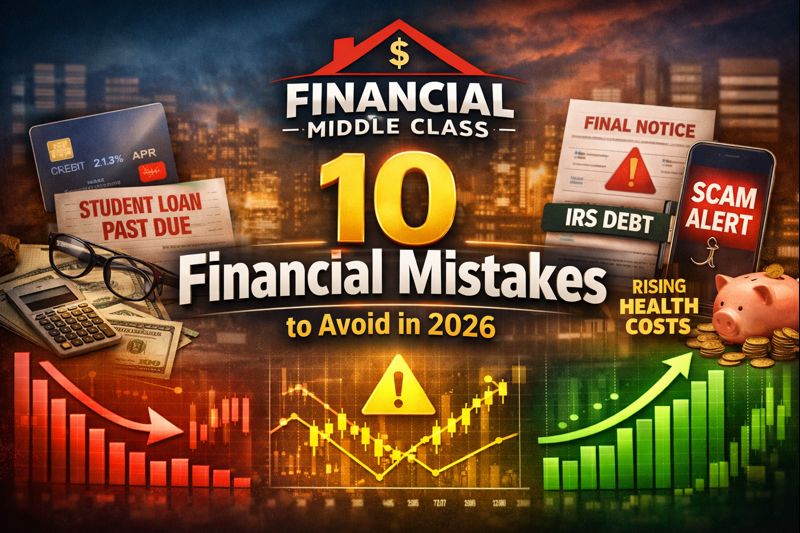
10 Financial Mistakes to Avoid in 2026 (Budgeting, Debt, Savings)
By MacKenzy Pierre
The estimated reading time for this post is 649 seconds
10 Financial Mistakes to Avoid in 2026 (Budgeting, Debt, Savings)
Last updated
December 30, 2025 — updated for 2026 IRS inflation adjustments/limits, student-loan credit reporting reality, healthcare cost risk, and fraud trends.
Table of Contents
Intro: 2026 is not the year to freestyle your money
Too many people treat money like it’s a vibe. Like you can “manifest” your way out of a 21% credit card APR.
Like the bills are going to respect your anxiety and wait politely.
That’s not how the system works. The system is consistent. It charges interest every day. It adds fees on schedule.
It reports missed payments when the rules say it can. And it never feels bad about doing it.
So 2026 can go one of two ways:
Option A: You keep doing “minimum payment behavior” and wonder why your money never stays.
Option B: You tighten a few screws, stop the leaks, and finally get control of your cash flow.
This article is the control list. Not theory. Not shame. Just the ten mistakes that quietly wreck budgets—and the FMC moves that fix them.
What makes 2026 different
The biggest mistake people make every year is assuming “this year will be normal.” In 2026, normal is expensive.
Interest is still high. The cost of being disorganized is higher. And a lot of households are operating with thin savings.
Translation: the margin for error is smaller. That’s why the mistakes below matter so much.
- High-cost debt is still high-cost. If you carry balances, the math doesn’t care about your intentions.
- Cash flow is fragile. When savings are low, one surprise turns into long-term debt.
- Student loans are “real” again. Payment issues can hit credit and consequences can escalate.
- Healthcare costs can swing. Plan like premiums could rise, not like they’re guaranteed to stay tame.
- Scammers are professional now. They don’t need you to be dumb. They need you to be rushed.
Key Takeaways
- Minimum payments keep you stuck. Attack high APR debt like it’s an emergency—because it is.
- BNPL is still debt. Loan stacking turns “small payments” into a full-size monthly bill.
- Student loans don’t disappear. Avoidance gets expensive fast—log in, verify, and choose a plan.
- Your emergency fund buys you peace. It stops “one surprise” from becoming “one year of debt.”
- Taxes don’t care that you forgot. Update withholding early so April doesn’t bully you.
- Fraud is a money leak. Slow down, verify, and lock your identity like it’s a bank vault.
2026 “Money Calendar” Timeline
Use this as your year map. Not a panic list. A control list.
January–February: Lock the basics (cash flow, debts, autopay)
- Pick your #1 payoff target (highest APR). Automate extra payments.
- Inventory BNPL, subscriptions, and “silent” monthly charges.
- Confirm student-loan status and repayment path; set reminders.
March–April: Tax season without the stress
- Run a withholding check so you’re not surprised later.
- If you have side income: create a “tax bucket” and pay on schedule.
May–August: Raise your savings floor
- Build a $1,000 buffer, then push toward 1 month of expenses.
- Move idle cash to a better-yield, insured account.
September–December: Finish strong (retirement, insurance, fraud protection)
- Increase retirement contributions (even +1%). Secure the match.
- Re-shop insurance with eyes open (health + auto).
- Freeze credit + tighten 2FA before holiday scam season ramps up.
The Top 10 Financial Mistakes to Avoid in 2026
Mistake #1: Treating credit-card debt like it’s “normal”
What it looks like: “I’ll pay it off when things calm down.” Meanwhile, the balance grows while you breathe.
Why it hurts: At high APRs, you can pay every month and still feel broke—because interest is eating your progress.
The FMC move:
- Pick one card as the target (highest APR first).
- Minimums on the rest. Everything extra goes to the target.
- Call the issuer and ask for a lower rate or hardship plan.
- If you do a balance transfer, lock the rule: no new debt while paying it down.
Mistake #2: Stacking BNPL like it’s not debt
What it looks like: Four payments here, four payments there… then suddenly your paycheck is spoken for before it lands.
Why it hurts: BNPL is easiest to abuse when you’re stressed, shopping fast, and telling yourself it’s “small.” Small payments can still build a big obligation.
The FMC move:
- One BNPL plan at a time. One.
- Track BNPL like a credit card: remaining balance + due dates.
- If you’re using BNPL for essentials, don’t rationalize it—fix the cash flow.
Mistake #3: Pretending student loans aren’t “real” again
What it looks like: You avoid the servicer portal because you don’t want to see what you already suspect.
Why it hurts: Credit reporting and consequences don’t wait for you to feel ready. If you’re behind, time is not your friend.
The FMC move (30-minute reset):
- Log in. Confirm your status: current, delinquent, or default.
- Pick a repayment path that fits your income and reality.
- Turn on autopay (or calendar reminders if autopay isn’t possible).
- If you’re in default, treat it like a fire drill. Options exist—avoidance isn’t one of them.
Mistake #4: Buying a car based on the monthly payment (and nothing else)
What it looks like: “I can afford $650/month” becomes the whole plan—no insurance quote, no maintenance math, no exit strategy.
Why it hurts: When the payment is stretched to fit, you end up paying longer, paying more, and staying trapped.
The FMC move:
- Budget the total: payment + insurance + gas + maintenance.
- Shop insurance before you buy the car.
- Don’t stretch a long term just to make the payment “look” smaller.
Mistake #5: Living without a real emergency fund
What it looks like: One tire, one doctor visit, one unexpected trip—and you’re swiping plastic.
Why it hurts: This is how debt becomes a lifestyle. Not because you love debt, but because you had no buffer.
The FMC move:
- Start with $1,000.
- Then aim for one month of expenses.
- Then build toward three months.
- Automate it on payday. Manual saving dies the first time life gets loud.
Mistake #6: Letting your savings earn pennies
What it looks like: Your money is “safe,” but the interest is insulting.
Why it hurts: A weak savings yield won’t make you rich, but it can keep your cash from being dead weight.
The FMC move:
- Keep emergency savings in an insured account—but choose one that actually pays.
- If money has a known timeline (6–12 months), consider short CDs.
- Don’t chase flashy teaser rates without reading the fine print.
Mistake #7: Sleepwalking into tax surprises
What it looks like: You file taxes and pray. Then you owe. Then you’re mad—like the IRS did you personally.
Why it hurts: Taxes punish disorganization. If your income changed, your withholding might be wrong.
The FMC move:
- Do a withholding check early (January/February).
- If you have side income, create a separate “tax bucket.”
- Make taxes boring. Boring taxes are winning taxes.
Mistake #8: Leaving retirement money on the table
What it looks like: You “mean to start” saving for retirement… but the match expires every paycheck.
Why it hurts: The match is free money. And free money is undefeated.
The FMC move:
- Capture the employer match first.
- Increase contributions by 1% each quarter until it’s meaningful.
- Use raises to upgrade retirement—not just lifestyle.
Mistake #9: Getting blindsided by health insurance costs
What it looks like: You renew on autopilot, then the premium jumps and your budget has to “eat it.”
Why it hurts: Health insurance is one of the few bills that can spike hard and fast—and when it does, people start borrowing to survive.
The FMC move:
- Shop coverage like a serious financial decision (because it is).
- Compare total annual cost: premiums + deductible + expected care.
- If you’re self-employed or switching jobs, plan early—don’t get cornered.
Mistake #10: Being casual about scams
What it looks like: You click because you’re tired, the message looks real, and it says “urgent.”
Why it hurts: Modern scams are designed for normal people on busy days. The goal is speed—so you don’t verify.
The FMC move (non-negotiables):
- Freeze your credit (all three bureaus).
- Turn on 2FA for email + banking.
- Never verify an “urgent” message using the link they sent. Use a known number/site.
The FMC 2026 “Fix-It Week” Plan
If you want momentum fast, do this in the next 7 days. Not next month. Not after you “feel ready.” This week.
- Pick one debt target and automate extra payments.
- List every BNPL plan and stop stacking.
- Log into your student-loan portal and lock in a plan + reminders.
- Build a $1,000 buffer (or protect it if you already have it).
- Move savings to an insured account that pays a competitive yield.
- Check withholding so taxes don’t ambush you.
- Lock your identity: freeze credit + enable 2FA.
You don’t need 100 new habits. You need one clean system: pay yourself first, pay down the worst debt, and stop the leaks.
FAQ
Should I build an emergency fund or pay off credit cards first?
Do both, but in order: build a small buffer first (so you stop re-swiping), then attack high APR debt hard. A tiny emergency fund prevents relapse.
Is BNPL bad for my credit?
BNPL becomes a problem when you stack plans and miss payments. Even when reporting varies, lenders still care about cash flow and payment behavior.
What’s the quickest way to stop living paycheck to paycheck?
Cut the silent bills (subscriptions + fees), automate one savings transfer, and eliminate one high-interest balance. One clean win creates momentum.
How big should my emergency fund be in 2026?
Start with $1,000, then aim for one month of expenses, then three. The “right” number is the one that prevents debt when life happens.
Should I pause investing to pay off debt?
If the debt is high-interest, it’s usually a guaranteed negative return. Keep the employer match if you have it, then focus on wiping out the worst APRs.
What’s the simplest anti-scam setup?
Freeze your credit, turn on 2-factor authentication for email and banks, and never click “urgent” links from texts. Verify using a known number/site.
Let’s talk
Which one of these mistakes hit you the hardest—and what’s your plan to fix it in 2026? Drop it in the comments. Somebody else needs your playbook.
Related Reads:
APR vs. APY, Revolving Debt, and the Interest Games Lenders Play
The 10 strategies that actually lower your mortgage rate

Senior Accounting & Finance Professional|Lifehacker|Amateur Oenophile
RELATED ARTICLES
Cash Strategy: Put Every Dollar in the Right Place
Your checking account, emergency fund, short-term savings, and investments should not be managed the same way. This cash strategy helps assign every dollar to the right financial job.
Best HYSA: How to Choose Beyond the Highest APY
A competitive interest rate matters, but it is only one part of choosing a high-yield savings account. Compare insurance, fees, access, transfer speed, and promotional conditions.
Leave Comment
Cancel reply
Gig Economy
Business / Aug 08, 2026
The Missing Middle in Black Entrepreneurship
Black entrepreneurship has expanded dramatically. The next challenge is helping more Black-owned businesses move from self-employment to employer firms and sustainable scale.
By FMC Editorial Team
Personal Finance / Aug 01, 2026
Cash Strategy: Put Every Dollar in the Right Place
Your checking account, emergency fund, short-term savings, and investments should not be managed the same way. This cash strategy helps assign every dollar to the right...
By Article Posted by Staff Contributor
Personal Finance / Aug 01, 2026
Best HYSA: How to Choose Beyond the Highest APY
A competitive interest rate matters, but it is only one part of choosing a high-yield savings account. Compare insurance, fees, access, transfer speed, and promotional conditions.
By Article Posted by Staff Contributor
Personal Finance / Aug 01, 2026
High-Yield Savings vs. CDs, Treasury Bills, and Other Safe Places for Cash
High-yield savings accounts are excellent for accessible cash, but they are not always the best choice. Compare HYSAs, CDs, Treasury bills, money market accounts, and I...
By Article Posted by Staff Contributor
American Middle Class / Aug 01, 2026
High-Yield Savings Accounts: A Safer Home for Your Cash
A high-yield savings account can pay several times the national savings rate while keeping qualified deposits federally insured. Here is how it works, what to watch...
By Article Posted by Staff Contributor
Real Estate / Jul 30, 2026
Mortgage Lock-In Is Freezing the Housing Market
Millions are trapped by 3% mortgages. Learn how mortgage lock-in worsens affordability—and why homeowners are renovating instead.
By FMC Editorial Team
Real Estate / Jul 26, 2026
Is South Florida More Expensive Than New York? The Complete 2026 Relocation Guide
Is South Florida more expensive than New York? Compare housing, taxes, insurance and 104 municipalities before you move.
By Article Posted by Staff Contributor
Personal Finance / Jul 25, 2026
The Time Value of Life Experiences: What Compound Interest Leaves Out,
Money compounds, but life experiences do too. Explore what compound interest leaves out—and how to balance saving with living.
By MacKenzy Pierre
American Middle Class / Feb 18, 2026
How Wealth Is Passed Across Generations in the United States: Mechanisms, Evidence, and the Policy Debate
How wealth passes between generations—trusts, taxes, and the debate. Get the facts, figures, and tradeoffs. Read now.
By FMC Editorial Team
American Middle Class / Feb 16, 2026
The S&P 7,000: How Wall Street Disconnects from Main Street
S&P 7,000 can rise while wages, benefits, and towns fall behind. See why the market isn’t the economy—read now.
By MacKenzy Pierre
Latest Reviews
Business / Aug 08, 2026
The Missing Middle in Black Entrepreneurship
Black entrepreneurship has expanded dramatically. The next challenge is helping more Black-owned businesses move from...
Personal Finance / Aug 01, 2026
Cash Strategy: Put Every Dollar in the Right Place
Your checking account, emergency fund, short-term savings, and investments should not be managed the same...
Personal Finance / Aug 01, 2026
Best HYSA: How to Choose Beyond the Highest APY
A competitive interest rate matters, but it is only one part of choosing a high-yield...