
Is It All Glitter? The Middle Class and the Gold Craze
By Article Posted by Staff Contributor
The estimated reading time for this post is 978 seconds
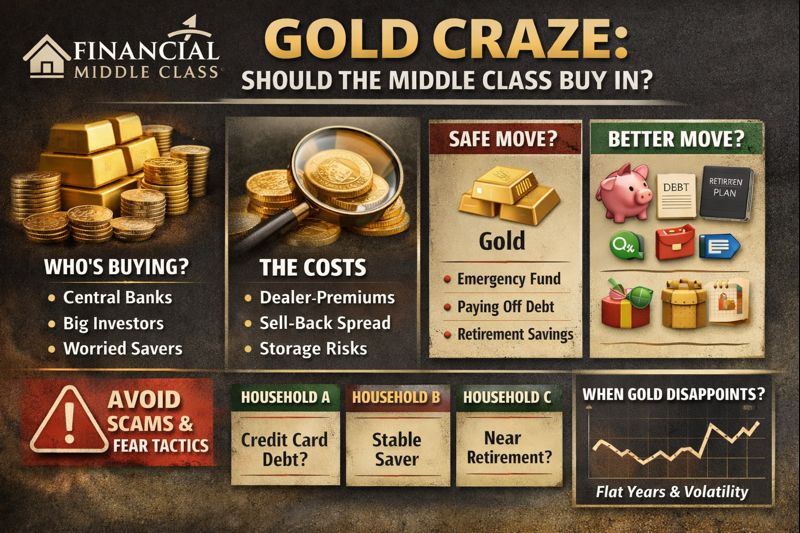
Gold Craze: Should the Middle Class Buy In?
Last updated: January 12, 2026 — Gold prices and flows move fast; this post focuses on decision rules that still work when headlines change.
Timeline: Why humans keep coming back to gold
Ancient world: money you can hold
Gold worked because it was scarce, durable, and widely trusted—long before anyone trusted banks, apps, or governments.
1800s–early 1900s: the gold standard mindset
Gold wasn’t just metal—it was a promise. Stability was tied to something physical, which is why the idea still feels comforting today.
1971 and after: “trust” becomes the real backing
Once money became more about policy and credibility, gold became the popular counterweight whenever people questioned the rules.
2008–2020s: crisis memory and inflation anxiety
When households feel the floor move—jobs, markets, prices—gold returns as a psychological anchor and a diversification tool.
Right now: headlines + momentum + fear
In hot markets, gold attracts both “insurance buyers” and “don’t want to be last” buyers. Same asset. Different motives.
Intro: Why gold feels louder right now
Gold is having a moment. Again. And if you’re middle class, you’re not watching because you suddenly developed a hobby for shiny metals. You’re watching because your life is expensive in a way that doesn’t show up on a résumé.
The mortgage is steady, but the escrow isn’t. The home insurance premium has been lifting weights. The grocery bill still acts like it’s trying to win a championship. Your paycheck is real, but the margin you keep is thin enough that one surprise can turn into a season.
So when you see gold headlines—record highs, “safe haven,” “protect your wealth”—it lands differently. It doesn’t sound like greed. It sounds like relief. Something solid. Something that can’t be printed. Something you can hold and say, “At least this doesn’t change its mind.”
That’s the emotional pitch. Here’s the reality: gold is not a wealth plan. Gold is insurance. Sometimes useful. Sometimes overpriced. Always misunderstood.
Who’s buying gold (and what that signals)
The loudest gold buyers aren’t influencers with ring lights. They’re institutions with flags.
Central banks have been buying gold at historically elevated levels. That’s not “catching a vibe.” That’s ballast. When the people who manage currencies keep increasing their gold reserves, they’re telling you they want options.
Then you have investors piling in through ETFs because it’s easy. You don’t need a safe. You need a brokerage account and a pulse. And when prices rise, more people show up—not always because they have a strategy, but because they don’t want to feel late.
In big gold cultures, households adjust when gold gets expensive. People don’t stop wanting it—they change the format. Less jewelry. More coins. More bars. More “just give me the simplest thing.” Same instinct, different product.
Why gold runs: fear, rates, geopolitics
Gold tends to roar when people feel like the floor might move. Geopolitics flares up. Confidence wobbles. Interest rate expectations shift. Markets get jumpy. And suddenly a metal that does absolutely nothing starts looking like it does everything.
The thing about fear is it has a marketing department. “Protect your family.” “Escape the system.” “Don’t get left holding paper.” If you’re middle class, that language can hit you right in the nervous system—because you’ve already lived the part where prices rise faster than wages and emergencies show up with a receipt.
But your goal isn’t to be emotional. Your goal is to be stable.
What gold does well (and what it doesn’t)
Gold doesn’t pay interest. It doesn’t send dividends. It doesn’t generate cash flow. It doesn’t compound quietly while you sleep. It just sits there—confident, inert, shiny.
That’s the appeal. And the trap.
Gold can diversify. It can hold value in certain ugly seasons. It can act like a psychological anchor when everything else feels like a screen full of numbers and disclaimers. But gold is not a solution to the most common middle-class crisis, which is not “currency collapse.”
It’s illiquidity. It’s having a life with no breathing room.
If you’re carrying high-interest debt, or you’re one car repair away from a credit card spiral, gold is not protecting you from your biggest risk. It’s just giving you something heavy to admire while interest keeps doing pushups.
Middle-class order of operations
The middle class doesn’t need more clever. It needs more margin. Before you buy anything shiny, you want your money to do the boring work that keeps you from tipping over.
| If you put your next dollars toward… | What it protects you from | What it gives you in real life |
|---|---|---|
| Emergency fund | One bad month turning into a long emergency | Cash you can use on Tuesday |
| High-interest debt payoff | Compounding working against you | A guaranteed win equal to the interest you stop paying |
| Retirement contributions | Outliving your earning years | Long-term structure and growth potential |
| Small gold allocation | Certain macro shocks and stress periods | Diversification and psychological ballast |
Gold belongs at the end of that list for most middle-class households. Not because gold is stupid. Because cash-flow reality is undefeated.
The true cost: spot vs premium vs spread
Most people look up “the price of gold” and assume that’s what gold costs. That’s like looking up the price of a car engine and thinking you can drive it home.
When you buy physical gold, you’re dealing with spot price plus premiums plus spreads. Premiums exist for a reason—minting, refining, distribution, security, and dealer economics all get baked in. And the middle-class takeaway is simple: you can be “right” on gold and still lose money on the transaction.
If you buy with a fat premium and later sell with a haircut, your gold has to rise just to get you back to even. That doesn’t make physical gold “bad.” It just makes it not as simple as the internet pretends.
How to buy gold without getting played
If you’re drawn to physical gold because you don’t trust systems, I need you to hear this: that exact mindset is what scammers target.
Counterfeit risk is real, especially in hot markets where demand is high and people are rushing. And then there’s the bigger trap: fear-based sales. “The government is coming.” “Your retirement will be confiscated.” “The dollar will be worthless by Friday.” If someone needs you panicked to sell you a product, that’s not protection. That’s a transaction.
| Buying path | Why it feels convenient | What can go wrong if you’re rushing |
|---|---|---|
| Random online seller | “Cheaper” and fast checkout | Authenticity risk, hard disputes, bad spreads |
| Pushy “gold hotline” | Feels guided and urgent | High markups, fear tactics, confusing products |
| Transparent local dealer | You can ask questions and compare | You still need to understand premiums and buyback |
| Gold ETF through brokerage | Simple, liquid, regulated wrapper | Not “in your hand,” but clean exposure |
If you’re buying physical, move slow. Ask about buyback. Ask what the premium is and why. Keep receipts. Treat it like a serious purchase, not a vibe.
3 ways to own gold (side-by-side)
Gold is not one thing. The “how” changes the risk. The cleanest middle-class approach is the one you can explain in one sentence without a salesperson.
| Method | What you’re really owning | Why people choose it | What bites people |
|---|---|---|---|
| Physical coins/bars | Metal you can hold | Tangible, no brokerage, “mine” feeling | Premiums/spreads, storage, theft, resale friction |
| Gold ETFs | Exposure backed by gold in custody | Easy buy/sell, low hassle, liquid | Fees, still a market instrument |
| Gold mining stocks | A business exposed to gold prices | Can pop in bull markets | Company risk, cost inflation, stock volatility |
If you want simple exposure, ETFs are often the most middle-class-friendly because you can size it small, buy it in seconds, and sell it if life happens. Mining stocks can be powerful, but they’re not “gold.” They’re companies, with all the mess that comes with companies.
Gold + retirement accounts (simple vs complex)
Near-retirees ask a fair question: “Can I hold gold in my retirement accounts?” At a high level, people find ways to do it. But the difference between clean and complicated matters—especially when your time horizon is shorter and fees matter more.
A straightforward approach many people use is owning gold exposure through an ETF inside an IRA. It’s simple. It’s liquid. It’s one layer of fees. The complicated approach is the physical “gold IRA” ecosystem, which can involve custodians, storage, and extra moving parts—plus the reality that sales pressure often lives here.
| Retirement approach | What you’re getting | Why it works | What to watch |
|---|---|---|---|
| Gold ETF in an IRA | Market exposure to gold | Simple, liquid, fewer moving parts | Expense ratio, price swings |
| Physical gold via specialized structure | Actual metal in approved custody | Tangible asset in a retirement wrapper | More fees, more complexity, more sales pressure |
If you’re already fighting to contribute consistently, adding complexity isn’t a flex. It’s a risk.
Scams & fear marketing: red flags
Scams don’t just steal money. They steal focus. They take a household that needs margin and distract it with apocalypse theater, then sell it a product with confusing markups and a story that makes you feel smart for panicking.
This is not a moral failing. It’s marketing. And it’s why you should treat fear like a cost. If the pitch is built on urgency, secrecy, and doom, you’re not being protected. You’re being processed.
Alternatives: boring hedges that work
One reason gold gets so much attention is because it feels like the only alternative to being helpless. It’s not. There are boring tools that often fit middle-class life better, especially when the real risk is a cash crunch.
| Option | Liquidity | Does it pay you? | Best for |
|---|---|---|---|
| High-yield cash / T-bills | High | Yes (interest) | Short-term safety and flexibility |
| Diversified stock/bond mix | Medium | Sometimes | Long-term growth and balance |
| Gold | Medium (ETF high; physical lower) | No | Diversification in stress periods |
| Paying off high-interest debt | N/A | Yes (avoided interest) | Guaranteed improvement in monthly cash flow |
Gold can be part of the picture. It just shouldn’t crowd out the tools that keep you afloat.
When gold disappoints (time horizon)
Gold is “safe” in the way a life jacket is safe. It helps when you’re in the water. It’s not how you get to your destination.
Gold can go through long stretches where it does nothing. That’s not a glitch. That’s the nature of an asset that doesn’t produce anything. If you buy gold expecting it to behave like a growth asset, you’ll resent it. If you buy it understanding its job is diversification and ballast, you’ll size it appropriately and move on with your life.
| Time horizon | Cash’s job | Stocks’ job | Gold’s job |
|---|---|---|---|
| 1 year | Keep you stable | Can be volatile | Can hedge stress, can also chop |
| 5 years | Buffer + flexibility | Growth with swings | Diversifier, sometimes helpful |
| 15+ years | Optional | Compounding engine | Small stabilizer, not the main engine |
3 households: 3 different answers
Now let’s make this real, because this is where middle-class decisions live: not in theory, but in the month.
Household A is carrying credit card balances and has no real emergency fund. Their “savings” is whatever survives after bills. For them, gold is mostly a distraction. They don’t need a hedge against macro chaos. They need a hedge against their own next surprise expense. Their best “investment” is paying down the interest that’s actively eating their future.
Household B is stable. Emergency fund exists. Debt is manageable. Retirement contributions are consistent. For them, gold can be reasonable as a small slice—something that adds diversification without touching the foundation. They’re not buying a dream. They’re buying balance.
Household C is near retirement and anxious about volatility. They’re not wrong to want ballast. But they’re most at risk of getting upsold into complexity and fees. The cleanest move is often simplicity: keep the plan understandable, keep fees visible, and avoid products that require a sales rep to explain your own money back to you.
| You have $100/month to deploy | Household A (thin margin, debt) | Household B (stable base) | Household C (near retirement) |
|---|---|---|---|
| Put it into gold | Adds stress, reduces flexibility | Fine as a small diversifier | Risky if it leads to complex products |
| Put it into emergency cash | Biggest stability gain | Still useful, builds resilience | Useful buffer against unexpected costs |
| Put it into debt payoff | Often the best “return” | Still smart if any high-interest debt | Smart if debt exists before retirement |
This is the part people hate because it’s not glamorous: gold works best when you don’t need it. The people who can use gold responsibly are usually the people who already did the boring work first.
How much is “small” + rebalancing
If gold belongs in your plan, it belongs as a slice you can ignore. That’s the middle-class rule: if the position is so big you obsess over it, it’s too big.
Decide your target. Keep it boring. Rebalance occasionally instead of reacting daily. Don’t chase headlines. Don’t punish your budget to prove you’re “diversified.” Gold isn’t a personality. It’s a tool.
FAQ
Questions people ask quietly
Is jewelry an investment?
Usually it’s culture and beauty first. Jewelry pricing includes retail markups and making costs, so resale often won’t match the “gold price” headline.
Is a gold ETF “real gold”?
It’s regulated exposure to gold in a wrapper that’s easy to buy and sell. It’s not a coin in your hand, but it’s often the most practical option for a small allocation.
Is physical gold safer?
Physical removes some counterparty risk, but adds other risks: premiums/spreads, storage, theft, and the possibility you can’t sell quickly at a fair price when you need cash.
How do I avoid scams?
Run from urgency, doom language, and complicated “exclusive” structures. Favor transparency: clear pricing, clear fees, and a buyback policy you understand.
Do I need gold if I already invest for retirement?
Most people don’t need it. Some choose a small slice for diversification. The test is whether it strengthens your foundation—or steals money from it.
Conclusion: the real flex is margin
Gold isn’t evil. Gold isn’t a scam by definition. Gold is a tool. It has a role in the world, and in the right portfolio, it can have a small role too.
But the middle class doesn’t fall because it didn’t own enough glitter. It falls because life happens and there’s no slack.
And that’s the truth under all this shine: the real flex isn’t having gold. The real flex is having breathing room—because when you have margin, you don’t need headlines to feel safe.


RELATED ARTICLES
The American Middle Class’s Guide to the 2026 Midterm Ballot Measures
The 2026 midterm elections will put major housing and tax proposals before American voters. From Florida's homestead exemptions to Massachusetts zoning reform and California's affordable housing initiatives, explore the potential effects on homeowners, renters, first-time buyers, and middle-class finances.
FICO Finally Has Competition. Will Homebuyers Get a Better Deal?
For decades, FICO dominated mortgage credit scoring. Now VantageScore 4.0 is challenging that dominance. Discover how new rules from federal housing regulators could affect mortgage approvals, borrowing costs, and financial opportunities for American homebuyers—and why a higher credit score doesn't...
Leave Comment
Cancel reply
Gig Economy
American Middle Class / Oct 16, 2026
The American Middle Class’s Guide to the 2026 Midterm Ballot Measures
The 2026 midterm elections will put major housing and tax proposals before American voters. From Florida's homestead exemptions to Massachusetts zoning reform and California's affordable housing...
By Article Posted by Staff Contributor
Personal Finance / Oct 14, 2026
FICO Finally Has Competition. Will Homebuyers Get a Better Deal?
For decades, FICO dominated mortgage credit scoring. Now VantageScore 4.0 is challenging that dominance. Discover how new rules from federal housing regulators could affect mortgage approvals,...
By Article Posted by Staff Contributor
American Middle Class / Oct 13, 2026
Selling Affordability Through Installments
Americans are increasingly buying based on what they can afford each month rather than what something actually costs. From buy now, pay later services to longer...
By Article Posted by Staff Contributor
American Middle Class / Oct 12, 2026
Fair Capitalism: We Don’t Need to Abolish Capitalism. We Need to Fix It.
Fair capitalism means preserving entrepreneurship and profits while ensuring working Americans share more meaningfully in the prosperity they help create.
By MacKenzy Pierre
American Middle Class / Oct 12, 2026
The Sunday Scaries: How Financial Independence Can Help You Reclaim Your Weekend
The Sunday Scaries can begin long before Monday morning. Building emergency savings, lowering monthly expenses, and increasing financial independence may help you reclaim your weekend.
By Article Posted by Staff Contributor
Business / Aug 08, 2026
The Missing Middle in Black Entrepreneurship
Black entrepreneurship has expanded dramatically. The next challenge is helping more Black-owned businesses move from self-employment to employer firms and sustainable scale.
By FMC Editorial Team
Personal Finance / Aug 01, 2026
Cash Strategy: Put Every Dollar in the Right Place
Your checking account, emergency fund, short-term savings, and investments should not be managed the same way. This cash strategy helps assign every dollar to the right...
By Article Posted by Staff Contributor
Personal Finance / Aug 01, 2026
Best HYSA: How to Choose Beyond the Highest APY
A competitive interest rate matters, but it is only one part of choosing a high-yield savings account. Compare insurance, fees, access, transfer speed, and promotional conditions.
By Article Posted by Staff Contributor
Personal Finance / Aug 01, 2026
High-Yield Savings vs. CDs, Treasury Bills, and Other Safe Places for Cash
High-yield savings accounts are excellent for accessible cash, but they are not always the best choice. Compare HYSAs, CDs, Treasury bills, money market accounts, and I...
By Article Posted by Staff Contributor
American Middle Class / Aug 01, 2026
High-Yield Savings Accounts: A Safer Home for Your Cash
A high-yield savings account can pay several times the national savings rate while keeping qualified deposits federally insured. Here is how it works, what to watch...
By Article Posted by Staff Contributor
Latest Reviews
American Middle Class / Oct 16, 2026
The American Middle Class’s Guide to the 2026 Midterm Ballot Measures
The 2026 midterm elections will put major housing and tax proposals before American voters. From...
Personal Finance / Oct 14, 2026
FICO Finally Has Competition. Will Homebuyers Get a Better Deal?
For decades, FICO dominated mortgage credit scoring. Now VantageScore 4.0 is challenging that dominance. Discover...
American Middle Class / Oct 13, 2026
Selling Affordability Through Installments
Americans are increasingly buying based on what they can afford each month rather than what...