
Investing or Paying Off the House?
By Article Posted by Staff Contributor
The estimated reading time for this post is 596 seconds
Invest or Pay Off the Mortgage? The Math, the Dividends, and the Part Nobody Can Spreadsheet
There are two kinds of rich: the kind you can calculate, and the kind you can feel. This is a story about both—using a real $500k home example, real compounding math, and the very real relief of sleeping in a house nobody can repossess.
The real question you’re asking
When people say, “Should I invest or pay off the house?” they’re usually not asking about optimization. They’re asking about control.
Because a mortgage is a monthly claim on your future. Markets are a bet on your future. And the middle class is tired of living in the “maybe.”
Key Takeaways (read this first)
- Paying down your mortgage is a guaranteed return roughly equal to your interest rate (net of any tax benefit you actually use).
- Investing is an uncertain return that can be higher over long horizons—but it comes with volatility, timing risk, and behavior risk.
- Dividends don’t magically create value; they shift value from the stock price to cash. The compounding comes from reinvesting and total return over time.
- Most homeowners don’t itemize; if you’re not itemizing, the mortgage-interest “tax break” is often more myth than money.
- The peace of a paid-off home has real value, even if it doesn’t show up on a calculator.
The “return” on paying down a mortgage
Paying extra principal is not “earning” in the way a dividend is earning. You’re not receiving cash. You’re shrinking a liability.
But financially, it behaves like a return because you’re avoiding future interest you would have otherwise paid.
If your rate is 6.17%, every extra dollar of principal you prepay is a dollar that won’t be charged 6.17% interest going forward.
That’s a clean, guaranteed, no-drama benefit.
One caveat that matters
The “effective return” on prepaying can be lower than your rate if you get a meaningful mortgage-interest deduction.
But that deduction only helps if you itemize—and itemizing only helps if your itemized deductions exceed your standard deduction.
Dividends and compounding: what actually compounds
Let’s clean up the dividend myth in one sentence: a dividend is not free money; it’s a transfer.
When a stock pays a cash dividend, the market typically adjusts the share price downward by roughly the dividend amount on the ex-dividend date.
You didn’t “create” wealth. You received cash that used to be inside the share price.
So where does compounding come from? From total return over time: price appreciation + dividends (and interest) that are reinvested.
If you reinvest dividends, you buy more shares. More shares means more future dividends and more participation in future price moves.
A practical dividend lens for homeowners
If you’re investing instead of prepaying, you’re essentially saying:
“I’m willing to accept volatility in exchange for the possibility that my long-run total return beats my mortgage rate.”
Translation: You’re trading certainty for expected value. That trade can be rational. It can also be emotionally expensive.
Taxes: the quiet third player in this fight
Taxes can flip the math—especially on the investing side—because taxable accounts don’t compound as cleanly as spreadsheets pretend.
Dividends can be taxable. Capital gains can be taxable. And the timing matters.
On the mortgage side, the “tax benefit” depends on whether you itemize and whether your loan fits within the interest deduction limits.
And plenty of middle-class households never see a meaningful benefit because the standard deduction is already large.
Keep it simple
- If you’re maxing retirement accounts (401(k), IRA), investing there can be structurally more efficient than investing in a taxable account.
- If you’re not itemizing, don’t over-credit the mortgage for a deduction you don’t actually use.
- If your investing plan only works on paper—and falls apart the first time the market drops 20%—it’s not a plan.
Case study: $500k home, 20% down, today’s 30-year fixed rate
Let’s do this the way the middle class experiences it: with a real purchase price, a real down payment, and a real monthly payment that competes with groceries, insurance, and everything else.
The setup
| Home price | $500,000 |
|---|---|
| Down payment (20%) | $100,000 |
| Loan amount | $400,000 |
| Rate (30-year fixed) | 6.17% |
| Monthly P&I payment | $2,442.09 |
| Extra monthly payment rule | Extra = 50% of P&I = $1,221.05 |
| “Paydown strategy” total monthly P&I outflow | $3,663.14 |
Note: This excludes taxes/insurance/HOA and assumes a stable rate for the full term.
Strategy A vs Strategy B (what we’re comparing)
Strategy A (Invest): Pay the regular mortgage. Invest $1,221.05/month (equal to half the P&I) in a diversified portfolio.
Strategy B (Pay down): Pay an extra $1,221.05/month toward principal (total P&I outflow $3,663.14). After the mortgage is paid off, invest the full $3,663.14/month for the remaining months of the 30-year window.
What the mortgage math says
| Normal schedule payoff | 30 years (360 months) |
|---|---|
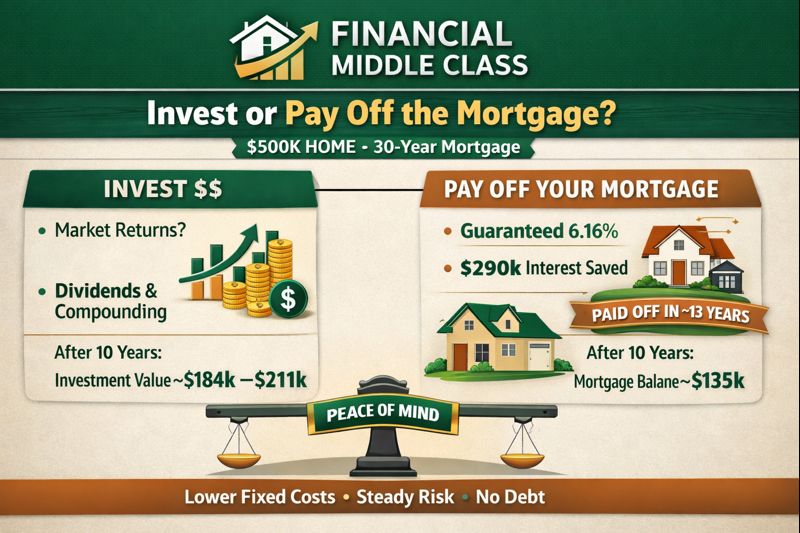
| Payoff with extra payment (50% of P&I) | ~13 years, 5 months (161 months) |
| Total interest (normal schedule) | $479,153.98 |
| Total interest (with extra payments) | $188,761.55 |
| Interest saved | $290,392.43 |
The 10-year checkpoint (where real life happens)
Ten years is where people actually make decisions. Kids. Job changes. A health scare. A move. A divorce. A layoff. A “we need to help family” moment.
So let’s check the scoreboard at year 10.
| Measure | Strategy A: Invest | Strategy B: Pay down |
|---|---|---|
| Remaining mortgage balance | $336,250.22 | $134,288.90 |
| Extra principal paid (difference) | $201,961.32 more principal eliminated under Strategy B | |
| Investment account value (4.5% annual return, compounded monthly) | $184,619.98 | $0 (you used the cash to pay down) |
| Investment account value (7% annual return, compounded monthly) | $211,344.72 | $0 |
Investment assumption here uses a nominal monthly rate (annual/12) to illustrate compounding; real markets vary and returns are not linear.
Notice what’s happening: Strategy B “wins” the certainty column—about $202k more principal gone by year 10.
Strategy A “wins” the liquidity column—an investable pile you can tap without applying for a loan (taxes/penalties and market timing aside).
The 30-year endgame (same 30-year window, different timing)
Now we compare both strategies over the same 30-year window. This is important. The paydown strategy isn’t “anti-investing.”
It’s “invest later, but heavier.”
| Assumed annual return | Strategy A: Invest $1,221.05/mo for 30 years | Strategy B: Invest $3,663.14/mo for last 199 months |
|---|---|---|
| 4.5% | $927,246.32 | $1,080,513.92 |
| 7% | $1,489,642.16 | $1,370,125.86 |
| 10% | $2,760,162.43 | $1,852,639.75 |
These are simplified illustrations that ignore taxes, inflation, and sequence-of-returns risk. They’re meant to show timing effects, not predict your future.
What the table is really saying
If markets are strong over the full 30 years, Strategy A can win because you started compounding earlier.
If your realistic return is lower (or you value certainty more), Strategy B looks better because the mortgage payoff is a guaranteed “return,” and your later investing happens without a mortgage dragging you down.
Timeline accordion: what happens when
Month 1–12: The fork in the road
- Strategy A: You begin compounding immediately. You also keep maximum monthly flexibility.
- Strategy B: You begin buying down risk immediately. Your “return” is your interest avoided.
Year 3–7: The stress test window
- This is where layoffs, childcare spikes, and “life happens” are most common.
- Strategy A’s liquidity can be a lifesaver—if you don’t panic-sell in a down market.
- Strategy B’s progress is slower to “use,” but it can lower anxiety and improve cash-flow resilience later.
Year 10: The “real life” checkpoint
- Strategy B has dramatically reduced the mortgage balance.
- Strategy A has built an investable pile that can be tapped (with caveats).
- Most people decide here whether they’re a “numbers person” or a “nervous system person.”
Year ~13.5: Mortgage-free moment (Strategy B)
- The mortgage is gone (principal & interest). That’s a psychological weight off the chest.
- Now you can redirect the entire former payment into investing, aggressively.
Year 30: The scoreboard
- Strategy A typically wins if long-run returns are strong and you stay invested.
- Strategy B can win when returns are middling, or when the household values certainty enough to avoid bad investor behavior.
The sleep-well-at-night factor
There’s a reason this debate never dies: because it’s not purely financial.
A paid-off house has no “intrinsic value” the way a business does. It doesn’t spit out dividends. It doesn’t compound. It sits there.
And yet the lived value can be enormous—because it changes how you move through the world.
Mortgage-free people make different decisions. They tolerate different jobs. They walk away from different bosses.
They take risks that aren’t desperation risks.
This is what “peace” looks like in money form
- Lower fixed expenses means a smaller emergency fund requirement (or the same fund lasts longer).
- You can weather income shocks without immediately negotiating with a bank.
- Retirement math becomes less fragile because fewer monthly bills depend on market performance.
If paying off the mortgage helps you sleep, and sleeping helps you perform, and performing helps you earn, then the “non-financial” decision still produces financial outcomes. Just not the kind you can plug into Excel.
A decision framework you can actually use
Step 1: Protect your base
Emergency fund first. If you don’t have cash reserves, prepaying the mortgage can leave you “house rich, life fragile.”
Step 2: Capture the easy wins
- Take the employer match in retirement accounts (if available).
- Pay down high-interest debt before you treat the mortgage like an enemy.
Step 3: Decide what problem you’re solving
If your problem is math: compare your mortgage rate to your realistic, after-tax, after-fees investment return—and your ability to stay invested.
If your problem is stress: treat the mortgage payoff like buying back peace, control, and bandwidth.
A middle-class “hybrid” that often works
Split the difference on purpose:
invest consistently (so you keep compounding alive), and also pay a smaller extra amount toward principal (so you keep progress visible).
The “best” plan is the one you’ll still follow in a bad year.
Quick gut-check questions
- Would a 25% market drop cause you to stop investing or sell?
- Would losing your job feel catastrophic because of the mortgage?
- Do you already invest automatically every month without thinking?
Disclaimer: This article is educational and not individualized financial advice. Consider taxes, risk tolerance, and your full household budget.
FAQ
Is paying off the mortgage “guaranteed” better?
It’s guaranteed in one way: you avoid the interest you would have paid. But “better” depends on your time horizon, taxes, liquidity needs, and behavior in volatile markets.
Do dividends make investing safer than paying down the mortgage?
Dividends can contribute to total return, but they don’t eliminate market risk. The compounding advantage comes from reinvesting dividends over time, not from dividends being “free.”
What if I want both: safety and growth?
A hybrid approach can be a strong middle-class strategy: invest automatically every month (so compounding isn’t optional), and also send a smaller extra principal payment to shorten the loan and reduce stress.
Should I prepay if my rate is low?
Lower rates reduce the “guaranteed return” of prepaying. In those cases, investing often looks more attractive mathematically—but the sleep-well factor may still matter.
Does this change if I’m close to retirement?
Often, yes. Reducing fixed monthly obligations can make retirement planning less fragile. Many households value the certainty of a paid-off home more as they approach retirement.
Comment
If you had an extra $1,200 a month right now, would you rather buy freedom by killing the mortgage—or buy upside by investing it? What’s your real reason?


RELATED ARTICLES
Cash Strategy: Put Every Dollar in the Right Place
Your checking account, emergency fund, short-term savings, and investments should not be managed the same way. This cash strategy helps assign every dollar to the right financial job.
Best HYSA: How to Choose Beyond the Highest APY
A competitive interest rate matters, but it is only one part of choosing a high-yield savings account. Compare insurance, fees, access, transfer speed, and promotional conditions.
Leave Comment
Cancel reply
Gig Economy
Business / Aug 08, 2026
The Missing Middle in Black Entrepreneurship
Black entrepreneurship has expanded dramatically. The next challenge is helping more Black-owned businesses move from self-employment to employer firms and sustainable scale.
By FMC Editorial Team
Personal Finance / Aug 01, 2026
Cash Strategy: Put Every Dollar in the Right Place
Your checking account, emergency fund, short-term savings, and investments should not be managed the same way. This cash strategy helps assign every dollar to the right...
By Article Posted by Staff Contributor
Personal Finance / Aug 01, 2026
Best HYSA: How to Choose Beyond the Highest APY
A competitive interest rate matters, but it is only one part of choosing a high-yield savings account. Compare insurance, fees, access, transfer speed, and promotional conditions.
By Article Posted by Staff Contributor
Personal Finance / Aug 01, 2026
High-Yield Savings vs. CDs, Treasury Bills, and Other Safe Places for Cash
High-yield savings accounts are excellent for accessible cash, but they are not always the best choice. Compare HYSAs, CDs, Treasury bills, money market accounts, and I...
By Article Posted by Staff Contributor
American Middle Class / Aug 01, 2026
High-Yield Savings Accounts: A Safer Home for Your Cash
A high-yield savings account can pay several times the national savings rate while keeping qualified deposits federally insured. Here is how it works, what to watch...
By Article Posted by Staff Contributor
Real Estate / Jul 30, 2026
Mortgage Lock-In Is Freezing the Housing Market
Millions are trapped by 3% mortgages. Learn how mortgage lock-in worsens affordability—and why homeowners are renovating instead.
By FMC Editorial Team
Real Estate / Jul 26, 2026
Is South Florida More Expensive Than New York? The Complete 2026 Relocation Guide
Is South Florida more expensive than New York? Compare housing, taxes, insurance and 104 municipalities before you move.
By Article Posted by Staff Contributor
Personal Finance / Jul 25, 2026
The Time Value of Life Experiences: What Compound Interest Leaves Out,
Money compounds, but life experiences do too. Explore what compound interest leaves out—and how to balance saving with living.
By MacKenzy Pierre
American Middle Class / Feb 18, 2026
How Wealth Is Passed Across Generations in the United States: Mechanisms, Evidence, and the Policy Debate
How wealth passes between generations—trusts, taxes, and the debate. Get the facts, figures, and tradeoffs. Read now.
By FMC Editorial Team
American Middle Class / Feb 16, 2026
The S&P 7,000: How Wall Street Disconnects from Main Street
S&P 7,000 can rise while wages, benefits, and towns fall behind. See why the market isn’t the economy—read now.
By MacKenzy Pierre
Latest Reviews
Business / Aug 08, 2026
The Missing Middle in Black Entrepreneurship
Black entrepreneurship has expanded dramatically. The next challenge is helping more Black-owned businesses move from...
Personal Finance / Aug 01, 2026
Cash Strategy: Put Every Dollar in the Right Place
Your checking account, emergency fund, short-term savings, and investments should not be managed the same...
Personal Finance / Aug 01, 2026
Best HYSA: How to Choose Beyond the Highest APY
A competitive interest rate matters, but it is only one part of choosing a high-yield...