
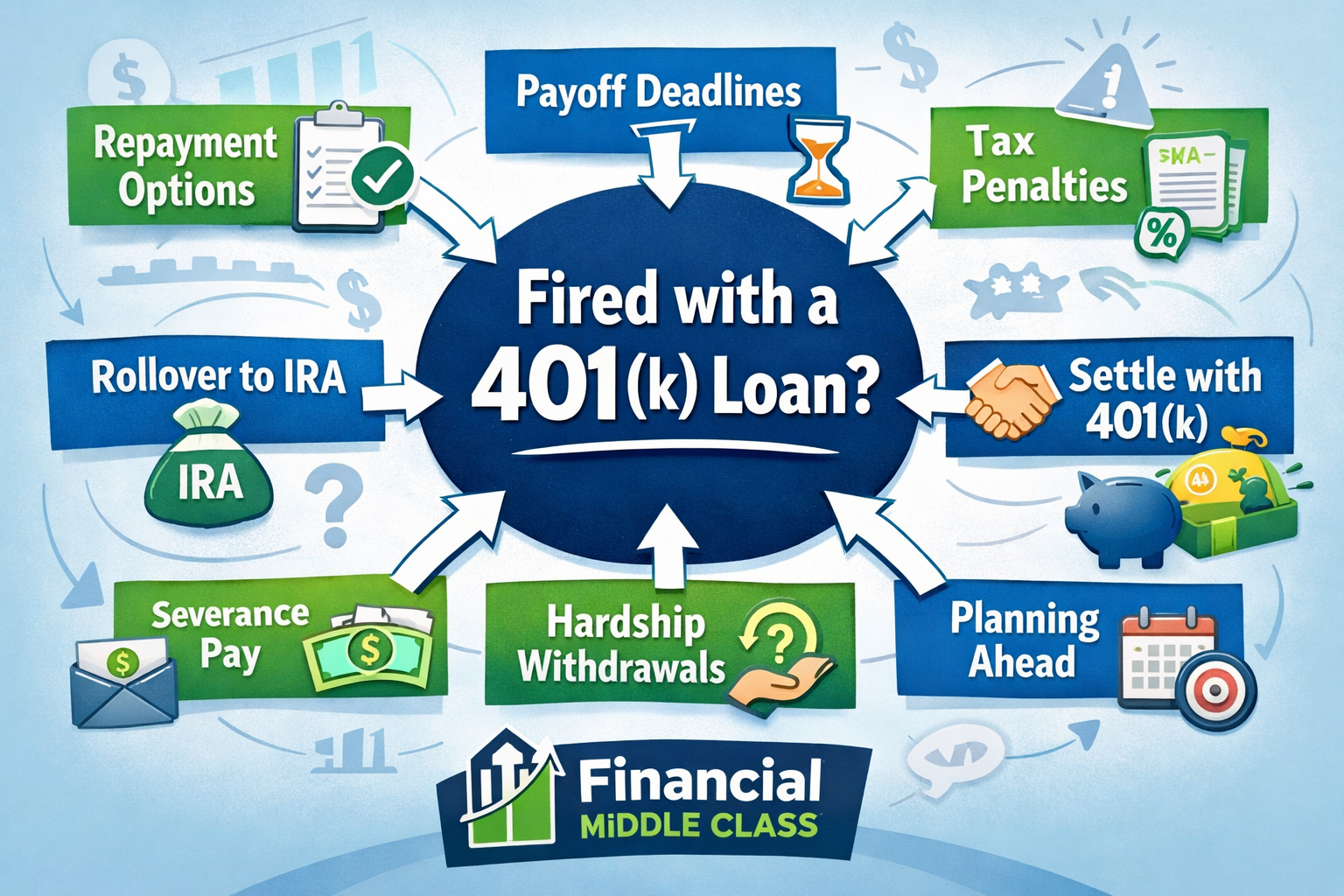
What To Do If You Get Fired With an Outstanding 401(k) Loan
By Article Posted by Staff Contributor
The estimated reading time for this post is 818 seconds
What To Do If You Get Fired with an Outstanding 401(k) Loan
Estimated read: 9–12 minutes •
Use-case: fired, laid off, or quit with a 401(k) loan still outstanding
Key Takeaways
- Separation flips a switch. Payroll deductions stop, and your plan’s loan policy takes over.
- Two clocks are running: your plan’s repayment/default rules and the IRS rollover deadlines.
- If post-separation payments are allowed, autopay is your best defense against accidental default.
- If an offset happens, you may be able to “replace” it with a rollover—timing is better if it’s a QPLO.
- Don’t assume withholding will save you. You can owe tax on an offset even if you never touched cash.
The moment you get fired, your 401(k) loan becomes a deadline problem
The meeting ends. Your email shuts off. You do the awkward walk to the parking lot with your brain running hot,
trying to remember what you even said in there.
Then, later—usually when you’re staring at the ceiling—you remember the loan.
Not a credit card. Not a bank loan. The one you took from your own retirement account because life got expensive
and somebody had to cover the gap.
Here’s what changes after separation: the “easy” repayment method (payroll deduction) disappears.
And now your outcome depends on plan rules and tax rules, not good intentions.
Most people think there’s one timeline. There isn’t. There are two.
- The plan clock: what your employer’s plan says must happen to the loan after you leave.
- The IRS clock: if a taxable event happens, how long you have to roll over money to avoid taxes/penalties.
If you understand those two clocks, you’re not powerless. You can choose the least-bad option.
If you don’t, the paperwork chooses for you.
Your 10-minute emergency checklist
You don’t need a finance degree for this. You need the right questions and the discipline to get answers in writing.
Call your recordkeeper/plan administrator and ask:
- Can I continue loan payments after separation (ACH/manual), or do you require payoff?
- What’s the exact payoff amount today and how do I submit it?
- What’s the deadline before the loan is treated as defaulted or offset?
- Was my loan “in good standing” on my termination date?
- If an offset occurs, will it be treated as a QPLO (Qualified Plan Loan Offset)?
What to pull up while you’re on the phone
- Your current loan balance and interest rate
- Your payment schedule (and whether you’re current)
- Any separation letter or loan notice from the plan
- Your SPD (Summary Plan Description) section on loans and distributions
Rule of thumb: Don’t request a rollover or distribution from the plan until you understand whether that action triggers a loan offset.
The 3 most common outcomes after separation
Once you’re no longer employed, most plans route your loan into one of three lanes. Each lane has a different cost.
Outcome 1: You pay it off
This is the cleanest outcome on paper. You repay the outstanding balance by the plan’s payoff process and the loan ends.
The downside is obvious: you’re being asked for a lump sum at the exact moment your income is unstable.
Outcome 2: You keep paying (only if your plan allows it)
Some plans allow post-separation repayment through ACH or manual payments. If yours does, this is often the best middle path:
you avoid a taxable event and you don’t need to produce a giant check today.
The key is not “I’ll remember.” The key is autopay. Job loss scrambles routines. Your loan doesn’t care.
Outcome 3: You default and/or the plan offsets the loan
This is where people get blindsided. A loan can become taxable because you missed payments (default),
or because the plan reduces your account balance to “repay” the loan (offset).
Either way, the pain tends to arrive later—in the form of a tax form and a bill—when you least need another surprise.
Glossary: the terms that decide whether you owe thousands
Most articles skip this part, then wonder why readers leave confused. Here’s the plain-English version.
Deemed distribution (loan default)
If payments stop and the loan fails the plan/IRS repayment rules, the unpaid amount can be treated like you took money out.
You may owe income tax on it, and if you’re under 59½, potentially an additional 10% penalty (unless an exception applies).
Plan loan offset
A loan offset is when the plan reduces your 401(k) balance by the remaining loan amount—essentially “netting it out.”
That offset amount is treated as a distribution for tax purposes.
QPLO (Qualified Plan Loan Offset)
This is the offset that matters. If an offset is treated as a QPLO (often tied to separation from service or plan termination),
you may get a longer window to roll over money and reduce or eliminate the tax hit.
Cure period
Many plans allow a cure period for missed payments (a window to get current). If you’re behind, this is not a detail.
This is your chance to stop a small problem from becoming a taxable event.
| Event | What it feels like in real life | Tax/penalty risk | What you do next |
|---|---|---|---|
| Deemed distribution | You missed payments; the loan becomes taxable even if no cash hit your bank. | Income tax likely; possible 10% additional tax if under 59½ (unless exception). | Ask about cure period, status, and reporting year; document everything. |
| Loan offset | Your 401(k) balance is reduced by the unpaid loan amount. | Often taxable as a distribution if not rolled over; withholding may be low/none. | Confirm rollover eligibility and the deadline (often 60 days if not QPLO). |
| QPLO | An offset triggered by separation/plan termination with special timing treatment. | Taxable unless you replace it via rollover by the extended deadline. | Plan for rollover replacement by tax return due date (including extensions). |
Deadlines that matter (and the mistake that wrecks people)
The mistake is simple: you assume your plan’s deadline and the IRS deadline are the same thing.
They’re not. One is internal policy. One is tax law.
Deadline bucket #1: your plan’s loan deadline (plan-specific)
Your plan decides what happens to repayment after separation. Some allow continued payments. Some demand payoff quickly.
Some effectively force an offset if you take a distribution. You don’t “figure this out” by vibes. You read the SPD and ask the administrator.
Deadline bucket #2: cure period (if you’re behind)
If you missed payments, ask for the cure rules. This is often the window that separates “fixable” from “taxable.”
Deadline bucket #3: rollover timing (if an offset happens)
If the plan offsets your loan, you may be able to avoid taxes by rolling over an equivalent amount from other money.
The deadline depends on whether the offset is treated as a QPLO.
| Clock | What it controls | Who sets it | Why it matters |
|---|---|---|---|
| Plan deadline | Whether you can keep paying, must payoff, default timeline, offset triggers | Your employer’s plan document / SPD | This determines what options you actually have in the real world. |
| IRS deadline | How long you have to roll over money after an offset to avoid tax treatment | Federal tax rules | This determines whether an offset becomes a permanent tax hit or something you can neutralize. |
Translation: You can “lose” even if you’re acting responsibly, simply because you missed the correct clock.
The fix is not panic. The fix is dates.
The tax reality (why it can hurt without cash in your pocket)
This is the part nobody explains in plain language: you can owe taxes on a 401(k) loan problem even if you never received cash.
That’s not a moral statement. It’s a mechanical one.
Income tax: why the unpaid loan can become taxable
When a loan is treated as a distribution (through default/deemed distribution or offset), the IRS generally treats that amount as income.
If you’re under 59½, you may also face an additional 10% tax unless you qualify for a specific exception.
Withholding: the “no cash, still taxed” trap
With some offsets, there may be little or no withholding because you didn’t receive cash to withhold from.
That’s how people end up with a tax bill they didn’t budget for—months after the job loss.
Form 1099-R: the form that tells you what happened
If a taxable distribution is reported, you’ll usually receive Form 1099-R.
Don’t ignore it. It’s the document that helps you (or your tax preparer) determine what happened and what options remain.
A middle-class rule that keeps you sane
If paying off the loan wipes out your emergency fund, you didn’t “solve” the problem—you just relocated it.
Prioritize staying housed, insured, and employed. Then address the retirement damage with the least permanent harm.
Decision tree: do this in order (no overthinking)
You don’t need a perfect plan. You need a sequence.
- Are you current on payments? If not, ask about the cure period and exact steps to cure.
- Does the plan allow post-separation payments? If yes, set up ACH/autopay immediately.
- If no, can you pay it off by the plan deadline? If yes, weigh the cash impact honestly.
- If payoff isn’t feasible, ask whether an offset will be treated as a QPLO.
- If you can replace the offset via rollover, map the deadline and execute it with documentation.
- If you can’t roll it over, estimate the tax hit and plan for it so it doesn’t become a second crisis.
Remember: the best move is often the one that buys time without turning a temporary job loss into a permanent tax wound.
Phone script (copy/paste)
“Hi, I separated from employment on [date]. I have an outstanding 401(k) loan.
Can I continue payments after separation (ACH/manual)? If not, what’s the payoff amount and payoff deadline?
If not repaid, will the plan do a loan offset, on what date, and will it be treated as a QPLO?
Was the loan in good standing on my separation date? Please send these answers in writing.”
Timeline accordion: from “fired” to “filed”
Day 0–2: Stop guessing, get dates
Call the recordkeeper. Confirm whether you can keep paying, the payoff deadline, and the exact payoff amount.
Ask whether any offset would be treated as a QPLO.
- Request written confirmation (secure message/email).
- Pull your SPD section on loans and distributions.
- Confirm whether your loan is “in good standing” as of separation.
Week 1–2: Prevent the avoidable default
If the plan allows payments after separation, set up autopay immediately.
If not allowed, decide whether payoff is feasible without burning down your emergency fund.
Month 1–3: If an offset is coming, plan the least permanent outcome
If payoff isn’t possible, your best move may be to prepare for an offset and determine whether it qualifies as a QPLO.
If you can replace the offset via rollover, map the deadline and the funding source.
- Document every call and message.
- Do not assume withholding will cover taxes.
Tax season: Reconcile the 1099-R and keep receipts
Save your 1099-R and any rollover confirmations. If you replaced an offset via rollover, make sure your filing reflects it properly.
If you didn’t, plan for the tax bill—early—so it doesn’t become next year’s emergency.
Mistakes that cost the most
- Thinking “fired” changes the rule. Separation is separation; the plan rules trigger either way.
- Mixing up the clocks. The plan deadline and IRS deadline are not the same timeline.
- Requesting a rollover too early. Some actions can trigger an offset before you’re ready.
- Trusting memory instead of autopay. If post-separation payments are allowed, automate them.
- Assuming taxes will be withheld. Offsets can generate taxable income without cash in hand.
A straight answer most people need
You didn’t take a 401(k) loan because you’re “bad with money.”
You took it because the middle class is forced to finance normal life with complicated tools.
The goal now is not to win a purity contest. The goal is to minimize permanent damage.
FAQ
If I’m fired, do I have to repay my 401(k) loan immediately?
Not always. It depends on your plan’s loan policy. Some plans allow post-separation payments; others require payoff or trigger an offset.
Get the payoff deadline in writing.
Can I keep making payments after I leave my employer?
Sometimes. If your plan allows ACH/manual payments after separation, continuing repayment can prevent a taxable event.
If allowed, automate it.
What is a plan loan offset—and why didn’t I get cash?
An offset reduces your 401(k) balance by the unpaid loan amount. It can be treated like a distribution for taxes even if you never received cash.
Can I roll over a 401(k) loan?
You usually can’t “roll over the loan” itself. If an offset occurs, you may be able to roll over an equivalent amount from other funds to reduce or eliminate taxation.
The deadline depends on whether the offset is treated as a QPLO.
Will this hurt my credit?
A 401(k) loan typically isn’t reported like a consumer loan to credit bureaus, but the tax consequences can still hurt your finances.
The bigger risk is a surprise tax bill after an offset or default.
What should I do first if I’m panicking?
Get dates. Confirm whether you can keep paying, the payoff deadline, and whether an offset would be treated as a QPLO.
Panic makes people click “rollover” before they understand the consequences.
Question for you
If you lost your job tomorrow, what would be your first move: pay the 401(k) loan off, keep paying it, or prepare for an offset and “replacement rollover”?
Drop your scenario (no personal details). I’ll add a real-world examples section that matches what readers are actually going through.


RELATED ARTICLES
Cash Strategy: Put Every Dollar in the Right Place
Your checking account, emergency fund, short-term savings, and investments should not be managed the same way. This cash strategy helps assign every dollar to the right financial job.
Best HYSA: How to Choose Beyond the Highest APY
A competitive interest rate matters, but it is only one part of choosing a high-yield savings account. Compare insurance, fees, access, transfer speed, and promotional conditions.
Leave Comment
Cancel reply
Gig Economy
Business / Aug 08, 2026
The Missing Middle in Black Entrepreneurship
Black entrepreneurship has expanded dramatically. The next challenge is helping more Black-owned businesses move from self-employment to employer firms and sustainable scale.
By FMC Editorial Team
Personal Finance / Aug 01, 2026
Cash Strategy: Put Every Dollar in the Right Place
Your checking account, emergency fund, short-term savings, and investments should not be managed the same way. This cash strategy helps assign every dollar to the right...
By Article Posted by Staff Contributor
Personal Finance / Aug 01, 2026
Best HYSA: How to Choose Beyond the Highest APY
A competitive interest rate matters, but it is only one part of choosing a high-yield savings account. Compare insurance, fees, access, transfer speed, and promotional conditions.
By Article Posted by Staff Contributor
Personal Finance / Aug 01, 2026
High-Yield Savings vs. CDs, Treasury Bills, and Other Safe Places for Cash
High-yield savings accounts are excellent for accessible cash, but they are not always the best choice. Compare HYSAs, CDs, Treasury bills, money market accounts, and I...
By Article Posted by Staff Contributor
American Middle Class / Aug 01, 2026
High-Yield Savings Accounts: A Safer Home for Your Cash
A high-yield savings account can pay several times the national savings rate while keeping qualified deposits federally insured. Here is how it works, what to watch...
By Article Posted by Staff Contributor
Real Estate / Jul 30, 2026
Mortgage Lock-In Is Freezing the Housing Market
Millions are trapped by 3% mortgages. Learn how mortgage lock-in worsens affordability—and why homeowners are renovating instead.
By FMC Editorial Team
Real Estate / Jul 26, 2026
Is South Florida More Expensive Than New York? The Complete 2026 Relocation Guide
Is South Florida more expensive than New York? Compare housing, taxes, insurance and 104 municipalities before you move.
By Article Posted by Staff Contributor
Personal Finance / Jul 25, 2026
The Time Value of Life Experiences: What Compound Interest Leaves Out,
Money compounds, but life experiences do too. Explore what compound interest leaves out—and how to balance saving with living.
By MacKenzy Pierre
American Middle Class / Feb 18, 2026
How Wealth Is Passed Across Generations in the United States: Mechanisms, Evidence, and the Policy Debate
How wealth passes between generations—trusts, taxes, and the debate. Get the facts, figures, and tradeoffs. Read now.
By FMC Editorial Team
American Middle Class / Feb 16, 2026
The S&P 7,000: How Wall Street Disconnects from Main Street
S&P 7,000 can rise while wages, benefits, and towns fall behind. See why the market isn’t the economy—read now.
By MacKenzy Pierre
Latest Reviews
Business / Aug 08, 2026
The Missing Middle in Black Entrepreneurship
Black entrepreneurship has expanded dramatically. The next challenge is helping more Black-owned businesses move from...
Personal Finance / Aug 01, 2026
Cash Strategy: Put Every Dollar in the Right Place
Your checking account, emergency fund, short-term savings, and investments should not be managed the same...
Personal Finance / Aug 01, 2026
Best HYSA: How to Choose Beyond the Highest APY
A competitive interest rate matters, but it is only one part of choosing a high-yield...