
Cheapest Ways to Access Credit Card Funds (Avoid Fees)
The estimated reading time for this post is 753 seconds
Cheapest Ways to Access Credit Card Funds (Avoid Fees)

TL;DR
If you can repay fast, the cheapest “credit card money” is usually not cash at all—it’s using the card for normal purchases, keeping your real cash for the bill that requires cash, and paying the statement in full.
If you need time, promos (0% purchases, balance tools, issuer plans) can be cheaper—but only if you set a payoff plan immediately.
If you’re headed for an ATM, pause. Cash advances are often the most expensive lane: fees + interest can start immediately.
Jump to: Cost Ladder | Choose Your Lane | Cheapest Way | Promos | What to Avoid | FAQ | One-Page Checklist
Let’s tell the truth. Nobody wakes up craving a cash advance. You’re not out here romanticizing a 29% APR with a fee on top. What you want is simple: you need money to move. Rent. Repairs. Groceries. A surprise bill that showed up like it pays your mortgage.
So you look at your credit card and think, “I’ve got available credit… how do I access it without getting robbed?” That’s the right question, because the system prices “being short” like it’s a luxury service.
Here’s the key: the cost of credit card borrowing depends on how you use the card. Same plastic, different toll roads. And too many of us accidentally pick the most expensive lane because it feels like the fastest lane.
Let’s start with the map.
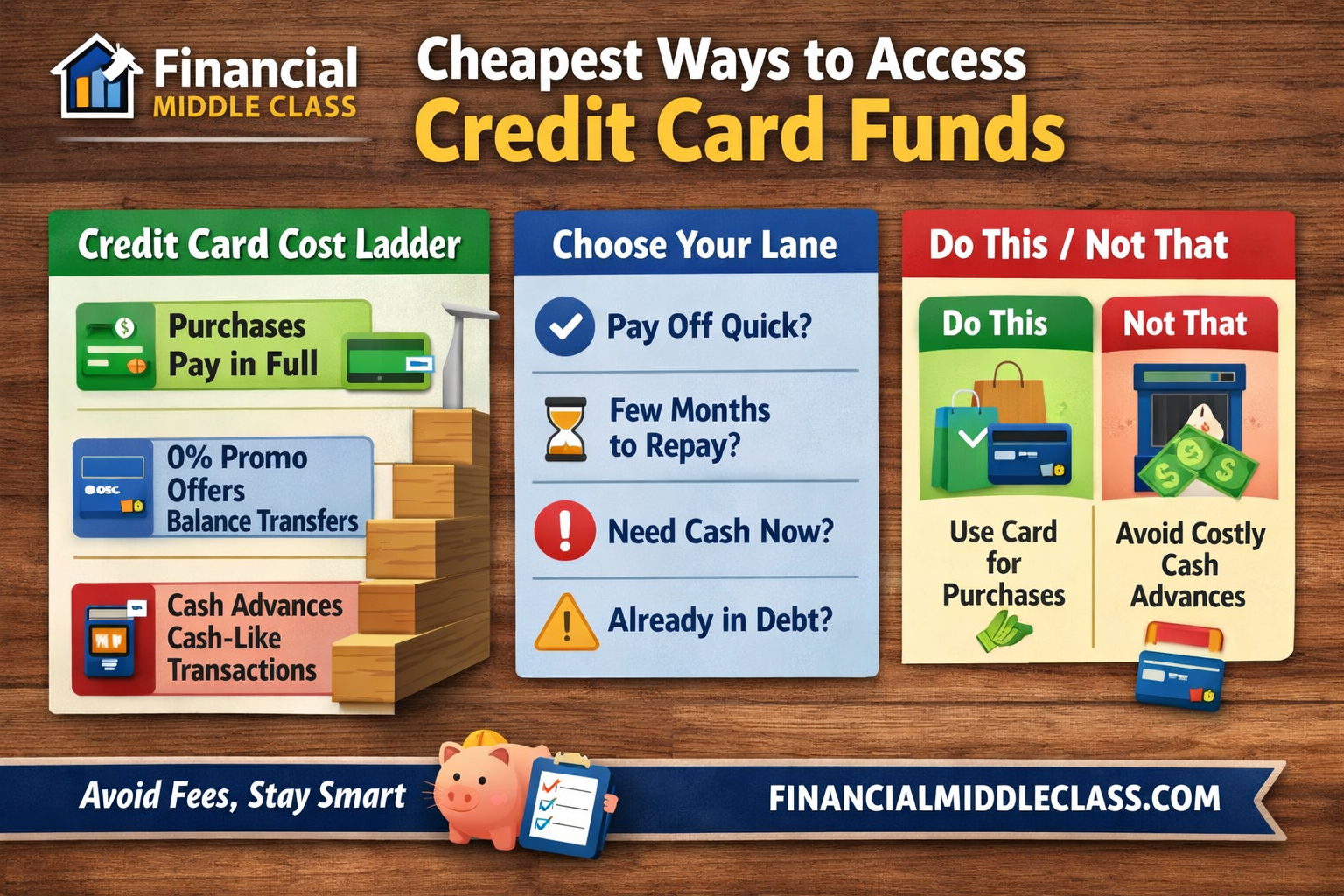
The Credit Card “Cost Ladder” (Cheapest → Most Expensive)
Same card. Different toll roads. The goal is to stay higher on the ladder.
Cheapest
Use the card for normal spending, keep cash for the bill that requires cash, then pay the statement balance.
Often low-cost
0% purchases, balance transfers, or issuer promos—good only with a payoff plan.
Usually costly
Fees + interest can start immediately. This is the “break glass” option.
If you only take one idea from this article, take this: “Accessing credit card funds” doesn’t have to mean cash. Most of the time, what you need is spending power and timing. Cash is just one way to solve that problem—and it’s often the most expensive way.
Now let’s make it personal and practical. Pick the lane that matches your situation.
Choose Your Lane (60 seconds)
Pick the situation that matches your reality. This isn’t moral. It’s pricing.
The cheapest way to “access credit card funds” is boring on purpose
Here’s the move that saves more middle-class households than any fancy trick: use your credit card for the purchases you were going to make anyway, and keep your cash in your checking account for the bill that requires cash or debit.
That’s not a loophole. That’s basic timing. If you normally spend on groceries, gas, utilities, and everyday life, putting those purchases on your card can protect your cash for the one expense that’s trying to choke you this month. Then you pay your statement like an adult—on time, ideally in full—so the card never turns into a long-term loan.
This is why the “grace period” matters. Many cards don’t charge interest on purchases if you pay the statement balance by the due date. Translation: the cheapest borrowing is often the borrowing you don’t pay interest on.
But let’s be real. This only works if you don’t use the card like it’s a raise. Too many of us swipe and then emotionally forget. If you’re going to use this method, your mindset has to be, “I’m shifting timing, not increasing lifestyle.”
Do This / Not That
Do thisUse your card for normal purchases and preserve cash for the bill that requires cash.
Translation: you’re shifting timing, not increasing spending.
Not thatDon’t treat the card like an ATM unless it’s truly last resort.
Cash advances often mean fees + interest can start immediately.
When you need months, not weeks: promos can be cheaper—if you respect the deadline
If you’re not paying this off quickly, you need a plan lane—not a vibes lane. That’s where promotional options can help. This includes things like 0% intro offers on purchases, issuer “pay over time” plans, and balance tools that reduce interest pressure so you can breathe.
The reason promos work is not because they’re magic. They work because they (sometimes) reduce the cost of borrowing long enough for you to actually pay down principal instead of feeding interest.
The trap is obvious: the promo period ends. And if you’ve been making “minimum payment” moves instead of “payoff schedule” moves, that balance becomes expensive overnight. Middle-class money stress isn’t just about low income. It’s about bad pricing stacked on bad timing.
So if you use a promo, set a payoff rule on day one. Not later. Not after the holidays. The day you swipe.
The “break glass” lane: cash advances and cash-like transactions
If you take nothing else from this section, take this: cash advances are usually priced like a penalty. You get convenience, but you pay for it with fees and fast-starting interest. That’s why it’s often the last resort option, not the “quick hack.”
And it’s not just ATMs. Some transactions behave like cash even when they don’t look like cash on the surface. The issue is how the transaction is coded by the merchant and how your issuer treats that category.
Red Flags You’re About to Overpay
- You’re about to use an ATM with your credit card.
- The app shows a “cash advance limit” and you’re tempted to use it like normal credit.
- You’re paying someone via P2P and selecting “credit card” as the funding source.
- The transaction is “cash-like” (money transfers, certain gift cards, gambling-related categories).
- You don’t know when interest starts—and you’re proceeding anyway.
If you see any of these, pause and confirm coding + fees first.
Notice how the problem isn’t just the action. It’s the lack of confirmation. The middle-class mistake isn’t using credit. It’s using expensive credit by accident.
Call/Chat Script: Confirm How It Will Be Coded
Before anything “cash-like,” confirm whether it’s treated as a purchase, balance transfer, or cash advance.
“Hi—before I complete this transaction, can you tell me how it will be categorized on my account:
purchase, balance transfer, or cash advance? And what fees apply, what APR applies, and when interest starts?”
Compare the paths without getting lost in the weeds
Most people don’t need a finance degree here. You need a simple way to compare the lanes: what’s cheap, what’s risky, and what’s usually a trap. This table is the “read it once and stop getting surprised” version.
Compare the Main Paths
| Path | Why it’s cheaper | Biggest risk | Best use-case |
|---|---|---|---|
| Purchases + pay in full | Often a grace period; can be $0 interest if paid by due date | Overspending because it “feels like free money” | Short bridge when you can repay fast |
| 0% promo / issuer plan | Lower-cost borrowing if you stick to a payoff plan | Promo ends or missed payment makes it expensive | Needed time to repay without chaos |
| Balance transfer | Can reduce interest on existing debt and free monthly cash flow | Fee up front; risk of running balances back up | When you’re serious about stopping the bleed |
| Cash advance | It usually isn’t—convenience priced at a premium | Fees + interest can start immediately | True last resort only |
Middle-class truth: this isn’t about “discipline,” it’s about pricing
Too many of us blame ourselves for needing a bridge. But the bigger story is that the system charges you more precisely when you have fewer options. That’s why this article isn’t about shaming anyone. It’s about choosing the cheapest lever available in your real life.
If you can repay quickly, keep it simple and cheap: purchases + pay in full. If you need time, use promo tools with a payoff plan. If you’re headed for a cash advance, pause, confirm, and treat it like emergency-only credit.
FAQ
FAQ: The Stuff People Get Burned By
Why are cash advances so expensive?
Because issuers price them like high-risk short-term loans: fees plus a higher APR, and interest can start immediately.
Is a “cash-like” purchase the same as a cash advance?
Sometimes. It depends on the issuer’s rules and the merchant category. If you aren’t sure, assume it could trigger cash-advance terms until confirmed.
Can a balance transfer help if I need cash?
It won’t hand you cash, but it can reduce interest on existing debt and free monthly cash flow if you stop adding new balances.
What’s the fastest “cheap” move if I’m tight this week?
Put normal purchases on the card, preserve cash for the bill that requires cash, then pay the statement balance as soon as you can.
What should I confirm before I do anything cash-like?
Category (purchase vs balance transfer vs cash advance), fee amount, APR, and when interest starts.
One-page action checklist (save this)
One-Page Action Checklist
- I know which lane I’m choosing (purchase, promo, balance tool, or last-resort).
- I confirmed how the transaction will be coded (purchase / transfer / cash advance).
- I confirmed the fee (if any), APR, and when interest starts.
- I set one payoff rule: no new discretionary spending until this balance is under control.
- I saved the call/chat script for next time so I don’t get surprised again.
Printing strips buttons automatically.
Final word
If you’re trying to “access credit card funds,” you’re really trying to buy time without paying a punishment fee. And you can do that—if you stay high on the cost ladder, confirm the coding before you do anything cash-like, and stop letting “available credit” trick you into lifestyle creep.
Disclosure: This article is educational and not individualized financial advice. Card terms vary by issuer—always confirm fees and how transactions are categorized.