
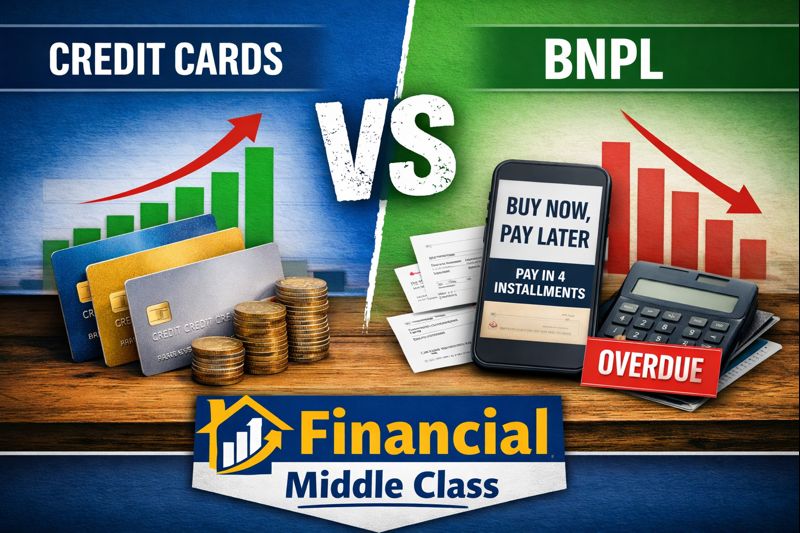
Credit Cards vs. BNPL: Which One Actually Works for the American Middle Class?
The estimated reading time for this post is 1153 seconds
Credit Cards vs. BNPL: Which One Actually Works for the American Middle Class?
A middle-class, no-fluff guide to choosing the tool that protects next month.

The real problem isn’t spending. It’s timing.
On paper, this is a simple question. In real life, it’s a Tuesday-night question. You’re at the kitchen table. Your mortgage is due. Your car insurance is on autopay. Your kid needs something for school that somehow costs $118. The fridge is doing that thing where it looks full until you realize it’s just condiments and hope.
And then you meet the modern checkout screen. It offers you two familiar doors. Door one is the credit card: swipe now, sort it out later. Door two is BNPL: “Pay in 4,” “as low as $29,” “no interest.” Just vibes.
The middle class doesn’t wake up craving debt. You wake up craving stability. But stability, in America, has a cover charge. Tires. Deposits. Medical copays. A laptop for school. A flight you didn’t plan because grief doesn’t schedule itself. The stuff you need tends to show up before the money is comfortable.
That’s why both credit cards and BNPL feel helpful. They’re timing tools. They move money through time. They let you say, “Not today, but soon.” The only question is what “soon” costs you.
Credit cards, stripped of marketing
A credit card is two products living in the same jacket. When you pay the statement balance in full, it’s basically a short grace period. You borrow for a moment, you settle up, you move on. If you’re disciplined and your cash flow is stable, that can be clean. You may even win a little with rewards.
When you don’t pay it off, the card turns into an expensive loan. And it’s not the kind of loan that comes with a clear ending. Revolving debt is the open tab that can stay open forever if you only pay the minimum. That’s the trap. Not because you’re careless. Because minimum payments are designed to keep you paying interest for a long time.
Credit cards also carry a quiet middle-class penalty system. Late fees. Penalty pricing. A credit-score hit at the exact moment you’re trying to refinance or buy something bigger. The product doesn’t just charge you for borrowing. It charges you for being slightly off-schedule.
BNPL, stripped of the “it’s just payments” vibe
BNPL is still credit. It’s just dressed like budgeting. It doesn’t feel like debt because it doesn’t look like a big number. It looks like a smaller number repeated. It looks like “I can handle $32 today.” It feels responsible because it feels structured, like there’s a plan and an end date.
And sometimes that structure genuinely helps. It can keep you from the open-ended mess of a revolving balance. But BNPL has its own middle-class danger: it pulls money from your future paychecks in a way that’s easy to underestimate. It turns next month into a pre-spent month. And because many BNPL plans draft from your debit card or bank account, the timing problem gets sharper. A credit card can sit there and glare at you. BNPL can reach into your checking account on a Tuesday morning while you’re trying to keep rent money intact.
BNPL is clean when it’s one plan. BNPL becomes chaos when it turns into a habit.
The 60-second decision framework you can use at checkout
You don’t need a seminar. You need a framework you can use when you’re tired, rushed, and trying not to spiral. Start here: if you can’t name the exact paycheck that will pay this off, you’re not choosing between payment methods. You’re choosing which kind of stress you want later.
Next, be honest about your biggest risk. If your risk is carrying a balance because your month is tight, credit cards get expensive fast. If your risk is missing a payment because your checking timing is tight, BNPL autopay can be a landmine. Then ask one more question: do you need protection? If this purchase is something that might get disputed, returned, delayed, or delivered wrong, you want the tool that gives you the cleanest path to fixing it.
| Question that matters | Credit card | BNPL |
|---|---|---|
| What it’s best at | Flexibility and protection when you can pay in full. | Structure and short payoff windows when you can stay on schedule. |
| What hurts you most | Carrying balances and paying interest for “normal life.” | Stacking plans and letting drafts collide with rent week. |
| Late-payment pain | Fees, possible penalty pricing, and credit damage when you’re tight. | Fees, possible restrictions, and bank-fee risk if checking is short. |
| Best use case | You can pay the statement balance in full; you need dispute leverage. | One purchase, short term, clear payoff plan, cash flow is predictable. |
The scoreboard: best-case, worst-case, and the real-case
In the best-case scenario, both tools can cost you nothing in interest. Pay your credit card statement balance in full and you avoid interest. Use a no-interest BNPL plan and pay on time and you also avoid interest. The difference is what happens when life is normal and messy and you don’t execute perfectly.
With credit cards, the danger is the long tail. A “one-time thing” becomes a monthly drain. With BNPL, the danger is friction. Multiple payment dates. Autopay drafts. Fees triggered by being off by one day. A budget that feels fine until you realize you promised the same paycheck to five different plans.
| Category | Credit card | BNPL |
|---|---|---|
| Best-case cost | $0 interest if paid in full. | Often $0 interest if paid on time. |
| Real middle-class risk | Balance sticks and quietly gets expensive. | Plans stack and become invisible monthly obligations. |
| Cash-flow impact | Flexible timing, but temptation to revolve. | Rigid schedule; drafts can collide with bills. |
| Protection & disputes | Established dispute/chargeback ecosystem. | Varies by provider and timing; returns can be messier. |
BNPL isn’t one product: pay-in-4 vs longer plans vs store-linked “special financing”
A lot of people talk about BNPL like it’s always pay-in-4. That’s the entry point, not the full picture. There’s pay-in-4, which is short and simple. There are longer installment plans that start behaving like traditional loans. And there’s store-linked “special financing,” which can come with terms that punish you for missing one rule.
If you’re going to use BNPL, you need to know which version you’re signing up for, because “BNPL” is now a family of products. Treating all of it like the same harmless thing is how people get surprised.
| BNPL type | What it feels like | What it really is | Where it can bite |
|---|---|---|---|
| Pay-in-4 | “I’m splitting the cost.” | Short-term credit. | Stacking plans, payment collisions, late fees. |
| Longer installments | “I can manage monthly.” | Installment loan behavior. | Longer exposure, possible interest/fees, harder refunds. |
| Store-linked financing | “This is a deal.” | Promotional credit product. | Deferred-interest traps, strict terms, rigid penalties. |
Stacking: how “easy payments” become a new monthly bill
BNPL stacking doesn’t feel like a choice. It feels like a series of reasonable decisions. That’s why it’s dangerous. You do pay-in-4 for shoes because the old ones are cooked. Then again for a laptop because school is school. Then for holiday gifts because you refuse to be the parent who looks broke on Christmas. Then for a flight because family is family.
Then you look up and you’ve built a new monthly bill without ever calling it that. Not because you’re irresponsible. Because the product is designed to make each yes feel small.
| Example month | BNPL stacking (multiple plans) | One payoff lane (single card plan) |
|---|---|---|
| What you’re managing | Multiple drafts on multiple dates from multiple checkouts. | One statement, one due date, one place to see the total. |
| How it feels | “Small payments” until they collide with rent week. | Clear total that’s easier to plan around. |
| Failure point | Miss one draft and you trigger fees or bank problems. | Carry the balance and you trigger interest. |
Late is where the middle class gets punished
Late payments aren’t usually a moral failure. They’re a calendar failure. You didn’t forget. You were short. You were early on one bill and late on another. You were waiting for payday. You were juggling. Late fees and penalty systems are designed for one thing: extracting money from people who are already stretched.
The most painful late-payment cascade isn’t even the fee itself. It’s the chain reaction. Draft hits checking. Bank hits you. Provider hits you. Now you’re paying for nothing. You’re paying because timing didn’t work, not because the product added value.
| What “late” means | Credit card | BNPL |
|---|---|---|
| Immediate consequence | Late fee and possible credit damage. | Late fee, possible account restrictions, and bank-fee risk if checking is short. |
| Where the pain lands | Fees plus the long tail if you keep revolving. | Fees plus cash-flow shock when drafts collide with essentials. |
| Middle-class danger | One late month can ripple into higher costs later. | One draft collision can trigger multiple fees fast. |
Refunds, returns, and disputes: the hidden headache
Returns are where payment systems reveal their quality. When you buy on a credit card, disputes and chargebacks are part of the ecosystem. It’s not always fun, but it’s a known process. There’s a paper trail. There’s leverage. With BNPL, refunds can be messier because your purchase is sliced into scheduled payments. The merchant timeline and the payment timeline don’t always line up.
If you’re going to use BNPL, don’t pretend “payments” means “no complications.” Screenshot the plan. Know the return window. And for high-risk purchases, use the tool that gives you the cleanest path to fixing problems.
| Scenario | Credit card | BNPL |
|---|---|---|
| Item arrives damaged | Dispute process is established and centralized. | Resolution can depend on provider-merchant coordination and timing. |
| Return approved | Refund typically credits the card account. | Refund may arrive after some payments have already drafted. |
| Best use case | High-risk purchases, travel, electronics, online marketplaces. | Low-risk buys with clear return policies and short payoff windows. |
Credit score reality: the middle-class price tag
Credit scores aren’t trophies for the middle class. They’re interest rates. They’re approvals. They’re rent applications. They’re the difference between a manageable car payment and a punishing one. Credit cards clearly impact credit because they’re built into the system. They can help if you pay on time and keep balances reasonable. They can hurt if you carry high balances or miss payments.
BNPL credit reporting has historically been inconsistent across providers and products, but it’s evolving. The practical point isn’t to debate whether BNPL counts. The practical point is to assume more of it will count over time, and behave accordingly when you’re chasing a mortgage move or a refinance.
| Behavior | Credit card | BNPL |
|---|---|---|
| Pay on time, pay in full | A clean, low-cost tool. | A clean, low-cost plan if schedule stays intact. |
| Carry balance month to month | Interest becomes a monthly tax. | Depends on product; longer plans may behave like loans. |
| Miss a payment | Fees and potential credit damage. | Fees and potential escalation depending on provider terms. |
Mortgage lens: what underwriters actually see
If you’re planning to buy a home or refinance, lenders don’t underwrite your intentions. They underwrite your monthly obligations and your margin. Revolving balances can make you look squeezed. Stacked installment obligations can do the same. Even if each BNPL payment is “small,” a lender sees the total picture and asks one question: do you have slack?
If you’re within six to twelve months of a mortgage move, the smartest play is to simplify your story. Fewer obligations. Cleaner cash flow. Less noise. The middle class doesn’t get denied for being irresponsible. The middle class gets denied for looking tight.
Why the BNPL button follows you everywhere (and why points do too)
BNPL isn’t at checkout because retailers want to help you budget. It’s there because it increases conversion and basket size. It turns “I should wait” into “I can do $28 today.” Credit card rewards do something similar. Points and cash back make spending feel like earning.
This is engineered. The solution isn’t shame. The solution is guardrails that protect your next month from your worst 90 seconds at checkout.
If you’re already in it: the cleanup plan that doesn’t insult you
If you’re juggling credit card balances and BNPL plans right now, the goal isn’t perfection. The goal is stopping the leaks. The first move is to stop stacking, not forever, just until you can see your month again. Then you list every obligation and every due date, because what’s invisible can’t be managed.
If autopay is colliding with rent money, protect rent first. Shift to reminders or manual payments until you’re stable. Then prioritize the debts most likely to trigger fees, not just the biggest balance. Fees are a tax on being slightly off. You want that tax gone. Finally, pick one payoff lane. Either the card becomes a tool again because you can pay in full, or you focus on shrinking the balance that’s bleeding you every month.
Alternatives that often beat both tools
Sometimes the best answer isn’t credit cards or BNPL. Sometimes you need time without turning your future paychecks into a battlefield. That’s where a few under-hyped options can beat both tools, depending on your situation.
| Option | When it’s better | What to watch |
|---|---|---|
| 0% intro APR promo | You can pay it off before the promo ends. | One missed rule can get expensive fast. |
| Provider payment plan | Medical bills, utilities, services with negotiable terms. | You have to ask; most people never do. |
| Credit union small loan | You need structure with saner terms. | Fixed payments still require margin. |
| Sinking fund | Predictable expenses like tires, holidays, school costs. | Slow at first, powerful over time. |
FMC guardrails: rules you can live by
If you can’t name the paycheck, you can’t finance it. If your rent week is sacred, don’t let autopay touch it. One plan at a time beats five “small” plans. Points aren’t worth interest. And when life feels unstable, your job is to buy slack, not stuff.
These aren’t rules for perfect people. These are rules for real people who are tired of getting surprised by their own calendar.
Timeline: how this decision usually unfolds
Moment 1You need something “normal” and it shows up early
Moment 2The checkout screen offers pain relief
Moment 3The month gets crowded
Moment 4Late fees don’t teach; they extract
Moment 5You either regain control or you start juggling
FAQ
Is BNPL better than a credit card for emergencies?
Does BNPL build credit?
What’s the biggest credit-card mistake for middle-class households?
What’s the biggest BNPL mistake?
Which is safer for online purchases and disputes?
The truth that hits home
Credit cards and BNPL aren’t good or evil. They’re tools built for a country where the timing of life doesn’t match the timing of money. But here’s the line that matters most if you’re middle class: debt usually doesn’t ruin you when you buy something stupid. It ruins you when you buy something normal—tires, school, a necessary repair—and the system still charges you stress for the crime of being human.