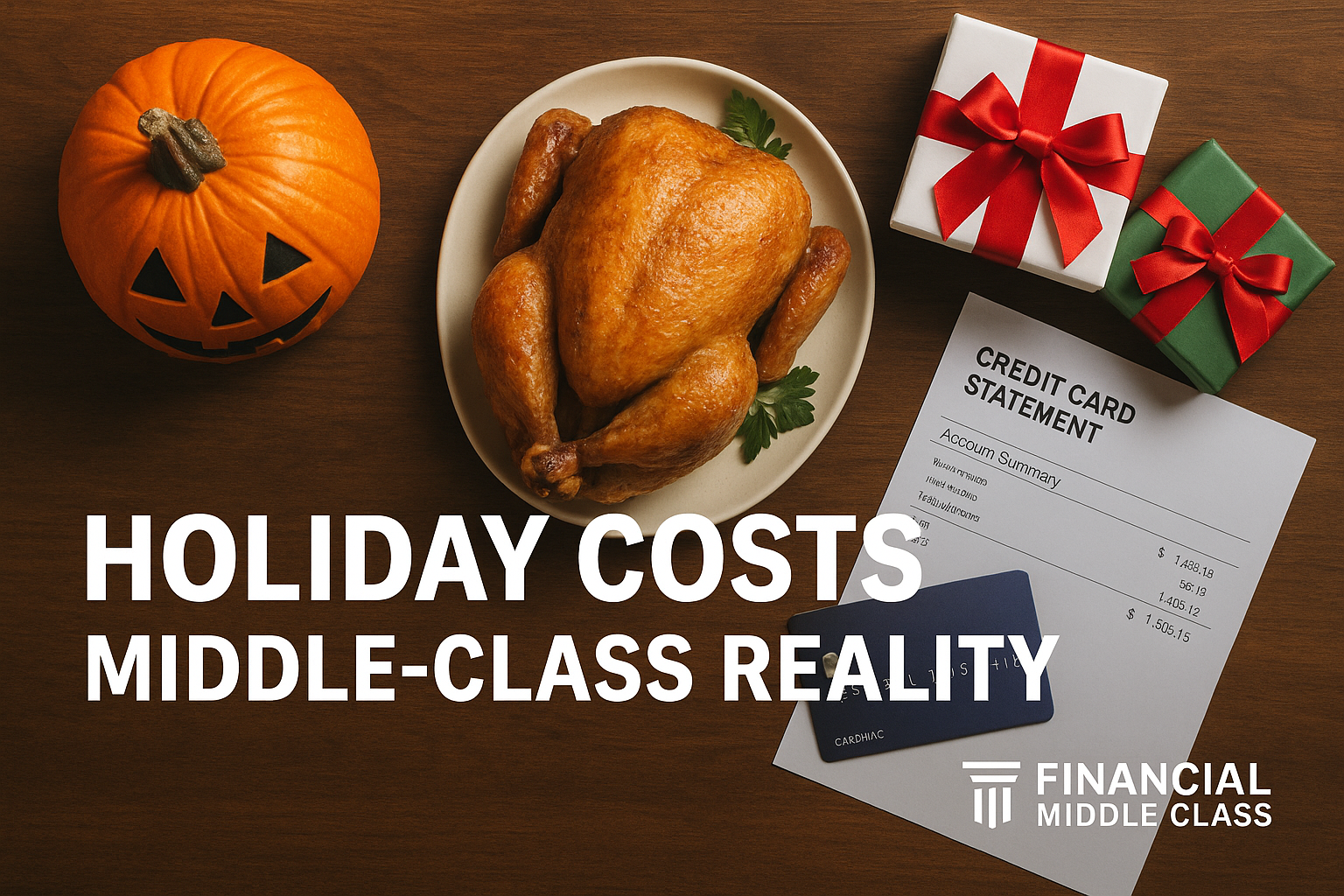
You already know the punchline: they cost more than we planned—financially and emotionally. Between Halloween, Thanksgiving, Christmas, and everything in between, too many middle-class families overspend, carry a balance, and walk into January tired and in debt. Let’s put real numbers on it, call out what’s driving the creep, then set up a plan that actually protects your paycheck.
The Real Bill (Before the Credit Card Interest)
- Core holiday season: Americans say they’ll spend about $890 per person on gifts, food, décor, and other seasonal buys this year—the second-highest on record. If you’re a two-adult household, that’s already ~$1,800 before travel or surprises.
- Halloween alone: 2025 Halloween spending is expected to hit a record $13.1B, with $114.45 per person on costumes, candy, and decorations. That’s the appetizer.
- Thanksgiving: The “classic dinner for 10” ran $58.08 in 2024—lower than 2023, but still ~19% higher than 2019. Food inflation cooled, not vanished.
Now add travel, shipping, work parties, teacher gifts, charitable drives, Secret Santa, winter clothes for the kids, streaming “holiday bundles,” and the random LED reindeer that “was on sale.” That $890 number doesn’t include interest.
Why January Hurts: The Financing Cost
- Credit cards are punishing right now. Average APRs hover around ~24%. If you revolve even a modest balance from holiday spending, the interest quietly turns a $1,000 December into a $1,200+ spring.
- BNPL looks gentle, but stacks fast. Holiday shoppers used $18.2B of Buy Now, Pay Later in 2024; this season, younger adults are leading BNPL use. Missed-payment fees and juggling multiple plans are why many users fall behind.
- Household strain is real. By Q2-2025, 4.4% of debt was delinquent and balances kept rising. The holidays don’t create that trend—but they do accelerate it.
The Middle-Class Trap (Cultural, Not Just Math)
Middle-class families don’t overspend because we’re reckless. We overspend because we’re aspirational and obligated—two powerful forces.
- Aspirational: We want our kids to feel included. We want the house to look “festive” for the neighborhood. We want to host like we were hosted as kids.
- Obligated: Office parties, friend swaps, extended family expectations. “Just a little something.” It adds up because it never shows up on one receipt.
That’s the trap: we measure love in price tags and prove stability with purchases. It’s a cultural script that punishes the exact group trying hardest to look like they have it together.
A Better Playbook (Punchy, Boring, Effective)
1) The Three-Number Holiday Budget
Number A: Gifting.
Number B: Food/hosting.
Number C: Travel/misc.
Write the cap for each on one index card and keep it in your wallet/phone case. You’re done when any one bucket taps out. (Yes, done.)
Use the NRF benchmark to sanity-check: If your total crosses $890 per adult, you’re not “being generous”—you’re financing a performance.
2) The “Cash-First Ladder”
- Debit/cash for décor, food, and small gifts.
- 0% promo only if the payoff fits inside the promo window with auto-pay set.
- Credit only for buyer protections—and auto-pay the full statement.
If you carry a balance at ~24%, you’re giving the bank your January raise.
3) The One-Gift Rule (Families & Friend Groups)
Agree—out loud—on one thoughtful gift per adult or pull names. Set a hard cap (e.g., $40). The point is presence, not presents. Kids still get their magic; adults get relief.
4) Scripts That Save You $300+
- “We’re capping gifts this year, but I’d love to do breakfast and a walk together.”
- “Let’s do a book swap—$20 limit.”
- “We’re hosting potluck style; I’ve got mains, can you do sides?”
People appreciate clarity. You just said the thing everyone else wanted to say.
5) The 10-Day Rule for Non-Essentials
If it’s not edible or a plane ticket, wait 10 days. Half the impulse buys evaporate on their own.
6) The January Off-Ramp (Set It Now)
- Auto-transfer $100/week in January–February to wipe any balance.
- If BNPL is in play, list every plan, date, and amount in one note—set alarms two days before each due date.
- Return what didn’t get used (duplicate toys, unopened décor, the third sweater “just in case”).
What If You’re Already Over Budget?
- Stop the clock. Freeze non-essentials today.
- List balances, APRs, and minimums. Highest APR gets the extra dollars (debt avalanche).
- Call your credit union about a temporary 0% balance transfer or low-rate holiday loan if it reduces interest and shortens payoff time (no new spending).
- Pick one tradition to downgrade—not cancel. Keep the meaning, shrink the cost.
- Plan next year now: auto-save $40/week Feb–Oct → ~$1,400 holiday fund.
The Quiet Costs You Forget (So Don’t)
- Shipping & rush fees (solve with earlier cutoffs).
- Tipping season (budget in advance; generosity is better when it’s planned).
- Work-related gifting (cards + notes beat gadgets).
- Batteries, wrapping, tape (buy once, reuse containers next year).
- Returns (track windows; many close pre-New Year).
Related Reads:
Black Friday & Cyber Monday: Deal or Theater?
Food Inflation vs. Holiday Menus: Feast Without the Financial Hangover
The Middle-Class Holiday Travel Playbook (Thanksgiving & December)
A Truth to Take With You
Holidays are supposed to be a celebration, not a credit strategy. The middle class keeps getting told to “make it special” by spending like the top 10%—then pays double through interest for the privilege. Special isn’t expensive. Special is intentional. Set your three numbers, buy like you mean it, and give what matters most: time, attention, and calm. The tree looks better when the balance sheet isn’t blinking red.