
January Is Financial Wellness Month — and Your Boss Cares More Than You Think
By Article Posted by Staff Contributor
The estimated reading time for this post is 599 seconds
January Is Financial Wellness Month — and Your Boss Cares More Than You Think
Skip menu + Table of Contents
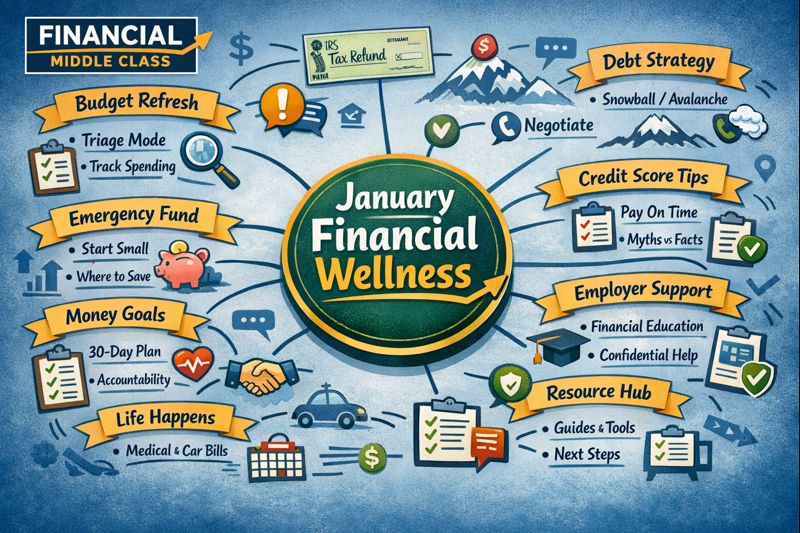
The January reset in plain English
-
Budget: one lever for 30 days + automate a win.
-
Emergency fund: start with a panic buffer ($500–$1,000), then climb.
-
Debt: pick a lane (snowball/avalanche) and commit 90 days.
-
Accountability: 15 minutes weekly. Same day, same time. Scoreboard it.
-
Employers: reduce friction, increase options, avoid performative “wellness.”
Rule: This month you’re building stability—not a fantasy version of yourself.
What “financial wellness” actually means (and what it’s not)
Financial wellness isn’t “I’m rich.” It’s I’m steady. It’s being able to meet obligations, absorb shocks, and feel some control over the next few months without your chest tightening every time your phone buzzes.
That definition matters because it shifts the goal from status to stability. A lot of people make decent money and still feel one surprise away from chaos. That’s not a character flaw. That’s what happens when housing, insurance, groceries, and debt all want a bigger bite than they used to.
The January money trap: refund dreams, credit card reality
January is when people make two common mistakes.
First: treating the tax refund like a miracle. A refund can help, but it’s not a plan. If you don’t decide where it’s going before it arrives, it’ll disappear into “catching up” and “I deserve it,” and you’ll be back in the same movie next January.
Second: trying to fix everything at once. People go full January—cancel everything, cook every meal, pay down every debt, save $10,000, become a minimalist monk by Tuesday. Then life happens. And the plan dies.
The goal of January is not perfection. It’s momentum.
Your paycheck isn’t your salary: the net pay reality check
Most “budget fails” aren’t budgeting failures. They’re math failures. You cannot run your household on gross pay. You live on net pay—after taxes, benefits, retirement deductions, and insurance.
Pay timing matters too. Biweekly pay gives you two “extra” paychecks in a year. Semi-monthly does not. If you budget like those are the same, you’ll feel broke in months where bills stack up before payday.
So the first January move is simple: look at your last pay stub and write down what actually hits your account. That’s your number. That’s the truth.
The January Financial Reset: 4 moves that actually work
1) Budget refresh — triage mode (not Pinterest mode)
A budget refresh isn’t a personality transplant. It’s you getting your bearings.
Start with the Four Walls: housing, utilities, groceries, transportation, minimum debt payments. That’s not ideology; that’s survival.
Then find your leak category. Not because you’re irresponsible—because stress has patterns. For many people it’s delivery. For others it’s “quick trips” that turn into $93.
Pick one lever for 30 days. One. Not ten. January success comes from doing fewer things consistently.
Budgeting when you’re behind: triage first
If you’re behind on a bill, you don’t need a cute spreadsheet. You need a triage plan. Call the biller early and ask about payment plans, hardship options, moving the due date, temporary reductions, and fee waivers. The earlier you call, the more options you usually have.
Triage budgeting is stabilizing the roof over your head, keeping the lights on, keeping transportation working, keeping food in the house, and keeping minimum payments flowing so the damage doesn’t spread. Optimization comes later. Triage is the bridge to later.
2) Emergency fund — start small so you actually start
People hear “3–6 months of expenses” and freeze. So they do nothing. And emergencies become debt. Start with a panic buffer on purpose.
| Level | Target | What it protects you from |
|---|---|---|
| 1 | $500 | Small surprises turning into credit card swipes |
| 2 | $1,000 | Tires, urgent care, “why is the power bill shaped like that” |
| 3 | 1 month essentials | One bad month from becoming a crisis |
| 4 | 3 months essentials | Layoffs, income dips, real breathing room |
Emergency money has one job: be there when life swings. That means boring and accessible. A separate savings (or high-yield savings) you don’t touch. Not crypto. Not single stocks. Not your checking account where “I’ll leave it alone” goes to die.
And yes—start with $10–$25 per paycheck. Automatic. Small. Consistent. That’s how resilience gets built.
3) Debt game plan — pick a lane, then add the lane no one talks about
Debt isn’t just a number. It’s pressure. High interest is pressure with teeth. So you need a lane.
| Lane | Best if… | Your rule |
|---|---|---|
| Avalanche | You want the lowest total interest | Extra payments go to highest APR first |
| Snowball | You need quick wins | Extra payments go to smallest balance first |
| Refi / Transfer | Your credit qualifies and you won’t re-run balances | Lower APR, then attack principal |
| Negotiate | You’ve paid on time and can ask | Call issuer: request APR reduction / fee waivers |
Phone script: “Lower my APR”
“Hi, I’m working on paying down my balance and want to keep this account in good standing.
Can you lower my APR or offer a temporary hardship APR? Also, can you waive any fees today?”
90-day rule: pick one lane and commit. Constant switching is how debt survives.
Credit score in plain English: what actually moves the needle
A credit score isn’t a personality test. It’s a behavior report. If you want the biggest improvements without becoming a full-time finance nerd, do the basics well: pay on time, keep utilization from staying high, avoid closing old accounts just because they’re paid off (especially if there’s no fee), and act fast if you miss a payment.
If you’re trying to refinance or transfer balances, the score matters—but it’s not the only lever. Your overall debt-to-income and lender appetite matter too. Don’t treat the score like magic.
4) Goals + accountability — the system that survives February
Most goals die because they’re vibes. January gives you energy. February gives you reality. So your system has to run on something stronger than motivation.
30-Day “Proof of Work” Plan
This is the plan that survives February.
Week 1 — Visibility
Track spending loosely (no shame). Find your leak category. Write your real net-pay number. You’re not fixing everything yet—you’re turning the lights on.
Week 2 — Automation
Set one automatic transfer to savings (even $10–$25 per paycheck) and one automatic extra debt payment. Small + consistent is how change starts.
Week 3 — One concrete win
Catch up one bill or push one balance down in a way you can measure. If you’re behind, call early and ask about payment plans, hardship options, or fee waivers.
Week 4 — Tighten one screw
Pick one additional lever (cut one expense, add one hour of overtime, sell one unused item, renegotiate one bill). Then schedule next month’s check-ins so you don’t disappear.
Accountability hack: 15 minutes a week, same day, same time. Scoreboard it.
The “life happens” section: medical bills, car repairs, family emergencies
This is where budgets go to get embarrassed. You can have the cleanest plan in the world and one urgent care visit can still kick the door in.
Build small sinking funds—car maintenance, medical, kids/school, family obligations. It doesn’t have to be complicated. It has to exist.
If a bill shows up that you can’t handle, ask for an itemized bill, ask for payment plans, ask about financial assistance policies. Those options are real—but you only get them if you ask early.
Employer Playbook 2.0 — what works vs. what’s performative
If you’re an employer reading this: people don’t need another inspirational webinar. They need reduced friction and real options.
Effective looks like: plain-language benefits communication, confidential coaching access, support for emergency savings (not only retirement), debt help resources that don’t shame people, and manager training so “wellness” doesn’t turn into passive-aggressive advice.
Performative looks like: one email about “mindfulness and budgeting,” a single lunch-and-learn with no follow-through, and “use the EAP” without making it easy or trusted.
One hard truth: if compensation isn’t matching costs, financial wellness content can feel like gaslighting. Education helps. Economics still matters.
How employers measure success without being creepy
You can measure progress without spying on people. Use participation rates, retention trends, anonymous pulse surveys, and aggregated utilization. Don’t turn financial wellness into surveillance. People won’t engage if it feels like a trap.
Resource hub: the only next steps you actually need
- CFPB: consumer tools & guidance
- Federal Reserve SHED: household financial well-being
- CFPB: consumer credit card market report
- PwC: employee financial wellness survey
Your January reset in one breath
You don’t need a brand-new life. You need a tighter system.
Budget: one lever for 30 days + automate a win.
Emergency fund: $500 → $1,000 → one month essentials.
Debt: pick a lane + consider negotiation.
Accountability: 15 minutes weekly + a scoreboard.
FAQ
What if I can’t save anything right now?
Start with $5–$10 per paycheck. Build the habit first, then the balance. Next, pick one lever to free up cash (one subscription, one delivery day, one “random run”).
Should I build savings or pay debt first?
Do both: keep minimums flowing, build a small panic buffer ($500–$1,000), then attack high-interest debt so the interest stops eating your progress.
Snowball vs avalanche—what’s better?
Avalanche saves the most interest. Snowball creates faster wins. The best method is the one you’ll follow for 90 days without switching.
How do I budget when I’m behind on bills?
You’re in triage mode. Stabilize the Four Walls first and call early to ask for payment plans, hardship options, due-date moves, or fee waivers.
Where should an emergency fund live?
Somewhere boring and accessible (a separate savings or high-yield savings). Emergency money has one job: be there when life swings.
Employers: what’s the easiest way to help without being corny?
Make benefits legible, offer confidential coaching access, support emergency savings, and train managers to avoid “budget harder” messaging.
Your turn
Real talk: where are you starting this January?
Which pillar needs the most attention right now—budget, emergency fund, debt, or accountability? Drop one sentence in the comments. No shame. Just honesty.
The bottom line
Financial wellness isn’t about becoming perfect. It’s about stopping the bleeding, building protection around your life, and getting your options back.
January is just the calendar’s way of saying what life eventually says anyway: you can keep winging it—or you can build a system that holds when the month gets ugly.


RELATED ARTICLES
How Wealth Is Passed Across Generations in the United States: Mechanisms, Evidence, and the Policy Debate
How wealth passes between generations—trusts, taxes, and the debate. Get the facts, figures, and tradeoffs. Read now.
The S&P 7,000: How Wall Street Disconnects from Main Street
S&P 7,000 can rise while wages, benefits, and towns fall behind. See why the market isn’t the economy—read now.
Leave Comment
Cancel reply
Gig Economy
American Middle Class / Feb 18, 2026
How Wealth Is Passed Across Generations in the United States: Mechanisms, Evidence, and the Policy Debate
How wealth passes between generations—trusts, taxes, and the debate. Get the facts, figures, and tradeoffs. Read now.
By FMC Editorial Team
American Middle Class / Feb 16, 2026
The S&P 7,000: How Wall Street Disconnects from Main Street
S&P 7,000 can rise while wages, benefits, and towns fall behind. See why the market isn’t the economy—read now.
By MacKenzy Pierre
American Middle Class / Feb 16, 2026
The “Resilient Consumer” Is Real—But So Is the Interest Bill
Credit card balances are rising as savings fall. See what it means—and the 30/60/90 plan to escape 25% APR debt.
By Article Posted by Staff Contributor
American Middle Class / Feb 09, 2026
What To Do If You Get Fired With an Outstanding 401(k) Loan
Fired with a 401(k) loan? Avoid taxes, offsets, and deadline traps with this step-by-step checklist. Read now.
By Article Posted by Staff Contributor
American Middle Class / Feb 09, 2026
The Real Math of Money in Relationships
Split finances without resentment. Any couple, any income ratio. Use the worksheet + rules—start today.
By Article Posted by Staff Contributor
American Middle Class / Feb 03, 2026
Investing or Paying Off the House?
Invest or pay off your mortgage? See a $500k example with today’s rates, dividends, and peace-of-mind math—then choose your plan.
By Article Posted by Staff Contributor
American Middle Class / Jan 30, 2026
Gold, Silver, or Bitcoin? Start With the Job—Not the Hype
Gold, silver or Bitcoin? Learn what each is for—and how to size it—before you buy. Read the framework.
By Article Posted by Staff Contributor
American Middle Class / Jan 29, 2026
Florida Homeowners Pay the Most in HOA Fees
Florida HOA fees are surging. See what lawmakers changed, what’s next, and how to protect your budget—read before you buy.
By Article Posted by Staff Contributor
American Middle Class / Jan 29, 2026
Why So Many Homebuyers Are Backing Out of Deals in 2026
Why buyers are backing out of home deals in 2026—and how to avoid costly surprises. Read the playbook before you buy.
By Article Posted by Staff Contributor
American Middle Class / Jan 28, 2026
How Money Habits Form—and Why “Self-Control” Is the Wrong Villain
Learn how money habits form—and how to rewire spending and saving using behavioral science. Read the framework and start today.
By FMC Editorial Team
Latest Reviews
American Middle Class / Feb 18, 2026
How Wealth Is Passed Across Generations in the United States: Mechanisms, Evidence, and the Policy Debate
How wealth passes between generations—trusts, taxes, and the debate. Get the facts, figures, and tradeoffs....
American Middle Class / Feb 16, 2026
The S&P 7,000: How Wall Street Disconnects from Main Street
S&P 7,000 can rise while wages, benefits, and towns fall behind. See why the market...
American Middle Class / Feb 16, 2026
The “Resilient Consumer” Is Real—But So Is the Interest Bill
Credit card balances are rising as savings fall. See what it means—and the 30/60/90 plan...