
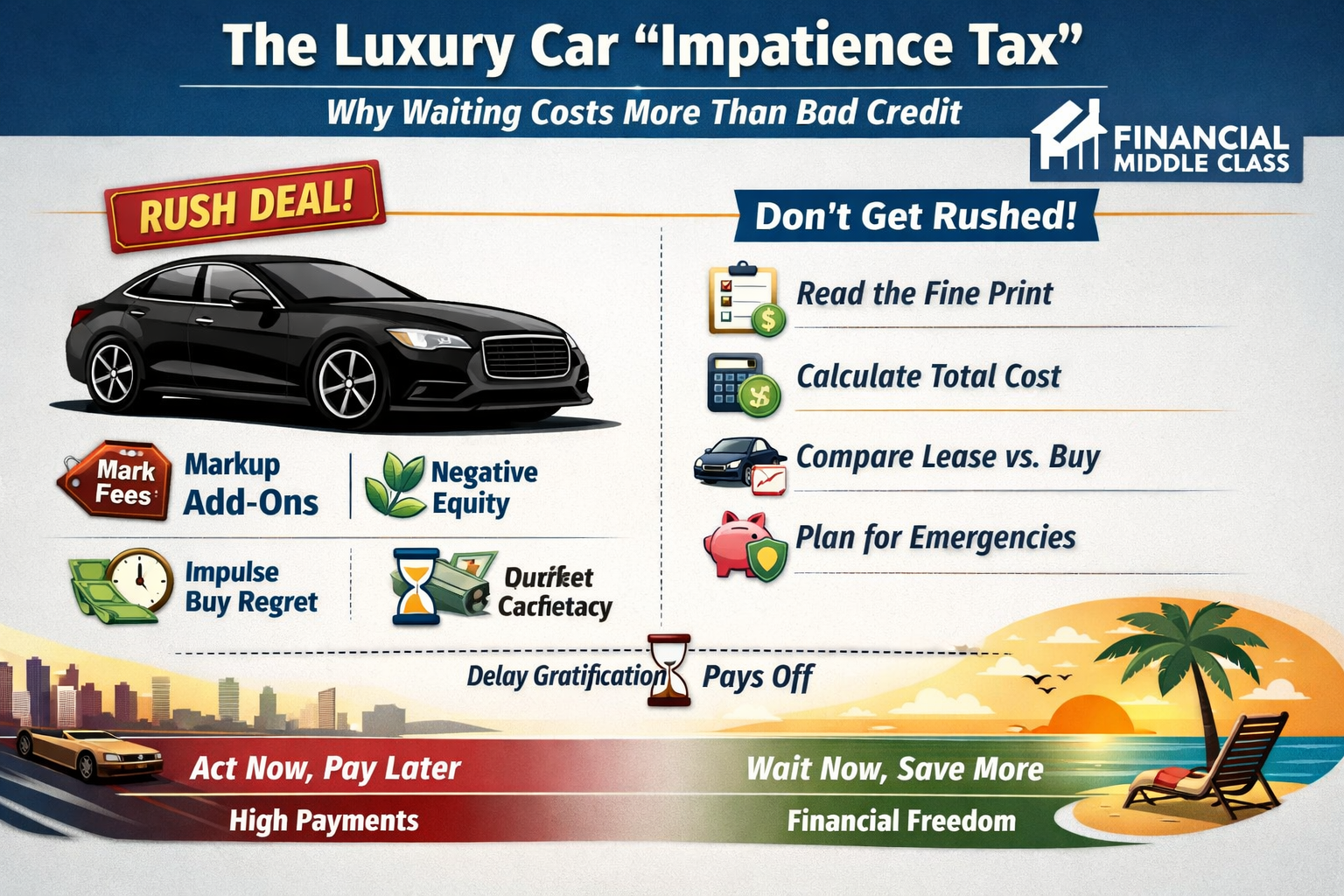
Luxury Cars Punish Impatience More Than Bad Credit
By Article Posted by Staff Contributor
The estimated reading time for this post is 416 seconds
Why waiting a week can save you more than raising your credit score
On a Saturday afternoon, the luxury showroom is designed to make you feel like the decision is already made. The lighting is soft. The paint is perfect. The salesperson talks in monthly payments, not totals. You’re told the car “won’t last,” and the deal is “today only.” Even if your credit is strong, the whole experience nudges you toward one thing: sign now, think later.
That’s where the real penalty lives.
In September 2025, the average American new-car buyer paid $50,080, a record and the first time the figure topped $50,000. In the same pricing tables, “entry-level luxury” averaged $56,374.
When the starting point is already that high, the cost of rushing doesn’t show up as a small mistake. It shows up as a second bill—one you can’t refinance away.
Bad credit can be expensive. But impatience—especially in luxury—can be financially permanent.
The difference people miss: a rate problem vs a process problem
“Bad credit” mostly punishes you through the interest rate. Experian reports that in Q3 2025, the average APR was 6.56% for new-car loans and 11.40% for used, with deep subprime borrowers averaging 15.85% (new) and 21.60% (used). Those spreads are real money, and you should take them seriously.
But impatience isn’t one fee. It’s a chain reaction:
- paying a markup because you don’t want to keep shopping,
- accepting add-ons you didn’t request,
- rolling negative equity into the next loan,
- locking yourself into a car whose insurance and ownership costs you didn’t price out,
- and absorbing luxury-grade depreciation the moment you drive off.
That’s why this is not a morality tale about “discipline.” It’s consumer math. Delay gratification is a financial tool.
Why luxury cars amplify every rushed decision
Think of luxury as a magnifier. The same mistake costs more because the base price is higher, and the ongoing costs tend to be higher.
AAA’s 2025 analysis puts the average annual cost to own and operate a new vehicle at $11,577, and it identifies depreciation as the largest single cost, averaging $4,334 per year. In other words: even if gas prices drop, depreciation keeps billing you.
Luxury models can compound that problem. iSeeCars’ depreciation research notes that luxury models commonly lose the most value after five years, highlighting groups where multiple luxury SUVs experienced more than 60% depreciation. That doesn’t mean “never buy luxury.” It means luxury doesn’t forgive impulse buying because the exit is expensive.
Insurance is another quiet multiplier. Bankrate’s 2025 analysis puts the national average full-coverage premium at $2,638 per year, up from 2024. If you buy first and quote insurance later, you’re gambling with a recurring bill that can outlive the excitement of the purchase. The 2025 warning sign: negative equity is rising
If there’s one metric that explains why so many households feel stuck with car payments, it’s negative equity—owing more than the car is worth when you trade it in.
Edmunds reported that in Q3 2025, 28.1% of trade-ins toward new-car purchases had negative equity, and the average upside-down amount hit $6,905, an all-time high.
In a separate Q3 2025 release, Edmunds also reported the average new-car down payment fell to $6,020, the lowest level since Q4 2021.
This is the debt loop in plain English: you buy expensive, put less down, depreciate fast, then trade in early and carry the difference forward. Luxury vehicles can accelerate the loop because the dollars involved are bigger.
What “impatience” looks like in a real luxury deal
Impatience is rarely one reckless moment. It’s usually a handful of “small” concessions that become large money.
Markups and “market adjustments”
When you overpay, the market doesn’t reimburse you later for being tired. That extra price becomes part of the amount you finance and the value you immediately start depreciating against.
Add-ons you didn’t want (or didn’t catch)
The FTC has warned consumers plainly: dealers can’t charge you for add-ons you don’t want, noting enforcement actions where add-ons were effectively “snuck in.” The problem is that you still have to read the paperwork and force clarity before you sign.
The monthly payment trap
A luxury deal can always be engineered to “work” monthly—by stretching term length or rolling in debt. That doesn’t make it affordable. It just makes it signable.
Rolling negative equity because you want out now
If you are upside down and you trade anyway, you’re not just buying a car. You’re buying your previous loan—again—at today’s prices. Edmunds’ $6,905 average negative equity figure is not trivia; it’s a warning label.
A cleaner way to say it: the credit tax vs the impatience tax
| The credit tax (rate) | The impatience tax (process) |
|---|---|
| You pay more interest because your APR is higher. Q3 2025 deep subprime APRs averaged 15.85% new and 21.60% used. | You pay more for the car itself (markup), for things you didn’t need (add-ons), and for past decisions (negative equity) — and you may pay interest on all of it. |
| You can sometimes reduce the damage later with refinancing if your credit improves. | You cannot refinance away an overpayment or depreciation you already absorbed. |
This is why delay gratification can outperform “just improve your credit.” A better score helps the APR. Waiting helps everything.
The consumer-protection angle: helpful rules, but you still have to defend yourself
Federal disclosures exist for a reason. The CFPB explains that the Truth in Lending Act requires lenders and dealers to give you key cost disclosures before you sign—so you understand what you’re agreeing to. For used cars, the FTC’s Used Car Rule requires a Buyers Guide display in every used car offered for sale (with exemptions in Maine and Wisconsin due to similar state requirements).
But the policy landscape is not a safety net you can count on day-to-day. A major attempt at stronger dealer transparency—the FTC’s CARS Rule—was overturned by the Fifth Circuit, according to Reuters, on procedural grounds. The takeaway for readers is simple: you can’t wait for Washington to make your deal fair. You have to make your deal clear.
The Delay-Gratification Playbook
Not a lecture. A protocol.
If the goal is to educate and warn, this is the heart of it: luxury purchases reward the buyer who can slow the room down. You don’t need to be cold-blooded. You need to be boring on purpose.
Here are the only “bullets” you really need—because they function like guardrails:
- No same-day signing. If it’s truly a good deal, it can survive one night of sleep.
- Get three numbers in writing before you discuss monthly payments: out-the-door price, APR/term, and the full list of add-ons (with line-item prices).
- Quote insurance before you commit. Luxury can turn “manageable” into “why is my premium that high?” fast.
- Treat negative equity as a stop sign. Don’t roll it into luxury and call it an upgrade.
- Assume depreciation is your largest invisible bill and shop accordingly.
Delay gratification doesn’t mean you never get the car. It means you refuse to buy it under pressure, at peak emotion, with incomplete information.
A dealership script you can actually use
Copy this into your notes app and read it like you’re ordering coffee—calm, short, non-negotiable:
“I’m not signing anything today. I need the out-the-door price in writing, including every fee and every add-on. If there are add-ons, list them line by line with prices, and remove anything I didn’t ask for. I’m also getting an insurance quote and comparing financing. If the numbers still make sense tomorrow, I’ll come back.”
That script is delay gratification in action. It’s you choosing to be the adult in the room.
The warning the middle class needs to hear
In a $50,000 average new-car market, impatience doesn’t just cost you money. It can cost you flexibility—your ability to save, to handle emergencies, to say yes to opportunities.
Bad credit is visible. You know when it’s hurting you.
Impatience is stealthy. It smiles, it rushes you, and it turns a luxury badge into a multi-year budget problem.
If you’re going to buy luxury, buy it the way people stay financially stable: slowly, deliberately, with receipts, and on your timeline.


RELATED ARTICLES
How Wealth Is Passed Across Generations in the United States: Mechanisms, Evidence, and the Policy Debate
How wealth passes between generations—trusts, taxes, and the debate. Get the facts, figures, and tradeoffs. Read now.
The S&P 7,000: How Wall Street Disconnects from Main Street
S&P 7,000 can rise while wages, benefits, and towns fall behind. See why the market isn’t the economy—read now.
Leave Comment
Cancel reply
Gig Economy
American Middle Class / Feb 18, 2026
How Wealth Is Passed Across Generations in the United States: Mechanisms, Evidence, and the Policy Debate
How wealth passes between generations—trusts, taxes, and the debate. Get the facts, figures, and tradeoffs. Read now.
By FMC Editorial Team
American Middle Class / Feb 16, 2026
The S&P 7,000: How Wall Street Disconnects from Main Street
S&P 7,000 can rise while wages, benefits, and towns fall behind. See why the market isn’t the economy—read now.
By MacKenzy Pierre
American Middle Class / Feb 16, 2026
The “Resilient Consumer” Is Real—But So Is the Interest Bill
Credit card balances are rising as savings fall. See what it means—and the 30/60/90 plan to escape 25% APR debt.
By Article Posted by Staff Contributor
American Middle Class / Feb 09, 2026
What To Do If You Get Fired With an Outstanding 401(k) Loan
Fired with a 401(k) loan? Avoid taxes, offsets, and deadline traps with this step-by-step checklist. Read now.
By Article Posted by Staff Contributor
American Middle Class / Feb 09, 2026
The Real Math of Money in Relationships
Split finances without resentment. Any couple, any income ratio. Use the worksheet + rules—start today.
By Article Posted by Staff Contributor
American Middle Class / Feb 03, 2026
Investing or Paying Off the House?
Invest or pay off your mortgage? See a $500k example with today’s rates, dividends, and peace-of-mind math—then choose your plan.
By Article Posted by Staff Contributor
American Middle Class / Jan 30, 2026
Gold, Silver, or Bitcoin? Start With the Job—Not the Hype
Gold, silver or Bitcoin? Learn what each is for—and how to size it—before you buy. Read the framework.
By Article Posted by Staff Contributor
American Middle Class / Jan 29, 2026
Florida Homeowners Pay the Most in HOA Fees
Florida HOA fees are surging. See what lawmakers changed, what’s next, and how to protect your budget—read before you buy.
By Article Posted by Staff Contributor
American Middle Class / Jan 29, 2026
Why So Many Homebuyers Are Backing Out of Deals in 2026
Why buyers are backing out of home deals in 2026—and how to avoid costly surprises. Read the playbook before you buy.
By Article Posted by Staff Contributor
American Middle Class / Jan 28, 2026
How Money Habits Form—and Why “Self-Control” Is the Wrong Villain
Learn how money habits form—and how to rewire spending and saving using behavioral science. Read the framework and start today.
By FMC Editorial Team
Latest Reviews
American Middle Class / Feb 18, 2026
How Wealth Is Passed Across Generations in the United States: Mechanisms, Evidence, and the Policy Debate
How wealth passes between generations—trusts, taxes, and the debate. Get the facts, figures, and tradeoffs....
American Middle Class / Feb 16, 2026
The S&P 7,000: How Wall Street Disconnects from Main Street
S&P 7,000 can rise while wages, benefits, and towns fall behind. See why the market...
American Middle Class / Feb 16, 2026
The “Resilient Consumer” Is Real—But So Is the Interest Bill
Credit card balances are rising as savings fall. See what it means—and the 30/60/90 plan...