
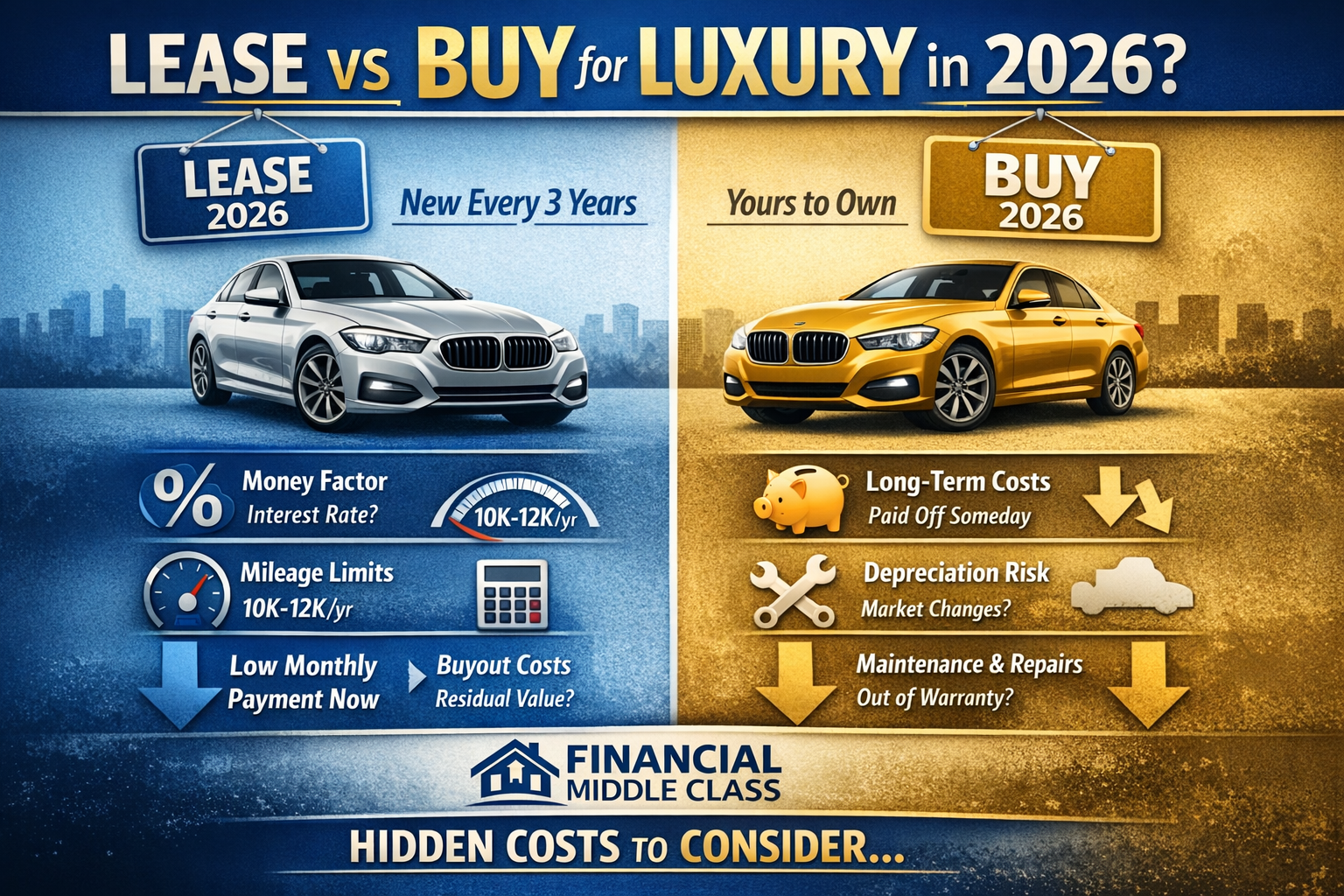
Lease vs. Buy for Luxury in 2026
By Article Posted by Staff Contributor
The estimated reading time for this post is 522 seconds
The hidden costs in money factors, mileage, and buyouts—and why delay gratification is your best “upgrade.”
Luxury dealerships and automakers have a clean pitch for 2026: “Lease it. Lower monthly payment. New car every few years. No commitment.” In a market where people are stretched thin, that pitch lands.
And sometimes, leasing really is the smarter move—especially when resale values are uncertain and incentives make the math work.
But too many middle-class buyers treat a lease like a cheat code. They chase the monthly payment, sign fast, and assume they’ll “figure it out later.” That’s how leasing turns from a controlled, short-term arrangement into a long-term money leak.
Here’s the number that should wake you up: the average monthly auto lease payment was $659 in 2025, according to Experian.Leasing is not “cheap.” It’s packaged to feel cheaper—right up until the contract starts charging you for the parts you didn’t respect: mileage, early termination, and end-of-lease decisions.
The lesson is not “never lease.” It’s this: luxury leasing punishes impatience in a different way than luxury buying does. It punishes the person who signs before they understand what they’re buying—and what they’re promising.
The 2026 backdrop: leasing is shifting, and incentives can disappear overnight
Leasing is meaningful in the U.S. market. Experian’s data shows 23.62% of new vehicles were leased in 2025, down from 26.12% in 2024. That’s not a niche behavior—it’s a mainstream choice.
But the incentive environment is not stable, especially in EVs, where “cheap leases” were often built on subsidies. Edmunds’ 2026 trends outlook notes EV market share is expected to soften in 2026 as incentive-driven shopping cools. Reuters reported that after legislation eliminated federal EV credits as of September 30, 2025, Tesla raised U.S. lease prices across its lineup—an example of how quickly lease math can change when incentives vanish.
If your plan depends on “leases always being cheap,” your plan is not a plan. It’s a hope.
The big misunderstanding: a lease is not “renting a car”
A luxury lease is a financing product with rules. It has three core moving parts, and the contract is built to ensure the leasing company gets paid whether you stay disciplined or not.
Edmunds’ lease calculator breakdown makes the structure plain: your payment is essentially depreciation + a rent charge (the rent charge is calculated using the money factor).
The key lease terms you’re really negotiating are:
- the capitalized cost (the price you’re effectively paying),
- the residual value (the car’s predicted value at lease end),
- and the money factor (the lease’s financing rate expressed as a small decimal).
If you don’t understand those, you’re not negotiating—you’re accepting.
The “hidden-cost” table that explains why people regret leasing
| What the salesperson emphasizes | What you need to obsess over |
|---|---|
| “Low monthly payment.” | Total cost: payment × months + due-at-signing + fees. (Cheap monthly can hide expensive upfront cash.) |
| “Just bring it back in 3 years.” | Mileage limits and end-of-lease charges. Many leases charge 15–25 cents per excess mile, sometimes higher. |
| “You can always buy it at the end.” | Buyout price (residual) might be a bad deal if market values drop—or if your budget changed. Regulation M covers purchase option disclosures. |
| “Put money down to lower the payment.” | A large down payment (cap cost reduction) can be risky—if the vehicle is totaled or stolen early, that cash may not protect you the way you think. (This is why many lease veterans prefer minimal money down.) |
| “Luxury comes with peace of mind.” | Insurance and fees don’t care about your peace of mind; they care about replacement cost and claim risk. |
This is where luxury leasing gets expensive: the costs that feel small when you sign become loud later.
This is why delay gratification matters. A lease is won or lost before you sign, not after.
The money factor problem: the rate you don’t feel
With loans, people talk APR. With leases, people talk “payment.” That’s not an accident.
Edmunds walks shoppers through how the money factor drives the rent charge in your payment. Cars.com’s leasing glossary explains money factor and other key lease terms so consumers can decode the contract language.
Here’s the practical warning for luxury shoppers: a small change in money factor on a high-priced vehicle can quietly add real money over 36 months, and you won’t notice if you’re hypnotized by the monthly payment.
If you’re going to lease luxury, you want the discipline to say: “Show me the cap cost, residual, and money factor.” If they can’t explain it clearly, you should be nervous.
Mileage: the most predictable fee people still ignore
Luxury leases are often written at 10,000–12,000 miles a year. That works for some lifestyles. It does not work for others. And in 2026, more people are commuting farther again, taking second jobs, driving for family obligations, or simply living in metros where everything is a drive.
Mileage overages are not theoretical. AutoTrader notes most companies charge 15 to 25 cents per mile for overages, with some charging 30 cents. Capital One gives a similar range and shows how quickly it adds up.
Regulation M (Consumer Leasing Act) focuses heavily on disclosures so consumers can compare leases—and it specifically addresses disclosures related to wear/use standards and charges like excess mileage when those standards exist.
The delayed-gratification move is simple: choose the right mileage upfront, even if it raises the payment. Paying a slightly higher payment to avoid a predictable end-of-lease bill is not “losing.” It’s planning.
Buyouts: the “I’ll decide later” decision that can cost you most
A luxury lease often ends with a fork in the road:
- return the car,
- lease something else, or
- buy it out.
Leasing contracts typically include a purchase option, and Regulation M covers purchase option disclosures as part of the consumer leasing framework.
But here’s what readers need to understand: “buy it out” is not automatically a bargain. The buyout price is usually tied to the residual set at the start. If the market value is lower than the residual (which can happen—especially if incentives fade, demand cools, or the model loses favor), buying it out can mean overpaying.
And because incentives can change quickly—as the post–September 30, 2025 EV credit shift illustrated—lease economics can turn on policy and pricing decisions consumers don’t control.
Delay gratification here means you don’t treat buyout as a default. You treat it like a fresh purchase decision: you compare the buyout price to current market value and to your budget today, not the budget you imagined three years ago.
When leasing luxury is actually smart
Leasing can be the disciplined choice when your life is stable, your driving habits are predictable, and you’re using the lease as a tool—not a lifestyle.
Leasing tends to make sense when you value:
- predictable ownership within warranty,
- a planned 2–3 year horizon,
- stable mileage,
- and strong credit (because the best lease terms usually go to higher-score borrowers; Experian’s Q1 2025 data cited in reporting put the average VantageScore for new leases in the “excellent” range).
Leasing can also be a rational hedge when resale values are uncertain (this has been part of the appeal in EVs), but as recent incentive changes show, you cannot assume that advantage will always be there.
When leasing luxury becomes a wealth-drainer
Leasing gets ugly when it becomes a monthly-payment addiction.
Luxury leasing is most dangerous when:
- you drive high miles but sign low-mileage terms,
- you expect to end early (job change, move, family change) but ignore early termination reality,
- you put too much cash down just to “get to the payment,”
- you treat the buyout as “future me’s problem,”
- or you hop from lease to lease without ever having a “no car payment” season.
That last one is the most middle-class-relevant. A lease can keep you perpetually in a payment—even when a paid-off car would have given you breathing room to build an emergency fund, pay down debt, or invest.
The consumer-protection reality: disclosures help, but they don’t stop bad decisions
Regulation M exists because consumers needed meaningful disclosures to compare lease terms and compare leasing with credit transactions. The CFPB’s Regulation M page lays out the framework: disclosures of payment schedules, purchase options, early termination notices, and more.
But here’s the honest truth: a fully disclosed lease can still be a bad deal for your life. The paper can be legal and still financially punishing if you signed under pressure.
That’s why your best protection is not just a regulation. It’s delayed gratification.
The Delay-Gratification Checklist
You don’t need a thousand tips. You need a short protocol that slows the room down.
- Sleep on it. If it’s a good deal, it survives 24 hours. If it collapses overnight, it wasn’t stable.
- Demand the lease worksheet. You want the cap cost, residual, money factor, term, miles, and every fee. (If they won’t show it clearly, you don’t have enough information.)
- Match miles to your real life. If you’re likely to exceed, price the correct miles now instead of paying overage later.
- Minimize money down. Don’t pay thousands upfront just to massage a payment—especially if you don’t understand what happens if the car is totaled early.
- Treat the buyout as a new purchase decision. Compare buyout price to market value when the time comes, not to your feelings.
That’s it. That’s the whole discipline.
A script you can use in the showroom
Say this calmly. Then stop talking.
“Before we discuss payments, I want the full lease worksheet: cap cost, residual, money factor, term, mileage allowance, and every fee line-by-line. I’m going to review it and come back tomorrow.”
Luxury sales thrives on momentum. Your finances thrive on friction.
The bottom line
Leasing a luxury car in 2026 can be smart. It can also be a quiet way to stay permanently “almost okay,” always one fee or mileage bill away from regret.
The market is already telling you what the pressure points are: lease payments are high, incentives can change quickly, and the contract is designed to charge you when your life doesn’t fit the assumptions you made under showroom lighting.
Delay gratification is not about denying yourself nice things. It’s about refusing to pay luxury prices for a rushed decision.


RELATED ARTICLES
How Wealth Is Passed Across Generations in the United States: Mechanisms, Evidence, and the Policy Debate
How wealth passes between generations—trusts, taxes, and the debate. Get the facts, figures, and tradeoffs. Read now.
The S&P 7,000: How Wall Street Disconnects from Main Street
S&P 7,000 can rise while wages, benefits, and towns fall behind. See why the market isn’t the economy—read now.
Leave Comment
Cancel reply
Gig Economy
American Middle Class / Feb 18, 2026
How Wealth Is Passed Across Generations in the United States: Mechanisms, Evidence, and the Policy Debate
How wealth passes between generations—trusts, taxes, and the debate. Get the facts, figures, and tradeoffs. Read now.
By FMC Editorial Team
American Middle Class / Feb 16, 2026
The S&P 7,000: How Wall Street Disconnects from Main Street
S&P 7,000 can rise while wages, benefits, and towns fall behind. See why the market isn’t the economy—read now.
By MacKenzy Pierre
American Middle Class / Feb 16, 2026
The “Resilient Consumer” Is Real—But So Is the Interest Bill
Credit card balances are rising as savings fall. See what it means—and the 30/60/90 plan to escape 25% APR debt.
By Article Posted by Staff Contributor
American Middle Class / Feb 09, 2026
What To Do If You Get Fired With an Outstanding 401(k) Loan
Fired with a 401(k) loan? Avoid taxes, offsets, and deadline traps with this step-by-step checklist. Read now.
By Article Posted by Staff Contributor
American Middle Class / Feb 09, 2026
The Real Math of Money in Relationships
Split finances without resentment. Any couple, any income ratio. Use the worksheet + rules—start today.
By Article Posted by Staff Contributor
American Middle Class / Feb 03, 2026
Investing or Paying Off the House?
Invest or pay off your mortgage? See a $500k example with today’s rates, dividends, and peace-of-mind math—then choose your plan.
By Article Posted by Staff Contributor
American Middle Class / Jan 30, 2026
Gold, Silver, or Bitcoin? Start With the Job—Not the Hype
Gold, silver or Bitcoin? Learn what each is for—and how to size it—before you buy. Read the framework.
By Article Posted by Staff Contributor
American Middle Class / Jan 29, 2026
Florida Homeowners Pay the Most in HOA Fees
Florida HOA fees are surging. See what lawmakers changed, what’s next, and how to protect your budget—read before you buy.
By Article Posted by Staff Contributor
American Middle Class / Jan 29, 2026
Why So Many Homebuyers Are Backing Out of Deals in 2026
Why buyers are backing out of home deals in 2026—and how to avoid costly surprises. Read the playbook before you buy.
By Article Posted by Staff Contributor
American Middle Class / Jan 28, 2026
How Money Habits Form—and Why “Self-Control” Is the Wrong Villain
Learn how money habits form—and how to rewire spending and saving using behavioral science. Read the framework and start today.
By FMC Editorial Team
Latest Reviews
American Middle Class / Feb 18, 2026
How Wealth Is Passed Across Generations in the United States: Mechanisms, Evidence, and the Policy Debate
How wealth passes between generations—trusts, taxes, and the debate. Get the facts, figures, and tradeoffs....
American Middle Class / Feb 16, 2026
The S&P 7,000: How Wall Street Disconnects from Main Street
S&P 7,000 can rise while wages, benefits, and towns fall behind. See why the market...
American Middle Class / Feb 16, 2026
The “Resilient Consumer” Is Real—But So Is the Interest Bill
Credit card balances are rising as savings fall. See what it means—and the 30/60/90 plan...