
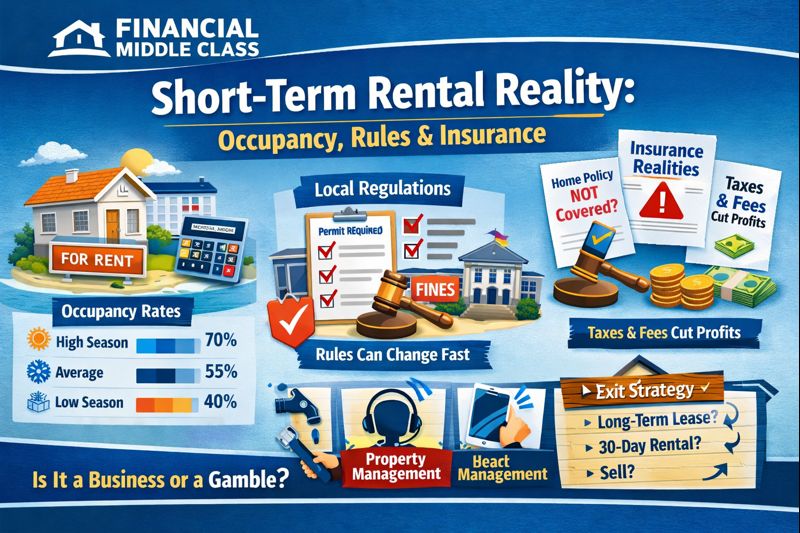
Short-Term Rental Reality: Occupancy, Regulation, and Insurance
By Article Posted by Staff Contributor
The estimated reading time for this post is 740 seconds
There’s a moment a lot of middle-class people know by heart.
The mortgage clears. The bank app refreshes. And you’re supposed to feel proud—because you did the responsible thing. You paid the bill. You stayed on track.
But the pride doesn’t last long, because the numbers still feel tight. Tight like you can’t breathe if anything goes wrong. Tight like one “surprise” can turn into a whole season of stress.
That’s when the short-term rental dream starts sounding like relief.
Not “get rich.” Just relief. A little breathing room. A second stream. A way to turn a property into a paycheck.
And I’m not here to mock that. I get it.
I’m here to tell you the part the highlight reels won’t: a short-term rental isn’t a rental first. It’s a small hospitality business sitting on top of your debt. And that business is controlled by three forces you don’t fully control—occupancy, regulation, and insurance.
If you’re going to do this, do it like someone who cannot afford a bad surprise.
Because most middle-class households can survive a slow month. What we can’t survive is a slow month plus a rule change plus an uncovered claim.
That’s the trap.
What a short-term rental really is
A long-term rental is boring in the best way. One tenant. One lease. A rhythm you can plan around.
A short-term rental is nightly sales. It’s pricing, marketing, customer service, reviews, turnover, and maintenance. It’s competition and seasonality and the kind of work that doesn’t look like work until it’s 11:47 p.m. and a guest is texting you because they can’t figure out the lockbox.
You’re not collecting rent. You’re selling nights.
That matters, because “nights” can disappear.
Occupancy isn’t rent. It’s a heartbeat.
If you’re thinking about STRs, you need to stop asking, “How much can it make in a good month?”
Start asking, “How often will it sit empty?”
Because empty nights are the whole game. A mortgage is fixed. Your STR income is not.
Nationally, occupancy has hovered around the low-to-mid 50% range in recent periods—useful as a reality anchor, not a promise. And here’s what that means in plain English: even in a “normal” environment, your property can be empty nearly half the time.
Now add competition. Add price drops. Add the fact that every other homeowner with a spare room had the same idea.
Occupancy is a heartbeat. It can be strong one month and weak the next. Your lender doesn’t care. Your escrow doesn’t care. Your property tax doesn’t care.
Seasonality is the silent killer
This is where the middle class gets hurt first, because we’re the ones running on thin margins.
In a lot of markets, summer is loud and winter is quiet. Holidays pop. Then there’s a long stretch where travel slows and your calendar looks like it’s been ghosted.
If your plan only works in peak season, you don’t have a plan. You have a seasonal hustle with a year-round mortgage.
Peak months aren’t “extra.” Peak months are your winter coat. If you spend them like they’re a bonus, you’ll freeze later.
Break-even math that doesn’t lie
Let’s do the kind of math that actually protects people.
Assume a realistic setup. Not influencer math. Middle-class math.
Your monthly mortgage, taxes, and insurance (PITI) are $3,000. Your average nightly rate is $225. After platform fees, cleaning turnover, supplies, utilities, and the fact that things break more often when strangers cycle through your home, you net around 65% of gross. Some people do better. Some do worse. The point is that gross revenue is not your money.
Now watch what happens when occupancy shifts.
| Monthly occupancy | Nights booked (30) | Gross revenue | Approx. net at 65% | Covers $3,000 PITI? |
|---|---|---|---|---|
| 70% (peak-ish) | 21 | $4,725 | $3,071 | Barely |
| 55% (normal-ish) | 17 | $3,825 | $2,486 | No |
| 40% (off-season) | 12 | $2,700 | $1,755 | Not close |
That “barely” is the truth people skip.
Even in a good month, you’re not swimming in profit. You’re treading water. And if you’re treading water, one surprise repair can push you under.
Now add the stress test that actually matters: three mediocre months in a row.
Because that’s how life works. It doesn’t punch you once. It punches you, waits for you to stand up, then punches you again.
If you can’t carry three mediocre months without borrowing from your life, your STR plan isn’t income. It’s leverage with anxiety attached.
The FMC viability scorecard: are we being realistic or just hopeful?
This is where the “skeptical spouse” in the household is usually right. Not because they hate fun, but because they understand risk.
Here’s the scorecard. Read it like a grown-up.
| Reality check | Green-light language | Red-flag language |
|---|---|---|
| Cash reserves | “We can cover 6 months of PITI without bookings.” | “We’ll build reserves after a few good months.” |
| Distance/ops | “We’re local or we have trusted boots-on-the-ground.” | “We’ll manage remotely and figure it out.” |
| Rules | “We read city/county and HOA docs and can comply.” | “My friend said everybody does it.” |
| Insurance | “Our insurer confirmed coverage in writing.” | “The platform’s protection should handle it.” |
| Household budget | “We can pay the mortgage without STR income.” | “We need bookings to make the payment.” |
If your plan depends on perfect occupancy, stable rules, and “probably” coverage, you’re not investing. You’re gambling with your peace.
Regulation: “allowed,” “permitted,” and “enforced” are three different realities
Here’s the part that makes people mad, because it feels unfair: local rules can change fast, even if you’re doing everything “right.”
Some cities treat STRs like a business license issue. Some treat them like a housing issue. Some treat them like a quality-of-life issue. In all cases, they can regulate you into a corner.
And the worst mistake is confusing “allowed” with “safe.”
“Allowed” means the law technically says you can do it. “Permitted” means you actually have the right paperwork. “Enforced” means the city and platforms are actively making sure you comply.
New York City shows what hard enforcement looks like. Under NYC’s Local Law 18, hosts must register, and platforms are restricted from processing bookings for unregistered rentals. That’s not a slap on the wrist. That’s the pipeline shutting off.
Other places may not be that strict today, but the trend line is clear: more registries, more requirements, more compliance pressure.
Your mortgage is a 30-year contract. Your STR framework can change in one council cycle.
That mismatch is risk. Real risk.
Insurance: the most expensive assumption you can make
Most people don’t get wrecked by a “bad guest.” They get wrecked by a bad assumption.
A common assumption is that homeowners insurance “basically covers it.” Another is that platform protections are a full substitute for a proper policy.
Insurance regulators and industry guidance have been warning for years that standard homeowners coverage often is not designed for short-term rental risk, especially when the activity is treated as business use.
That doesn’t mean you can’t insure an STR. It means you have to do it intentionally.
Here’s what you’re really choosing between, in plain language:
| Coverage path | What it’s designed for | What can go wrong if you assume |
|---|---|---|
| Standard homeowners | Your own household living there | Business activity with paying guests may be limited/excluded |
| Landlord/dwelling policy | Long-term tenants, rental property risk | May not match short-stay turnover and guest behavior |
| STR endorsement/add-on | Short-term rental activity (varies by carrier) | Coverage varies; you need it confirmed in writing |
| Commercial policy | Business operations, broader exposures | Costs more, but aligns with “tiny hotel” reality |
| Umbrella | Extra liability limits above underlying policies | Only helps if underlying coverage applies |
The middle-class move is not to be brave. It’s to be clear.
Call your insurer. Tell the truth about what you’re doing. Ask what policy form or endorsement you need. Ask about liability for paying guests. Ask about vacancy rules if the property sits empty. Get the answers in writing.
Because “I thought we were covered” is not a plan. It’s a future regret.
Taxes and fees: the part that shrinks your “amazing month”
The STR highlight reels love gross revenue. Gross revenue is flattering. Gross revenue is also not yours.
Short-term rentals can bring lodging or occupancy taxes, platform fees, higher utilities, higher supplies, more repairs, and then income taxes on what’s left. Depending on the jurisdiction, platforms may collect certain taxes, or you may be responsible for registration and remittance. Either way, you’re operating in a business lane.
And if you’re in a place like Florida, there’s also a state-level licensing framework for vacation rentals that can apply depending on your setup. The details vary, but the theme doesn’t: this is regulated, taxable activity.
You don’t need to become an accountant overnight. You do need to stop believing that “$8,000 month” equals “$8,000 kept.”
Operations: the hidden second job you didn’t apply for
This is where a lot of W-2 folks realize the STR isn’t “passive.” It’s another job, just with different hours and different stress.
It’s guest messaging. Cleaner coordination. Stocking supplies. Fixing small things before they become big things. Dealing with disputes. Managing reviews like your rating is a credit score.
The big decision here is whether you self-manage or hire management. Either path has a cost—time or money.
| Choice | What you gain | What you give up |
|---|---|---|
| Self-manage | More control, potentially higher net | Your evenings, your weekends, your mental bandwidth |
| Hire a manager | Less day-to-day stress | Management fees, less control, higher break-even occupancy |
People love to talk about STR income like it’s effortless. But effortless doesn’t coordinate a last-minute plumber. Effortless doesn’t handle a guest who wants a refund because it rained.
If you’re already stretched thin, be honest: do you want a hospitality business, or do you want the idea of one?
Platform risk and market saturation: you don’t control the algorithm
Even when travel demand is strong, your performance can soften if supply grows faster. That’s been a real theme in recent market reporting: record demand can coexist with occupancy pressure when more listings flood the market.
And platforms are not neutral. They change ranking. They tweak policies. They adjust what “good host behavior” means. They can delist. They can enforce compliance requirements.
Your income living inside someone else’s app is a specific kind of risk.
Middle-class rule: if your mortgage depends on an algorithm, you’re not as in control as you think.
Neighbor and community risk: one bad guest can become your city’s new ordinance
This is the part people ignore until they’re the problem on the block.
Short-term rentals can bring noise, parking chaos, trash issues, and the kind of disruption that turns neighbors into activists. One bad weekend can create ten angry emails to city council.
You can reduce the risk. You can set strict occupancy. You can enforce quiet hours. You can use legal monitoring where allowed. You can have a local contact. You can be proactive.
But you can’t pretend the community layer doesn’t exist. In many towns, that’s the political fuel that tightens regulation.
Exit strategy: the plan you write before the first guest
If STRs were always stable, you wouldn’t need this section. But they’re not. So you do.
Your exits are usually:
| Exit option | Stability | Workload | Revenue volatility |
|---|---|---|---|
| Mid-term (30+ days) | Higher | Medium | Lower than STR |
| Long-term lease | Highest | Lower | Lowest |
| Sell | Final | Medium upfront | Depends on market |
| Personal use | Emotional value | Medium | None |
The point isn’t to be pessimistic. The point is to be prepared. Middle-class households don’t have unlimited runway. You don’t get to “ride it out” forever if cash flow turns.
Red flags: when the STR dream becomes a debt trap
Here’s the compassionate truth: sometimes the right decision is not “no.” It’s “not now.”
If you have thin reserves, if you need bookings to make the payment, if rules are unclear, if insurance is not confirmed in writing, if your market is highly seasonal and you’re counting peak-season profit twice—those are not “challenges.” Those are warning signs.
People don’t get crushed because they’re lazy. They get crushed because they overestimated stability and underestimated risk.
That’s not a character flaw. That’s a math flaw.
Three mini case studies you’ll recognize
One couple did it the disciplined way. They bought a property they could carry without bookings. They treated peak-season profit like reserve-building, not lifestyle inflation. When the fall slowed down, they didn’t panic. They planned for it. They didn’t get rich. They got stable. That’s the kind of win the middle class actually needs.
Another host bought with a tight payment and a thin cushion. July was great. August was fine. September slowed. Then the AC failed. Then a guest complained. Then they started floating supplies and repairs on a credit card, telling themselves it was temporary. By the time they admitted it wasn’t working, the stress had already moved into the house. Not because they were irresponsible. Because the margin was a rumor.
A third host had a strong calendar until the local rules tightened and enforcement got serious. They pivoted to 30+ day stays, lowered turnover, and kept the property. They didn’t “lose.” They adapted. The lesson: the most valuable STR skill isn’t decor. It’s flexibility.
Related Reads:
APR vs. APY, Revolving Debt, and the Interest Games Lenders Play
The 10 strategies that actually lower your mortgage rate
What credit score do you need to buy a house in 2026?
The truth that hits home
A short-term rental can be a smart move. It can be a wealth lever. It can be a real source of breathing room.
But only if you stop calling it “passive income” and start calling it what it is: a business with volatile revenue sitting on top of fixed debt.
The middle class doesn’t get wrecked by one bad month. We get wrecked by thin margins plus optimistic assumptions.
So if you’re going to do this, do it the middle-class way: build reserves first, read the rules like your mortgage depends on them, insure it like you mean it, and make sure your household can still stand up when the calendar goes quiet.
Because the mortgage is due in January the same way it’s due in July.
And if your whole plan depends on strangers behaving, city hall staying calm, and insurance “probably” covering it…
That’s not a plan.
That’s a prayer with a monthly payment.


RELATED ARTICLES
How Wealth Is Passed Across Generations in the United States: Mechanisms, Evidence, and the Policy Debate
How wealth passes between generations—trusts, taxes, and the debate. Get the facts, figures, and tradeoffs. Read now.
The S&P 7,000: How Wall Street Disconnects from Main Street
S&P 7,000 can rise while wages, benefits, and towns fall behind. See why the market isn’t the economy—read now.
Leave Comment
Cancel reply
Gig Economy
American Middle Class / Feb 18, 2026
How Wealth Is Passed Across Generations in the United States: Mechanisms, Evidence, and the Policy Debate
How wealth passes between generations—trusts, taxes, and the debate. Get the facts, figures, and tradeoffs. Read now.
By FMC Editorial Team
American Middle Class / Feb 16, 2026
The S&P 7,000: How Wall Street Disconnects from Main Street
S&P 7,000 can rise while wages, benefits, and towns fall behind. See why the market isn’t the economy—read now.
By MacKenzy Pierre
American Middle Class / Feb 16, 2026
The “Resilient Consumer” Is Real—But So Is the Interest Bill
Credit card balances are rising as savings fall. See what it means—and the 30/60/90 plan to escape 25% APR debt.
By Article Posted by Staff Contributor
American Middle Class / Feb 09, 2026
What To Do If You Get Fired With an Outstanding 401(k) Loan
Fired with a 401(k) loan? Avoid taxes, offsets, and deadline traps with this step-by-step checklist. Read now.
By Article Posted by Staff Contributor
American Middle Class / Feb 09, 2026
The Real Math of Money in Relationships
Split finances without resentment. Any couple, any income ratio. Use the worksheet + rules—start today.
By Article Posted by Staff Contributor
American Middle Class / Feb 03, 2026
Investing or Paying Off the House?
Invest or pay off your mortgage? See a $500k example with today’s rates, dividends, and peace-of-mind math—then choose your plan.
By Article Posted by Staff Contributor
American Middle Class / Jan 30, 2026
Gold, Silver, or Bitcoin? Start With the Job—Not the Hype
Gold, silver or Bitcoin? Learn what each is for—and how to size it—before you buy. Read the framework.
By Article Posted by Staff Contributor
American Middle Class / Jan 29, 2026
Florida Homeowners Pay the Most in HOA Fees
Florida HOA fees are surging. See what lawmakers changed, what’s next, and how to protect your budget—read before you buy.
By Article Posted by Staff Contributor
American Middle Class / Jan 29, 2026
Why So Many Homebuyers Are Backing Out of Deals in 2026
Why buyers are backing out of home deals in 2026—and how to avoid costly surprises. Read the playbook before you buy.
By Article Posted by Staff Contributor
American Middle Class / Jan 28, 2026
How Money Habits Form—and Why “Self-Control” Is the Wrong Villain
Learn how money habits form—and how to rewire spending and saving using behavioral science. Read the framework and start today.
By FMC Editorial Team
Latest Reviews
American Middle Class / Feb 18, 2026
How Wealth Is Passed Across Generations in the United States: Mechanisms, Evidence, and the Policy Debate
How wealth passes between generations—trusts, taxes, and the debate. Get the facts, figures, and tradeoffs....
American Middle Class / Feb 16, 2026
The S&P 7,000: How Wall Street Disconnects from Main Street
S&P 7,000 can rise while wages, benefits, and towns fall behind. See why the market...
American Middle Class / Feb 16, 2026
The “Resilient Consumer” Is Real—But So Is the Interest Bill
Credit card balances are rising as savings fall. See what it means—and the 30/60/90 plan...