The “Resilient Consumer” Is Real—But So Is the Interest Bill
By Article Posted by Staff Contributor
The estimated reading time for this post is 362 seconds
Last updated: February 16, 2026
The tap is so quiet now you can miss it.
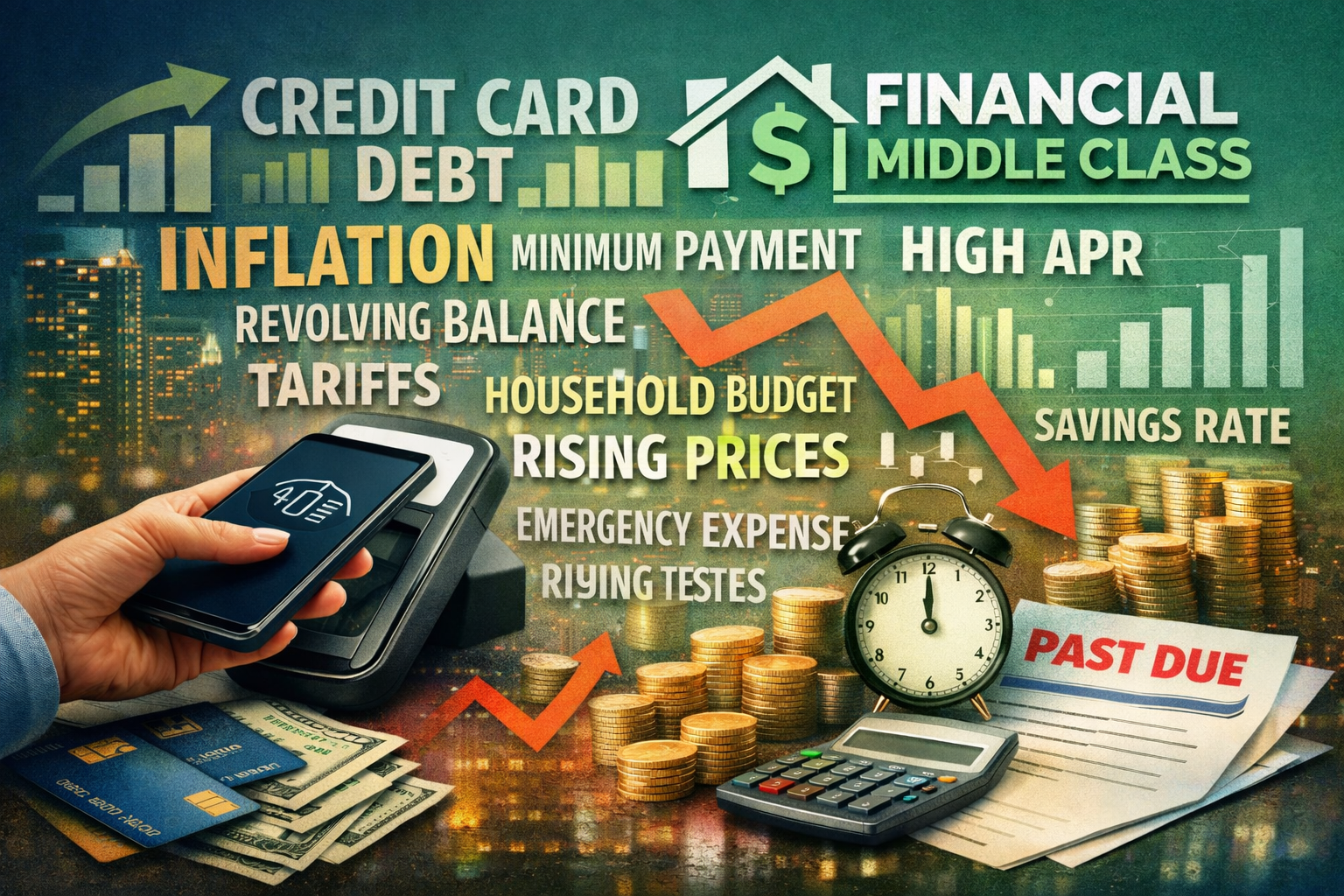
A couple in line at a pharmacy. A commuter grabbing coffee. A parent buying batteries because the remote died again. Phone comes out. Wrist tilts. A gentle vibration confirms the transaction. Life keeps moving.
That frictionless moment is why the headline about a “resilient consumer” can be both true and misleading. Yes, spending continues. But a growing share of that continuity is being financed—quietly—through revolving credit.
In other words: the consumer is holding up. The household balance sheet is doing more work to make that true.
The dashboard: what’s solid, what’s easy to misread
Here are the cleanest, public, high-signal readings behind the story.
| Indicator | Latest reading | What it suggests |
|---|---|---|
| Revolving consumer credit (level) | $1.329T (Dec 2025) | The revolving “pile” is large. |
| Revolving credit growth (full year) | +3.4% in 2025 | Revolving credit expanded in 2025, not contracted. |
| Credit card balances (NY Fed) | $1.28T (Q4 2025) | Card debt is sitting near record levels. |
| Personal saving rate | 3.5% (Nov 2025) | Thin cushion → more “life happens” spending lands on credit. |
| CPI inflation (headline) | +2.4% YoY (Jan 2026) | Inflation cooled further—but price levels remain elevated vs. pre-2020. |
| Unemployment rate | 4.3% (Jan 2026) | Paychecks still broadly landing; that matters for minimum payments. |
| Credit-card delinquency rate (all banks) | 2.98% (Q3 2025) | Stress is present, but not a default wave. |
| Credit-card charge-off rate (all banks) | 4.17% (Q3 2025) | Losses exist; lenders are pricing for risk. |
Important distinction (where people get tricked): “Revolving consumer credit” from the Board of Governors of the Federal Reserve System is a broad category; the Federal Reserve Bank of New York figure is specifically credit-card balances tracked in its household debt report. They should be directionally consistent, but they’re not the same series.
Revolving credit: plumbing—until it becomes a bridge
Credit cards aren’t automatically a crisis. Many households use them as plumbing: pay for convenience, earn rewards, pay in full, move on.
The problem begins when the card becomes a bridge—the thing that covers the gap between what your paycheck covers and what life demands. And the price of that bridge has gotten brutal.
The Consumer Financial Protection Bureau reported that average APRs reached 25.2% for general-purpose cards and 31.3% for private-label cards in 2024. It also reported $160 billion in interest charges assessed in 2024 (up from $105 billion in 2022).
That’s not a rounding error. That’s a parallel cost-of-living system—one that shows up after the tap, not at the shelf.
What 25% APR does to a normal balance
A lot of households don’t need a luxury habit to get stuck. They just need thin savings and a few ordinary shocks.
Here’s what a $5,000 balance looks like at 25.2% APR, assuming you stop charging new purchases and just pay it down:
| Fixed monthly payment | Time to pay off | Total interest paid | Total paid |
|---|---|---|---|
| $150 | ~58 months | ~$3,690 | ~$8,690 |
| $250 | ~27 months | ~$1,553 | ~$6,553 |
| $400 | ~15 months | ~$861 | ~$5,861 |
The balance is the headline. The interest is the ending—unless you change the script early.
If this is happening, why aren’t delinquencies exploding?
Because the system can bend for a while before it breaks.
First: the labor market is softer than it was, but paychecks are still broadly landing (unemployment 4.3% in January).
Second: lenders manage risk before it becomes a headline. They can tighten underwriting, lower lines, reprice accounts, and reduce promotions without waiting for mass defaults.
Third: households triage. People will often cut almost anything before they miss the payment that detonates fees, triggers penalty pricing, and wrecks credit access.
That’s why you can see delinquencies below 3% and charge-offs above 4% in the banking data at the same time: the system is functioning, but it’s charging a toll for that stability.
The two pressure points that can turn a bridge into a break
Job insecurity (the fast snap)
Revolving debt is uniquely exposed to income shocks because it’s flexible—until it isn’t. Once you miss, costs can accelerate quickly.
In early 2026, layoff announcements jumped: Challenger, Gray & Christmas reported 108,435 job cuts announced in January 2026, the highest January total since 2009.
Layoff announcements aren’t the same thing as realized unemployment. But they’re part of the mood shift that makes households more cautious—and makes lenders quicker to tighten.
Price pressure (the slow squeeze)
Inflation has cooled: CPI is up 2.4% over the year ending January 2026.
But households don’t buy “CPI.” They buy groceries, insurance, repairs, utilities—categories that don’t politely step aside just because the headline number improved.
And trade policy can add uncertainty on top. Research often finds that tariff costs are at least partly passed through to buyers, though the magnitude varies by product and market structure.
For a household already leaning on cards for basics, even modest added pressure in the wrong categories lengthens the bridge—and raises the eventual interest bill.
What to watch in 2026 if you want the consumer story before the headlines
| If this moves… | In this direction… | It usually means… |
|---|---|---|
| Saving rate | Down | Less buffer; more shock-financing. |
| Revolving credit | Up | Debt-funded “stability” rising. |
| Delinquencies / charge-offs | Up | Stress turning into losses; lenders tighten. |
| Layoff announcements | Up | Risk of payment shocks rises. |
| Inflation re-accelerates | Up | More essentials land on credit again. |
Your options besides “just carrying it” (and the honest catch)
| Option | Best for | The catch |
|---|---|---|
| 0% balance transfer | Strong credit + real payoff plan | Transfer fee; promo ends; must stop new charging. |
| Personal loan | People who need structure | Lower APR than cards (often), but fixed payments you must meet. |
| Hardship plan | Temporary squeeze | Requires calling early; terms vary; card may be frozen/closed. |
| Debt management plan (DMP) | Multiple cards + high stress | Not instant; requires discipline; can meaningfully cut rates. |
| Home equity (HELOC/refi) | Some homeowners with large balances | Can lower APR, but shifts consumer debt onto the house—serious risk if income drops. |
A practical 30/60/90-day plan if you’re carrying balances
First 30 days: stop the fee cascade
- Autopay minimums on every card (late fees and penalty pricing are where balances go feral).
- Stop new charges on the highest-APR card.
- Write down balances, APRs, and due dates—no guessing.
A note on fees: the CFPB’s late-fee cap rule was vacated in 2025, so fee exposure remains part of the landscape.
Next 60 days: restructure
- Call issuers before you miss: ask about hardship terms or APR relief.
- Decide: transfer vs. loan vs. DMP—based on your credit and your ability to stop new charging.
- Build a micro-buffer ($500–$1,000) so the next surprise doesn’t go back on the card.
Next 90 days: create momentum
- Pick avalanche (highest APR first) or snowball (smallest balance first) and commit.
- Automate one extra principal payment each month.
- Cut one recurring cost you don’t value—one cut you can live with beats five cuts you’ll reverse.
The quiet truth
The American consumer can be “fine” and fragile at the same time.
We’ve built an economy where the tap is effortless, the spending can look steady, and the damage often shows up later—in the form of years-long payoff timelines and interest that quietly taxes the households with the least margin.
Credit cards can be a bridge. Sometimes you need a bridge.
But when the bridge becomes the plan, resilience starts to look a lot like debt-funded stability. And the bill for that stability doesn’t arrive with the purchase.
It arrives month after month.

RELATED ARTICLES
How Wealth Is Passed Across Generations in the United States: Mechanisms, Evidence, and the Policy Debate
How wealth passes between generations—trusts, taxes, and the debate. Get the facts, figures, and tradeoffs. Read now.
The S&P 7,000: How Wall Street Disconnects from Main Street
S&P 7,000 can rise while wages, benefits, and towns fall behind. See why the market isn’t the economy—read now.
Leave Comment
Cancel reply
Gig Economy
American Middle Class / Feb 18, 2026
How Wealth Is Passed Across Generations in the United States: Mechanisms, Evidence, and the Policy Debate
How wealth passes between generations—trusts, taxes, and the debate. Get the facts, figures, and tradeoffs. Read now.
By FMC Editorial Team
American Middle Class / Feb 16, 2026
The S&P 7,000: How Wall Street Disconnects from Main Street
S&P 7,000 can rise while wages, benefits, and towns fall behind. See why the market isn’t the economy—read now.
By MacKenzy Pierre
American Middle Class / Feb 16, 2026
The “Resilient Consumer” Is Real—But So Is the Interest Bill
Credit card balances are rising as savings fall. See what it means—and the 30/60/90 plan to escape 25% APR debt.
By Article Posted by Staff Contributor
American Middle Class / Feb 09, 2026
What To Do If You Get Fired With an Outstanding 401(k) Loan
Fired with a 401(k) loan? Avoid taxes, offsets, and deadline traps with this step-by-step checklist. Read now.
By Article Posted by Staff Contributor
American Middle Class / Feb 09, 2026
The Real Math of Money in Relationships
Split finances without resentment. Any couple, any income ratio. Use the worksheet + rules—start today.
By Article Posted by Staff Contributor
American Middle Class / Feb 03, 2026
Investing or Paying Off the House?
Invest or pay off your mortgage? See a $500k example with today’s rates, dividends, and peace-of-mind math—then choose your plan.
By Article Posted by Staff Contributor
American Middle Class / Jan 30, 2026
Gold, Silver, or Bitcoin? Start With the Job—Not the Hype
Gold, silver or Bitcoin? Learn what each is for—and how to size it—before you buy. Read the framework.
By Article Posted by Staff Contributor
American Middle Class / Jan 29, 2026
Florida Homeowners Pay the Most in HOA Fees
Florida HOA fees are surging. See what lawmakers changed, what’s next, and how to protect your budget—read before you buy.
By Article Posted by Staff Contributor
American Middle Class / Jan 29, 2026
Why So Many Homebuyers Are Backing Out of Deals in 2026
Why buyers are backing out of home deals in 2026—and how to avoid costly surprises. Read the playbook before you buy.
By Article Posted by Staff Contributor
American Middle Class / Jan 28, 2026
How Money Habits Form—and Why “Self-Control” Is the Wrong Villain
Learn how money habits form—and how to rewire spending and saving using behavioral science. Read the framework and start today.
By FMC Editorial Team
Latest Reviews
American Middle Class / Feb 18, 2026
How Wealth Is Passed Across Generations in the United States: Mechanisms, Evidence, and the Policy Debate
How wealth passes between generations—trusts, taxes, and the debate. Get the facts, figures, and tradeoffs....
American Middle Class / Feb 16, 2026
The S&P 7,000: How Wall Street Disconnects from Main Street
S&P 7,000 can rise while wages, benefits, and towns fall behind. See why the market...
American Middle Class / Feb 16, 2026
The “Resilient Consumer” Is Real—But So Is the Interest Bill
Credit card balances are rising as savings fall. See what it means—and the 30/60/90 plan...