
Your High-Yield Savings Account Isn’t High-Yield Anymore (And Your Bank Is Counting on Your Silence)
By Article Posted by Staff Contributor
The estimated reading time for this post is 686 seconds
You did the responsible thing. You finally moved your emergency fund out of that dusty “savings” account paying basically air. You opened a high-yield savings account. You watched interest show up like clockwork, and for the first time in a long time, your money looked like it was doing something besides just sitting there.
Then the APY started slipping.
Not with a warning siren. Not with a big email titled “We’re cutting your rate.” It just… drifted down. Quietly. The same way a streaming subscription gets more expensive while the app swears it’s “improving your experience.”
So now you’re asking the question a lot of people should be asking out loud: if my “high-yield” savings account isn’t yielding much anymore, what am I actually holding—and what counts as a competitive savings rate right now?
Let’s make this simple, accurate, and useful. Because “high-yield” is not a personality trait. It’s a number. And if the number is weak, the label doesn’t matter.
What “high-yield” actually means (and why the label can become a lie)
A high-yield savings account is still a savings account. The “high-yield” part just means it pays more than a typical, traditional savings account rate. Banks themselves describe it that way: it’s generally higher than the national average of traditional savings accounts, and the APY can change over time.
That “can change over time” part is the whole story. Savings APYs are variable. Your bank can raise them, cut them, and reshape them whenever it wants. The product name stays the same while the yield shrinks, because marketing is forever and rates are not.
Here’s the cleanest way to think about it.
| Feature | Regular savings account | “High-yield” savings account |
|---|---|---|
| What it is | A standard savings deposit account | The same basic type of account, usually paying a higher APY |
| Rate behavior | Variable and often low | Variable and typically higher than “typical” savings rates |
| Who tends to offer the best rates | Big banks often pay less | Online banks and rate-competitive institutions often pay more |
| The catch | You can “set and forget” and get underpaid | You can still “set and forget” and eventually get underpaid |
The problem isn’t that you picked a HYSA. The problem is thinking a HYSA stays high-yield just because the name did.
The national average savings APY: yes, you should know it—but no, you shouldn’t worship it
People love quoting “the national average” like it’s the scoreboard. But in savings-rate world, the national average is more like the speed limit on a road where half the drivers are doing 30 and the other half are doing 80.
Two “national averages” show up most often in personal finance conversations, and they’re both legitimate, but they mean different things.
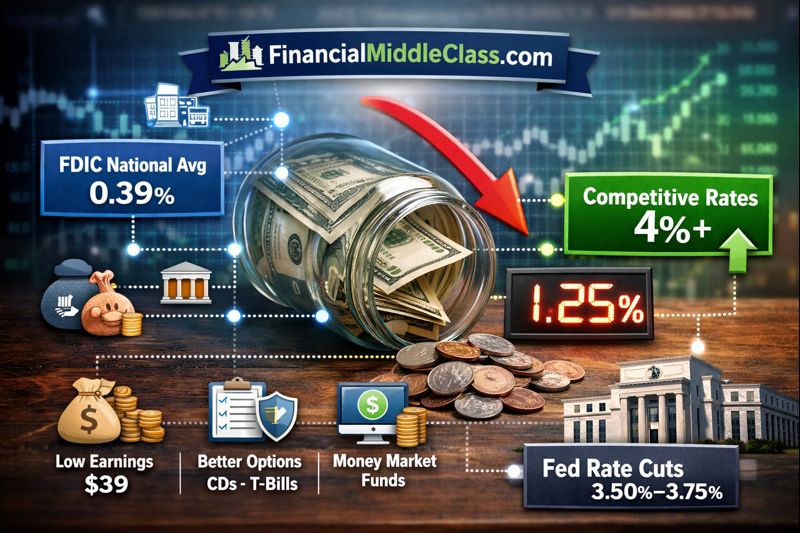
The FDIC publishes a deposit-weighted national rate that is used in its “National Rates and Rate Caps” tables. In December 2025, the FDIC’s national deposit rate for savings was 0.39%.
Bankrate publishes a national average savings yield based on its weekly survey of more than 500 banks and credit unions. As of December 30, 2025, Bankrate’s national average savings yield was 0.62% APY, and it explicitly notes that the best high-yield savings accounts were paying upwards of 4% APY.
Put them side by side and the confusion starts to make sense.
| “National average” source | What it is | How it’s calculated | Late Dec 2025 savings “average” |
|---|---|---|---|
| FDIC | A national rate used for rate-cap calculations | Weighted by each institution’s share of domestic deposits | 0.39% (Savings) |
| Bankrate | A national average benchmark for consumers | Survey of 500+ banks and credit unions; includes broadly available institutions and some large banks | 0.62% APY (as of Dec 30, 2025) |
Here’s the part that matters for your life: both averages can be “true” and still be useless if you use them as permission to settle.
If your bank pays you 1.25% and says, “You’re beating the national average,” that’s technically correct. It’s also financially disrespectful, because the market is paying way more to people who bother to look.
The math that exposes the “loyalty tax”
The fastest way to stop arguing with yourself is to do one simple calculation on real dollars. Not vibes. Not branding. Dollars.
Assume $10,000 sitting in cash for one year.
| APY | What you earn on $10,000 in one year (roughly) | What it feels like in real life |
|---|---|---|
| 0.39% (FDIC national savings rate) | $39 | “That’s it?” money |
| 0.62% (Bankrate national average) | $62 | “Still not worth flexing” money |
| 4.00%+ (competitive HYSA territory) | $400+ | groceries, a utility month, a real buffer |
That gap isn’t a rounding error. It’s the middle-class penalty for being busy, tired, and loyal to a bank that is not loyal to you.
Why your HYSA dropped: the Fed changed the climate, and banks followed the money
Savings rates don’t float in space. They’re connected to the broader interest-rate environment, and the federal funds rate is one of the biggest signals banks react to.
On December 10, 2025, the Federal Reserve announced it lowered the target range for the federal funds rate by a quarter percentage point to 3.50%–3.75%.
When the Fed moves, banks eventually adjust what they pay depositors. Some banks cut quickly. Some cut slowly. Some fight to stay on “best rate” lists because they’re still trying to attract deposits.
But many institutions do something even more strategic: they stop paying up for customers who already parked money and stopped paying attention.
That’s not conspiracy. That’s business.
The business model nobody says out loud: banks pay high rates only when they need your cash
Banks compete for deposits the same way stores compete for customers. If they’re trying to grow, they run a sale. If they’re not trying to grow, the “sale” ends and you’re quietly paying full price.
A lot of “high-yield” is simply promotional behavior. When a bank wants deposits, it prices aggressively. When it has enough, it relaxes. When it sees you’re not leaving, it learns it can pay you less.
That’s how you end up in the situation you’re in: a high-yield savings account that used to be high-yield, and now is mostly just a savings account with a better logo.
So what’s “competitive” right now? A yardstick that actually helps
Here’s the clean rule: competitive doesn’t mean “above average.” Competitive means “close to what top broadly available accounts are paying right now.”
Bankrate’s December 30, 2025 benchmark page says the best high-yield savings accounts are paying upwards of 4% APY.
Bankrate’s best-HYSA roundup lists top rates around 4.20% APY (with specific institutions and minimums).
That doesn’t mean you must chase the absolute top decimal every week. It means if you’re sitting at 1%–2% while the market offers ~4%+, you’re not being “safe.” You’re being underpaid.
Here’s the comparison in plain view.
| Benchmark | What it tells you | Late Dec 2025 figure |
|---|---|---|
| National average (FDIC) | What the deposit-weighted system pays on average | 0.39% savings |
| National average (Bankrate) | A consumer benchmark from a broad weekly survey | 0.62% APY |
| Competitive HYSA leaders | What strong, broadly available accounts are paying | Around 4.00%–4.20% on major roundups |
Rates change, so you verify the day you act. But the direction is clear: “high-yield” right now is not 0.80%. It’s not 1.30%. It’s not “well, it used to be good.”
It’s closer to the 4% neighborhood.
The 10-minute HYSA audit (no spiraling, no spreadsheets)
You don’t need to become a rate trader. You just need to stop being the easiest customer in America.
Start by logging in and finding your APY today, not the APY you remember from six months ago. Savings is variable, and your memory is not a statement.
Next, read the fine print that decides whether your rate is real or a performance. If your account has tiers, the headline APY might apply only up to a certain balance. If it has requirements, you might need direct deposit or a linked checking account to earn the higher rate, and some relationship structures pay dramatically different APYs depending on how much money you keep with the bank.
Then verify the boring but important part: insurance. You want FDIC coverage at banks and NCUA coverage at credit unions, because the point of a savings account is safety plus yield, not drama.
Finally, check transfer and withdrawal policies. People still repeat the “six withdrawals per month” rule like it’s federal law carved into stone tablets, but the Fed changed that in 2020. In April 2020, the Federal Reserve issued an interim final rule allowing institutions to suspend enforcement of the six-transfer limit. The catch is your bank can still impose limits and fees by policy even if it’s no longer required by federal rule, which Bankrate notes plainly.
If you want a quick diagnostic, use this table as your “am I lagging?” dashboard.
| Your current APY | What it usually means | What you should do next |
|---|---|---|
| Under 1% | You’re getting traditional-bank treatment, even if the product name says “high-yield” | Price-check competitive HYSAs and consider moving |
| 1%–3% | You’re earning something, but you may be paying the loyalty tax | Compare against 4%+ leaders and run the fee/requirements test |
| Around 4%+ | You’re still in competitive territory (for now) | Monitor occasionally; don’t obsess, but don’t sleepwalk |
Four smarter ways to run your cash (depending on how you actually live)
There isn’t one perfect savings product, because there isn’t one perfect life. Some of you need instant access. Some of you need guardrails so you don’t spend your emergency fund the moment your favorite airline drops a “deal.” Some of you are saving for a house. Some of you just want your money to stop embarrassing you.
Here are the major options people use, compared the way grown-ups compare things: side by side.
| Option | Access to cash | Rate type | Insurance / risk | Best for |
|---|---|---|---|---|
| High-yield savings account | High access, easy transfers | Variable | FDIC/NCUA if held at insured institution | Emergency fund, near-term goals, flexibility |
| Certificate of deposit (CD) | Lower access (penalty if you break early) | Often fixed | FDIC/NCUA at insured institution | People who want certainty and won’t need the cash tomorrow |
| Treasury bills (T-bills) | Access depends on maturity/rolling strategy | Varies with auction rates; you can ladder | Backed by U.S. government credit | Short-term parking with strong safety; people who like structure |
| Money market fund (brokerage product) | Typically easy to buy/sell, but not the same as a bank account | Varies | Not FDIC-insured; investment product risk exists | People comfortable using a brokerage for cash management |
The simplest move for most readers is still switching to a genuinely competitive HYSA. You’re not changing your entire financial identity. You’re just refusing to accept an uncompetitive rate.
If you want a low-effort reality anchor, Bankrate’s HYSA roundup is one example of a list that shows named institutions and APYs, including top rates around 4.20% APY in late December 2025.
The myths that keep people underpaid
The first myth is the most dangerous because it sounds responsible: “I’m beating the national average, so I’m good.” If “average” is 0.39% or 0.62%, beating it is not a victory. It’s survival. The real question is whether you’re beating what competitive, broadly available accounts are paying right now.
The second myth is that your bank will automatically keep you competitive because you’re a loyal customer. Banks reward behavior, not history. If you don’t move, the bank learns it can pay you less.
The third myth is the withdrawal rule. The Fed’s 2020 change allowed institutions to suspend the old six-transfer limit. But banks can still enforce limits by policy and charge fees, which is why you always read your account disclosures and stop assuming “the rules” are universal.
FAQ (quick answers, no fluff)
Is my HYSA “bad” if it’s under 4%?
Not morally bad. Financially behind, depending on what’s available that week. In late December 2025, Bankrate described the best high-yield savings accounts as paying upwards of 4% APY, and its roundup listed top rates around 4.20% APY. If you’re far below that, you’re likely donating interest to your bank.
Which national average should I use?
Use both as context, then move on. The FDIC’s deposit-weighted national savings rate was 0.39% in December 2025. Bankrate’s survey-based national average was 0.62% as of December 30, 2025. Neither number tells you what you could be earning if you choose competitive options.
How often should I check savings rates?
Often enough to avoid being asleep at the wheel, not so often you become anxious. If your rate drops meaningfully and you’re no longer in the competitive neighborhood, you check the market and act.
What’s the simplest “set-it-and-forget-it” plan?
Pick one competitive HYSA with no nonsense—no fees that eat your yield, no goofy tiers that punish your balance, no requirements you won’t keep—then schedule one quick check a few times a year. The goal is not perfection. The goal is not being the easiest customer to underpay.
Related Reads:
APR vs. APY, Revolving Debt, and the Interest Games Lenders Play
The 10 strategies that actually lower your mortgage rate
What credit score do you need to buy a house in 2026?
What Does Your Credit Limit Say About Your Financial Self?
The bottom line (Financial Middle Class truth)
Your job is not to be loyal to a bank. Your job is to be loyal to your household.
If your “high-yield” savings account stopped being high-yield, that’s not a personal failure. That’s a business model doing what it does. The fix is simple: benchmark correctly, do the math in real dollars, and move your cash like you move everything else in life—toward the better deal.
When you let your bank underpay you, you’re not being cautious. You’re being taxed by inertia.


RELATED ARTICLES
How Wealth Is Passed Across Generations in the United States: Mechanisms, Evidence, and the Policy Debate
How wealth passes between generations—trusts, taxes, and the debate. Get the facts, figures, and tradeoffs. Read now.
The S&P 7,000: How Wall Street Disconnects from Main Street
S&P 7,000 can rise while wages, benefits, and towns fall behind. See why the market isn’t the economy—read now.
Leave Comment
Cancel reply
Gig Economy
American Middle Class / Feb 18, 2026
How Wealth Is Passed Across Generations in the United States: Mechanisms, Evidence, and the Policy Debate
How wealth passes between generations—trusts, taxes, and the debate. Get the facts, figures, and tradeoffs. Read now.
By FMC Editorial Team
American Middle Class / Feb 16, 2026
The S&P 7,000: How Wall Street Disconnects from Main Street
S&P 7,000 can rise while wages, benefits, and towns fall behind. See why the market isn’t the economy—read now.
By MacKenzy Pierre
American Middle Class / Feb 16, 2026
The “Resilient Consumer” Is Real—But So Is the Interest Bill
Credit card balances are rising as savings fall. See what it means—and the 30/60/90 plan to escape 25% APR debt.
By Article Posted by Staff Contributor
American Middle Class / Feb 09, 2026
What To Do If You Get Fired With an Outstanding 401(k) Loan
Fired with a 401(k) loan? Avoid taxes, offsets, and deadline traps with this step-by-step checklist. Read now.
By Article Posted by Staff Contributor
American Middle Class / Feb 09, 2026
The Real Math of Money in Relationships
Split finances without resentment. Any couple, any income ratio. Use the worksheet + rules—start today.
By Article Posted by Staff Contributor
American Middle Class / Feb 03, 2026
Investing or Paying Off the House?
Invest or pay off your mortgage? See a $500k example with today’s rates, dividends, and peace-of-mind math—then choose your plan.
By Article Posted by Staff Contributor
American Middle Class / Jan 30, 2026
Gold, Silver, or Bitcoin? Start With the Job—Not the Hype
Gold, silver or Bitcoin? Learn what each is for—and how to size it—before you buy. Read the framework.
By Article Posted by Staff Contributor
American Middle Class / Jan 29, 2026
Florida Homeowners Pay the Most in HOA Fees
Florida HOA fees are surging. See what lawmakers changed, what’s next, and how to protect your budget—read before you buy.
By Article Posted by Staff Contributor
American Middle Class / Jan 29, 2026
Why So Many Homebuyers Are Backing Out of Deals in 2026
Why buyers are backing out of home deals in 2026—and how to avoid costly surprises. Read the playbook before you buy.
By Article Posted by Staff Contributor
American Middle Class / Jan 28, 2026
How Money Habits Form—and Why “Self-Control” Is the Wrong Villain
Learn how money habits form—and how to rewire spending and saving using behavioral science. Read the framework and start today.
By FMC Editorial Team
Latest Reviews
American Middle Class / Feb 18, 2026
How Wealth Is Passed Across Generations in the United States: Mechanisms, Evidence, and the Policy Debate
How wealth passes between generations—trusts, taxes, and the debate. Get the facts, figures, and tradeoffs....
American Middle Class / Feb 16, 2026
The S&P 7,000: How Wall Street Disconnects from Main Street
S&P 7,000 can rise while wages, benefits, and towns fall behind. See why the market...
American Middle Class / Feb 16, 2026
The “Resilient Consumer” Is Real—But So Is the Interest Bill
Credit card balances are rising as savings fall. See what it means—and the 30/60/90 plan...