
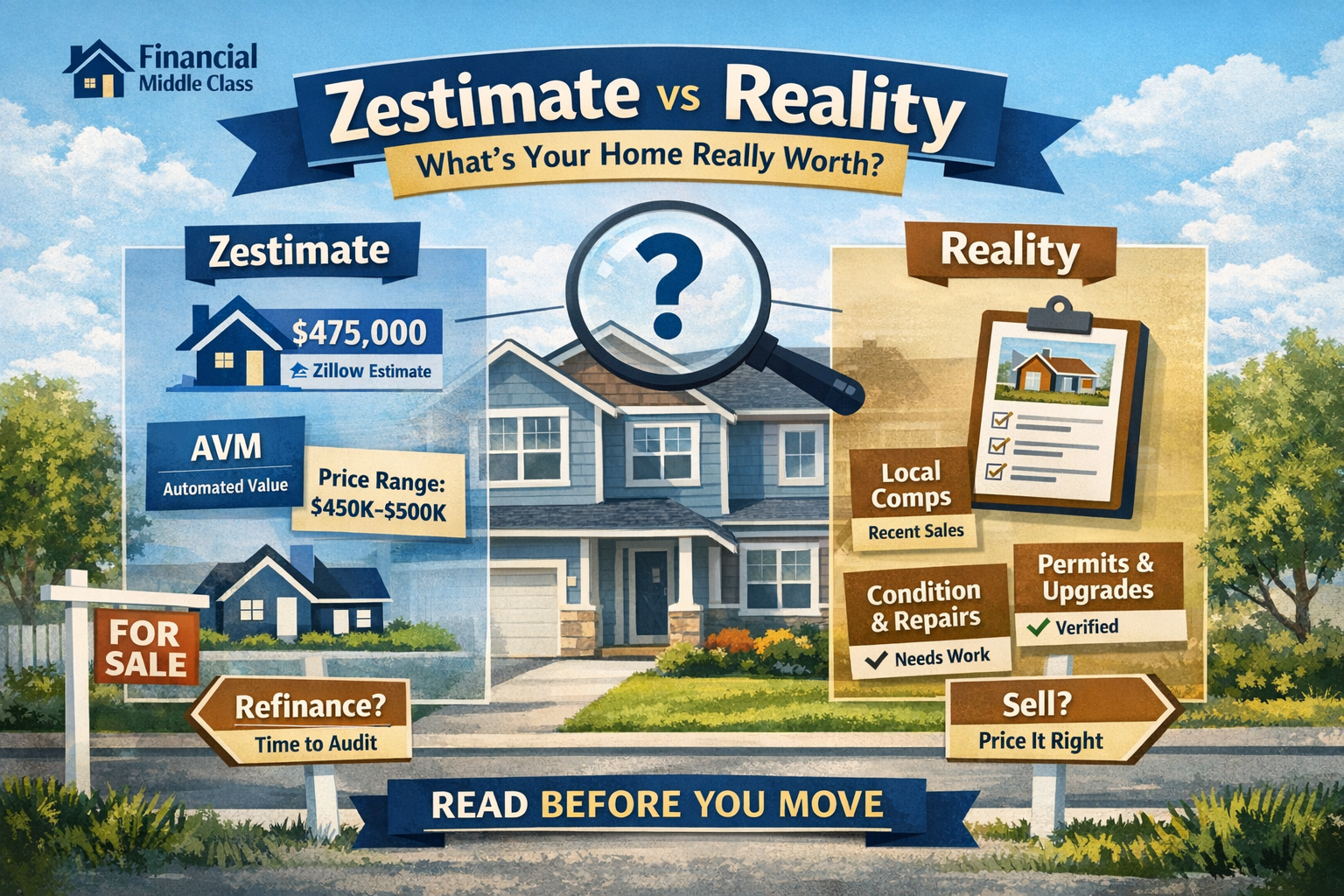
Zestimates vs. Reality: How to Read the Number Without Letting It Read You
The estimated reading time for this post is 730 seconds
Zestimates vs. Reality: How to Read the Number Without Letting It Read You

The number that starts a family argument
If you’ve ever typed your address into Zillow “just to check” and felt your stomach drop—or puff up—welcome to the modern homeowner experience. One minute you’re just browsing. The next minute you’re mentally refinancing, listing, renovating, or arguing with your spouse based on a number that appeared on a screen.
Let’s say the quiet part out loud: Zestimate accuracy is real enough to be useful and shaky enough to hurt you if you treat it like gospel. Homes are hyper-local and messy, and most of the value lives in details that don’t fit neatly in a spreadsheet.
Three truths before you believe any “home value”
First truth: real estate is local in a way people underestimate. Two homes can be the same size on paper and still sell for radically different prices because one sits near a noisy road and one sits near water. One is in the school zone people chase. One is across an invisible line buyers treat like a wall.
Second truth: condition is the dark matter of home value. Roof age, HVAC life, water issues, deferred maintenance, and “DIY confidence” renovations can swing the real number hard.
Third truth: value depends on purpose. Buyers care about today’s price. Lenders care about collateral risk. Assessors care about rules and cycles. Insurers care about risk and rebuild realities. One number can’t serve all those masters equally well.
Glossary so we’re speaking the same language
AVM: Automated Valuation Model. A statistical estimate of value based on data patterns.
Zestimate: Zillow’s AVM output for a specific home.
CMA: Comparative Market Analysis. An agent’s comp-based pricing opinion (not an appraisal).
Comp: A comparable recently sold home used to estimate value.
Condition: The real-life state of the home (roof, HVAC, updates, deferred maintenance).
Permits: Proof that work was done legally and inspected where required. “Nice renovation” and “permitted renovation” are not the same thing.
Uncertainty: If the site shows a sale range, a wider range is the model admitting it’s less sure. Treat that like a warning label.
Accuracy without hype: on-market vs off-market
The most important thing to understand is that accuracy changes based on whether a home is actively listed. When a home is listed, there’s more fresh information and more market feedback. When it’s not listed, the model is forced to infer more from older records and nearby sales patterns.
| On-market (listed) | Off-market (not listed) |
|---|---|
| More current signals exist (listing details, active pricing context, market feedback). | Fewer current signals exist (public records + nearby sales patterns; condition gets lost). |
| Best use: sanity-check pricing conversations and direction. | Best use: broad planning and early research. |
| Big mistake: assuming it will match appraisal/contract price. | Big mistake: setting list price or cash-out expectations from the headline number alone. |
A Zestimate is a thermometer, not a diagnosis. Useful signal. Dangerous gospel.
The sale range is the confidence signal. A wide range means “do comps and fact-checking.”
Before you refinance, borrow, or list, translate condition and permits into dollars you can defend.
AVM vs CMA vs appraisal vs “neighbor value”
Homeowners get tripped up because they treat every valuation like it belongs to the same category. It doesn’t. The tool that matters depends on what you’re trying to do.
| AVM (Zestimate) | Fast estimate based on patterns. Good for a quick temperature check. Weak at capturing your home’s true condition, layout quirks, unpermitted work, and micro-location issues buyers feel immediately. |
|---|---|
| CMA (Agent comps) | Human pricing opinion built on comps and local context. Strong for list strategy. Still an opinion, not a formal valuation. |
| Appraisal | Formal valuation used for lending decisions. Often determines whether financing clears or gets renegotiated. |
| Neighbor value | Not bankable. Sometimes a decent guess, often a story. Don’t build a plan on it. |
Why your Zestimate changes when nothing changed
Most movement comes from data changes around you: nearby homes sell, listings change, public records refresh, and models update. Your home can stay the same while the estimate moves because the neighborhood inputs moved.
Sometimes the estimate changes because the facts are wrong. If the square footage is off, that’s a valuation grenade. If bed/bath counts are wrong, or an addition wasn’t captured correctly, the model can drift far from reality while still looking “precise.”
The homeowner’s Zestimate audit
Before you believe the number, do a quick audit: verify the facts, interpret the range, pull comps, and translate condition into dollars. This is how you stop anchoring to fantasy and start making decisions you can defend.
Fill in the fields. Then use the formulas below to get a conservative planning value.
| Step | Formula | Why it matters |
|---|---|---|
| Midpoint | (Low + High) ÷ 2 | Stops you from anchoring to the headline Zestimate. |
| Planning value | Midpoint − Adjustment | Prices in roof/HVAC/repairs/permitting reality. |
| Confidence read | If range feels tight = higher confidence; wide = lower confidence | Wide range = pull comps and verify facts before acting. |
FINANCIAL MIDDLE CLASS — ZESTIMATE AUDIT NOTES

Property:
Purpose (refi/sell/tax/ins):

Zestimate:
Sale Range Low:
Sale Range High:

Comps I’m using:
1)
2)
3)
4)
5)

Reality adjustments (condition/permits):
- Roof:
- HVAC:
- Plumbing/electrical:
- Permits/invoices:
- Other:

My one-sentence conclusion:
“My planning value is ______ because ______.”
The three decision lanes: refinance/HELOC, selling, and taxes/insurance
If you’re refinancing or taking a HELOC, you’re stepping into the lender’s world, where collateral rules and underwriting reality decide the number. If you’re selling, you’re stepping into the buyer’s world, where condition and micro-location can override spreadsheets. If you’re thinking about taxes or insurance, you’re stepping into systems that can diverge from market value entirely.
| If you’re trying to… | Use the estimate for… | Reality check |
|---|---|---|
| Refinance / HELOC | Rough planning and deciding whether it’s worth making calls. | Lender valuation processes decide what you can borrow against. |
| Sell / List | Sanity-check and a prompt to pull comps. | Buyer behavior + condition + appraisal clearance decide the outcome. |
| Taxes / Insurance | General context, not authority. | Assessment rules and risk/rebuild realities often move differently. |
What changed recently (timeline)
Automated valuations face stronger expectations in serious money decisions2024–2025
Home value is colliding with risk, insurance cost, and “future headache” pricing2025
Use the worksheets below to keep your Zestimate from turning into a bad decision.
Enter 3–6 sold comps. Compute $/sqft manually: Sold Price ÷ Sq Ft. Then apply the average to your home’s sq ft.
| Comp | Sold Price ($) | Sq Ft | $ / Sq Ft (Price ÷ Sq Ft) |
|---|---|---|---|
| #1 | |||
| #2 | |||
| #3 | |||
| #4 | |||
| #5 |
| Outcome | Manual formula |
|---|---|
| Average $/sqft | (Add all $/sqft) ÷ (number of comps used) |
| Mid estimate | Average $/sqft × Your sq ft |
| Planning value | Mid estimate − Adjustment |
| Conservative range | Planning value ± 5% (or ± 7–10% in volatile markets) |
Pick one and customize. This is the grown-up way to get a CMA or challenge missing valuation facts.
| Agent (CMA request) | Lender/Valuation review | Assessor/Tax office |
|---|---|---|
|
Subject: CMA Request for [ADDRESS]
Hi [Agent Name], I’m looking for a realistic comp-based pricing opinion for [ADDRESS]. I’m not trying to “win Zillow,” I’m trying to understand market reality. Please include 3–6 sold comps, any pending/active comps you think matter, and what condition/permitting issues change pricing. Thanks, [Your Name]
|
Subject: Request for Review of Valuation – [ADDRESS]
Hi [Team], I’m requesting a review of the valuation for [ADDRESS]. I believe some information may be missing or correctable. Facts: [FACTS]. Comps: [COMPS]. Please advise the preferred format and deadline for supporting docs (permits, invoices, photos). Thanks, [Your Name], [Phone]
|
Subject: Assessment Question for [ADDRESS]
Hello, I’m reviewing the assessed value for [ADDRESS] and would like the basis used (method, effective date, comparable properties). Please advise the appeal window, accepted evidence, and where I can see comps used. Thanks, [Your Name], [Phone]
|
FAQ
How accurate is a Zestimate, really?
Why did my Zestimate change overnight?
Can I change my Zestimate?
Is a Zestimate the same as an appraisal?
What should I use if I’m selling soon?
What should I use if I’m refinancing or getting a HELOC?
Quick question before you go
Tell us what happened and what you think the model missed: condition, permits, square footage, micro-location, or something else. If you’re comfortable, include your metro area and whether your home was listed at the time.
Bottom line
Your Zestimate can be a useful signal, especially when you treat it like a thermometer and not a diagnosis. The homeowner win is reading the range, verifying the facts, pulling comps, and pricing in condition and permits. Do that, and the internet becomes a tool. Skip that, and you let a screen steer your biggest asset from the passenger seat.

