
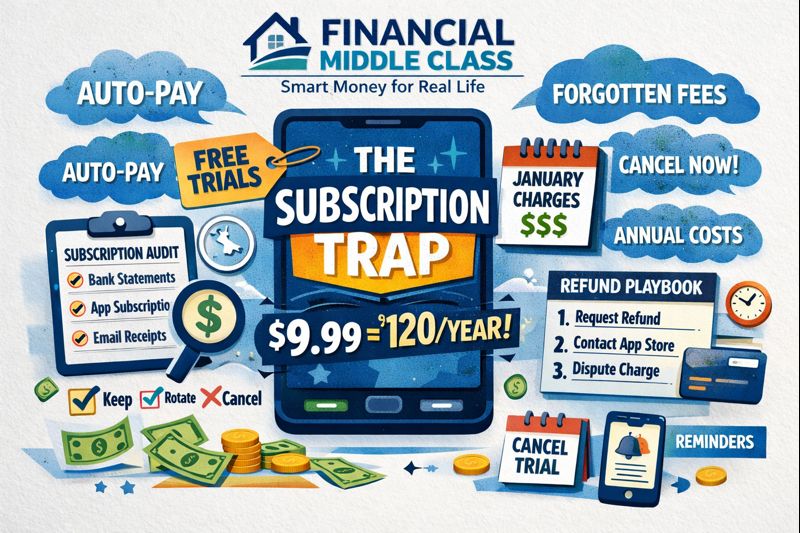
The Subscription Trap: Free Trials That Start Charging in January
By Article Posted by Staff Contributor
The estimated reading time for this post is 510 seconds
The Subscription Trap: Free Trials That Start Charging in January
Audit, cancel flow, and a reminder system that saves you all year.
Last updated: December 29, 2025
Table of Contents
The Subscription Trap hits in January
January is when your budget gets jumped.
Not by the mortgage. That bill has your address on it like a tattoo. Not by the car note. That one never misses.
January gets you with the quiet stuff. The “free” trials you tapped in December while you were tired, busy, and just trying to make life easier for five minutes—streaming for holiday movies, a fitness app because “new year,” delivery perks because you were running on fumes, cloud storage because your phone screamed Storage Full at midnight.
Then January shows up like it’s collecting rent: Surprise. That’ll be $9.99. And $12.99. And $5.99. And $19.99.
Why January is the perfect month to get you
Because January is already expensive for the middle class.
You might be carrying a holiday balance. Your insurance didn’t get cheaper because the calendar flipped. Groceries didn’t calm down. And if you’ve got kids, January is the month where the whole machine restarts—school routines, activities, “we need this for class,” and all the little charges that come with “normal life.”
Subscriptions thrive in busy seasons. Not because you’re irresponsible. Because you’re human.
Why the trap works on good people
This isn’t a morality play. Nobody needs a lecture.
The Subscription Trap works because the system is built for forgetting:
- Autopay turns spending invisible. You don’t feel it like you feel a checkout line.
- Cancellation friction is a feature. Not always impossible—just irritating enough to delay.
- “Future you” gets billed. You sign up for the person you wish you were, then real life shows up and wins.
A quick reality check on subscription spending
Surveys cited by Investopedia report Americans underestimate monthly subscription spending by about $133, and reported averages can hover around $90/month. Streaming alone can be meaningful: Deloitte reports about $69/month across four services on average, and Reviews.org reports about $51.71/month on average in a 2025 survey. (Different surveys, same story: it stacks.)
The real math: $9.99 isn’t $9.99
A subscription’s superpower is how harmless it looks.
- $9.99/month ≈ $120/year
- $14.99/month ≈ $180/year
- $19.99/month ≈ $240/year
Now stack six subscriptions averaging $12/month. That’s $72/month—$864/year. Not small. Not “whatever.” That’s a car repair. That’s a plane ticket. That’s a debt chunk you could’ve killed.
Who this helps most
If you don’t have “leak room,” this is for you:
- households living close to the edge (even with decent incomes)
- anyone carrying credit card debt
- parents and caregivers (kid apps + bundles multiply fast)
- variable-income workers (autopay surprises hit harder)
- couples sharing bills without clear subscription ownership
Keep / Rotate / Cancel framework
You don’t need perfect discipline. You need a decision rule.
Core subscriptions (Keep)
Used weekly. Solves a real problem. Your household would notice immediately if it disappeared.
Seasonal subscriptions (Rotate)
You want it sometimes, not always. Keep one main service and rotate the rest.
Fantasy-self subscriptions (Cancel)
This one stings because it’s honest. You’re paying for the person you wish you were, not the person living your real Tuesday. Cancel it. If you become that person later, you can resubscribe later.
The 30-minute subscription audit
Three places. No overthinking.
1) Statements (last 60–90 days)
Scan bank + credit card statements for recurring charges (monthly or annual).
2) App subscriptions (Apple / Google)
This is where “I didn’t know I had that” money lives.
3) Email receipts
Search: receipt, trial, subscription, renewal, invoice.
Sort into four buckets
- Keep
- Rotate
- Cancel
- What is this? (unknown merchant/charge)
If you truly don’t recognize a charge, treat it like a stranger in your house. Identify it immediately.
Free trial fine print cheat sheet
Before you tap “Start,” look for:
- trial length (7/14/30 days)
- when the first charge hits (sometimes it’s before the end date)
- annual-plan default toggles
- cancel window rules (often “cancel 24 hours before”)
- where you must cancel (website vs Apple/Google vs bundle provider)
If you can’t find the cancel path in under a minute, that’s not an accident.
The clean cancel flow
Cancel where you subscribed
- Subscribed in an app? Cancel in Apple/Google subscriptions.
- Subscribed on a website? Cancel on the website (billing → manage plan).
- Subscribed via a bundle? Cancel through the bundle provider.
Deleting the app is not canceling. That’s like throwing away the remote and thinking the cable company will stop billing you.
Cancel immediately after starting the trial
Most services still let you use the trial until it ends. You’re just removing the “gotcha” moment.
Screenshot the confirmation
Save it. Email it to yourself. Put it in a folder called “Cancellations.”
Already got charged? Refund & reversal playbook
A lot of people read this after the first charge hits. Here’s how to handle it cleanly.
Step 1: Ask the company for a refund (fast)
Script: “Hi—my free trial converted to a paid plan and I didn’t intend to continue. I canceled as soon as I noticed the charge. Please refund the most recent charge and confirm the subscription is canceled.”
Attach screenshots: the charge, the cancellation confirmation (if you have it), and any receipt email.
Step 2: If it was in-app, request the refund through Apple/Google
In-app purchases often live under the platform’s process. Don’t waste time arguing in circles.
Step 3: If it’s unauthorized or keeps charging, contact your card issuer
Document everything. Time, date, screenshots. Keep it factual.
Household mode: stop duplicate subscriptions
If you share bills, subscriptions multiply like leftovers. Two music plans. Two clouds. Three streamers because everyone swears they “need” a different one.
One rule that fixes most of it
One owner per subscription. One login email. One payment method. One person responsible. Shared access if needed.
If nobody owns it, everybody pays for it.
Subscription rotation strategy
You don’t need everything at once.
Pick one primary streaming service. Keep it. Rotate the rest monthly or quarterly. Binge, cancel, rotate. This isn’t deprivation. It’s budgeting with a backbone.
Copy/paste worksheet
SUBSCRIPTION | MONTHLY COST | RENEWAL DATE | WHO USES IT | KEEP/ROTATE/CANCEL | NOTES
------------ | ------------ | ----------- | ---------- | ------------------ | -----
            |              |             |            |                    |
            |              |             |            |                    |
            |              |             |            |                    |
TOTAL MONTHLY SUBSCRIPTIONS: $
TOTAL YEARLY SUBSCRIPTIONS (x12): $
Reminder system that saves you all year
Willpower won’t beat autopay. Systems will.
The Two-Date Rule (every time)
- 2 days before trial ends: “Cancel if not essential.”
- Day of trial end: “Confirm canceled.”
The one-card strategy (visibility beats vibes)
Use one credit card just for subscriptions (or one checking “bucket”). The goal is visibility. Subscriptions shouldn’t hide.
Subscription Sunday (10 minutes monthly)
Once a month, ask: what did we actually use, what got more expensive, what should be rotated, and what should die today?
30-Day Cleanup Timeline
A simple month-long reset that doesn’t require perfection.
Week 1: Audit everything (30 minutes)
- Pull 60–90 days of statements.
- Check Apple/Google subscriptions.
- Search email for receipts/renewals.
- Sort into Keep / Rotate / Cancel / Unknown.
Week 2: Cancel fantasy-self subscriptions
- Cancel where you subscribed (app store vs website).
- Screenshot cancellation confirmations.
- Track what “should” stop next month.
Week 3: Downgrade or rotate seasonal subscriptions
- Swap annual plans to monthly if you don’t use them year-round.
- Pick one streaming “starter” service and pause the rest.
- Set a rotation calendar (monthly/quarterly).
Week 4: Lock in your system
- Two-date reminders for every new trial.
- One payment method for subscriptions (visibility).
- Household rule: one owner per subscription.
- Schedule “Subscription Sunday” (10 minutes monthly).
FAQ
If I cancel now, do I lose the free trial?
Often you keep access until the trial ends, but policies vary. Confirm on the cancellation screen or confirmation email.
Why does the merchant name look different on my statement?
Some services bill under a parent company or processor. Search the merchant name + “charge” and check email receipts for a match.
Should I cancel in the App Store/Google Play or on the website?
Cancel where you subscribed. If you signed up inside an app, you typically must cancel through Apple/Google subscriptions.
What if the company says “no refunds”?
Ask anyway—fast, politely, with documentation. If the charge is unauthorized or keeps recurring after cancellation, escalate to the platform or your card issuer.
How do I prevent annual renewals from sneaking up?
Put annual renewal dates in your calendar 30 days ahead. If you don’t use it year-round, choose monthly and rotate instead.
Let’s Talk
What subscription did you cancel and instantly feel relief? Or—be honest—what “free trial” got you in January? Drop it in the comments so other readers can spot the trap faster.
The truth that hits home
The middle class usually doesn’t get knocked out by one reckless purchase.
It gets worn down by quiet automatic charges—small enough to ignore, relentless enough to keep you stuck.
That’s the Subscription Trap. And the way out isn’t “try harder.” It’s a system that protects your money while you’re busy protecting your life.


RELATED ARTICLES
High-Yield Savings Accounts: A Safer Home for Your Cash
A high-yield savings account can pay several times the national savings rate while keeping qualified deposits federally insured. Here is how it works, what to watch for, and where it belongs in your financial life.
How Wealth Is Passed Across Generations in the United States: Mechanisms, Evidence, and the Policy Debate
How wealth passes between generations—trusts, taxes, and the debate. Get the facts, figures, and tradeoffs. Read now.
Leave Comment
Cancel reply
Gig Economy
Business / Aug 08, 2026
The Missing Middle in Black Entrepreneurship
Black entrepreneurship has expanded dramatically. The next challenge is helping more Black-owned businesses move from self-employment to employer firms and sustainable scale.
By FMC Editorial Team
Personal Finance / Aug 01, 2026
Cash Strategy: Put Every Dollar in the Right Place
Your checking account, emergency fund, short-term savings, and investments should not be managed the same way. This cash strategy helps assign every dollar to the right...
By Article Posted by Staff Contributor
Personal Finance / Aug 01, 2026
Best HYSA: How to Choose Beyond the Highest APY
A competitive interest rate matters, but it is only one part of choosing a high-yield savings account. Compare insurance, fees, access, transfer speed, and promotional conditions.
By Article Posted by Staff Contributor
Personal Finance / Aug 01, 2026
High-Yield Savings vs. CDs, Treasury Bills, and Other Safe Places for Cash
High-yield savings accounts are excellent for accessible cash, but they are not always the best choice. Compare HYSAs, CDs, Treasury bills, money market accounts, and I...
By Article Posted by Staff Contributor
American Middle Class / Aug 01, 2026
High-Yield Savings Accounts: A Safer Home for Your Cash
A high-yield savings account can pay several times the national savings rate while keeping qualified deposits federally insured. Here is how it works, what to watch...
By Article Posted by Staff Contributor
Real Estate / Jul 30, 2026
Mortgage Lock-In Is Freezing the Housing Market
Millions are trapped by 3% mortgages. Learn how mortgage lock-in worsens affordability—and why homeowners are renovating instead.
By FMC Editorial Team
Real Estate / Jul 26, 2026
Is South Florida More Expensive Than New York? The Complete 2026 Relocation Guide
Is South Florida more expensive than New York? Compare housing, taxes, insurance and 104 municipalities before you move.
By Article Posted by Staff Contributor
Personal Finance / Jul 25, 2026
The Time Value of Life Experiences: What Compound Interest Leaves Out,
Money compounds, but life experiences do too. Explore what compound interest leaves out—and how to balance saving with living.
By MacKenzy Pierre
American Middle Class / Feb 18, 2026
How Wealth Is Passed Across Generations in the United States: Mechanisms, Evidence, and the Policy Debate
How wealth passes between generations—trusts, taxes, and the debate. Get the facts, figures, and tradeoffs. Read now.
By FMC Editorial Team
American Middle Class / Feb 16, 2026
The S&P 7,000: How Wall Street Disconnects from Main Street
S&P 7,000 can rise while wages, benefits, and towns fall behind. See why the market isn’t the economy—read now.
By MacKenzy Pierre
Latest Reviews
Business / Aug 08, 2026
The Missing Middle in Black Entrepreneurship
Black entrepreneurship has expanded dramatically. The next challenge is helping more Black-owned businesses move from...
Personal Finance / Aug 01, 2026
Cash Strategy: Put Every Dollar in the Right Place
Your checking account, emergency fund, short-term savings, and investments should not be managed the same...
Personal Finance / Aug 01, 2026
Best HYSA: How to Choose Beyond the Highest APY
A competitive interest rate matters, but it is only one part of choosing a high-yield...