
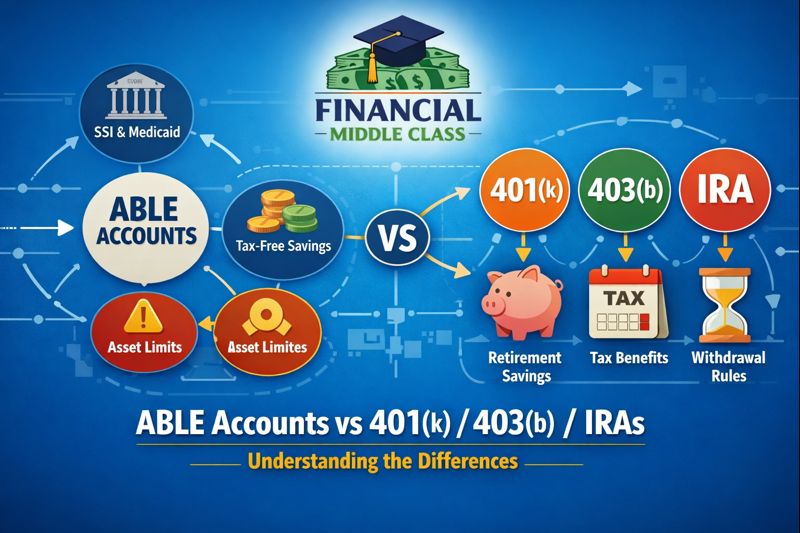
ABLE accounts vs. 401(k), 403(b), and IRAs (Roth + Traditional)
By Article Posted by Staff Contributor
The estimated reading time for this post is 892 seconds
ABLE Accounts vs 401(k), 403(b), Roth IRA, and Traditional IRA: What Actually Matters
A benefits-safe savings tool is not the same thing as a retirement engine. If you mix them up, you can accidentally lose money, lose benefits, or both.
Topic: Disability + Benefits + Retirement
Read time: ~12–15 minutes
Last updated:
December 29, 2025 — includes the 2026 ABLE eligibility expansion (age-of-onset to 46) and current IRS/SSA limits referenced below.
Too many of you hear “tax-advantaged” and immediately ask the wrong question: “Which account is best?”
The real question is: best for what job?
An ABLE account was built for a specific mission: letting eligible people with disabilities save and spend for disability-related needs without blowing up means-tested benefits like SSI and Medicaid. That’s a different mission than a 401(k), 403(b), or IRA — which are built to fund retirement.
Key Takeaways (read this if you’re busy)
- ABLE is not a “better IRA.” It’s a benefits-friendly life fund for qualified disability expenses (QDEs). (SSA + law list QDE categories.)
- 2026 change: ABLE eligibility expands to people whose disability began before age 46 (up from before 26). Effective January 1, 2026.
- SSI rule: Up to $100,000 in ABLE funds is disregarded for SSI resource counting; above that can suspend SSI (not terminate).
- Housing timing matters: ABLE distributions kept into the next month can count as a resource — especially for housing/non-QDEs.
- 2026 ABLE annual contribution cap: $20,000 (separately inflation-adjusted for 2026).
- 2026 retirement limits: 401(k)/403(b) elective deferrals $24,500; IRA contributions $7,500.
Table of Contents
- Pick Your Lane (who this is for)
- The 15-second truth: ABLE vs retirement accounts
- ABLE eligibility + the 2026 expansion
- Qualified Disability Expenses (QDE): what counts
- SSI + Medicaid rules you can’t afford to get wrong
- The housing timing rule (the most common mistake)
- ABLE vs 401(k)/403(b)/Traditional IRA/Roth IRA (table)
- Order of operations: what to fund first (by lane)
- How to choose a state ABLE plan (checklist)
- ABLE-to-Work: extra contributions (when eligible)
- ABLE vs Special Needs Trust (SNT)
- Common mistakes + simple recordkeeping
- Case studies (real-life scenarios)
- FAQ
- Final word
Quick timeline (for context, not fluff)
- 2014: ABLE Act creates 529A ABLE accounts.
- SSA guidance: ABLE treatment in SSI includes the $100,000 SSI disregard for ABLE balances.
- January 1, 2026: eligibility expands to disability onset before age 46.
- 2026: IRS inflation adjustments include an ABLE annual contribution cap of $20,000.
Pick Your Lane: Who This Guide Is For
If your situation changes, your “best account” changes. So choose the lane that matches real life:
Lane 1 — You’re on SSI/Medicaid (or you need to stay eligible)
You care less about “maximizing returns” and more about not getting cut off from lifeline benefits while still having money for life.
Lane 2 — You’re not on benefits, but disability-related costs are real
You may still use ABLE, but you’re usually going to prioritize retirement accounts first — because you’re not fighting SSI resource limits.
Lane 3 — Parent/caregiver planning for someone else
You’re trying to avoid the classic tragedy: leaving money that accidentally disqualifies your loved one from benefits.
Lane 4 — You’re mainly optimizing retirement, but ABLE is in the mix
You want clean rules: match, taxes, penalties, withdrawal flexibility — and where ABLE fits without confusion.
Truth check:ABLE is a tool for disability-related living + benefits compatibility. Retirement accounts are tools for retirement. Stop forcing one tool to do two jobs.
The 15-Second Truth: ABLE Is a Benefits-Safe Life Fund (Not a Retirement Replacement)
ABLE account: a tax-advantaged account under Section 529A for eligible individuals to pay qualified disability expenses (QDEs). If distributions are used for QDEs, they’re tax-free.
401(k)/403(b)/IRA: retirement accounts designed to build long-term retirement savings, with tax breaks tied to retirement-focused rules (and usually penalties for early use).
Simple translation: ABLE helps you live with stability. Retirement accounts help you retire with dignity.
ABLE Eligibility (Including the 2026 Expansion)
ABLE eligibility isn’t about your income. It’s about when the disability began (age of onset) and whether you meet the definition of disability/blindness.
2026 update (big deal):Starting January 1, 2026, the maximum age of disability onset for ABLE eligibility expands to before age 46 (previously before 26).
How people typically qualify
- Already receiving disability benefits (like SSI/SSDI based on disability/blindness), or
- Disability certification that meets the law’s requirements.
Qualified Disability Expenses (QDE): What Counts
The definition is intentionally broad: QDEs are expenses related to the eligible individual’s disability/blindness made for the beneficiary’s benefit — including categories like education, housing, transportation, health, assistive tech, and more.
What this looks like in real life
- Housing: rent, mortgage, utilities
- Transportation: rides, vehicle modifications, transit costs
- Health: therapies, copays, prevention/wellness services
- Assistive technology: devices + related services
- Financial management & administrative services: fees and support services that help manage life
- Legal fees, oversight/monitoring, funeral/burial
“Good vs questionable” spending examples
- Good: therapy copay, wheelchair repair, rent paid the same month funds are distributed, accessible transportation.
- Questionable: random non-disability shopping with no connection to “health, independence, or quality of life.” (If audited, you’re the one proving it.)
If you want a decision guide with examples, ABLE NRC provides a QDE decision framework.
The Benefits Section: SSI + Medicaid Rules You Can’t Afford to Get Wrong
The resource limit problem (plain English)
SSI has strict countable resource limits — generally $2,000 for an individual and $3,000 for a couple.
That’s why people get trapped: you can’t build a cushion without risking ineligibility.
The ABLE cushion (why it exists)
SSA rules generally disregard up to $100,000 in an ABLE account for SSI resource purposes. Amounts above $100,000 can count as resources and may suspend SSI if total countable resources exceed the limit — but SSA notes SSI can be reinstated when resources drop back under the limit.
What about Medicaid if SSI is suspended?
ABLE guidance commonly notes that Medicaid can continue if SSI is suspended due to ABLE balances over $100,000, as long as the person remains otherwise eligible.
Medicaid payback (the part people avoid talking about)
Upon the beneficiary’s death, states can file a claim against remaining ABLE funds (after outstanding QDEs) up to the amount of Medicaid medical assistance paid after the ABLE account was established (net of certain premiums).
Translation:ABLE is powerful — but it’s not a “hide money forever” account. It’s a “live better while protecting benefits” account.
The Housing Timing Rule (The Most Common ABLE Mistake)
Here’s the trap: ABLE distributions are not income — they’re treated as a resource converted from one form to another. And those distributions can still count as a resource if retained into the following month, especially for housing or non-QDE spending.
The simple rule that keeps you safe
If it’s for housing:Pull the ABLE funds and pay housing costs in the same month. If you carry that cash into the next month, it can be counted as a resource.
A quick example
- Safer: Withdraw on March 10 → pay rent March 28 (same month).
- Risky: Withdraw on March 28 → rent is due April 1 → the money sits into April and can count as a resource.
ABLE vs 401(k), 403(b), Traditional IRA, Roth IRA (Side-by-Side)
| Feature | ABLE (529A) | 401(k) / 403(b) | Traditional IRA | Roth IRA |
|---|---|---|---|---|
| Main job | Benefits-friendly savings/spending for QDEs | Workplace retirement savings | Retirement savings (individual) | Retirement savings (individual, tax-free qualified withdrawals) |
| Who it’s for | Eligible individual (disability onset before 46 starting 2026) | Employees (plan rules vary) | Individuals (deduction may depend on income/plan coverage) | Individuals (contribution eligibility depends on income limits) |
| 2026 contribution limit | $20,000 annual aggregate contribution cap for 2026 | $24,500 elective deferral limit (2026) | $7,500 IRA limit (2026): | $7,500 IRA limit (2026): |
| Tax treatment | Tax-free if used for QDEs; non-QDE distributions can be taxable and face a 10% additional tax on includible income: | Traditional: pretax + taxable later. Roth option: after-tax + tax-free qualified withdrawals (plan dependent) | Often pretax (if deductible) + taxable later | After-tax contributions + tax-free qualified withdrawals |
| Early-use “penalty vibe” | No “retirement age” lock, but must be QDE to stay tax-free; non-QDE can trigger tax + extra 10% on includible portion: | Usually penalties/taxes for early withdrawals, with exceptions | Penalties/taxes may apply before age thresholds, with exceptions | Rules vary; contributions vs earnings treatment differs |
| Benefits impact (the big one) | Up to $100,000 disregarded for SSI resource counting; housing timing matters: | May count as a resource depending on program and accessibility rules | May count as a resource depending on program rules | May count as a resource depending on program rules |
Don’t miss this: If you’re on SSI/Medicaid, “the best account” is often the one that won’t get you kicked out of eligibility. That’s the entire reason ABLE exists.
Order of Operations: What to Fund First (Based on Your Lane)
Lane 4 / Lane 2: You’re working and not dependent on SSI resource limits
- Get the employer match in your 401(k)/403(b). That’s free money.
- Build emergency stability (cash cushion). If disability expenses are significant, consider ABLE as a dedicated bucket.
- Then IRA (Traditional or Roth depending on taxes and eligibility).
- Then go back and increase workplace contributions for retirement.
Lane 1: You’re on SSI/Medicaid or must remain eligible
- ABLE for stability first (your life fund).
- Then workplace match if it doesn’t create benefit problems and you can keep things compliant.
- Then retirement accounts with caution — because accessibility and resource rules can get complicated fast.
Lane 3: Parent/caregiver
- ABLE for day-to-day quality of life (when eligible).
- Trust planning when large gifts/inheritance/settlement money is involved (see SNT section).
- Document everything (keep spending simple and provable).
How to Choose a State ABLE Plan (Checklist)
ABLE plans are run by states. Features and fees vary. Don’t pick blindly.
- Fees: account fees + investment expense ratios (silent killers over time)
- Investment options: does the plan match the risk tolerance?
- Banking features: debit card, bill pay, easy transfers
- Residency rules: many plans allow out-of-state enrollment, but check
- State tax perks: some states offer deductions/credits for in-state plans
- Usability: if it’s annoying to use, you won’t use it well
Street-smart advice: Pick the plan you can actually manage monthly. A “perfect” plan that you never use correctly is a bad plan.
ABLE-to-Work: Extra Contributions (When Eligible)
ABLE-to-Work can let a working ABLE beneficiary contribute above the normal annual ABLE cap — but only in specific circumstances.
Who typically qualifies for ABLE-to-Work?
- Working beneficiary, and
- Generally not participating in an employer-sponsored retirement plan for the year (plan contribution rules matter), and
- Extra contribution is limited (commonly tied to the prior year’s federal poverty guideline or compensation).
ABLE-to-Work rules are technical; if you’re relying on it to stay benefits-safe, verify with your ABLE plan materials and a benefits specialist.
ABLE vs Special Needs Trust (SNT): When You Need Which
ABLE works best when…
- You need a spendable, disability-focused bucket for life expenses
- Savings are modest-to-moderate (not a multi-hundred-thousand inheritance strategy)
- You want the beneficiary to have control and flexibility
A Special Needs Trust becomes important when…
- There’s a large settlement, inheritance, or structured gift
- You need tighter control over distributions
- You’re doing multi-decade planning with bigger money and more complexity
Real talk:Many families use both: ABLE for day-to-day quality of life, trust for large/long-term assets.
Common Mistakes (and How to Avoid Them)
- Mistake: Treating ABLE like a retirement account.
Fix: Use it for disability-related life needs and benefits safety. - Mistake: Ignoring the housing timing rule.
Fix: Pay housing expenses in the same month you distribute. - Mistake: Skipping the employer match.
Fix: Match first (in most lanes) because it’s instant ROI. - Mistake: No receipts, no categories, no proof.
Fix: Use a simple log (below).
Simple recordkeeping system (no perfection required)
The “ABLE spending log” (5 columns):
Date • Amount • Category (QDE type) • What it paid for • Proof (receipt/bill screenshot)
That’s it. If the IRS ever asks questions, you’re not trying to remember 18 months later. You’re showing your log.
Case Studies (So This Feels Real)
Case A — On SSI/Medicaid: building stability without losing benefits
Jordan receives SSI and Medicaid. The $2,000 resource limit makes it almost impossible to save.
Jordan uses ABLE as the “life fund” bucket. Up to $100,000 in ABLE is disregarded for SSI resource counting, which creates room to breathe.
Jordan learns the hard part: when pulling money for rent, they distribute and pay rent in the same month to avoid the housing timing trap.
Case B — Not on benefits: optimizing retirement and using ABLE only when relevant
Taylor isn’t on SSI/Medicaid but has consistent disability-related expenses. Taylor grabs the employer match in a 401(k), then maxes an IRA if eligible, and keeps ABLE as a dedicated “disability costs” bucket to simplify spending and recordkeeping.
ABLE isn’t the retirement engine here — it’s a targeted life tool.
FAQ
Can I have an ABLE account and a 401(k)/403(b)/IRA at the same time?
Yes — many people do. The real issue is purpose and rules: ABLE is for QDE spending and benefits compatibility, while retirement accounts are for retirement. If you’re on SSI/Medicaid, confirm how retirement assets are treated under the program rules you’re subject to.
What’s the 2026 ABLE eligibility change in one sentence?
Starting January 1, 2026, ABLE expands to people whose disability began before age 46 (previously before age 26).
How much can be contributed to ABLE in 2026?
The IRS inflation adjustments include a 2026 annual aggregate ABLE contribution limit of $20,000.
How much can I contribute to a 401(k)/403(b) and IRA in 2026?
For 2026, the IRS announced $24,500 for 401(k)/403(b) elective deferrals and $7,500 for IRAs.
What counts as a Qualified Disability Expense (QDE)?
The law lists broad categories like education, housing, transportation, employment training/support, assistive technology and services, health, prevention/wellness, financial management/admin services, legal fees, oversight/monitoring, funeral/burial, and other approved expenses.
Does ABLE affect SSI?
SSA generally disregards up to $100,000 in an ABLE account for SSI resource counting; amounts above can count as resources and may suspend SSI if total resources exceed the SSI limit.
Explain the housing timing rule like I’m five.
If you pull ABLE money for rent, don’t let it “sit” into next month. Pay housing costs in the same month you withdraw/distribute, because retained distributions can count as a resource in the next month.
What happens if ABLE money is used for non-QDE spending?
The portion includible in income can be taxed, and the law imposes an additional 10% tax on the includible amount (with certain exceptions).
Is there Medicaid payback with ABLE?
Yes. The statute allows a state to file a claim after the beneficiary’s death against remaining ABLE funds (after outstanding QDEs), up to the amount of Medicaid medical assistance paid after the ABLE account was established (net of certain premiums).
Related Reads:
APR vs. APY, Revolving Debt, and the Interest Games Lenders Play
The 10 strategies that actually lower your mortgage rate
Final Word
Stop trying to force one account to do two jobs.
If you’re on SSI/Medicaid: ABLE is often the difference between living fragile and living stable. Respect the rules (especially housing timing), keep receipts, and use ABLE the way it was designed.
If you’re not on benefits: your retirement accounts are usually your engine. ABLE can still be useful — but as a targeted bucket for disability-related quality-of-life spending, not as your main retirement strategy.
Comment prompt (to drive engagement):Which lane are you in — SSI/Medicaid, not on benefits, or caregiver planning — and what’s the one rule about ABLE you wish someone had explained earlier?
Want a bonus upgrade? I can turn the “ABLE spending log” into a downloadable template (Google Sheet style) and add a short decision-tree graphic for the top of the post.


RELATED ARTICLES
Cash Strategy: Put Every Dollar in the Right Place
Your checking account, emergency fund, short-term savings, and investments should not be managed the same way. This cash strategy helps assign every dollar to the right financial job.
Best HYSA: How to Choose Beyond the Highest APY
A competitive interest rate matters, but it is only one part of choosing a high-yield savings account. Compare insurance, fees, access, transfer speed, and promotional conditions.
Leave Comment
Cancel reply
Gig Economy
Business / Aug 08, 2026
The Missing Middle in Black Entrepreneurship
Black entrepreneurship has expanded dramatically. The next challenge is helping more Black-owned businesses move from self-employment to employer firms and sustainable scale.
By FMC Editorial Team
Personal Finance / Aug 01, 2026
Cash Strategy: Put Every Dollar in the Right Place
Your checking account, emergency fund, short-term savings, and investments should not be managed the same way. This cash strategy helps assign every dollar to the right...
By Article Posted by Staff Contributor
Personal Finance / Aug 01, 2026
Best HYSA: How to Choose Beyond the Highest APY
A competitive interest rate matters, but it is only one part of choosing a high-yield savings account. Compare insurance, fees, access, transfer speed, and promotional conditions.
By Article Posted by Staff Contributor
Personal Finance / Aug 01, 2026
High-Yield Savings vs. CDs, Treasury Bills, and Other Safe Places for Cash
High-yield savings accounts are excellent for accessible cash, but they are not always the best choice. Compare HYSAs, CDs, Treasury bills, money market accounts, and I...
By Article Posted by Staff Contributor
American Middle Class / Aug 01, 2026
High-Yield Savings Accounts: A Safer Home for Your Cash
A high-yield savings account can pay several times the national savings rate while keeping qualified deposits federally insured. Here is how it works, what to watch...
By Article Posted by Staff Contributor
Real Estate / Jul 30, 2026
Mortgage Lock-In Is Freezing the Housing Market
Millions are trapped by 3% mortgages. Learn how mortgage lock-in worsens affordability—and why homeowners are renovating instead.
By FMC Editorial Team
Real Estate / Jul 26, 2026
Is South Florida More Expensive Than New York? The Complete 2026 Relocation Guide
Is South Florida more expensive than New York? Compare housing, taxes, insurance and 104 municipalities before you move.
By Article Posted by Staff Contributor
Personal Finance / Jul 25, 2026
The Time Value of Life Experiences: What Compound Interest Leaves Out,
Money compounds, but life experiences do too. Explore what compound interest leaves out—and how to balance saving with living.
By MacKenzy Pierre
American Middle Class / Feb 18, 2026
How Wealth Is Passed Across Generations in the United States: Mechanisms, Evidence, and the Policy Debate
How wealth passes between generations—trusts, taxes, and the debate. Get the facts, figures, and tradeoffs. Read now.
By FMC Editorial Team
American Middle Class / Feb 16, 2026
The S&P 7,000: How Wall Street Disconnects from Main Street
S&P 7,000 can rise while wages, benefits, and towns fall behind. See why the market isn’t the economy—read now.
By MacKenzy Pierre
Latest Reviews
Business / Aug 08, 2026
The Missing Middle in Black Entrepreneurship
Black entrepreneurship has expanded dramatically. The next challenge is helping more Black-owned businesses move from...
Personal Finance / Aug 01, 2026
Cash Strategy: Put Every Dollar in the Right Place
Your checking account, emergency fund, short-term savings, and investments should not be managed the same...
Personal Finance / Aug 01, 2026
Best HYSA: How to Choose Beyond the Highest APY
A competitive interest rate matters, but it is only one part of choosing a high-yield...