
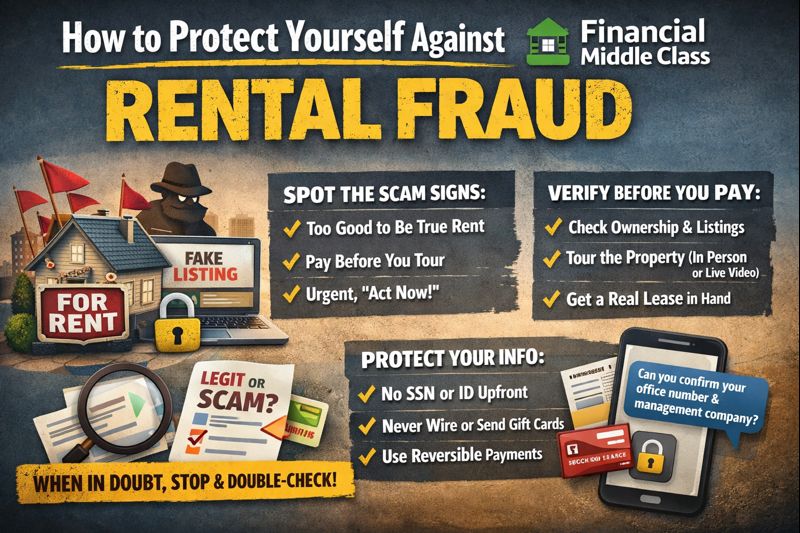
How to Protect Yourself Against Rental Fraud (Without Losing Your Deposit, Your Identity, or Your Mind)
By Article Posted by Staff Contributor
The estimated reading time for this post is 690 seconds
Key Takeaways (Read This Before You Apply)
- Verify the property and the person before you send money or documents.
- No tour + no lease review = no payment. Pressure is the tell.
- Protect your identity like cash. SSN and ID come late in a legitimate process.
- Payment method reveals intent. Wire, gift cards, and crypto are “cash with no undo.”
- Ten minutes of checks can save months of cleanup.
Rental Fraud Timeline: What to Do (And When)
Phase 1 — Before You Tour
- Search the address and compare listings. If the contacts or prices don’t match, pause.
- Verify the owner/manager using contact info you find independently (not the DM).
- Clock the vibe: urgency + discount rent is a scammer’s favorite perfume.
Phase 2 — Before You Apply
- Tour in person or insist on a live video walkthrough (real-time, not a recycled clip).
- Refuse credit-score screenshots and mystery links.
- Share only basic info until the property and person are verified.
Phase 3 — Before You Pay
- Review the lease first. No lease, no money.
- Avoid cash-like payments (wire, gift cards, crypto, “friends & family”).
- Pay only to a verified owner/company name that matches the lease and the listing.
Phase 4 — If Something Feels Off (First 24 Hours)
- Contact your bank/payment platform immediately and report fraud.
- Save screenshots, messages, receipts, and the listing URL.
- Report the scam to the platform and file a fraud report for a paper trail.
How to Protect Yourself Against Rental Fraud (Without Losing Your Deposit, Your Identity, or Your Mind)
You know the moment. You finally find a place that looks livable.
Not luxury. Not “resort-style amenities.” Just safe, clean, close enough to work, and priced at a number that doesn’t make you re-run your budget like it’s a crime scene.
And then the modern plot twist hits: it might not even be real.
Rental fraud isn’t a niche problem anymore. It’s a predictable tax on people who are rushed. Middle-class people don’t apartment-hunt for entertainment. You do it because the lease is up, the rent jumped again, the relationship changed, the job moved, the kid needs a different school zone, or your mortgage dream got body-slammed by rates.
Scammers know you’re not careless. You’re tired. That’s the opening.
Why Rental Scams Work Right Now
Rental scams work because they don’t require you to be reckless. They only require you to be under pressure.
Here’s the formula:
- Pressure: You need housing on a deadline.
- Speed: “Act now” short-circuits verification.
- Distance: Even in-town renters are touring via phone screens and lunch breaks.
That’s why rental fraud shows up hard in social feeds and group chats—places built for fast decisions, not careful ones.
The Rental Scam Playbook (What They Do, In Plain English)
1) The fake listing
A place that doesn’t exist, isn’t for rent, or was never available. The listing is the bait. Your payment is the catch.
2) The hijacked listing
They copy a real listing and swap in their contact info. The home is real. The “landlord” isn’t.
3) The “hold it now” deposit
They manufacture urgency: “I have three applicants.” “First deposit takes it.” They’re not trying to rent. They’re trying to get paid before you think.
4) The credit score screenshot trap
They tell you to send a credit-score screenshot or click a “quick credit check” link. It sounds normal because screening is normal. The scam is the shortcut and the pressure.
5) Identity harvest
They ask for your SSN, ID photo, paystubs—your whole life in PDF form—before you’ve verified anything. If the deposit doesn’t land, your identity might.
6) The self-tour illusion
This one is nasty because it feels legitimate. You might even walk through the property. But a tour doesn’t prove you’re dealing with the actual owner/manager. It only proves the walls exist.
7) Roommate/sublet/lease-takeover scams
“I’m moving out early, just send the deposit and I’ll add you to the lease.” That line has drained more wallets than people want to admit.
8) The fake lease theater
They send polished PDFs and signatures to look official. Scammers love paperwork because people trust paperwork.
What a Legit Rental Process Looks Like (So You Can Spot What’s Off)
A legitimate rental process is boring. That’s a compliment.
Tour → Apply → Screening → Lease review/sign → Pay → Keys
Yes, real landlords can move fast. Yes, they can be strict. But “fast” is different from “pay first, details later.” If the process starts with money and ends with answers, you’re not renting. You’re donating.
The 10-Minute Verification Checklist (For People With Jobs)
Before you fall in love with the photos, do this. Ten minutes now can save you months of cleanup later.
- Search the address and compare listings. Same address + different price/contact info = problem.
- Check if it’s listed for sale. Scammers love “for sale” photos because they’re high quality and public.
- Compare the rent to the neighborhood. If it’s wildly low, assume bait until proven otherwise.
- Verify the owner/manager independently (website, office line, property management directory).
- Tour in person or do a live video walkthrough. Real-time. Real unit. Real answers.
- No sensitive documents yet. You’re scheduling a tour, not applying for citizenship.
- No payment before lease review. If they won’t send a lease for review, keep moving.
Legit Listing vs Scam Listing (Side-by-Side)
| What you notice | Legit listing | Scam listing |
|---|---|---|
| Price | In the area’s normal range (even if it’s painful) | “Too good to be true” cheap |
| Touring | Clear options: in-person or live video | Dodges touring, excuses, or pressure to pay to “hold it” |
| Contact | Verifiable company/owner info | DM-only, random email, refuses verification |
| Screening | Standard application process | Credit-score screenshots, sketchy links, urgency |
| Payments | Lease first; receipts; normal methods | Wire, gift cards, crypto, “friends & family,” rush tactics |
| Consistency | Details match across platforms | Same address shows different prices/contacts elsewhere |
| Story | Simple, verifiable, process-based | “Out of town,” emotional pressure, “I’m doing you a favor” |
Payment Methods Ranked by Risk & Recoverability
Here’s the truth: some payment methods are basically cash with extra steps. If the “landlord” insists on the least reversible method, that’s not a preference. That’s intent.
| Payment method | Risk | Recoverability | Middle-class move |
|---|---|---|---|
| Credit card (fees where accepted) | Low–Medium | Better dispute options | Use only after verification + lease review |
| Check (to verified owner/company) | Medium | Varies | Pay only to a name that matches lease + ownership |
| ACH / bank transfer | Medium–High | Hard to reverse | Only after lease is signed and payee is verified |
| Zelle/Cash App/“friends & family” | High | Often limited | Avoid for deposits to strangers |
| Wire transfer | Very high | Usually unrecoverable | Walk away |
| Gift cards | Very high | Essentially none | Walk away |
| Cryptocurrency | Very high | Essentially none | Walk away |
Protect Your Personal Information (Because Scams Don’t Stop at Money)
Your documents are currency now. Not metaphorically. Literally.
Before you’ve verified the property and the person renting it, a stranger does not need your Social Security number. They don’t need a photo of your ID. They don’t need paystubs. They definitely don’t need “just a quick screenshot” of anything.
A safer document-sharing timeline
- Before verification: Name, phone, general move-in window. That’s it.
- After you’ve toured/verified: Standard application basics, cautiously.
- Only in a legitimate screening step: SSN and sensitive details—through an established process, not a random email thread.
Being “helpful” with extra documents is how people get hurt. You’re not being difficult. You’re being responsible.
Remote Renting Without Getting Burned (Relocation Edition)
If you’re moving from another city or state, scammers assume you can’t verify anything. Prove them wrong.
Insist on a live walkthrough
Live video. Real time. Have them show unit details and something location-specific (entry, unit number, street sign). Pre-recorded tours are easy to recycle.
Verify the company outside the conversation
Call the property management office using a publicly listed number you find yourself. Don’t rely on the number that texted you.
Lease first, always
If they won’t let you review the lease before payment, you’re not looking at a “strict process.” You’re looking at a trap door.
Roommate/Sublet/Lease-Takeover Scams (The Group Chat Trap)
This one hits people because it sounds casual. Familiar. “A friend of a friend.” That’s the camouflage.
Here’s the rule that saves you: If the landlord/property manager hasn’t confirmed you in writing, you’re not on the lease.
No confirmation = no deposit. No keys. No “I’ll add you later.” Later is where money disappears.
Copy/Paste Scripts (Because Pressure Makes People Freeze)
Script 1 — Verify the landlord/property manager
Script 2 — Push back on paying before touring
Script 3 — Shut down the credit-score screenshot request
Script 4 — Remote renting (live walkthrough request)
These scripts aren’t rude. They’re adult. Scammers don’t like adults.
If You Get Scammed: The 24-Hour Damage Control Plan
First: don’t do shame. Shame keeps scams quiet and repeatable.
If you sent money
- Contact your bank/payment platform immediately. Speed is your best weapon.
- Save everything: screenshots, messages, listing URL, payment confirmations.
- Report the listing on the platform where you found it.
- File a fraud report so there’s a paper trail.
If you sent personal documents
- Assume your identity is at risk and act like it.
- Write down exactly what you sent and when.
- Monitor your credit activity and accounts closely.
- Report it to create a record if damage shows up later.
Middle-class life doesn’t have room for “learning experiences” that cost four figures. That’s why we move fast.
FAQ
Is it ever normal to pay before seeing the unit?
In most legitimate rentals, you tour first (or do a live video walkthrough), review the lease, then pay. If you’re being pushed to pay before verification, treat that as a stop sign.
How can I verify who owns the property quickly?
Start with the address: search it online, compare listings, and check local property/tax records if available. Then verify the owner/manager using contact info you find independently—not the number in the DM.
What info should I never send before touring?
Don’t send your SSN, a photo of your ID, paystubs, or credit score screenshots before you’ve verified the property and the person renting it. That’s how deposit scams become identity scams.
Are self-guided tours always scams?
Not always. Some legitimate managers use self-tour systems. The risk is when the person demanding money can’t be verified as the actual owner/manager and refuses a normal lease process.
Why do scammers ask for credit score screenshots?
Because it sounds normal, it lowers your guard, and it can be used to push you into sketchy links or harvest personal details. A legit process doesn’t need screenshots and urgency.
What payment methods should I refuse?
Refuse cash-like methods—wire transfers, gift cards, crypto, and “friends & family” transfers. Use methods that provide receipts and dispute options, and only after verification and lease review.
How do I rent safely from another city or state?
Insist on a live video walkthrough, verify the company via a publicly listed number, review the lease before paying, and avoid irreversible payment methods. Remote renting requires extra proof, not extra trust.
If I already paid, what do I do in the first 24 hours?
Contact your bank/payment platform immediately, save every receipt and message, report the listing to the platform, and file a fraud report so there’s a record. Fast action is your best chance to limit damage.
Related Reads:
APR vs. APY, Revolving Debt, and the Interest Games Lenders Play
The 10 strategies that actually lower your mortgage rate
The Truth That Hits Home
Rental scams don’t work because you’re careless.
They work because you’re tired.
Housing is expensive. Time is tight. Life changes fast. And the middle class gets forced to make big decisions under small deadlines.
So keep this line in your pocket:
If a rental requires you to rush, pay, or overshare before you can verify the basics, it’s not an opportunity. It’s a trap—built for people who can’t afford a mistake.
Quick question for you
What’s the most suspicious thing you’ve ever seen in a rental listing—or what’s your personal rule for not getting scammed?


RELATED ARTICLES
Cash Strategy: Put Every Dollar in the Right Place
Your checking account, emergency fund, short-term savings, and investments should not be managed the same way. This cash strategy helps assign every dollar to the right financial job.
Best HYSA: How to Choose Beyond the Highest APY
A competitive interest rate matters, but it is only one part of choosing a high-yield savings account. Compare insurance, fees, access, transfer speed, and promotional conditions.
Leave Comment
Cancel reply
Gig Economy
Business / Aug 08, 2026
The Missing Middle in Black Entrepreneurship
Black entrepreneurship has expanded dramatically. The next challenge is helping more Black-owned businesses move from self-employment to employer firms and sustainable scale.
By FMC Editorial Team
Personal Finance / Aug 01, 2026
Cash Strategy: Put Every Dollar in the Right Place
Your checking account, emergency fund, short-term savings, and investments should not be managed the same way. This cash strategy helps assign every dollar to the right...
By Article Posted by Staff Contributor
Personal Finance / Aug 01, 2026
Best HYSA: How to Choose Beyond the Highest APY
A competitive interest rate matters, but it is only one part of choosing a high-yield savings account. Compare insurance, fees, access, transfer speed, and promotional conditions.
By Article Posted by Staff Contributor
Personal Finance / Aug 01, 2026
High-Yield Savings vs. CDs, Treasury Bills, and Other Safe Places for Cash
High-yield savings accounts are excellent for accessible cash, but they are not always the best choice. Compare HYSAs, CDs, Treasury bills, money market accounts, and I...
By Article Posted by Staff Contributor
American Middle Class / Aug 01, 2026
High-Yield Savings Accounts: A Safer Home for Your Cash
A high-yield savings account can pay several times the national savings rate while keeping qualified deposits federally insured. Here is how it works, what to watch...
By Article Posted by Staff Contributor
Real Estate / Jul 30, 2026
Mortgage Lock-In Is Freezing the Housing Market
Millions are trapped by 3% mortgages. Learn how mortgage lock-in worsens affordability—and why homeowners are renovating instead.
By FMC Editorial Team
Real Estate / Jul 26, 2026
Is South Florida More Expensive Than New York? The Complete 2026 Relocation Guide
Is South Florida more expensive than New York? Compare housing, taxes, insurance and 104 municipalities before you move.
By Article Posted by Staff Contributor
Personal Finance / Jul 25, 2026
The Time Value of Life Experiences: What Compound Interest Leaves Out,
Money compounds, but life experiences do too. Explore what compound interest leaves out—and how to balance saving with living.
By MacKenzy Pierre
American Middle Class / Feb 18, 2026
How Wealth Is Passed Across Generations in the United States: Mechanisms, Evidence, and the Policy Debate
How wealth passes between generations—trusts, taxes, and the debate. Get the facts, figures, and tradeoffs. Read now.
By FMC Editorial Team
American Middle Class / Feb 16, 2026
The S&P 7,000: How Wall Street Disconnects from Main Street
S&P 7,000 can rise while wages, benefits, and towns fall behind. See why the market isn’t the economy—read now.
By MacKenzy Pierre
Latest Reviews
Business / Aug 08, 2026
The Missing Middle in Black Entrepreneurship
Black entrepreneurship has expanded dramatically. The next challenge is helping more Black-owned businesses move from...
Personal Finance / Aug 01, 2026
Cash Strategy: Put Every Dollar in the Right Place
Your checking account, emergency fund, short-term savings, and investments should not be managed the same...
Personal Finance / Aug 01, 2026
Best HYSA: How to Choose Beyond the Highest APY
A competitive interest rate matters, but it is only one part of choosing a high-yield...