
Starting a Nonprofit Is Easy. Starting the Right Nonprofit Is the Hard Part.
By Article Posted by Staff Contributor
The estimated reading time for this post is 880 seconds
Last updatedJanuary 13, 2026 — Updated for IRS e-filing pathways (Pay.gov), the 501(c)(4) notice requirement, and a clearer “choose your lane” decision framework.
Nonprofit types aren’t vibes. They’re lanes.
If you only remember one thing, remember this: your mission is the heart, but your structure is the skeleton. Choose the lane that matches your primary activity—services, advocacy, elections, member dues, or grants—and the process gets dramatically less chaotic.
Quick lens: Services + deductible giving usually points toward a 501(c)(3). Advocacy-heavy work often points toward a 501(c)(4). Election activity belongs in 527/PAC territory. Member-dues orgs usually live in (c)(6) or (c)(7). Grants love clarity, governance, and clean books.
Starting a Nonprofit Is Easy. Starting the Right Nonprofit Is the Whole Game.
Somebody says, “Let’s start a nonprofit,” the way people say, “Let’s grab coffee.” Light. Casual. Like the hardest part is picking a logo.
Then you sit at your kitchen table at 11:47 p.m. staring at three tabs—state formation, IRS tax status, Pay.gov filings—and you realize this isn’t coffee. This is a system. And if you build the system wrong, the mission pays the price.
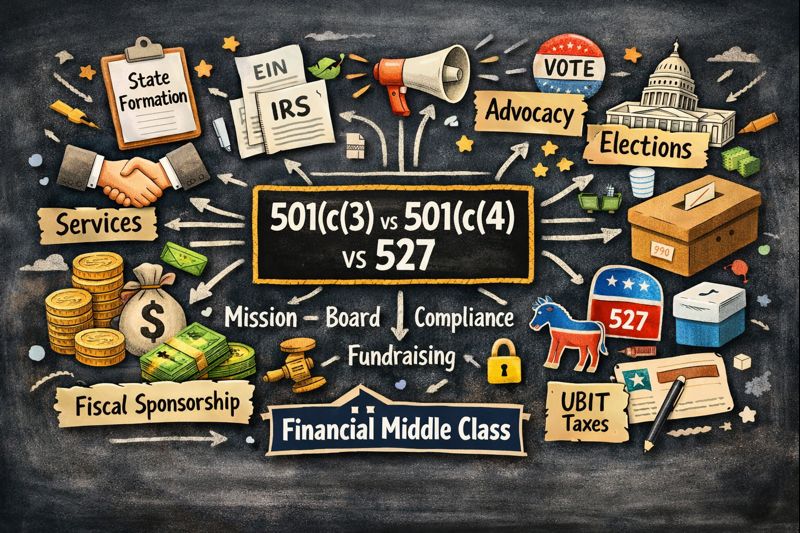
The problem isn’t that people want to help. The problem is that we use the word “nonprofit” like it’s one thing. It’s not. It’s a family of nonprofit types with different rules: 501(c)(3), 501(c)(4), 527, member-dues categories, and more. Your lane depends on what you’re actually trying to do: services, advocacy, elections, member dues, grants.
Note: This is informational and educational. It’s not legal or tax advice. If you’re making structural decisions, talk to nonprofit counsel and a CPA who understands exempt organizations.
Two Doors You Must Walk Through: State Formation vs IRS Tax Status
Here’s the first thing that clears the fog: “nonprofit” and “tax-exempt” are not synonyms. One lives in state law. The other lives in federal tax law.
Door one is your state. You form a nonprofit corporation (most common) or another nonprofit entity type, adopt governance rules, appoint decision-makers, and become a legal entity that can open accounts and sign contracts. Door two is the IRS. That’s where you’re recognized (or treated) as tax-exempt under a particular section of the Internal Revenue Code.
If you mix those doors up, you end up stuck: you can’t apply cleanly, you can’t explain what you are to a bank or a funder, and you keep using “we’re a nonprofit” as a substitute for “we have the correct structure.”
The Five Lanes: Services, Advocacy, Elections, Member Dues, Grants
Before you file anything, answer this like you plan to defend it: what is your primary activity most of the time? Not what you admire. Not what you might do “later.” What you actually do on regular days.
Services means direct help. Programs. Coaching. Food distribution. Financial literacy classes. The work where somebody’s life is better because you showed up.
Advocacy means change-the-system work. Public education, coalition building, lobbying, and community organizing. It’s a powerful lane—and a lane where people accidentally cross lines because they treat all “political” activity as one bucket.
Elections means influencing who wins office: endorsing candidates, opposing candidates, spending to support or attack candidates, coordinating with campaigns. That’s a separate lane with separate reporting expectations and often separate legal regimes beyond the IRS.
Member dues means you’re built around members who pay to belong: chambers, trade groups, professional associations, clubs. That’s not a “charity” model. It’s a membership model, and it matters because the structure should match the reality.
Grants isn’t a mission by itself. It’s a funding strategy. But it still shapes your choices because many grantmakers expect certain structures, governance discipline, and clean financial reporting before they take you seriously.
Choose Your Vehicle: 501(c)(3) vs 501(c)(4) vs 527 (and Friends)
Most people say “nonprofit” and mean “501(c)(3).” That’s the most common charity lane. But if your work is primarily advocacy or elections, forcing yourself into the 501(c)(3) box is how you build a compliance problem with a mission statement taped over it.
| Vehicle | Best for | Donation deductibility | Lobbying posture | Elections posture |
|---|---|---|---|---|
| 501(c)(3) | Services + charitable/educational work | Often deductible (classic “charity” expectation) | Can lobby within limits; needs guardrails | Candidate intervention is restricted |
| 501(c)(4) | Social welfare + advocacy-heavy work | Often not deductible as a charitable gift | Typically a stronger fit for lobbying | More room than c3, but not unlimited |
| 501(c)(6) | Trade/professional/business leagues | Not a charity model | Common | Depends on facts; dues rules can get technical |
| 501(c)(7) | Social/recreation clubs | Not a charity model | Not the point | Not the point |
| 527 | Election-focused political organizations | Not a charity model | Political by design | The point |
That table is the whole story in one glance. Everything else is the mechanics of launching what you just picked.
The Universal Launch Steps (Everyone Does This Part)
Every lane starts with the same adult steps. Skip these and you’re basically trying to build a plane in the air because you were excited about the destination.
First, write the quiet part out loud in one sentence: “We primarily do ______ for ______, funded mainly by ______, and we do/do not plan to engage in elections.” That sentence will expose your lane immediately and prevent you from choosing a structure based on what sounds respectable.
Next, form the entity under state law and act like you mean it. That means adopting basic governance rules, documenting who can approve spending, and building a paper trail that makes sense to banks, funders, auditors, and future board members.
Then get your EIN, open a bank account, and set up bookkeeping before you raise real money. Not because it’s cute, but because clean books are how you protect the mission when the organization grows beyond your personal memory.
Lane-Specific Forks: What You File Depends on What You Are
Now comes the fork where most people get it wrong. The lane you chose tells you what you’ll file, how you’ll fundraise, and what lines you can’t cross without consequences.
| If your org is mainly… | Typical lane | What you’re building | What you should be thinking about early |
|---|---|---|---|
| Direct programs and services | 501(c)(3) | Grant-friendly, donor-trust-friendly charity machine | Governance discipline, donor language, and political boundaries |
| Advocacy and lobbying | 501(c)(4) | Social welfare/advocacy engine | Disclosure language, political activity guardrails, and clean cost allocation |
| Electing/defeating candidates | 527 | Election-focused organization with disclosures | Reporting discipline and election-law compliance beyond the IRS |
| Membership representation (industry/profession) | 501(c)(6) | Trade/professional association | Dues structure, member benefits, and lobbying allocations |
| Member recreation/social | 501(c)(7) | Social club | Nonmember income exposure and clear membership boundaries |
Fiscal Sponsorship: Start Now, Formalize Later
Fiscal sponsorship is the option a lot of people ignore because they’re romanticizing incorporation. If you’re primarily doing services and you need to start now—especially if you want to accept grants or deductible donations—working under a reputable fiscal sponsor can be a practical bridge.
The key word is oversight. A real sponsor isn’t a donation pass-through. They’re taking responsibility for charitable funds and compliance, which is why sponsorship agreements should feel serious. If it feels like a casual handshake, that’s not a shortcut. That’s a future problem with your name on it.
Board Reality: Who You Need, What They Do, and How Boards Go Bad
A board is not a group chat with titles. It’s the legal adult in the room, whether you feel like an adult today or not.
Founders often recruit friends because they’re loyal and excited. Then the first real grant shows up. Or a staff issue. Or an angry donor. Suddenly the board is expected to govern an organization it barely understands. The fix is not “get fancier people.” The fix is a board culture that can read a budget, document decisions, manage conflicts of interest, and ask uncomfortable questions without taking it personally.
Money: Survival Budgeting + Fundraising Truth Serum
The first nonprofit budget most people write is optimism dressed as math. It assumes donors behave, grants arrive on time, and costs don’t surprise you. Reality loves to humble that kind of budget.
A survival budget separates program costs from admin and fundraising, respects that restricted money is not flexible money, and treats “overhead” as the place where compliance and continuity live. You don’t keep an organization alive with vibes. You keep it alive with cash flow discipline.
Then comes fundraising truth serum: you cannot borrow credibility from a structure you don’t actually have. If you’re not a charity-deductible giving lane, your fundraising language should not imply that you are. Even when the law doesn’t force a specific sentence for your exact facts, trust does. Donors give differently when they think they’re supporting a classic charity.
And yes, fundraising is not only an IRS conversation. Many states regulate charitable solicitation, and online fundraising can trigger multi-state considerations. If you’re asking the public for money, act like you’re operating in a regulated environment—because you are.
The Political Border Patrol: Education vs Lobbying vs Elections
Most nonprofit confusion lives here. “Advocacy” is not one thing. It’s layers.
Education is explaining issues, publishing research, hosting forums, and informing the public without telling them which candidate to support. Lobbying is influencing legislation—asking lawmakers to vote for or against specific bills, or urging the public to pressure lawmakers on legislation. Elections is candidate-focused activity—endorsements, opposition, campaign-style ads, and coordination that aims to influence who wins office.
If you blur those lines, you don’t just create compliance risk. You create donor risk. You create reputational risk. You create the kind of drama that makes the mission harder to deliver because every conversation turns into “Are you allowed to do that?”
If You Need Both: The c3 + c4 Sibling Structure (Without the Mess)
Some missions are both-and. You want grant-friendly services and serious advocacy muscle. That’s where organizations sometimes build a 501(c)(3) for charitable programs and a 501(c)(4) for heavier advocacy.
This can work beautifully, but only if you respect separation. Separate money. Separate accounting. A disciplined way to track staff time and shared costs. Clean agreements when one entity supports the other. If you treat two entities like one organization wearing two hats, your future self will pay for your present-day shortcuts.
Compliance Calendar: The Boring Part That Keeps You Alive
Tax-exempt doesn’t mean set-it-and-forget-it. It means you’ve signed up for ongoing filings, disclosures, and calendar discipline. If you treat compliance like a one-time chore, the organization becomes fragile the second you’re busy or the second key people leave.
Build the filing calendar early. Put it on recurring reminders. Document decisions. Keep receipts. Keep minutes. Keep the books clean. Boring is the goal. Boring is stability. Stability is how you serve people consistently instead of in bursts followed by burnout.
Side Income + UBIT: Tax-Exempt Doesn’t Mean Tax-Free
Modern nonprofits love creative revenue: merch, sponsorships, paid events, affiliate income, consulting. Some of that can fit. Some of that is taxable if it looks like a regular business unrelated to the exempt purpose. The point isn’t “don’t earn revenue.” The point is “don’t act surprised when revenue has rules.”
If you want diversified revenue, plan it like an adult: keep clean categories, document how it ties to the mission, and don’t let the tail wag the dog. When the business line becomes the main thing, the mission becomes the marketing.
Transparency + Trust: What the Public Can See
Nonprofits operate in a glass house. Donors will Google you. Journalists will read filings. A skeptical board member will ask hard questions at the worst possible time. Treat transparency as a feature, not a threat.
That means building systems you won’t be embarrassed to explain. It means writing fundraising language you can defend. It means running meetings that create a paper trail. Trust isn’t a vibe. It’s a record.
Pick Your Launch Timeline: 30 Days vs 90 Days vs 6 Months
Different missions have different urgency. The timeline that fits you depends on complexity, funding needs, and how quickly you expect scrutiny.
| Timeline | What’s realistic | Who it fits |
|---|---|---|
| 30 days | State formation, EIN, bank account, bookkeeping setup, basic governance rhythm | Small teams starting services with low complexity |
| 90 days | Everything above plus policies, compliance calendar, clean fundraising language, lane filings queued | Most founders who want to do it right without stalling |
| 6 months | Grant readiness, board rhythm, staffing systems, multi-state fundraising plan, c3+c4 separation if needed | Orgs expecting growth, scrutiny, and real money |
30-day launch: the “get it real” sprint
This is the timeline for teams that need a clean start fast. You form the entity, get the EIN, open the bank account, set up bookkeeping, and write down basic governance rules so decisions are documented. You begin early outreach and relationship-building immediately, but you avoid promising grant-scale operations before you have the infrastructure to back it up.
90-day launch: the “do it right without stalling” build
This is the sweet spot for most founders. You build the compliance calendar, adopt core policies, set up clean financial categories, and prepare the correct IRS pathway for your lane. This is also where you tighten fundraising language so you don’t mislead donors about deductibility or scope.
6-month launch: the “grant-ready machine” runway
This timeline fits organizations expecting real money and real scrutiny. You build grant readiness, board cadence, documentation habits, and staffing/contractor systems. If you need a two-entity model like c3 + c4 siblings, this is when you set up separation and cost allocation so you don’t blend operations and create avoidable risk.
FAQ
Is “nonprofit” the same as “tax-exempt”?
No. “Nonprofit” is typically a state-law entity status. “Tax-exempt” is an IRS classification. People form a nonprofit corporation and assume they’re automatically exempt; that’s how confusion starts.
Can a 501(c)(3) do advocacy?
Yes, depending on what you mean by advocacy. Nonpartisan education is different from lobbying, and lobbying is different from elections. The key is staying inside the rules for your lane and not letting restricted activity become the main thing.
Why do people create both a c3 and a c4?
Because some missions are both-and. A c3 can house charitable services and grant-friendly work, while a c4 can handle heavier lobbying and advocacy. The benefit is clarity; the risk is sloppiness if money, staff time, and messaging aren’t properly separated.
Do I have to apply to the IRS right away?
It depends on your lane and your funding plan. If you need deductible donations or grants quickly, you may need a c3 pathway or fiscal sponsorship. If you’re building advocacy infrastructure, you still need to handle your lane’s early requirements so you don’t create unnecessary compliance issues.
What’s the biggest mistake new organizations make?
They pick a structure based on what sounds respectable instead of what they actually plan to do. The second biggest mistake is treating compliance like a one-time chore instead of an operating cost.
Let’s talkIf you had to choose today, which lane fits your mission best—services, advocacy, elections, member dues, or grants—and what’s the one thing you’re most unsure about?


RELATED ARTICLES
The American Middle Class’s Guide to the 2026 Midterm Ballot Measures
The 2026 midterm elections will put major housing and tax proposals before American voters. From Florida's homestead exemptions to Massachusetts zoning reform and California's affordable housing initiatives, explore the potential effects on homeowners, renters, first-time buyers, and middle-class finances.
FICO Finally Has Competition. Will Homebuyers Get a Better Deal?
For decades, FICO dominated mortgage credit scoring. Now VantageScore 4.0 is challenging that dominance. Discover how new rules from federal housing regulators could affect mortgage approvals, borrowing costs, and financial opportunities for American homebuyers—and why a higher credit score doesn't...
Leave Comment
Cancel reply
Gig Economy
American Middle Class / Oct 16, 2026
The American Middle Class’s Guide to the 2026 Midterm Ballot Measures
The 2026 midterm elections will put major housing and tax proposals before American voters. From Florida's homestead exemptions to Massachusetts zoning reform and California's affordable housing...
By Article Posted by Staff Contributor
Personal Finance / Oct 14, 2026
FICO Finally Has Competition. Will Homebuyers Get a Better Deal?
For decades, FICO dominated mortgage credit scoring. Now VantageScore 4.0 is challenging that dominance. Discover how new rules from federal housing regulators could affect mortgage approvals,...
By Article Posted by Staff Contributor
American Middle Class / Oct 13, 2026
Selling Affordability Through Installments
Americans are increasingly buying based on what they can afford each month rather than what something actually costs. From buy now, pay later services to longer...
By Article Posted by Staff Contributor
American Middle Class / Oct 12, 2026
Fair Capitalism: We Don’t Need to Abolish Capitalism. We Need to Fix It.
Fair capitalism means preserving entrepreneurship and profits while ensuring working Americans share more meaningfully in the prosperity they help create.
By MacKenzy Pierre
American Middle Class / Oct 12, 2026
The Sunday Scaries: How Financial Independence Can Help You Reclaim Your Weekend
The Sunday Scaries can begin long before Monday morning. Building emergency savings, lowering monthly expenses, and increasing financial independence may help you reclaim your weekend.
By Article Posted by Staff Contributor
Business / Aug 08, 2026
The Missing Middle in Black Entrepreneurship
Black entrepreneurship has expanded dramatically. The next challenge is helping more Black-owned businesses move from self-employment to employer firms and sustainable scale.
By FMC Editorial Team
Personal Finance / Aug 01, 2026
Cash Strategy: Put Every Dollar in the Right Place
Your checking account, emergency fund, short-term savings, and investments should not be managed the same way. This cash strategy helps assign every dollar to the right...
By Article Posted by Staff Contributor
Personal Finance / Aug 01, 2026
Best HYSA: How to Choose Beyond the Highest APY
A competitive interest rate matters, but it is only one part of choosing a high-yield savings account. Compare insurance, fees, access, transfer speed, and promotional conditions.
By Article Posted by Staff Contributor
Personal Finance / Aug 01, 2026
High-Yield Savings vs. CDs, Treasury Bills, and Other Safe Places for Cash
High-yield savings accounts are excellent for accessible cash, but they are not always the best choice. Compare HYSAs, CDs, Treasury bills, money market accounts, and I...
By Article Posted by Staff Contributor
American Middle Class / Aug 01, 2026
High-Yield Savings Accounts: A Safer Home for Your Cash
A high-yield savings account can pay several times the national savings rate while keeping qualified deposits federally insured. Here is how it works, what to watch...
By Article Posted by Staff Contributor
Latest Reviews
American Middle Class / Oct 16, 2026
The American Middle Class’s Guide to the 2026 Midterm Ballot Measures
The 2026 midterm elections will put major housing and tax proposals before American voters. From...
Personal Finance / Oct 14, 2026
FICO Finally Has Competition. Will Homebuyers Get a Better Deal?
For decades, FICO dominated mortgage credit scoring. Now VantageScore 4.0 is challenging that dominance. Discover...
American Middle Class / Oct 13, 2026
Selling Affordability Through Installments
Americans are increasingly buying based on what they can afford each month rather than what...