
Gold, Silver, or Bitcoin? Start With the Job—Not the Hype
By Article Posted by Staff Contributor
The estimated reading time for this post is 554 seconds
Gold, Silver, or Bitcoin? Start With the Job—Not the Hype
Table of Contents
- The Shared Truth: They Don’t Pay You to Wait
- Side-by-Side: Gold vs Silver vs Bitcoin
- Gold: Insurance, Not Excitement
- Silver: Precious + Industrial
- Bitcoin: Venture Sleeve, Volatility-First
- Myth vs Reality
- Scenario Matrix
- Taxes & Ownership Plumbing
- Timeline: How This Debate Got Here
- Decision Framework
- Closing
- FAQ
You don’t ask this question when life feels stable.
You ask it when the world starts acting expensive and unpredictable—groceries up, insurance up, rates doing their little dance, and your group chat suddenly full of “hedge” takes from people who didn’t know what CPI stood for last year.
That’s when gold shows up. Silver shows up. And Bitcoin shows up—usually with the most confidence and the least calm.
Here’s the trap: most people treat these assets like a personality test. Like you’re supposed to pick the one that proves you’re smarter than the market.
Gold, silver, and Bitcoin aren’t identities. They’re tools. And if you buy the wrong tool for the job, you don’t just lose money—you lose money when you expected protection.
Key Takeaways
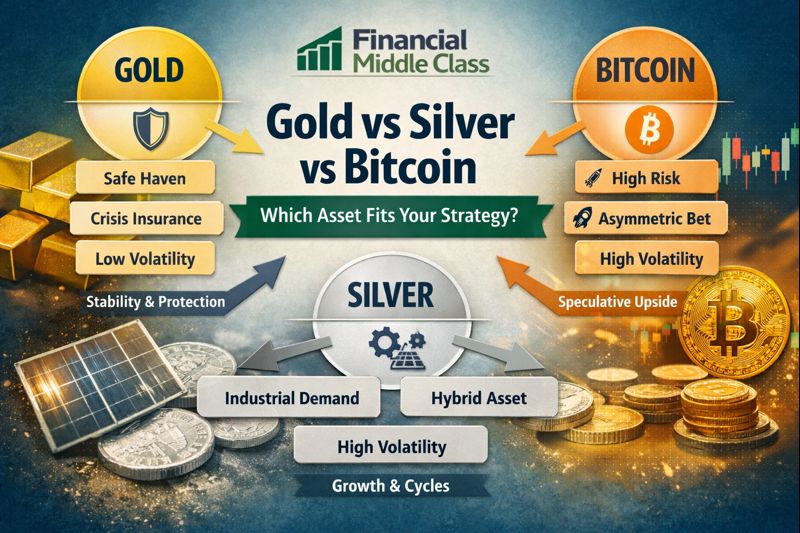
- Start with the job. Gold is closer to insurance; silver is a hybrid metal; Bitcoin is asymmetric speculation.
- None pays you to wait. These are non-yielding assets; returns are mostly price-driven.
- Silver isn’t “cheap gold.” Industrial demand can amplify upside—and downside.
- Bitcoin isn’t reliably calm. Treat it like a venture sleeve sized to survive deep drawdowns.
- The wrapper matters. Taxes, custody, spreads, and fees can change the outcome more than your thesis.
- Discipline beats prediction. Sizing + rules > guessing the winner.
The Shared Truth: They Don’t Pay You to Wait
Stocks can pay dividends. Bonds can pay interest. Real estate can pay rent.
Gold, silver, and Bitcoin don’t. They’re non-yielding assets. Your return comes mostly from price—what the next buyer is willing to pay. That’s not automatically bad. It just means you need to be honest about what you’re buying:
If you’re buying “peace,” you should also buy the part that comes with it: patience, boredom, and the possibility that nothing happens for a while.
Side-by-Side: Gold vs Silver vs Bitcoin
| Asset | Best “job” | Main risk | Best used as |
|---|---|---|---|
| Gold | Insurance / diversification in stress | Long flat stretches; opportunity cost | Small, steady hedge sleeve |
| Silver | Hard-asset torque + industrial theme | Whiplash volatility; cyclical behavior | Tactical tilt (if you can tolerate swings) |
| Bitcoin | Asymmetric upside / venture-style bet | Deep drawdowns; risk-on behavior in stress | Speculative sleeve sized for survival |
Gold: Insurance, Not Excitement
Gold’s best argument isn’t that it makes you rich. It’s that it can behave differently than the rest of your portfolio in certain stress regimes—when confidence shakes, when liquidity gets tight, when people start pricing fear instead of growth.
The mistake is buying gold like a growth asset and then getting angry when it behaves like insurance: quiet for years, useful when nobody wants to talk about it.
What gold does well
Gold can reduce portfolio regret in the bad year. That’s the cleanest way to say it without turning it into a myth.
What gold doesn’t promise
Gold isn’t a guaranteed inflation button and it’s not a savings account. Sometimes it protects you. Sometimes it just sits there while everything else rallies. That’s not failure. That’s the price of holding insurance in a calm year.
Silver: Precious + Industrial
Silver is where people get seduced by the price-per-ounce and forget the risk-per-dollar.
Silver has two identities: it can trade like a precious metal when fear rises, but it also lives in the real economy—electronics, solar, electrification, manufacturing. That industrial pull is why silver can run hard in risk-on periods and disappoint people who bought it for safety.
If gold is insurance, silver is closer to an amplifier. Sometimes it amplifies the right thing. Sometimes it amplifies your stress.
Bitcoin: Venture Sleeve, Volatility-First
Bitcoin is the asset people talk about like it’s a verdict. Either you “get it,” or you don’t. That framing is useless.
The practical framing is simpler: Bitcoin is volatility-first. You buy it because you want exposure to a network asset with potential asymmetric upside, and you accept that drawdowns are part of the deal.
If you need your hedge to feel calm in a liquidity crunch, Bitcoin usually isn’t the tool. If you want a small slice that can matter if adoption continues, Bitcoin can live in a speculative sleeve—sized so you don’t panic-sell when it does what it tends to do.
Myth vs Reality
| Myth | Reality |
|---|---|
| “Gold always hedges inflation.” | Gold can diversify in certain regimes, but it’s not a guaranteed CPI mirror across all windows. |
| “Silver is just cheaper gold.” | Silver’s industrial demand changes its behavior—often more cyclical and more volatile than gold. |
| “Bitcoin is digital gold in every crisis.” | Bitcoin can offer upside, but it often behaves risk-on during liquidity stress. Treat it like a venture sleeve, not a life raft. |
Scenario Matrix: What Tends to Happen (Not a Forecast)
| Scenario | Gold tends to… | Silver tends to… | Bitcoin tends to… |
|---|---|---|---|
| A) Risk-on rally / liquidity loosens | Drift if insurance demand fades | Run hot with growth/industry mood | Benefit—often with sharp swings |
| B) Credibility shock | Strengthen as hedge demand rises | Whipsaw: precious narrative vs industrial reality | Mixed: narrative can lift it, stress can crush it |
| C) Liquidity crisis / forced selling | More likely to hold up as hedge | Can sell off first, then recover | Often sells off with risk assets |
Taxes & Ownership Plumbing
This is the part people skip—and then act surprised when the “good call” becomes a mediocre after-tax outcome.
How you own the asset changes what you actually own
| Route | What you gain | What you take on |
|---|---|---|
| Physical gold/silver | Direct ownership, no fund structure | Storage, insurance, spreads, authenticity risk |
| ETFs/ETPs (metals) | Convenience and liquidity | Fees, structure differences, potential collectibles tax treatment depending on product |
| Bitcoin via broker/ETP | Ease of access and rebalancing | Tracking/fee friction, plus the asset’s volatility and tax reporting obligations |
| Mining equities | Equity upside (sometimes dividends) | Company risk + equity correlation (not the same behavior as metal) |
“Gold exposure” can mean different tax treatment and different risk depending on whether you hold physical metal, a trust/ETP wrapper, or a mining stock. Same with Bitcoin: the wrapper may be convenient, but volatility is still the main event.
Timeline: How This Debate Got Here
Phase 1: Gold becomes mainstream “insurance” language
Gold’s role gets framed less as an inflation button and more as diversification when confidence or liquidity breaks.
Phase 2: Silver’s industrial story grows louder
Electronics and solar demand bring cyclicality into a metal people assume should behave like a safe haven.
Phase 3: Bitcoin becomes easier to access in traditional accounts
Wrappers reduce friction, not volatility. Convenience doesn’t change the personality of the asset.
Phase 4: The “plumbing” becomes the differentiator
Taxes, reporting, custody, fees, and spreads start deciding outcomes as much as the thesis does.
Decision Framework
If you want a framework you can actually live with, stop asking, “Which one wins?” and ask, “Which one fits my role and my temperament?”
| If your goal is… | Best fit (usually) | The risk you must accept | How to size it like a grown-up |
|---|---|---|---|
| Insurance / diversification in stress | Gold | Boredom + long flat periods | Small, steady slice you can hold for years |
| Hard-asset torque + industrial theme | Silver | Whiplash volatility + cyclicality | Smaller than gold unless volatility is the point |
| Asymmetric upside | Bitcoin | Deep drawdowns + risk-on behavior in stress | Size so a major drawdown doesn’t force a sale |
Three rules that protect you:
1 Name the job in one sentence. If you can’t, you’re buying a vibe.
2 Size for the bad day. If the drawdown changes your life, the position is too big.
3 Write your rebalancing rule before you buy. Otherwise the market writes it for you.
Closing
Most people don’t get hurt because they chose the “wrong” asset.
They get hurt because they chose the wrong role, then sized it like a conviction instead of a plan.
If you’re building a middle-class life—mortgage, bills, kids, real responsibilities—your edge isn’t winning a debate about gold versus Bitcoin. Your edge is staying power. Own things you can hold through embarrassment, and structure the “extras” so they can’t crack your foundation.
FAQ
Is gold really a safe haven?
Gold can diversify in certain stress regimes, but nothing is guaranteed. Treat gold as insurance: it’s there to reduce regret in the bad year, not to outperform in every good year.
Is silver safer than Bitcoin?
Different risks. Silver can be extremely volatile and may trade like a cyclical commodity. “Cheaper per ounce” doesn’t mean “cheaper risk.”
Is Bitcoin “digital gold”?
Sometimes it diversifies; sometimes it behaves risk-on—especially during liquidity stress. If you hold it, treat it as a speculative sleeve sized for survival.
Physical vs ETF/ETP: what should I consider?
Focus on friction: spreads, fees, custody/storage, and tax treatment. Two people can both “own gold” and end up with different outcomes based on the wrapper.
How do I avoid panic-selling?
Decide up front: the job, the max drawdown you can tolerate, and the rebalancing trigger. If you don’t write rules before you buy, emotion becomes the rule.
Comment
If you had to pick one—gold, silver, or Bitcoin—what job are you hiring it to do: insurance, industrial upside, or the long shot?


RELATED ARTICLES
Cash Strategy: Put Every Dollar in the Right Place
Your checking account, emergency fund, short-term savings, and investments should not be managed the same way. This cash strategy helps assign every dollar to the right financial job.
Best HYSA: How to Choose Beyond the Highest APY
A competitive interest rate matters, but it is only one part of choosing a high-yield savings account. Compare insurance, fees, access, transfer speed, and promotional conditions.
Leave Comment
Cancel reply
Gig Economy
Business / Aug 08, 2026
The Missing Middle in Black Entrepreneurship
Black entrepreneurship has expanded dramatically. The next challenge is helping more Black-owned businesses move from self-employment to employer firms and sustainable scale.
By FMC Editorial Team
Personal Finance / Aug 01, 2026
Cash Strategy: Put Every Dollar in the Right Place
Your checking account, emergency fund, short-term savings, and investments should not be managed the same way. This cash strategy helps assign every dollar to the right...
By Article Posted by Staff Contributor
Personal Finance / Aug 01, 2026
Best HYSA: How to Choose Beyond the Highest APY
A competitive interest rate matters, but it is only one part of choosing a high-yield savings account. Compare insurance, fees, access, transfer speed, and promotional conditions.
By Article Posted by Staff Contributor
Personal Finance / Aug 01, 2026
High-Yield Savings vs. CDs, Treasury Bills, and Other Safe Places for Cash
High-yield savings accounts are excellent for accessible cash, but they are not always the best choice. Compare HYSAs, CDs, Treasury bills, money market accounts, and I...
By Article Posted by Staff Contributor
American Middle Class / Aug 01, 2026
High-Yield Savings Accounts: A Safer Home for Your Cash
A high-yield savings account can pay several times the national savings rate while keeping qualified deposits federally insured. Here is how it works, what to watch...
By Article Posted by Staff Contributor
Real Estate / Jul 30, 2026
Mortgage Lock-In Is Freezing the Housing Market
Millions are trapped by 3% mortgages. Learn how mortgage lock-in worsens affordability—and why homeowners are renovating instead.
By FMC Editorial Team
Real Estate / Jul 26, 2026
Is South Florida More Expensive Than New York? The Complete 2026 Relocation Guide
Is South Florida more expensive than New York? Compare housing, taxes, insurance and 104 municipalities before you move.
By Article Posted by Staff Contributor
Personal Finance / Jul 25, 2026
The Time Value of Life Experiences: What Compound Interest Leaves Out,
Money compounds, but life experiences do too. Explore what compound interest leaves out—and how to balance saving with living.
By MacKenzy Pierre
American Middle Class / Feb 18, 2026
How Wealth Is Passed Across Generations in the United States: Mechanisms, Evidence, and the Policy Debate
How wealth passes between generations—trusts, taxes, and the debate. Get the facts, figures, and tradeoffs. Read now.
By FMC Editorial Team
American Middle Class / Feb 16, 2026
The S&P 7,000: How Wall Street Disconnects from Main Street
S&P 7,000 can rise while wages, benefits, and towns fall behind. See why the market isn’t the economy—read now.
By MacKenzy Pierre
Latest Reviews
Business / Aug 08, 2026
The Missing Middle in Black Entrepreneurship
Black entrepreneurship has expanded dramatically. The next challenge is helping more Black-owned businesses move from...
Personal Finance / Aug 01, 2026
Cash Strategy: Put Every Dollar in the Right Place
Your checking account, emergency fund, short-term savings, and investments should not be managed the same...
Personal Finance / Aug 01, 2026
Best HYSA: How to Choose Beyond the Highest APY
A competitive interest rate matters, but it is only one part of choosing a high-yield...