
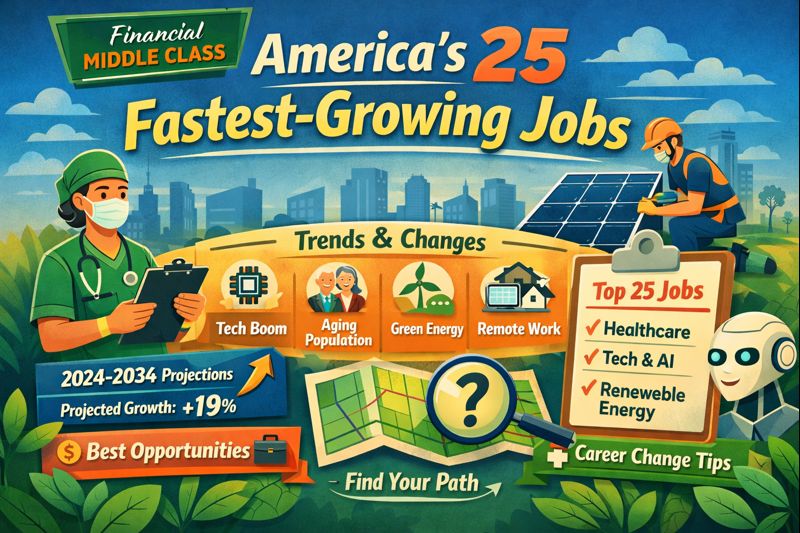
America’s 25 Fastest-Growing Jobs—and the part nobody tells you
By Article Posted by Staff Contributor
The estimated reading time for this post is 702 seconds
Numbers reflect BLS 2024–34 projections. Validate with local postings and program costs before taking on education debt.
America’s 25 Fastest-Growing Jobs—and the part nobody tells you
You’ve seen the posts. Somebody screenshots a “fastest-growing jobs” list and drops it in the group chat like they just discovered fire. Somebody else reposts it with a caption that’s basically, “If you’re not pivoting into THIS, you hate your future.”
Meanwhile, you’re doing what middle-class people actually do: running numbers on a kitchen table. Because rent doesn’t care about projections. Childcare doesn’t accept “but the market is trending.” Your bills do not pause while you “reinvent yourself.”
This article is built on the U.S. Bureau of Labor Statistics (BLS) Employment Projections for 2024–2034. BLS projects the U.S. economy adds about 5.2 million jobs (3.1% total employment growth) over that decade, which is much slower than the prior decade’s growth.
The list is useful—if you read it like an adult with bills, not like a motivational poster.
Key takeaways
Read the list like an adult with bills
Fastest-growing is not the same as most hiring. Percent growth can be huge in small occupations, while big occupations add far more total jobs.
Headcount beats hype. Always check how many jobs exist today, the projected numeric increase, and how many openings happen each year.
Pay + entry cost is the real tradeoff. Some fast-growing roles pay well but require long, expensive credential paths. Others are faster to enter but cap out sooner.
The tools below help you pick a lane that fits your time, debt tolerance, schedule reality, and location.
The 25 fastest-growing jobs (BLS projections, 2024–2034)
This is the “fastest-growing” list: occupations with the highest projected percent change in employment from 2024 to 2034. The table includes percent growth, numeric change, and 2024 median annual pay so you can see what the headline hides.
The list
America’s 25 fastest-growing jobs
| Rank | Occupation | Growth % | Emp. 2024 (k) | Emp. 2034 (k) | Change (k) | 2024 Median Pay |
|---|---|---|---|---|---|---|
| 1 | Wind turbine service technicians | 49.9% | 13.6 | 20.5 | 6.8 | $62,580 |
| 2 | Solar photovoltaic installers | 42.1% | 28.6 | 40.6 | 12.0 | $51,860 |
| 3 | Nurse practitioners | 40.1% | 320.4 | 448.8 | 128.4 | $129,210 |
| 4 | Data scientists | 33.5% | 245.9 | 328.3 | 82.5 | $112,590 |
| 5 | Information security analysts | 28.5% | 182.8 | 234.9 | 52.1 | $124,910 |
| 6 | Medical and health services managers | 23.2% | 616.2 | 759.1 | 142.9 | $117,960 |
| 7 | Physical therapist assistants | 22.0% | 111.5 | 136.0 | 24.5 | $65,510 |
| 8 | Actuaries | 21.8% | 33.6 | 40.9 | 7.3 | $125,770 |
| 9 | Operations research analysts | 21.5% | 112.1 | 136.2 | 24.1 | $91,290 |
| 10 | Physician assistants | 20.4% | 162.7 | 195.8 | 33.2 | $133,260 |
| 11 | Psychiatric technicians | 20.0% | 144.5 | 173.3 | 28.9 | $42,590 |
| 12 | Ophthalmic medical technicians | 19.8% | 78.8 | 94.4 | 15.6 | $44,080 |
| 13 | Computer and information research scientists | 19.7% | 40.3 | 48.3 | 7.9 | $140,910 |
| 14 | Occupational therapy assistants | 19.2% | 49.2 | 58.7 | 9.5 | $68,340 |
| 15 | Financial examiners | 18.5% | 65.1 | 77.2 | 12.1 | $90,400 |
| 16 | Hearing aid specialists | 18.4% | 10.7 | 12.6 | 2.0 | $61,560 |
| 17 | Health specialties teachers, postsecondary | 17.3% | 289.6 | 339.7 | 50.1 | $105,620 |
| 18 | Home health and personal care aides | 17.0% | 4,347.7 | 5,087.5 | 739.8 | $34,900 |
| 19 | Nursing instructors and teachers, postsecondary | 16.8% | 91.6 | 106.9 | 15.3 | $79,940 |
| 20 | Substance abuse, behavioral disorder, and mental health counselors | 16.8% | 483.5 | 564.6 | 81.0 | $59,190 |
| 21 | Logisticians | 16.7% | 241.0 | 281.3 | 40.3 | $80,880 |
| 22 | Epidemiologists | 16.2% | 12.3 | 14.3 | 2.0 | $83,980 |
| 23 | Industrial machinery mechanics | 16.1% | 439.6 | 510.3 | 70.7 | $63,760 |
| 24 | Software developers | 15.8% | 1,693.8 | 1,961.4 | 267.7 | $133,080 |
| 25 | Massage therapists | 15.4% | 168.0 | 193.9 | 25.9 | $57,950 |
Source: BLS Employment Projections Table 1.3 (2024 and projected 2034). See sources at the end.
The two traps that make smart people pick bad pivots
The fastest-growing list is where people get hypnotized by percentages. That’s trap number one: a big percentage can come from a small starting point. If an occupation has 13,600 jobs and grows to 20,500, that’s a huge percentage jump and still a small slice of the labor market.
Trap number two is more subtle: “fastest-growing” is not the same as “most hiring.” BLS literally warns that the two fastest-growing occupations, wind turbine service technicians and solar photovoltaic installers, are projected to add fewer than 20,000 new jobs combined, despite massive growth rates.
Percent growth is loud. Headcount is the quiet truth you can actually build a plan on.
Fastest-growing vs most job growth (same decade, different reality)
If you want to know where the bulk hiring happens, you read the “occupations with the most job growth” table next. It sorts by raw job additions, not percent change. The difference matters because the middle class is not picking a career like it’s a hobby; you’re picking a path that needs to produce income in the real world.
Side-by-side
Two lists, two different stories
| Fastest-growing (by %) | What that often means | Most job growth (by #) | What that often means |
|---|---|---|---|
| Wind turbine service technicians | Big % jump from a small base. | Home health and personal care aides | Mass hiring demand in raw numbers. |
| Solar photovoltaic installers | Strong growth; geography can matter. | Software developers | Large occupation still expanding fast. |
| Data scientists | Analytics demand rises with data and AI. | Stockers and order fillers | Big base plus steady demand. |
| Information security analysts | Risk goes digital; defense becomes a job category. | Fast food and counter workers | High turnover plus large base. |
Source: BLS Tables 1.3 and 1.4 (2024 and projected 2034). See sources at the end.
What’s driving the growth (three forces, not 25 random jobs)
Once you stop staring at the ranking like it’s a scoreboard, the list becomes a confession. It’s America admitting what it needs next: more care, more security, more analysis, and more people who can keep systems running when everything is online and everybody is aging.
The care economy isn’t a trend. It’s demographic math.
BLS projects healthcare and social assistance will be the fastest-growing major sector and add the most jobs over the decade. That’s why this list is stacked with nurse practitioners, physician assistants, therapy assistants, counselors, and the managers who keep the whole machine moving.
Data, AI, and cybersecurity aren’t “the future.” They’re today’s renovation project.
BLS links growth in computer and mathematical occupations to the expansion of data available for analysis and increasing demand for AI solutions, while also pointing to cyberattacks and data breaches as drivers of demand for information security analysts. Translation: the economy is rebuilding its brain and its armor at the same time.
Electrification shows up as technicians and installers, not just headlines.
Wind and solar sit at the top of the growth list, but the adult takeaway is not “drop everything and climb a turbine.” The adult takeaway is that energy and electrification are creating real work, often tied to where projects actually get built.
Timeline accordion: why this decade looks like this
Timeline
Five moments that shaped the jobs list you’re staring at
2008–2012: Aftershocks and a new definition of “secure”
The labor market resets after the financial crisis. Healthcare demand keeps rising quietly in the background, and technology becomes the default plumbing for everything from banking to shopping to scheduling your doctor.
2013–2019: The long expansion and the quiet buildout
Healthcare expands with demographics, logistics grows with e-commerce, and cybersecurity starts moving from “IT problem” to “business survival.”
2020–2022: Pandemic distortion and permanent shifts
Healthcare strain becomes visible, remote systems accelerate digital dependency, and mental health needs rise in public view. The care economy stops being invisible.
2023–2026: AI moves from headline to workflow
Data, software, and security roles gain gravity as AI adoption spreads and digital risk increases. At the same time, routine tasks face more automation pressure.
2027–2034: Care + security + electrification compound
Aging keeps pulling healthcare upward, cybersecurity stays elevated, and electrification drives steady demand for technicians where infrastructure is being built or maintained.
This is context, not prophecy. Your location, credential path, and cost of entry matter as much as national trends.
Pick your lane (the middle-class way)
Most people don’t need “the perfect job.” They need a lane that can carry them to stability without destroying their finances on the way in. This list contains three lanes that keep repeating, and each comes with a tradeoff you can’t negotiate away.
Side-by-side
Three lanes hiding inside the top 25
| Lane | What it looks like in the top 25 | Pay signal (from the table) | The real constraint |
|---|---|---|---|
| Licensed healthcare | Nurse practitioners; physician assistants; therapy assistants | High for NPs/PAs; solid for assistants | Credential time, licensure, clinical hours, tuition |
| Tech / data / cyber | Data scientists; security analysts; software developers; research scientists | High medians across many roles | Skill ramp, portfolio/experience, constant learning |
| Hands-on systems work | Wind techs; solar installers; industrial machinery mechanics; logistics | Mid-range medians; can climb with experience | Physical demands, safety, and sometimes geographic concentration |
The “best” lane is the one you can finish without breaking your budget or your life schedule.
Here’s the move middle-class people forget to make: you pick the lane based on your constraints first, and your interest second. Interest matters, but the bills come every month whether you’re inspired or not.
Mini-tool: Career Pivot Scorecard (fill this in before you “pivot”)
Mini-tool
Career Pivot Scorecard
Income floor: The minimum annual income I need within 12 months is __________. The minimum hourly wage I can accept right now is __________.
Runway: I can afford ______ months of training or transition. If that number is under 6, my plan must include earning while learning.
Debt tolerance: I am willing to take on $__________ in new education or training debt. If the number is small, I need employer-paid training, stackable credentials, or a cheaper pathway.
Schedule reality: My non-negotiables are __________ (childcare pickup, second job, elder care, weekends, nights). Any job that violates this will fail even if it pays well.
Location reality: I can relocate: yes/no. I can commute more than 45 minutes: yes/no. If “no,” I must filter by local demand.
This week’s next step: I will spend 60 minutes doing one action: informational interview, local job scan, program cost check, or portfolio project. The goal is a real plan, not motivation.
You don’t need a perfect plan. You need a plan that survives reality.
FAQ (because readers will ask anyway)
FAQ
Answers that stop the spiral
Does “fastest-growing” mean it’s easy to get hired?
No. It means the occupation is projected to grow by a high percentage. Hiring ease depends on local demand, credentials, and how many openings occur each year.
Why can a job be #1 on the list and still feel rare?
Some occupations start small. A large percentage increase can still translate into a modest number of new jobs nationally, and those jobs may cluster in specific regions.
What matters more than percent growth when I’m picking a path?
Time-to-credential, total openings (including replacements), income floor, schedule fit, physical demands, and whether you can enter without destructive debt.
Should I choose based on median pay alone?
No. Median pay is the midpoint. Your pay depends on location, employer type, experience, and shift differentials. Always validate with local postings.
Are BLS projections a guarantee?
No. They’re based on assumptions and do not predict recessions, booms, or policy changes. Use them as direction, then validate locally.
If you want, you can add a short “Sources” note at the bottom of your post (included below) to increase trust and reduce misinformation sharing.
Your turn
Comment prompt
If you had to pivot this year, what’s your biggest constraint?
Is it time, tuition, age, childcare, location, or fear of starting over? Tell me which one is boxing you in right now—and which lane you’re considering (healthcare, tech, hands-on). I’ll reply with the best next-step play.
The goal here is a plan that survives real life, not a fantasy pivot.
Sources
Data sources (primary)
BLS Table 1.3: https://www.bls.gov/emp/tables/fastest-growing-occupations.htm
BLS Table 1.4: https://www.bls.gov/emp/tables/occupations-most-job-growth.htm
BLS projections news release (PDF): https://www.bls.gov/news.release/pdf/ecopro.pdf
BLS projections release notice: https://www.bls.gov/emp/notices/2025/projections-release.htm


RELATED ARTICLES
How Wealth Is Passed Across Generations in the United States: Mechanisms, Evidence, and the Policy Debate
How wealth passes between generations—trusts, taxes, and the debate. Get the facts, figures, and tradeoffs. Read now.
The S&P 7,000: How Wall Street Disconnects from Main Street
S&P 7,000 can rise while wages, benefits, and towns fall behind. See why the market isn’t the economy—read now.
Leave Comment
Cancel reply
Gig Economy
American Middle Class / Feb 18, 2026
How Wealth Is Passed Across Generations in the United States: Mechanisms, Evidence, and the Policy Debate
How wealth passes between generations—trusts, taxes, and the debate. Get the facts, figures, and tradeoffs. Read now.
By FMC Editorial Team
American Middle Class / Feb 16, 2026
The S&P 7,000: How Wall Street Disconnects from Main Street
S&P 7,000 can rise while wages, benefits, and towns fall behind. See why the market isn’t the economy—read now.
By MacKenzy Pierre
American Middle Class / Feb 16, 2026
The “Resilient Consumer” Is Real—But So Is the Interest Bill
Credit card balances are rising as savings fall. See what it means—and the 30/60/90 plan to escape 25% APR debt.
By Article Posted by Staff Contributor
American Middle Class / Feb 09, 2026
What To Do If You Get Fired With an Outstanding 401(k) Loan
Fired with a 401(k) loan? Avoid taxes, offsets, and deadline traps with this step-by-step checklist. Read now.
By Article Posted by Staff Contributor
American Middle Class / Feb 09, 2026
The Real Math of Money in Relationships
Split finances without resentment. Any couple, any income ratio. Use the worksheet + rules—start today.
By Article Posted by Staff Contributor
American Middle Class / Feb 03, 2026
Investing or Paying Off the House?
Invest or pay off your mortgage? See a $500k example with today’s rates, dividends, and peace-of-mind math—then choose your plan.
By Article Posted by Staff Contributor
American Middle Class / Jan 30, 2026
Gold, Silver, or Bitcoin? Start With the Job—Not the Hype
Gold, silver or Bitcoin? Learn what each is for—and how to size it—before you buy. Read the framework.
By Article Posted by Staff Contributor
American Middle Class / Jan 29, 2026
Florida Homeowners Pay the Most in HOA Fees
Florida HOA fees are surging. See what lawmakers changed, what’s next, and how to protect your budget—read before you buy.
By Article Posted by Staff Contributor
American Middle Class / Jan 29, 2026
Why So Many Homebuyers Are Backing Out of Deals in 2026
Why buyers are backing out of home deals in 2026—and how to avoid costly surprises. Read the playbook before you buy.
By Article Posted by Staff Contributor
American Middle Class / Jan 28, 2026
How Money Habits Form—and Why “Self-Control” Is the Wrong Villain
Learn how money habits form—and how to rewire spending and saving using behavioral science. Read the framework and start today.
By FMC Editorial Team
Latest Reviews
American Middle Class / Feb 18, 2026
How Wealth Is Passed Across Generations in the United States: Mechanisms, Evidence, and the Policy Debate
How wealth passes between generations—trusts, taxes, and the debate. Get the facts, figures, and tradeoffs....
American Middle Class / Feb 16, 2026
The S&P 7,000: How Wall Street Disconnects from Main Street
S&P 7,000 can rise while wages, benefits, and towns fall behind. See why the market...
American Middle Class / Feb 16, 2026
The “Resilient Consumer” Is Real—But So Is the Interest Bill
Credit card balances are rising as savings fall. See what it means—and the 30/60/90 plan...