
Is Homeownership Really the “Gateway to the Middle Class”… or Just the Most Popular Myth We Repeat?
By Article Posted by Staff Contributor
The estimated reading time for this post is 564 seconds
Is Homeownership Really the “Gateway to the Middle Class”… or Just the Most Popular Myth We Repeat?
Last updated: December 18, 2025
Americans say it like it’s scripture: “Homeownership is the gateway to the middle class.” You hear it from politicians, your uncle at Thanksgiving, and the guy on TikTok who swears he “house-hacked” his way to freedom while somehow never mentioning property taxes.
Here’s the honest answer: homeownership has absolutely helped a lot of middle-class Americans build wealth. But it’s not a magic door. It’s a tool. And like any tool, it works beautifully when you use it right—and it can take your hand off when you don’t.
So let’s do this the Financial Middle Class way: no motivational posters, no shame, no fairy tales. Just the data, the mechanics, the risks, and the practical truth about when buying a home actually builds wealth for regular people.
The Wealth Gap That Makes the Slogan Feel True
If you only look at one chart, this is the one. The Federal Reserve’s Survey of Consumer Finances shows that between 2019 and 2022, median net worth for renters/non-homeowners rose to $10,400, while median net worth for homeowners rose to $396,200. That’s not “a little better.” That’s a different universe.
And this isn’t just one dataset doing something weird. The Census Bureau’s “Wealth of Households: 2022” finds that households who owned their home had median wealth about 44 times larger than households that rented.
At this point you might be thinking: case closed. Buy a house, become middle class, cue the closing credits. Not so fast. We still have to talk about what’s actually inside these numbers—and why homeownership can be both a ladder and a landmine.
Side-by-side reality check: homeowners vs. renters
| What we’re comparing | Homeowners | Renters / Non-homeowners |
|---|---|---|
| Median net worth (SCF, 2022) | $396,200 | $10,400 |
| Median wealth multiple (Census, 2022) | About 44× renters | Baseline group |
| Even excluding home equity | About 17× renters | Baseline group |
That last line matters: even excluding home equity, homeowners still show far more wealth than renters. That’s the first hint that the story isn’t simply “the house did it.”
Why the House Becomes the Middle-Class Balance Sheet
For a lot of middle-class households, the “wealth plan” isn’t some complicated portfolio. It’s simple: work, pay bills, contribute something to retirement if you can, and build equity by paying the mortgage. It’s not glamorous, but it’s common—because it’s accessible in a way other wealth engines often aren’t.
Brookings puts it plainly: for households in the three middle-income quintiles, home equity is the largest single financial asset and typically represents 50% to 70% of net wealth.
Pew shows how dramatic that dependency is. In 2021, the median household net worth was $166,900 when you count home equity. But without home equity, it drops to $57,900. That’s not a rounding error. That’s the whole game for many families.
This is why homeownership feels like a “gateway.” Not because homeowners are automatically smarter. Not because renters are “behind.” It’s because the home often becomes the one asset people actually manage to build over time, month after month, year after year.
How Homeownership Builds Wealth (No Hype, Just Mechanics)
Homeownership builds wealth through a combination of boring math and human behavior. And honestly? Boring is good. Boring is reliable.
First, forced saving. A traditional mortgage doesn’t let you “forget” to save. You pay the note, and over time, more of each payment goes toward principal. You’re converting cash flow into equity—sometimes without even thinking of it as saving.
Second, appreciation. Over long horizons, home values tend to rise (not in a straight line, not in every neighborhood, not for every decade). But when they rise and you own the asset, you benefit.
Third, leverage. This is the part people love when it works and pretend they never heard of when it doesn’t. You control a large asset with a down payment and a mortgage. Gains can be magnified on the equity you put in—and so can losses if prices drop or you’re forced to sell early.
The Cleveland Fed summarizes it cleanly: housing can be a reliable vehicle for wealth accumulation, but the return is risky in ways that hit lower-income households harder. They highlight three big risk buckets: location risk, timing risk, and liquidity risk.
That’s the real trade: homeownership can build wealth, but it’s not a diversified portfolio. It’s one property in one market, tied to your life and your job and your ability to hold on through chaos.
The Part People Skip: Homeowners Often Start Ahead
Let’s say this plainly, because it’s important and it’s not an insult: many people become homeowners because they already have advantages that help them build wealth—steady income, decent credit, some savings, family support, or all of the above.
That’s why the Census finding is so revealing: homeowners had median wealth about 44 times renters, and even if you strip out home equity, homeowners still had median wealth about 17 times renters.
So yes, the house builds wealth. But homeownership is also a “club” with an entry fee: down payment, credit, income, reserves, closing costs, and the ability to stay put. The households who can pay the entry fee often have other wealth-building behaviors and resources already in motion.
The Equity Era: Why So Many Owners Feel “Richer” (and Why It’s Complicated)
If you owned a home through the 2010s into the mid-2020s, chances are you watched your equity grow. That’s not imagination. ATTOM’s Q4 2024 Home Equity & Underwater Report found that 47.7% of mortgaged residential properties were “equity-rich,” meaning the total loans secured by the property were no more than half of the home’s estimated value.
That’s real wealth on paper. But equity has a personality flaw: it’s not cash. You can’t pay Publix with “my Zestimate went up.” Accessing equity can mean selling (and then buying again in the same expensive market) or borrowing (which can raise your monthly obligations). Whether equity improves your life depends on what you do with it and what it costs you to touch it.
And the current environment makes that tension sharper. Harvard’s State of the Nation’s Housing 2025 reports that high prices and elevated interest rates reduced homebuying to its lowest level since the mid-1990s. In other words: existing owners gained; new buyers ran into a wall.
When Homeownership Fails as a Wealth Strategy
This is where the “gateway” story breaks. Because the middle class doesn’t collapse from one bad decision—it collapses from a chain reaction: stretched payment, no reserves, one surprise expense, then debt, then stress, then forced choices.
The Cleveland Fed’s risk framework is a good map of the failure modes. Location risk is the reality that not all markets appreciate the same way; some neighborhoods stagnate for years. Timing risk is what happens when you buy near a peak or have to sell during a downturn. Liquidity risk is the most middle-class risk of all: you can be “worth” a lot on paper and still not have enough cash to handle life.
Then there’s the part homeowners don’t put in the Instagram caption: the non-mortgage costs. Harvard’s Joint Center for Housing Studies has been documenting rising burdens on homeowners. Their research shows homeowner cost burdens are heavily concentrated among the lowest-income owners. As of 2023, households under $30,000 made up a small share of homeowners but a huge share of cost-burdened and severely burdened homeowners.
In a Harvard JCHS blog analysis, the share of homeowners with income under $30,000 who were cost-burdened rose to a record-high 74% in 2023.
And it’s not only low-income owners feeling pressure. Harvard’s press release around the 2025 housing report notes that in 2023 the number of cost-burdened homeowners rose to 20.3 million (about 24% of homeowner households), with rising costs partially explained by increases in insurance premiums and property taxes.
That same Harvard release cites a striking figure: home insurance premiums jumped 57% from 2019 to 2024, with sharp increases in higher climate-risk areas.
This is why “just buy something” can be dangerous advice. A home can be a wealth engine. But a home can also be a financial treadmill that speeds up every year while your paycheck stays human.
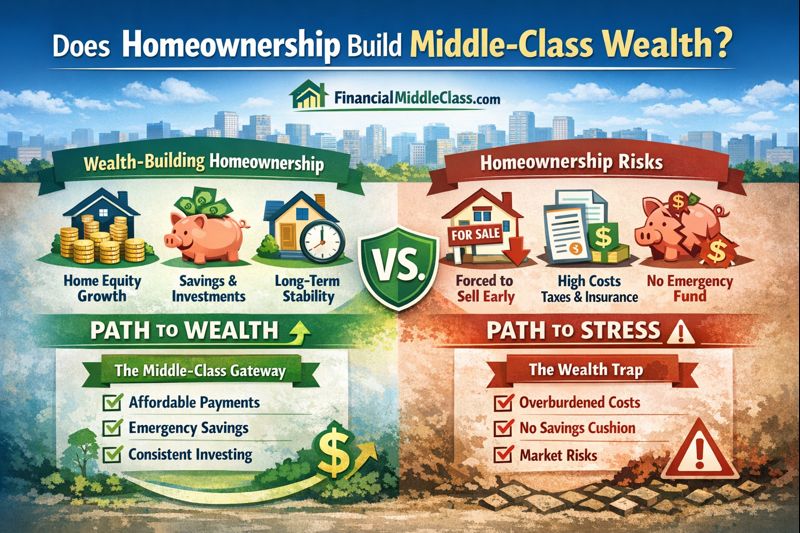
Side-by-Side: When Homeownership Builds Wealth vs. When It Becomes a Trap
| The same “homeownership” label | Wealth-building ownership | Wealth-trap ownership |
|---|---|---|
| Monthly payment | Fits the budget while still allowing saving/investing and reserves. | Crowds out savings; every surprise becomes debt. |
| Time horizon | You can hold long enough for forced saving + appreciation to compound. | You’re likely to be forced to sell early (timing risk). |
| Market exposure | You understand the neighborhood/market and can absorb ups/downs. | You’re betting your whole net worth on one local market (location risk). |
| Liquidity | Emergency fund exists; repairs don’t trigger crisis. | No reserves; equity exists but can’t be used safely (liquidity risk). |
| Non-mortgage costs | Taxes/insurance/maintenance are budgeted realistically. | Insurance/taxes climb; stress rises (a growing national issue). |
The “gateway” version is not about granite countertops. It’s about durability: can you keep the house and keep building wealth at the same time?
So Has Homeownership Helped the Middle Class Build Wealth? Yes—But It’s a Narrower Path in 2025 Than People Admit
Historically, the evidence is strong that homeownership has been one of the central ways middle-income households accumulate wealth. When home equity is the largest asset for the middle class, and when the median wealth difference between homeowners and renters is this large, it’s not serious to pretend the home didn’t matter.
But the environment matters. Harvard’s 2025 housing report describes a market where high prices and elevated interest rates pushed homebuying to a generational low and where rising insurance premiums and property taxes add stress even after you “win” and buy the house.
That’s why the modern middle-class version of the slogan needs an update. The gateway isn’t just homeownership. The gateway is stable housing costs plus consistent investing. Sometimes that’s ownership. Sometimes that’s renting with discipline. What’s not a gateway is a payment that leaves you one repair away from revolving debt.
The Bottom Line
Homeownership has helped the American middle class build wealth because it’s one of the few wealth-building systems that normal people can access, stick with, and understand without a finance degree. It’s forced saving, it’s an appreciating asset over long horizons, and it becomes the backbone of the middle-class balance sheet.
But the slogan fails when it becomes a commandment. Buying a house does not automatically make you middle class. Being middle class is about margin—enough room in your finances to handle life, save consistently, and not get wiped out by predictable surprises. The Cleveland Fed’s risks—location, timing, liquidity—are exactly the risks that punish households with thin margins.
So if you want the real “gateway” definition, here it is: homeownership builds wealth when you can hold it and still build wealth outside of it. If it kills your saving, kills your investing, and turns your emergency fund into a fantasy, then you didn’t buy a gateway—you bought a stress subscription.


RELATED ARTICLES
How Wealth Is Passed Across Generations in the United States: Mechanisms, Evidence, and the Policy Debate
How wealth passes between generations—trusts, taxes, and the debate. Get the facts, figures, and tradeoffs. Read now.
The S&P 7,000: How Wall Street Disconnects from Main Street
S&P 7,000 can rise while wages, benefits, and towns fall behind. See why the market isn’t the economy—read now.
Leave Comment
Cancel reply
Gig Economy
American Middle Class / Feb 18, 2026
How Wealth Is Passed Across Generations in the United States: Mechanisms, Evidence, and the Policy Debate
How wealth passes between generations—trusts, taxes, and the debate. Get the facts, figures, and tradeoffs. Read now.
By FMC Editorial Team
American Middle Class / Feb 16, 2026
The S&P 7,000: How Wall Street Disconnects from Main Street
S&P 7,000 can rise while wages, benefits, and towns fall behind. See why the market isn’t the economy—read now.
By MacKenzy Pierre
American Middle Class / Feb 16, 2026
The “Resilient Consumer” Is Real—But So Is the Interest Bill
Credit card balances are rising as savings fall. See what it means—and the 30/60/90 plan to escape 25% APR debt.
By Article Posted by Staff Contributor
American Middle Class / Feb 09, 2026
What To Do If You Get Fired With an Outstanding 401(k) Loan
Fired with a 401(k) loan? Avoid taxes, offsets, and deadline traps with this step-by-step checklist. Read now.
By Article Posted by Staff Contributor
American Middle Class / Feb 09, 2026
The Real Math of Money in Relationships
Split finances without resentment. Any couple, any income ratio. Use the worksheet + rules—start today.
By Article Posted by Staff Contributor
American Middle Class / Feb 03, 2026
Investing or Paying Off the House?
Invest or pay off your mortgage? See a $500k example with today’s rates, dividends, and peace-of-mind math—then choose your plan.
By Article Posted by Staff Contributor
American Middle Class / Jan 30, 2026
Gold, Silver, or Bitcoin? Start With the Job—Not the Hype
Gold, silver or Bitcoin? Learn what each is for—and how to size it—before you buy. Read the framework.
By Article Posted by Staff Contributor
American Middle Class / Jan 29, 2026
Florida Homeowners Pay the Most in HOA Fees
Florida HOA fees are surging. See what lawmakers changed, what’s next, and how to protect your budget—read before you buy.
By Article Posted by Staff Contributor
American Middle Class / Jan 29, 2026
Why So Many Homebuyers Are Backing Out of Deals in 2026
Why buyers are backing out of home deals in 2026—and how to avoid costly surprises. Read the playbook before you buy.
By Article Posted by Staff Contributor
American Middle Class / Jan 28, 2026
How Money Habits Form—and Why “Self-Control” Is the Wrong Villain
Learn how money habits form—and how to rewire spending and saving using behavioral science. Read the framework and start today.
By FMC Editorial Team
Latest Reviews
American Middle Class / Feb 18, 2026
How Wealth Is Passed Across Generations in the United States: Mechanisms, Evidence, and the Policy Debate
How wealth passes between generations—trusts, taxes, and the debate. Get the facts, figures, and tradeoffs....
American Middle Class / Feb 16, 2026
The S&P 7,000: How Wall Street Disconnects from Main Street
S&P 7,000 can rise while wages, benefits, and towns fall behind. See why the market...
American Middle Class / Feb 16, 2026
The “Resilient Consumer” Is Real—But So Is the Interest Bill
Credit card balances are rising as savings fall. See what it means—and the 30/60/90 plan...