Commerce Secretary Howard Lutnick said during an interview with Fox News a few weeks ago that when the new gross domestic product (GDP) number is released later this month, it will exclude government spending.
I believe the secretary should spend time figuring out how to incorporate—or at least factor in—America’s high inequality, overall happiness, and well-being into GDP, rather than proposing to omit government spending purely for political theater.
Gross domestic product (GDP) measures the total value of all final transactions in the U.S. economy over a 12‑month period. Government spending is only about 3% of GDP, so why strip it out? Politicians universally cheer higher GDP—not lower—because it’s a snapshot of economic health, warts and all.
The U.S. GDP is approximately $29 trillion, making America the world’s largest economy, with an average annual growth rate of about 3% over the past decade. China follows with a GDP of around $19.5 trillion, despite having four times our population (1.416 billion compared to 342 million) and a smaller share of consumer spending within GDP (53.7% versus America’s 68%).
That pair of Jordan 5 Black Metallic Reimagined sneakers (guilty) you purchased last month counts toward GDP. Your new car is part of GDP. The expansion of your company that earned you a promotion also contributes to GDP. And yes, those F‑15 fighter jets Uncle Sam orders count as part of GDP, too.
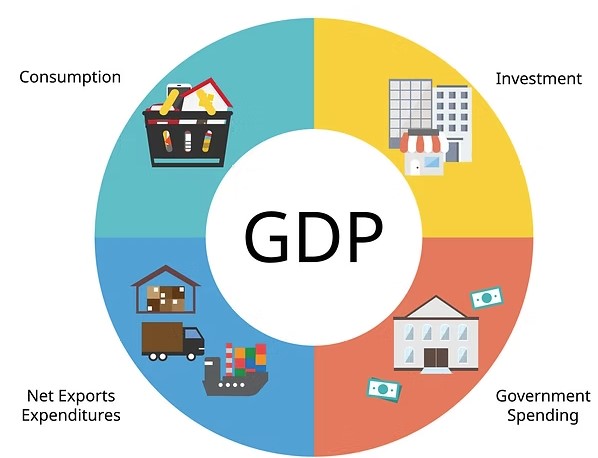
Here’s the familiar formula: GDP = C (Consumer spending) + I (Business investment) + G (Government spending) + (X–M) (Net exports)
Currently, C = 68%, I = 16%, (X–M) = 16.5%, and G = 3% of GDP. Excluding G, the reported GDP falls by at least 3%, possibly nearing 6% in real terms once inflation is considered.
Why Lutnick Wants to Omit Government Spending
Omitting government spending means a lower GDP number gets reported, which could have serious economic implications. So why is Secretary Lutnick floating this idea?
You see, the new administration’s unofficial advisory body, dubbed the Department of Government Efficiency (DOGE) and overseen by the self-proclaimed “First Buddy” Elon Musk, has been firing federal employees, rescinding contracts, and slashing government grants and subsidies, among other cuts. All of these reductions in government spending—the “G” in the GDP formula—will likely result in at least a 6% real decline in GDP, especially with inflation hovering around 3%.
Financial markets, global investors, and everyday consumers don’t like a shrinking GDP. It signals potential economic weakness and malaise ahead. Thus, the secretary wants to hide the impact of the new administration’s actions on GDP.
The Bureau of Economic Analysis (BEA), a division of the U.S. Department of Commerce, already publishes several derivatives of GDP—including real GDP (adjusted for inflation), GDP by industry, and GDP by expenditures (consumption, investment, government spending, and net exports).
As you can see, the government already provides a version of GDP without government spending, offering a comprehensive understanding of the U.S. economy. However, Secretary Lutnick wants the headline numbers in every economic newspaper and news network to focus on GDP excluding government spending, masking the administration’s assault on federal employees and contractors.
The time and effort the secretary is putting into dramatizing a macroeconomic indicator that already exists—purely for political theater—could be better spent developing metrics that genuinely reflect Americans’ financial stress and quality of life.
GDP and Happiness
Americans buy a lot of goods every year—which is why consumer spending accounts for about 70% of GDP. In contrast, consumer spending in China makes up just 53.7% of its GDP, despite China having a population nearly four times that of the United States. As of this writing, the U.S. has approximately 342 million people, while China has about 1.416 billion.
Easy credit and hyper-financialization have transformed us into a grossly materialistic society—and our well-being and happiness suffer as a result.
Despite high disposable incomes, America consistently ranks among the least happy developed countries. Our well-being is poor. We are an anxious, overly medicated nation.
That bigger home or newer car might give us a temporary dopamine hit, but the risk-return tradeoff is increasingly unbalanced. According to the 2025 World Happiness Report, the United States ranks seventh from the bottom in happiness among OECD countries.
GDP is not a perfect barometer of a country’s overall health. It doesn’t account for the underground economy, income inequality, well-being, or happiness.
Our government should focus on crafting and implementing policies that help Americans live more satisfying and meaningful lives—rather than misleading them for political gain.