
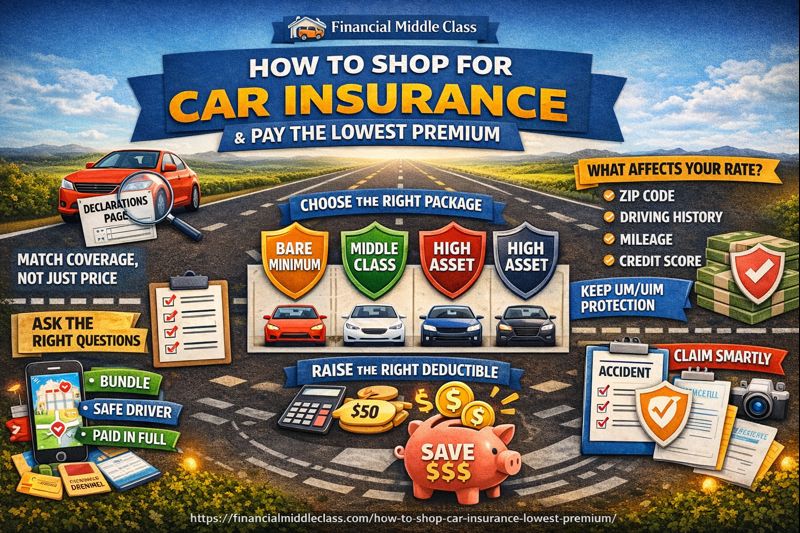
How to Shop for Car Insurance and Pay the Lowest Premiums (Without Getting Burned)
By Article Posted by Staff Contributor
The estimated reading time for this post is 887 seconds
How to Shop for Car Insurance and Pay the Lowest Premiums (Without Getting Burned)
If you’re searching for cheap car insurance, you’re not alone. But “cheap” only helps if the coverage still protects your life when the worst Tuesday of the year shows up.
The middle-class rule of car insurance
Every renewal feels like the same little betrayal.
Same car. Same commute. Same you. But the premium climbs like it’s trying to win a contest.
And here’s the thing: I’m not mad at people who want cheap car insurance. I get it. The middle class isn’t asking for luxury. We’re asking for stability. We’re trying to keep the car on the road so we can keep the job, keep the schedule, keep the family moving.
So let’s stop treating car insurance like a mysterious bill you swallow twice a year. You can’t control everything the market does. But you can control how you shop—and what you refuse to pay for.
Here’s the rule that saves the most money and prevents the most regret: You can’t compare quotes unless the coverage matches.
Before you shop: build your quote template
Do not start shopping by clicking random quote sites and typing from memory. That’s how you end up with five quotes that can’t be compared and one policy that looks cheap because it’s missing half the coverage.
Instead, pull your current policy’s Declarations Page (your “Dec Page”). It lists your coverages, limits, deductibles, drivers, discounts—everything that matters.
Now you have a template. Every quote you request should match it first. Then you adjust intentionally. Not accidentally. Not because a form defaulted you into something you didn’t notice.
The apples-to-apples quoting rule
When you call or quote online, your goal is simple: make carriers price the same product. If you don’t, the “cheapest” quote is usually just the quote that quietly cut your protection.
Shop earlier than you think
Quote 2–4 weeks before renewal when you can. Last-minute shopping often costs more because you look like you’ll accept anything to avoid a lapse.
What car insurance coverage actually does (plain English)
Car insurance isn’t one product. It’s a bundle. A combo meal with consequences.
Liability coverage
Liability pays other people when you’re at fault—injuries you cause and property damage you cause. This is the “lawsuit protection” part.
Collision coverage
Collision pays to fix your car after a crash (minus your deductible). If you finance or lease, your lender typically requires it.
Comprehensive coverage
Comprehensive covers non-crash damage: theft, vandalism, hail, storms, falling objects, animal hits.
Uninsured/Underinsured Motorist (UM/UIM)
UM/UIM protects you if the other driver can’t pay—or doesn’t have enough coverage. If you’ve ever watched someone cause chaos on the road like they’re late for a movie premiere, you already understand why this matters.
Rental reimbursement and roadside
Rental reimbursement helps cover a rental car while yours is in the shop. Roadside covers towing and breakdown services. These aren’t the “main” coverages, but they can save you from an unexpected cash hit.
How insurers price you (why your premium “randomly” jumps)
Insurance companies don’t price fairness. They price risk—and sometimes their current appetite for your zip code.
ZIP code and garaging address
Same driver, different neighborhood can mean a different rate. Claims, theft, weather, litigation patterns—insurers care.
Your vehicle
Repair costs have changed. Sensors, cameras, specialty headlights—some “normal” cars are expensive to fix now. Your model and trim matter.
Mileage and commute
More time on the road equals more exposure. If your commute changed or you work from home more, update it.
Driving history and claims history
Tickets, accidents, and claim frequency matter. Also: turning insurance into a coupon for every small ding can haunt you later.
Lapse in coverage
Even a single day without coverage can spike rates. Don’t let a cancellation date sneak up on you.
Credit-based insurance scoring (where allowed)
In many states, insurers can use credit-based factors as part of pricing. If your credit took hits during a hard season, shop harder—carriers weigh this differently.
Coverage limits that protect a middle-class life (not just “legal”)
Minimum coverage is designed to make you legal, not protected.
If your finances are tight—if one lawsuit would threaten your paycheck, your savings, your ability to keep the lights on—limits matter.
The uncomfortable truth is this: the middle class is the easiest target. You’ve got wages and assets worth going after, but not enough cushion to shrug off a big hit.
Florida is a perfect example of why “legal” can still leave you exposed. Florida’s basic requirement to register a vehicle is $10,000 PIP and $10,000 property damage liability. Being legal is not the same as being protected.
Don’t shop for cheap. Shop for “won’t ruin me.”
Choose the right coverage package (stop guessing)
Note: This is educational guidance, not legal advice. Match coverage to your real risk and your real life.
| Package | Who it fits | What you prioritize |
|---|---|---|
| Bare-Minimum Survival | Temporary squeeze; staying insured is the goal | Keep the policy active, avoid lapses, and don’t cut core protections by accident |
| Middle-Class Protection | Most working households with real responsibilities | Solid liability limits, smart deductibles, and coverage that matches your replacement reality |
| High-Asset Protection | Home equity, higher savings/income, bigger exposure | Higher limits and a serious plan for lawsuit risk (sometimes umbrella coverage) |
The mistake isn’t choosing a cheaper package. The mistake is choosing it by accident because the quote form defaulted you into lower limits and missing coverage.
Deductible math: the break-even test
Raising deductibles is one of the fastest ways to lower premiums. It can also be a trap.
Here’s the simple test: if raising your deductible saves you $20/month, that’s $240/year. If you raised your collision deductible from $500 to $1,000, you’re taking on $500 more risk.
Break-even time: $500 ÷ $20 = 25 months.
If you can’t comfortably pay the higher deductible right now, don’t take the discount. Cheap premiums feel great until you’re standing in a body shop office with a credit card you didn’t want to use.
When to drop collision or comprehensive (and when not to)
This is where a lot of middle-class money leaks out quietly.
| Your situation | Collision | Comprehensive |
|---|---|---|
| Financed or leased | Keep (usually required) | Keep (usually required) |
| Paid-off, older car you could replace | Consider dropping | Consider keeping (theft/weather can still hurt) |
| You can’t replace the car without debt | Keep | Keep |
| High theft or storm exposure | Maybe | Often worth keeping |
Collision is often the coverage people outgrow first on a paid-off car. Comprehensive can still make sense if theft or weather is common where you live.
Discounts that matter vs marketing discounts
Some discounts are real. Some are basically a coupon for doing what the company wanted anyway.
Usually meaningful: bundling (auto + renters/home), multi-car, paid-in-full, safe driver, and sometimes defensive driving courses. Usually tiny: paperless billing, random “online quote” discounts, and loyalty discounts that don’t feel loyal when renewal hits.
Telematics (“safe driving” apps): do it with your eyes open
These programs can save money if you’re genuinely a smooth driver. But understand what it is: monitoring. Hard braking, fast turns, phone movement—real traffic doesn’t always let you drive like a meditation app. Try it if the discount is meaningful. Quit if it turns into a surveillance tax.
Claims strategy nobody teaches you
Insurance is for financial pain, not for every annoyance.
If you file claims for every small scrape, you train the system to label you as “frequent.” That can show up later in renewals.
A cleaner approach is simple: handle small, truly affordable repairs out of pocket when you can, and use insurance for the hits that would disrupt your budget or stability.
What to document after an accident
Photos (wide and close). License plates. Driver info. Witness names. Police report number. Notes while it’s fresh. You’re not being dramatic—you’re protecting future you from “he said, she said.”
Shopping scripts: what to ask (copy/paste)
- “Can you quote this to match my Declarations Page exactly first?”
- “Is UM/UIM included in this quote, or excluded?”
- “What annual mileage are you using?”
- “What are the rental limits—per day and total?”
- “Do repairs use OEM parts or aftermarket?”
- “Is roadside included, and what are the limits?”
- “Would a not-at-fault claim affect renewal pricing here?”
- “Show me the annual price difference if I raise deductibles.”
- “What discounts apply—bundle, paid-in-full, defensive driving?”
- “Is there any penalty for canceling mid-term if I switch?”
If an insurer can’t answer these clearly, that’s the answer.
Traps & red flags (quick, painful, avoidable)
Watch for the “cheap premium” trap: a low quote that quietly lowered limits, removed UM/UIM, bumped deductibles you can’t pay, or cut rental coverage to nothing.
Also: don’t exclude a household driver just to get a lower price unless you understand the consequences. And never let your policy lapse—even for one day. Lapses can haunt your rates.
Special situations that change the math
Teen drivers
Teen drivers are expensive. Period. Ask about good-student discounts, defensive driving, and whether adding them to your policy beats a separate policy.
Rideshare or delivery driving (Uber/DoorDash)
If you drive for work, you may need a rideshare endorsement. Personal policies can deny claims if you’re driving commercially.
Moving states
Shop immediately after you move. Pricing can swing dramatically by state, carrier, and ZIP code.
Financed or leased cars
Don’t waste time trying to drop collision/comp. Your lender will usually require it.
7-day renewal timeline (do this, in this order)
Day 1: Pull your Declarations Page + build your quote template
Day 2: Decide what you won’t compromise on
Day 3: Get 3 quotes using the same template
Day 4: Send your Dec Page to an independent agent
Day 5: Ask your current insurer to re-rate
Day 6: Compare annual cost + coverage side-by-side
Day 7: Switch if the savings are real (avoid lapses)
FAQ: Car insurance shopping
Is “full coverage” a real thing?
How often should I shop for car insurance?
Will raising my deductible always lower my premium?
Should I file a claim for small damage?
Is bundling auto and home/renters always cheaper?
Quick question for you
When was the last time you shopped your car insurance—and what happened at renewal: up, down, or “same but somehow more”?
Drop your state (if you’re comfortable) and whether you bundle home/renters. It helps other readers compare reality.
The truth that hits home
Car insurance isn’t optional for most of the middle class. It’s the toll you pay to keep your life moving—work, family, responsibility, survival.
So the goal isn’t to find the cheapest number on a screen. The goal is to build the lowest premium that still protects your future.
Because the middle-class nightmare isn’t the premium itself. It’s paying that premium for years—then finding out, on the worst day of your year, that what you bought was “affordable” but not actually protection.


RELATED ARTICLES
How Wealth Is Passed Across Generations in the United States: Mechanisms, Evidence, and the Policy Debate
How wealth passes between generations—trusts, taxes, and the debate. Get the facts, figures, and tradeoffs. Read now.
The S&P 7,000: How Wall Street Disconnects from Main Street
S&P 7,000 can rise while wages, benefits, and towns fall behind. See why the market isn’t the economy—read now.
Leave Comment
Cancel reply
Gig Economy
American Middle Class / Feb 18, 2026
How Wealth Is Passed Across Generations in the United States: Mechanisms, Evidence, and the Policy Debate
How wealth passes between generations—trusts, taxes, and the debate. Get the facts, figures, and tradeoffs. Read now.
By FMC Editorial Team
American Middle Class / Feb 16, 2026
The S&P 7,000: How Wall Street Disconnects from Main Street
S&P 7,000 can rise while wages, benefits, and towns fall behind. See why the market isn’t the economy—read now.
By MacKenzy Pierre
American Middle Class / Feb 16, 2026
The “Resilient Consumer” Is Real—But So Is the Interest Bill
Credit card balances are rising as savings fall. See what it means—and the 30/60/90 plan to escape 25% APR debt.
By Article Posted by Staff Contributor
American Middle Class / Feb 09, 2026
What To Do If You Get Fired With an Outstanding 401(k) Loan
Fired with a 401(k) loan? Avoid taxes, offsets, and deadline traps with this step-by-step checklist. Read now.
By Article Posted by Staff Contributor
American Middle Class / Feb 09, 2026
The Real Math of Money in Relationships
Split finances without resentment. Any couple, any income ratio. Use the worksheet + rules—start today.
By Article Posted by Staff Contributor
American Middle Class / Feb 03, 2026
Investing or Paying Off the House?
Invest or pay off your mortgage? See a $500k example with today’s rates, dividends, and peace-of-mind math—then choose your plan.
By Article Posted by Staff Contributor
American Middle Class / Jan 30, 2026
Gold, Silver, or Bitcoin? Start With the Job—Not the Hype
Gold, silver or Bitcoin? Learn what each is for—and how to size it—before you buy. Read the framework.
By Article Posted by Staff Contributor
American Middle Class / Jan 29, 2026
Florida Homeowners Pay the Most in HOA Fees
Florida HOA fees are surging. See what lawmakers changed, what’s next, and how to protect your budget—read before you buy.
By Article Posted by Staff Contributor
American Middle Class / Jan 29, 2026
Why So Many Homebuyers Are Backing Out of Deals in 2026
Why buyers are backing out of home deals in 2026—and how to avoid costly surprises. Read the playbook before you buy.
By Article Posted by Staff Contributor
American Middle Class / Jan 28, 2026
How Money Habits Form—and Why “Self-Control” Is the Wrong Villain
Learn how money habits form—and how to rewire spending and saving using behavioral science. Read the framework and start today.
By FMC Editorial Team
Latest Reviews
American Middle Class / Feb 18, 2026
How Wealth Is Passed Across Generations in the United States: Mechanisms, Evidence, and the Policy Debate
How wealth passes between generations—trusts, taxes, and the debate. Get the facts, figures, and tradeoffs....
American Middle Class / Feb 16, 2026
The S&P 7,000: How Wall Street Disconnects from Main Street
S&P 7,000 can rise while wages, benefits, and towns fall behind. See why the market...
American Middle Class / Feb 16, 2026
The “Resilient Consumer” Is Real—But So Is the Interest Bill
Credit card balances are rising as savings fall. See what it means—and the 30/60/90 plan...