
“People live in homes, not corporations.” Now what?
By FMC Editorial Team
The estimated reading time for this post is 741 seconds
In early January 2026, President Donald Trump announced that he wants to bar “large institutional investors” from buying additional single-family homes, describing the idea as part of a broader push to improve housing affordability and expand access to homeownership for first-time buyers. The proposal landed in a political environment where high prices and elevated mortgage rates remain central concerns, and where public frustration has increasingly focused on the role of investors—especially private equity–backed landlords—in the starter-home market.
The announcement also reopened a long-running argument: how much of the affordability problem is driven by investor activity, and how much reflects deeper structural forces such as underbuilding, zoning constraints, and the post-pandemic collision of demand and limited supply.
Defining the players: “investors” vs “institutional” vs “mega-investors”
In housing data, “investor” can include everyone from a local landlord who owns a handful of homes to a national firm with tens of thousands of properties. The U.S. Government Accountability Office (GAO), reviewing research on institutional investment in single-family rentals, emphasizes that there is no consistent definition of “institutional investor,” and that data limitations make it difficult to cleanly measure effects on prices, rents, or homeownership opportunities.
News and research organizations often distinguish:
- All investors: any non-owner-occupant buyers, including small landlords and LLCs.
- Institutional investors: business entities or professional operators above a certain scale.
- Mega-investors: in some reporting, firms owning 1,000+ single-family rental properties.
Those categories overlap but are not interchangeable—and they matter because a policy targeting large firms may not meaningfully change overall investor activity if most “investor purchases” are made by smaller landlords.
The scale of the issue: national footprint vs local concentration
Investor buying is a meaningful share of transactions
Investor participation in home purchases is not marginal. For example, Redfin reported that investors bought 17% of homes sold in Q3 2025, a figure that captures investor activity broadly rather than only large institutions. Other commentary and reporting have cited even higher shares depending on definitions and data sources, but the direction is consistent: investors constitute a substantial portion of buyers in many markets.
Large institutions are smaller nationally, but can be significant locally
A central empirical claim in this debate is that large institutional ownership is small nationally but concentrated in specific metro areas, particularly in parts of the Sun Belt. Associated Press coverage of Trump’s proposal notes that institutional investors own only about 1% of single-family homes nationally, while acknowledging higher presence in certain cities.
On the rental side, the concentration pattern is clearer. GAO’s 2024 report describes how institutional investors expanded rapidly after the financial crisis, and it summarizes research finding that the largest investors’ national share is modest but their metro-level share can be sizable.
GAO-linked summaries report that institutional investors held roughly:
- 25% of Atlanta’s single-family rental market,
- 21% of Jacksonville’s,
- 18% of Charlotte’s,
- 15% of Tampa’s (as of the period analyzed).
Recent press reporting in January 2026 similarly highlights metro concentration and puts the “mega-investor” national share of single-family rentals at roughly 2–3%, while citing higher metro shares—for example, around the high-20% range in Atlanta depending on the dataset and cutoff used.
This national-versus-local distinction is crucial: a policy could have limited measurable impact on national prices while still mattering in a subset of markets where large investors are unusually active.
How the market got here: what changed after 2008
The current institutional single-family rental (SFR) industry is widely traced to the aftermath of the 2007–2009 financial crisis. GAO explains the post-crisis dynamic: as foreclosures surged and distressed inventory rose, institutional investors with access to capital bought foreclosed homes at discounts—often at auction—and converted them into rentals.
GAO’s highlights also point to how quickly the sector scaled. As of late 2011, GAO notes that no investor owned 1,000 or more single-family rental homes; by 2015, institutional investors collectively owned an estimated 170,000–300,000 homes.
Separate research from Harvard’s Joint Center for Housing Studies (JCHS) adds longer-run context: over the past two decades, an increasing share of rental properties has been owned by business entities and medium-to-large operators, though the magnitude varies with definitions and data choices.
The post-2008 role of institutional buyers remains contested. Some see them as stabilizers that absorbed vacant inventory and helped neighborhood recovery; others see them as a force that shifted homes from ownership into long-term rentership, potentially limiting wealth-building for households that might otherwise have bought in those neighborhoods.
GAO’s synthesis reflects that mixed picture: studies it reviewed found institutional investors may have contributed to higher home prices and rents after the financial crisis and may have helped stabilize neighborhoods, while evidence on homeownership opportunities and tenant outcomes is less clear due to limited data and confounding factors.
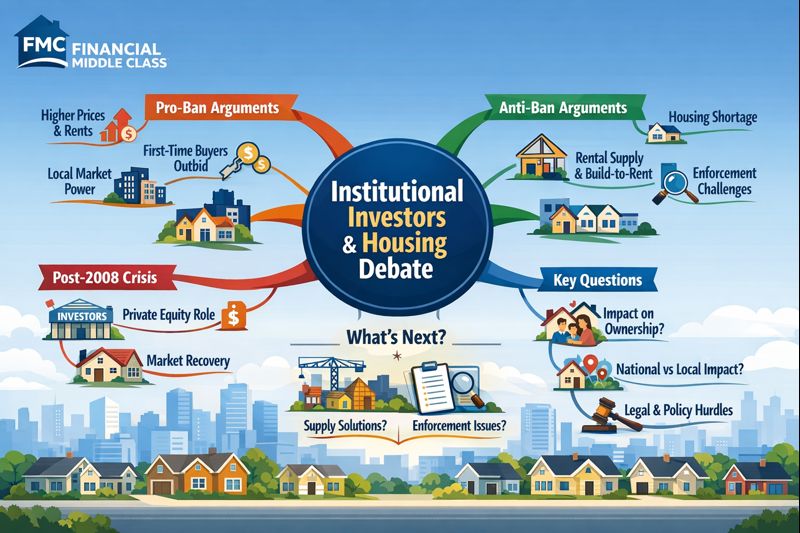
The pro-ban case: what supporters argue, and what evidence they cite
Proponents typically make four core claims.
1) Large investors can outcompete households—especially first-time buyers
The most intuitive argument is transactional: large firms can deploy cash or rapid financing, purchase in volume, and bid aggressively, potentially crowding out individual buyers—particularly in starter-home price bands. This claim appears in legislative efforts aimed at institutional ownership, which often emphasize the ability of large investors to make competitive offers and accumulate local market share.
2) Concentration can create market power in specific metros
Supporters argue that even if institutional ownership is small nationally, concentration in certain metro areas can affect local prices, rents, tenant experience, and bargaining power. The GAO concentration estimates in markets like Atlanta and Jacksonville are often cited to support the idea that local impact can be substantial even when national impact is modest.
3) Homeownership is a policy goal in itself
Many proponents treat homeownership not just as a market outcome but as a public interest: a pathway for wealth accumulation and neighborhood stability. This framing is evident in federal and state proposals that aim to “disincentivize” or restrict institutional purchases of one- and two-family homes.
4) The research suggests institutional investors may have raised prices and rents after the crisis
Supporters point to the research summarized by GAO indicating that institutional investors may have contributed to increasing home prices and rents in the post-crisis period. While GAO does not claim a single definitive effect size across markets, its literature review provides a credible basis for the argument that large investor activity can influence outcomes, particularly in the markets where it is concentrated.
Policy precedents supporters highlight
The pro-ban side can point to a growing landscape of legislative proposals at multiple levels:
- Federal efforts to curb hedge fund or large investor ownership, including proposals that would require divestment over time and/or restrict future acquisitions.
- State-level approaches such as waiting periods before covered institutional investors can bid on certain homes (a proposal highlighted by New York’s governor).
- Public interest scrutiny, including the Federal Trade Commission’s move to seek public comment on a study of single-family rental “mega-investors.”
From this perspective, the ban proposal is framed as a corrective: reducing competition from the largest buyers for the housing stock most likely to be targeted by first-time homebuyers.
The anti-ban case: what opponents argue, and what evidence they cite
Opponents of a ban generally do not dispute that investor activity exists; they dispute its centrality and warn about unintended consequences.
1) The primary affordability driver is the housing shortage, not investor ownership type
A common argument is that even eliminating large investors would not solve affordability because prices are fundamentally constrained by supply. In recent commentary on the administration’s housing agenda, Federal Reserve officials have emphasized that the affordability problem is “more about supply than financing.”
This view aligns with prominent analyses in the January 2026 coverage of the proposed ban, which argue that institutional investors’ national share is too small to be a major driver of national price levels, and that the binding constraint is years of underbuilding in high-demand areas.
2) A ban may shift purchases to smaller investors rather than to owner-occupants
Some critics argue the likely effect is substitution: if large institutional buyers are barred, homes may be bought by smaller investors (local LLCs, mid-sized operators) rather than by first-time buyers—especially if households remain constrained by down payments, credit standards, or mortgage rates. This “who replaces the buyer?” critique appears repeatedly in recent reporting and analysis.
3) Institutional capital can support rental supply, including build-to-rent
Another argument is that large institutional participation can finance or stabilize rental supply in neighborhoods where demand for rental single-family homes is strong. Critics warn that broad restrictions could reduce capital for certain forms of supply—especially build-to-rent—unless carveouts are carefully designed.
4) Implementation is difficult: defining “large,” tracing ownership, and enforcing at scale
Practical enforceability is a recurring objection. Large buyers can use subsidiaries, affiliates, and special purpose entities, complicating any rule that relies on the name on the deed. GAO and the Minneapolis Fed both emphasize that policymakers are often working in a “data-poor environment” with inconsistent definitions and limited visibility into ownership structures.
This issue is sharpened by the state of beneficial ownership reporting. In 2025, FinCEN issued an interim final rule removing the requirement for U.S. companies and U.S. persons to report beneficial ownership information to FinCEN under the Corporate Transparency Act framework, narrowing reporting obligations largely to certain foreign entities. Whatever one’s view of that change, it illustrates why a policy that assumes quick, universal “look-through” transparency for domestic LLCs may be harder to operationalize than expected.
5) Legal constraints and litigation risk
Legal analysts have also examined potential constitutional boundaries for state-level prohibitions on institutional investment in single-family rentals, suggesting that broad restrictions can face significant legal challenges depending on structure and jurisdiction.
In this view, even if the policy goal is popular, a sweeping ban could be slowed or narrowed by litigation, and its ultimate impact could be diluted by exemptions and workarounds.
What a “ban” could mean in practice: design choices that shape outcomes
The public debate often treats “ban institutional investors” as one policy. In practice, it is many possible policies.
Scope: existing homes vs new construction
A key design question is whether restrictions apply to:
- existing single-family homes, where the first-time buyer competition narrative is strongest, or
- new construction, where institutional buyers may be funding net-new units (including build-to-rent).
Recent expert commentary warns that a blanket ban risks mis-targeting the underlying shortage problem and may have little effect on national prices.
Geography: national ban vs targeted metros
Because concentration is uneven, the same policy could have very different effects across regions. GAO’s metro-level estimates are frequently cited by those arguing for targeted interventions in specific markets rather than nationwide rules.
Threshold: 100+ vs 1,000+ (and aggregation across affiliates)
Reporting varies on where lines are drawn. Some discussions of “large institutional investors” use thresholds around 100+ homes, while “mega-investor” datasets often use 1,000+. A meaningful rule would need to specify whether thresholds are measured nationally or within a metro area, and whether affiliated entities are aggregated under common control.
Authority: executive levers vs legislation
Many analyses suggest that implementing a broad ban would likely require congressional legislation, both to establish clear authority and to create a workable enforcement framework.
A related question: did private equity “save” housing after 2008—and would we need them in the next crisis?
The post-2008 episode looms over the current debate. Institutional investors did help absorb distressed inventory in some markets, as GAO documents. But national stabilization in the wake of the crisis also relied heavily on macro-financial policy that supported mortgage lending and housing markets.
The Federal Reserve’s own documentation notes that $1.25 trillion in agency mortgage-backed securities were purchased between January 2009 and March 2010 as part of its MBS purchase program. Research from the Federal Reserve system estimated that the MBS purchase program reduced risk premiums embedded in mortgage rates and helped re-establish a robust secondary mortgage market during the crisis period.
This history does not resolve the investor-ban question, but it complicates a common narrative. It suggests that in a future crisis, the “rescue” of housing would not necessarily depend on private equity landlords as buyers of last resort; it could depend more on the structure of mortgage-market support, foreclosure mitigation, and supply response—factors that sit alongside, and sometimes overshadow, the identity of marginal buyers.
What we know, what we don’t, and what would decide the outcome
What we know (with relatively strong evidence)
- Investor buying is a substantial share of transactions in many markets (e.g., 17% in Q3 2025 per Redfin).
- Large institutional ownership is modest nationally but can be highly concentrated in certain metros; GAO-linked estimates put institutional shares of the single-family rental market in the teens to mid-20s in select Sun Belt metros.
- The institutional SFR model scaled materially after the financial crisis, growing from essentially no 1,000+ owner portfolios in 2011 to an estimated 170,000–300,000 institutionally owned homes collectively by 2015.
- The research literature summarized by GAO suggests institutional investors may have increased prices and rents in the post-crisis period and may have stabilized neighborhoods, though effects vary by market and period.
What we don’t know (or can’t estimate confidently)
- The size of the causal effect on homeownership rates and long-run wealth building in affected neighborhoods, because many confounding factors move simultaneously (credit conditions, migration, zoning, construction cycles). GAO emphasizes these limitations.
- Whether a ban would meaningfully increase owner-occupant purchases versus simply shifting homes from mega-investors to smaller investors, a substitution effect raised by critics.
- How enforceable a ban would be in practice without robust mechanisms to identify control groups behind LLCs, and how much evasion would occur. Data and definitional constraints remain central.
What would decide whether a ban “works”
- How “large-scale” is defined (threshold and aggregation across affiliates).
- Whether the policy targets existing homes, new construction, or both, and what carveouts exist for supply-adding activity.
- Whether enforcement is built into transactions (disclosure, auditing, penalties), especially given the broader landscape of beneficial ownership reporting.
- Whether complementary supply policies accompany the restriction, since supply constraints are widely cited as the dominant affordability driver.
A balanced synthesis
The case for restricting large institutional purchases is strongest where the empirical pattern is strongest: metros where ownership concentration is high enough to plausibly affect competition, pricing, and tenant outcomes. GAO’s metro estimates and recent reporting underscore that such markets exist.
At the same time, the case against a broad national ban rests on two substantial points: (1) institutional ownership appears too small nationally to be a primary driver of national price levels, and (2) the affordability problem is widely understood to be anchored in long-running supply shortages that restrictions alone cannot fix.
Because the evidence points to both realities—modest national footprint and meaningful local concentration—“ban or don’t ban” is likely less informative than “what kind of restriction, applied where, with what enforcement, and alongside what supply response.” The policy’s effects would depend less on the rhetoric surrounding it and more on the technical details that turn a headline into a functioning rule.


RELATED ARTICLES
How Wealth Is Passed Across Generations in the United States: Mechanisms, Evidence, and the Policy Debate
How wealth passes between generations—trusts, taxes, and the debate. Get the facts, figures, and tradeoffs. Read now.
The S&P 7,000: How Wall Street Disconnects from Main Street
S&P 7,000 can rise while wages, benefits, and towns fall behind. See why the market isn’t the economy—read now.
Leave Comment
Cancel reply
Gig Economy
American Middle Class / Feb 18, 2026
How Wealth Is Passed Across Generations in the United States: Mechanisms, Evidence, and the Policy Debate
How wealth passes between generations—trusts, taxes, and the debate. Get the facts, figures, and tradeoffs. Read now.
By FMC Editorial Team
American Middle Class / Feb 16, 2026
The S&P 7,000: How Wall Street Disconnects from Main Street
S&P 7,000 can rise while wages, benefits, and towns fall behind. See why the market isn’t the economy—read now.
By MacKenzy Pierre
American Middle Class / Feb 16, 2026
The “Resilient Consumer” Is Real—But So Is the Interest Bill
Credit card balances are rising as savings fall. See what it means—and the 30/60/90 plan to escape 25% APR debt.
By Article Posted by Staff Contributor
American Middle Class / Feb 09, 2026
What To Do If You Get Fired With an Outstanding 401(k) Loan
Fired with a 401(k) loan? Avoid taxes, offsets, and deadline traps with this step-by-step checklist. Read now.
By Article Posted by Staff Contributor
American Middle Class / Feb 09, 2026
The Real Math of Money in Relationships
Split finances without resentment. Any couple, any income ratio. Use the worksheet + rules—start today.
By Article Posted by Staff Contributor
American Middle Class / Feb 03, 2026
Investing or Paying Off the House?
Invest or pay off your mortgage? See a $500k example with today’s rates, dividends, and peace-of-mind math—then choose your plan.
By Article Posted by Staff Contributor
American Middle Class / Jan 30, 2026
Gold, Silver, or Bitcoin? Start With the Job—Not the Hype
Gold, silver or Bitcoin? Learn what each is for—and how to size it—before you buy. Read the framework.
By Article Posted by Staff Contributor
American Middle Class / Jan 29, 2026
Florida Homeowners Pay the Most in HOA Fees
Florida HOA fees are surging. See what lawmakers changed, what’s next, and how to protect your budget—read before you buy.
By Article Posted by Staff Contributor
American Middle Class / Jan 29, 2026
Why So Many Homebuyers Are Backing Out of Deals in 2026
Why buyers are backing out of home deals in 2026—and how to avoid costly surprises. Read the playbook before you buy.
By Article Posted by Staff Contributor
American Middle Class / Jan 28, 2026
How Money Habits Form—and Why “Self-Control” Is the Wrong Villain
Learn how money habits form—and how to rewire spending and saving using behavioral science. Read the framework and start today.
By FMC Editorial Team
Latest Reviews
American Middle Class / Feb 18, 2026
How Wealth Is Passed Across Generations in the United States: Mechanisms, Evidence, and the Policy Debate
How wealth passes between generations—trusts, taxes, and the debate. Get the facts, figures, and tradeoffs....
American Middle Class / Feb 16, 2026
The S&P 7,000: How Wall Street Disconnects from Main Street
S&P 7,000 can rise while wages, benefits, and towns fall behind. See why the market...
American Middle Class / Feb 16, 2026
The “Resilient Consumer” Is Real—But So Is the Interest Bill
Credit card balances are rising as savings fall. See what it means—and the 30/60/90 plan...