The January Freeze: 30 Days of No-Spend (How to Make It Stick)
By Article Posted by Staff Contributor
The estimated reading time for this post is 674 seconds
The January Freeze: 30 Days of No-Spend (How to Make It Stick)
January is the Monday of months.
The decorations come down. The credit-card statement shows up like a recap episode you didn’t ask for. You scan charges you barely remember and think, We didn’t even do anything. Meanwhile, your pantry is full of ingredients that don’t combine into dinner, and your bank account is full of reminders that “tight” is a lifestyle now.
So you declare a reset. You promise you’ll be disciplined. You’ll stop spending on nonsense. You’ll finally “get it together.” And then real life shows up on January 8 with the same energy it had in December: tired, rushed, hungry, and just a little offended.
This is why the January Freeze works when other money resolutions don’t. It’s not a personality transplant. It’s a short, controlled pause—a financial Dry January. Thirty days where you stop feeding the leaks long enough to see what’s really happening, and take your money back from autopilot.
Reality check: The average household spends around $6,500 a month (based on 2024 consumer expenditure averages). That’s why “normal” can still feel squeezed. And record-level credit-card balances are a reminder that a lot of people aren’t thriving—they’re floating.
What “no-spend” really means for middle-class households
A no-spend month doesn’t mean you stop paying for life. You’re not canceling electricity to prove a point.
The January Freeze means you stop paying for impulse, convenience, and dopamine. You keep paying essentials. You pause the non-essentials.
Because the middle class doesn’t usually get wrecked by one dramatic purchase. It gets worn down by a thousand tiny “it’s fine” moments: the delivery fee, the quick Target run, the little treat, the subscription you forgot, the “we deserve it” dinner on a random Tuesday.
Is a no-spend month right for you?
Some people don’t need a no-spend challenge. They need stabilization.
If you’re behind on essentials—rent/mortgage, utilities, medication, food, or transportation to work—then a strict Freeze can backfire. Not because you lack discipline, but because your life is already in triage.
When to do a Modified January Freeze
If you’re dealing with shutoff notices, eviction risk, food insecurity, or a medical crisis, do a Modified Freeze instead. Your mission is not “save $600.” Your mission is “stop the spiral.”
- Pause all discretionary spending.
- Prioritize getting current (or negotiating) on essentials.
- Hunt fees and penalties like they’re termites.
Day 0: The baseline audit that tells you the truth
Most people don’t have a spending problem. They have a fog problem.
Before January starts, pull the last 30 days of transactions from your bank and credit cards. Don’t judge them yet. Label them.
Use these categories (simple, but revealing)
- Essentials: housing, utilities, insurance, childcare, prescriptions, minimum debt payments
- Food at home: groceries
- Food away from home: restaurants, takeout, delivery fees
- Convenience: quick stops, impulse snacks, rideshares, “I was in a rush” spending
- Subscriptions: apps, streaming, memberships, trials that quietly renewed
- Retail/Impulse: Amazon, Target runs, little treats, boredom buys
Two questions that change everything
- What were my top 2–3 leak categories?
- What was the trigger—tired, stressed, rushed, bored, social pressure?
That’s the point of the Freeze: not virtue. Pattern interruption.
Choose your Freeze level (so your plan fits your life)
People fail when they choose a plan for an imaginary version of themselves. Pick a level you can sustain.
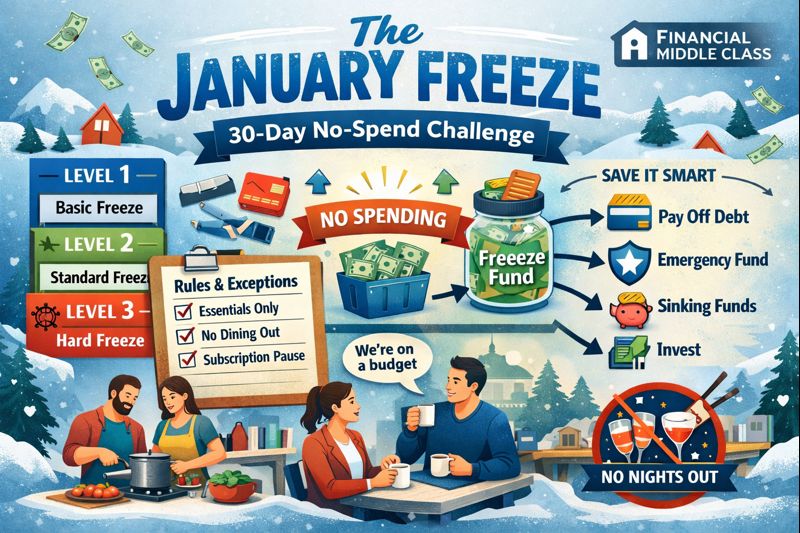
| Freeze level | What you pause | What you allow | Best for |
|---|---|---|---|
| Level 1: Basic Freeze | Nonessential shopping + impulse spending | One planned low-cost social activity per week | First-timers, busy households |
| Level 2: Standard Freeze | Restaurants/takeout + nonessential shopping + subscription pause/audit | Planned groceries + at-home fun | Most middle-class households |
| Level 3: Hard Freeze | All discretionary spending + browsing + “quick runs” | Tiny discretionary cap in cash only | Debt payoff sprint, serious reset |
Rules that make No-Spend January actually stick
Rules aren’t “strict.” Rules are what keep you from renegotiating with yourself when you’re tired.
Rule 1: Define “allowed” once—before January begins
If you decide in the moment, you’ll decide in the direction of comfort. Write your allowed list. Write your frozen list. Keep it visible.
Rule 2: No browsing
No “just looking.” No cart-building. No scrolling as therapy. Shopping apps are designed to convert your boredom into a purchase. Don’t walk into the casino to “just enjoy the lighting.”
Rule 3: Capture every win
Open a savings bucket called Freeze Fund. Every time you skip a spend, move money into it. Even $10. Especially $10.
Rule 4: The 24-hour rule for non-essentials
If it isn’t health/safety/work-required, wait 24 hours before buying. Most impulse spending doesn’t survive daylight.
Rules + Exceptions contract (printable template)
If you share money with a spouse/partner, the contract prevents weekend renegotiations that turn into fights.
Household January Freeze Agreement (30 Days)
Our goal is: Build a buffer / Pay down credit cards / Catch up essentials / Stop fees (circle one; rank if needed)
Allowed (Essentials): Housing • Utilities • Insurance • Childcare • Groceries • Work transportation • Prescriptions • Minimum debt payments
Frozen (No-spend categories): Dining out/takeout • Delivery fees • Nonessential shopping • New subscriptions • Entertainment spend • Random store runs • Browsing
Pre-approved exceptions (planned):
• One social expense per week capped at $____
• One kid-related necessity per week capped at $____
• Emergency repairs (health/safety/work-related)
If we slip: We log it, we don’t spiral, and we reset immediately.
Signed: ____________________ Date: _________ Signed: ____________________ Date: _________
Exceptions & the 24-hour filter
A no-spend month fails when it pretends emergencies don’t exist. Build exceptions into the system—then follow the system.
Automatic exceptions
- Health and safety
- Work-required expenses
- True repairs (the kind that get worse and more expensive if ignored)
The 24-hour + 3-question filter
- What happens if I don’t buy this in January?
- Am I solving a problem—or soothing a feeling?
- Will Future Me thank me—or forget this purchase existed?
Food strategy (without misery)
Food is where good intentions go to die. Especially when you’re tired.
Cutting takeout can be the fastest win—but only if you replace it with a plan that doesn’t feel like punishment.
Grocery guardrails
- Shop once per week. Not three “small trips.” Small trips are where budgets go to get mugged.
- Buy for a rotation, not a fantasy version of yourself who cooks like a food blogger.
- Allow two convenience items (rotisserie chicken, bagged salad, frozen meals, pre-chopped veggies). Exhaustion is real.
The 4-night dinner rotation (repeat it)
- Pantry night: pasta, rice/beans, eggs, soup
- Protein night: tacos, stir-fry, baked chicken, sheet-pan meals
- Leftovers night: non-negotiable
- Freezer night: frozen veg + protein + sauce
Kids, spouse, and social pressure (real scripts)
You don’t need stronger willpower. You need better words.
Scripts that work in real life
- To friends: “I’m doing a No-Spend January. I’m down to hang—walk, coffee at home, somebody’s house. I’m just not spending this month.”
- To family: “We’re doing a reset. January is quiet. February we’ll loosen up.”
- To your partner: “I’m not trying to control you. I’m trying to protect us. Let’s follow the plan we agreed on and stop renegotiating every weekend.”
- To your kids: “Not this month. We’re doing a 30-day challenge. Let’s pick something free to do tonight.”
Accountability systems that don’t depend on motivation
Motivation disappears the moment you’re tired. Systems don’t.
The weekly 15-minute money huddle
Same day, same time. You check spending, Freeze Fund balance, what tripped you up, and what you’ll change next week. No shame. Just reality.
Make spending inconvenient
- Delete stored cards from shopping apps
- Unsubscribe from marketing emails
- Turn on transaction alerts
- Move shopping apps off your home screen (or delete them)
Anti-Spiral Protocol (when you slip)
You will mess up once. Maybe twice. The danger isn’t the slip. It’s the spiral.
- Pause: No “since we already messed up…” second purchase.
- Log it: What happened and why (tired? stressed? social pressure?).
- Replace it: Cut that amount elsewhere or move a small amount to Freeze Fund anyway.
- Reset immediately: Next meal, next decision.
30-Day Timeline (What Hits Each Week)
Week 1: Convenience withdrawal
You’ll crave “easy” spending. Make it hard to buy fast, and easy to eat at home.
Move: Grocery once. Two convenience items allowed. Set transaction alerts.
Week 2: Boredom spending
This is the “just browsing” danger zone. Your phone wants your money.
Move: Replace scrolling with something physical (walk, clean-out, free activity). Transfer a “browse avoided” amount into Freeze Fund.
Week 3: The “I deserve it” week
You’ll feel like you earned a relapse. Plan one cheap at-home treat so the month doesn’t feel like punishment.
Move: Review Freeze Fund progress. Re-read your contract before any exception.
Week 4: Fatigue & impatience
“February is close anyway” becomes the excuse. Finish strong. Keep meals simple. Keep rules tight.
Move: Do a quick audit and lock in your February thaw plan.
What to do with the savings (so January actually changes your life)
This is where people fumble. They save money in January, feel proud, then treat February like a rebound relationship.
Your Freeze Fund needs a job.
The Freeze Fund decision tree
- Build a small buffer ($200–$1,000).
- Kill fees (late fees, overdrafts, penalties, past-due essentials).
- Attack high-interest debt (credit cards first).
- Build emergency savings that matches your life.
- Create sinking funds (car repairs, insurance renewals, holidays, back-to-school).
- Automate investing (401(k), Roth IRA, brokerage) if you’re stable enough.
Mini case studies (real households, real outcomes)
Case 1: Two-income household with the daycare squeeze (Level 2)
They cut restaurants/takeout, pause two subscriptions, and transfer $25 each time they skip a spend. End of month, they’ve found $450–$600 without feeling like they lived in a bunker. They put $250 into a starter buffer and throw the rest at the highest APR card. The win isn’t perfection. It’s momentum.
Case 2: Single professional with “I make good money, why am I stressed?” syndrome (Level 1)
The leaks aren’t dramatic. They’re constant: convenience buys, browsing, subscriptions, and “quick runs.” End of month, they’ve found $500–$800. They build sinking funds for car maintenance and travel so predictable expenses stop becoming credit-card emergencies.
Case 3: Family coming off a holiday hangover (Modified Freeze)
They aren’t chasing a perfect no-spend streak. They’re stopping fees and getting current. End of month, they stabilized $250–$400 by avoiding late charges and panic purchases. Not glamorous. Powerful.
The February thaw plan (how to restart spending without snapping back)
Day 31 isn’t the finish line. It’s the handoff.
How to thaw without rebound-spending
- Reintroduce one discretionary category at a time.
- Set a monthly fun cap you can spend guilt-free.
- Keep the 24-hour rule for purchases over $50 (or your number).
- Do a subscription audit the first weekend of every month.
- Keep the 15-minute money huddle. Short, honest, consistent.
The truth that hits home
The middle class doesn’t usually collapse because of one reckless purchase.
It collapses from exhaustion. From paying too much for basics, then using convenience spending to survive the day, then using credit cards to cover the gap, then acting shocked when the statement arrives like a verdict.
The January Freeze is not you becoming a different person. It’s you stopping the quiet surrender.
For 30 days, you tell the world—and your own impulses—something simple: My money is not a stress toy. It’s my stability. And I’m taking it back.
FAQ
Is this a “no fun” month?
No. It’s a “spend with intention” month. If you need a sanity line, use Level 1 or a small planned cap.
What counts as an “essential”?
Essentials keep life stable: housing, utilities, insurance, childcare, groceries, work transportation, prescriptions, and minimum debt payments.
What if I slip and spend anyway?
Use the Anti-Spiral Protocol: pause, log it, replace it (cut elsewhere), and reset immediately. One mistake isn’t the month.
Should I use cash or debit?
If cards are your weakness, use cash for any allowed discretionary cap. If you’re disciplined, debit + alerts can work.
Where should the savings go first?
Start with a tiny buffer, then kill fees, then attack high-interest debt, then emergency fund, then sinking funds, then investing.
Let’s talk
What’s your biggest “money leak” category—takeout, Amazon/Target runs, subscriptions, or convenience spending?
Drop it in the comments and tell me which Freeze level you’re choosing (Level 1, 2, or 3). I read them all.

RELATED ARTICLES
Cash Strategy: Put Every Dollar in the Right Place
Your checking account, emergency fund, short-term savings, and investments should not be managed the same way. This cash strategy helps assign every dollar to the right financial job.
Best HYSA: How to Choose Beyond the Highest APY
A competitive interest rate matters, but it is only one part of choosing a high-yield savings account. Compare insurance, fees, access, transfer speed, and promotional conditions.
Leave Comment
Cancel reply
Gig Economy
Business / Aug 08, 2026
The Missing Middle in Black Entrepreneurship
Black entrepreneurship has expanded dramatically. The next challenge is helping more Black-owned businesses move from self-employment to employer firms and sustainable scale.
By FMC Editorial Team
Personal Finance / Aug 01, 2026
Cash Strategy: Put Every Dollar in the Right Place
Your checking account, emergency fund, short-term savings, and investments should not be managed the same way. This cash strategy helps assign every dollar to the right...
By Article Posted by Staff Contributor
Personal Finance / Aug 01, 2026
Best HYSA: How to Choose Beyond the Highest APY
A competitive interest rate matters, but it is only one part of choosing a high-yield savings account. Compare insurance, fees, access, transfer speed, and promotional conditions.
By Article Posted by Staff Contributor
Personal Finance / Aug 01, 2026
High-Yield Savings vs. CDs, Treasury Bills, and Other Safe Places for Cash
High-yield savings accounts are excellent for accessible cash, but they are not always the best choice. Compare HYSAs, CDs, Treasury bills, money market accounts, and I...
By Article Posted by Staff Contributor
American Middle Class / Aug 01, 2026
High-Yield Savings Accounts: A Safer Home for Your Cash
A high-yield savings account can pay several times the national savings rate while keeping qualified deposits federally insured. Here is how it works, what to watch...
By Article Posted by Staff Contributor
Real Estate / Jul 30, 2026
Mortgage Lock-In Is Freezing the Housing Market
Millions are trapped by 3% mortgages. Learn how mortgage lock-in worsens affordability—and why homeowners are renovating instead.
By FMC Editorial Team
Real Estate / Jul 26, 2026
Is South Florida More Expensive Than New York? The Complete 2026 Relocation Guide
Is South Florida more expensive than New York? Compare housing, taxes, insurance and 104 municipalities before you move.
By Article Posted by Staff Contributor
Personal Finance / Jul 25, 2026
The Time Value of Life Experiences: What Compound Interest Leaves Out,
Money compounds, but life experiences do too. Explore what compound interest leaves out—and how to balance saving with living.
By MacKenzy Pierre
American Middle Class / Feb 18, 2026
How Wealth Is Passed Across Generations in the United States: Mechanisms, Evidence, and the Policy Debate
How wealth passes between generations—trusts, taxes, and the debate. Get the facts, figures, and tradeoffs. Read now.
By FMC Editorial Team
American Middle Class / Feb 16, 2026
The S&P 7,000: How Wall Street Disconnects from Main Street
S&P 7,000 can rise while wages, benefits, and towns fall behind. See why the market isn’t the economy—read now.
By MacKenzy Pierre
Latest Reviews
Business / Aug 08, 2026
The Missing Middle in Black Entrepreneurship
Black entrepreneurship has expanded dramatically. The next challenge is helping more Black-owned businesses move from...
Personal Finance / Aug 01, 2026
Cash Strategy: Put Every Dollar in the Right Place
Your checking account, emergency fund, short-term savings, and investments should not be managed the same...
Personal Finance / Aug 01, 2026
Best HYSA: How to Choose Beyond the Highest APY
A competitive interest rate matters, but it is only one part of choosing a high-yield...