
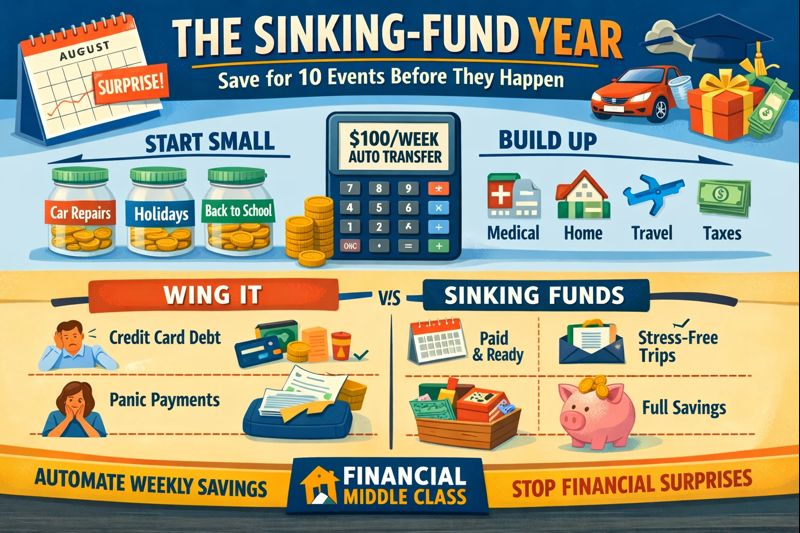
The Sinking-Fund Year: Save for 10 Events Before They Happen
By Article Posted by Staff Contributor
The estimated reading time for this post is 881 seconds
Last updated: — updated for a simpler, more realistic “start with 3, build to 10” sinking fund plan.
Key takeaways
- Most “surprise” bills aren’t surprises—they’re calendar events you can pre-pay.
- Start with 3 sinking funds, then build to 5, then 10—coverage beats perfection.
- Automate the transfer for the day after payday so saving isn’t optional.
- Separate + label the money (buckets/vaults) so you don’t spend it by accident.
- Sinking funds protect your emergency fund and keep debt payoff from relapsing.
Timeline: the Sinking-Fund Year at a glance
Open each season to see what usually hits—and what to fund before it shows up.
January–March: resets + renewals
Deductibles reset, annual renewals hit, and the post-holiday hangover shows up on your statements.
- Seed medical out-of-pocket + renewals buckets early.
- Restart the weekly transfer—momentum matters most here.
April–June: school events + travel + maintenance
“Small” events stack up fast: graduations, trips, activities, and home maintenance season.
- Build the travel/family obligations bucket.
- Schedule car/home maintenance before peak summer costs.
July–September: back-to-school shock
Supplies, clothes, fees, and “my kid grew overnight” spending can wreck cash flow.
- Back-to-school is its own category for a reason—fund it on purpose.
- Plan for activity fees and uniforms (the sneaky add-ons).
October–December: the holiday freight train
Gifts, food, travel, tips, events—this season rewards people who started in February.
- Set a holiday cap, then fund it weekly like a bill.
- Spend from the holiday bucket without guilt—planned spending isn’t failure.
The calendar isn’t your enemy
If you’re middle class, you don’t usually get knocked out by one dramatic disaster. You get worn down by the calendar.
Not the truly unexpected emergency. The expected stuff you still weren’t ready for. Birthdays. Back-to-school. Holiday travel. Holiday gifts. Tires. A car battery. The deductible reset. The annual renewal you forgot was annual because your brain has 47 tabs open.
So you do what millions of responsible people do: you swipe, you shuffle, you promise you’ll catch up next paycheck. And the stress doesn’t come from the spending. It comes from the timing.
A sinking fund year is how you stop acting surprised by your own life. You pre-pay predictable events in small automatic chunks—$X per week—so when they show up, you don’t negotiate with your checking account like it’s a hostage situation.
Why money feels tight even when you’re responsible
Let’s say you’re doing “the right things.” Bills get paid. You show up to work. You aren’t out here financing vacations with a smile and a prayer. And still—one extra expense can mess up your entire week.
That’s not just you. The Federal Reserve’s data for 2024 shows 63% of adults said they could cover a hypothetical $400 unexpected expense with cash or its equivalent—meaning a lot of people would still have to borrow or scramble for something that small.
Bankrate’s 2025 emergency savings report tells the same story: only 46% say they have enough emergency savings to cover three months of expenses, and 24% say they have no emergency savings at all.
Now add the predictable spending seasons we all pretend are random. NRF’s holiday survey put average planned spending at about $890 per person for 2025. And NRF’s back-to-school survey showed families planning hundreds more for supplies, clothes, shoes, and electronics—right as the rest of life is also billing you.
If you feel like you’re always recovering from the last big month, you’re not clueless. You’re paying for predictable life events in the least efficient way possible: all at once, at the worst time.
What a sinking fund is (and isn’t)
A sinking fund is purpose-specific savings for a known expense.
It’s not your emergency fund. Emergencies are random. Sinking funds are scheduled. It’s not investing, either. This money has a short mission and a near-term timeline. And it’s definitely not about “discipline.” It’s about building a system that runs when you’re tired, busy, or over it.
Think of it like this: instead of letting December kick you in the teeth, you make December pay you weekly from February to November. You’re paying Future You’s bills in installments.
The Sinking-Fund Calendar
Middle-class stress has seasons. The year has heavy months the way Florida has hurricane season. You don’t act shocked when August rolls around. You prepare.
The heavy months most people underestimate
January–March: deductible resets, renewals, car tags, “why are we still paying for December?”
April–June: graduations, weddings, travel, school events, home maintenance season
July–September: back-to-school/back-to-college, fees, uniforms, “my kid grew overnight” clothing
October–December: the holiday freight train—gifts, food, travel, tips, events, outfits, pressure
None of this is a surprise. Your savings system just hasn’t been built to match reality.
Start in tiers: 3 → 5 → 10
“Save for 10 events” sounds great until you’re staring at your budget like it’s a crime scene. So don’t start at 10 if it makes you freeze. Start with coverage. Then build.
Tier 1: The Big 3 (the credit-card triggers)
Car repairs. Holidays. Back-to-school.
Tier 2: The Big 5 (the stability layer)
Add medical out-of-pocket and travel/family obligations.
Tier 3: The full 10 (the grown-up insurance policy)
Now you’re saving for the year like someone who’s tired of being surprised.
Ten sinking fund categories most middle-class households face
- Winter holidays (gifts + food + travel)
- Birthdays (kids, partner, parents)
- Back-to-school / back-to-college
- Car repairs + maintenance (tires, brakes, battery, oil)
- Home maintenance (HVAC, plumbing, pest control)
- Medical out-of-pocket (copays, meds, deductibles)
- Property taxes / move-and-renew costs (renters too)
- Annual subscriptions + renewals (memberships, software, kids’ stuff)
- Travel/family obligations (weddings, funerals, reunions)
- The “one-time” stuff that always happens (school trips, uniforms, tipping)
How to calculate $X per week (without lying to yourself)
The math is boring. That’s why it works.
The weekly sinking-fund formula
$X per week = (Total yearly cost of your events × 1.10) ÷ 52
The “× 1.10” is a buffer. Life will add a little extra. Better to admit it now than act shocked later.
If you get paid every two weeks
Per paycheck = (Total yearly cost × 1.10) ÷ 26
Quick example (illustrative)
Let’s say your chosen events total $4,800 for the year. Buffer it: $4,800 × 1.10 = $5,280. Weekly: about $102/week. Biweekly: about $203/paycheck.
That number can feel aggressive until you remember you were already paying it—just through credit card balances, “temporary” debt, and stress.
Wing-it vs sinking-fund year
You can’t put a price on peace, but you can absolutely calculate it.
| What happens | Wing-it budget | Sinking fund year |
|---|---|---|
| Holidays arrive | Swipe, regret, scramble | Spend what you already saved |
| Car repair hits | Credit card or panic | Pay it and keep moving |
| Back-to-school comes | “We’ll make it work” | Category is already funded |
| Your brain all year | Low-grade anxiety | Quiet confidence (boring, beautiful) |
Where to keep the money (so you don’t steal it from yourself)
If your sinking funds sit in your checking account, your checking account will eat them alive by Tuesday. That’s not moral failure. That’s proximity.
Your best options are simple: a savings account with buckets/vaults, a separate “Sinking Funds” savings account, or multiple savings accounts if your bank makes it painless. The labels matter more than you think. “Savings” is vague. “Back-to-School 2026” is a boundary.
Automation setup (make it run without motivation)
Motivation is unreliable. Autopay is undefeated.
The rule that changes everything
Set the transfer for the day after payday. Not “when there’s extra.” Not “when I remember.” Day after payday means your plan runs before life starts spending for you.
Keep it boring at first
Use fixed amounts (weekly or per paycheck). Complicated systems are where good intentions go to die. Once a quarter, review and adjust.
Irregular income: the percentage method
If you’re gig-based, commission-based, or your hours bounce around, fixed transfers can feel risky. So make it proportional.
Move 8%–12% of every deposit into sinking funds. Big weeks fund faster. Light weeks still keep the habit alive. If you want stability, set a small floor transfer so the system never goes dormant.
“I’m already behind” catch-up plan
If your budget is tight, “save for 10 categories” can sound like a joke told by someone who has never paid for daycare.
Start with reality: $10–$25/week into Tier 1 (the Big 3). Pick the category that most often puts you on a credit card—usually car repairs or holidays.
Then use a reset moment. A refund. A bonus. Overtime. One strong month can seed a bucket enough to change the rest of the year.
Sinking funds vs emergency fund vs debt payoff
This is where people get messy.
Emergency fund: job loss, true surprise medical crisis, actual chaos. Sinking funds: tires, school, holidays, renewals, planned travel, routine maintenance. Debt payoff: essential—but fragile if predictable events keep forcing you back onto the card.
Here’s the real-world truth: if you’re paying down debt but you keep swiping for the holidays, you’re not “bad.” You’re under-systems’d. Sinking funds protect your payoff plan from the calendar.
Common mistakes + fixes
Mistake: underestimating to make the number feel nicer
Fix: use last year’s spending if possible and add a 10% buffer.
Mistake: starting with 10 funds and quitting
Fix: start with 3. Expand quarterly.
Mistake: raiding the funds
Fix: if you borrow, make it official—set a short repayment plan (like a 4-week catch-up transfer).
Mistake: keeping it in checking
Fix: separate account + labels. Make stealing harder.
A realistic case study: “stable” on paper, stressed in real life
Two incomes. One kid. Mortgage. Two car payments. Childcare. Insurance. A grocery bill that climbs even when you swear you’re buying the same things. They aren’t reckless. They’re just running a life with thin margin.
They start with Tier 1:
Car repairs: $1,200/year. Holidays: $1,500/year. Back-to-school: $900/year. Total $3,600. Buffer 10%: $3,960. Weekly: about $76/week.
Three months later, brakes happen. Old life: credit card. New life: the car bucket. Paid. No argument. No shame. No “we’ll catch up next paycheck.” Then they add Tier 2—not because they became rich, but because the system proved itself.
The Sinking Fund Starter Pack (do this in one sitting)
Keep it simple. Keep it repeatable.
- Pick Tier 1 (or list all 10 if you’re ready).
- Estimate yearly costs (use last year’s statements if you can).
- Add a 10% buffer.
- Divide by 52 (weekly) or 26 (biweekly).
- Separate the money from checking and label it.
- Automate the transfer for the day after payday.
- Review every 90 days and adjust.
The truth that hits home
The middle class doesn’t need another lecture about discipline. It needs fewer ambushes.
A sinking fund year is what happens when you stop acting like the calendar is your enemy and start treating predictable expenses like what they are: scheduled bills that deserve scheduled money.
Because the real flex isn’t spending. It’s being ready.
FAQs
How many sinking funds do I really need to start?
Start with 3: car repairs, holidays, back-to-school. Build to 5, then 10. Coverage first, perfection later.
What’s the difference between a sinking fund and an emergency fund?
An emergency fund is for true surprises (job loss, real emergencies). Sinking funds are for known events you can see coming (tires, school, holidays, renewals).
Do I need a separate bank account?
You don’t need ten accounts, but you do need separation. A dedicated savings account or bucket/vault feature works well—labels keep you from “accidentally” spending it.
What if my income is irregular?
Use a percentage method: move 8%–12% of every deposit into sinking funds. If a month is light, keep a small minimum transfer so the habit doesn’t die.
I’m behind already. Should I still do this?
Yes—start small. Even $10–$25/week into one category reduces the next predictable crisis. Use windfalls (refund/bonus/overtime) to “seed” the biggest bucket.
Should I do sinking funds while paying down debt?
Yes. Sinking funds help you stop adding new debt for predictable events. They protect your payoff plan from the calendar.
Quick question for you:
What’s the one category that always ambushes your budget—holidays, car repairs, back-to-school, medical, or something else?
Drop it in the comments (and tell us what month it usually hits).


RELATED ARTICLES
How Wealth Is Passed Across Generations in the United States: Mechanisms, Evidence, and the Policy Debate
How wealth passes between generations—trusts, taxes, and the debate. Get the facts, figures, and tradeoffs. Read now.
The S&P 7,000: How Wall Street Disconnects from Main Street
S&P 7,000 can rise while wages, benefits, and towns fall behind. See why the market isn’t the economy—read now.
Leave Comment
Cancel reply
Gig Economy
American Middle Class / Feb 18, 2026
How Wealth Is Passed Across Generations in the United States: Mechanisms, Evidence, and the Policy Debate
How wealth passes between generations—trusts, taxes, and the debate. Get the facts, figures, and tradeoffs. Read now.
By FMC Editorial Team
American Middle Class / Feb 16, 2026
The S&P 7,000: How Wall Street Disconnects from Main Street
S&P 7,000 can rise while wages, benefits, and towns fall behind. See why the market isn’t the economy—read now.
By MacKenzy Pierre
American Middle Class / Feb 16, 2026
The “Resilient Consumer” Is Real—But So Is the Interest Bill
Credit card balances are rising as savings fall. See what it means—and the 30/60/90 plan to escape 25% APR debt.
By Article Posted by Staff Contributor
American Middle Class / Feb 09, 2026
What To Do If You Get Fired With an Outstanding 401(k) Loan
Fired with a 401(k) loan? Avoid taxes, offsets, and deadline traps with this step-by-step checklist. Read now.
By Article Posted by Staff Contributor
American Middle Class / Feb 09, 2026
The Real Math of Money in Relationships
Split finances without resentment. Any couple, any income ratio. Use the worksheet + rules—start today.
By Article Posted by Staff Contributor
American Middle Class / Feb 03, 2026
Investing or Paying Off the House?
Invest or pay off your mortgage? See a $500k example with today’s rates, dividends, and peace-of-mind math—then choose your plan.
By Article Posted by Staff Contributor
American Middle Class / Jan 30, 2026
Gold, Silver, or Bitcoin? Start With the Job—Not the Hype
Gold, silver or Bitcoin? Learn what each is for—and how to size it—before you buy. Read the framework.
By Article Posted by Staff Contributor
American Middle Class / Jan 29, 2026
Florida Homeowners Pay the Most in HOA Fees
Florida HOA fees are surging. See what lawmakers changed, what’s next, and how to protect your budget—read before you buy.
By Article Posted by Staff Contributor
American Middle Class / Jan 29, 2026
Why So Many Homebuyers Are Backing Out of Deals in 2026
Why buyers are backing out of home deals in 2026—and how to avoid costly surprises. Read the playbook before you buy.
By Article Posted by Staff Contributor
American Middle Class / Jan 28, 2026
How Money Habits Form—and Why “Self-Control” Is the Wrong Villain
Learn how money habits form—and how to rewire spending and saving using behavioral science. Read the framework and start today.
By FMC Editorial Team
Latest Reviews
American Middle Class / Feb 18, 2026
How Wealth Is Passed Across Generations in the United States: Mechanisms, Evidence, and the Policy Debate
How wealth passes between generations—trusts, taxes, and the debate. Get the facts, figures, and tradeoffs....
American Middle Class / Feb 16, 2026
The S&P 7,000: How Wall Street Disconnects from Main Street
S&P 7,000 can rise while wages, benefits, and towns fall behind. See why the market...
American Middle Class / Feb 16, 2026
The “Resilient Consumer” Is Real—But So Is the Interest Bill
Credit card balances are rising as savings fall. See what it means—and the 30/60/90 plan...