
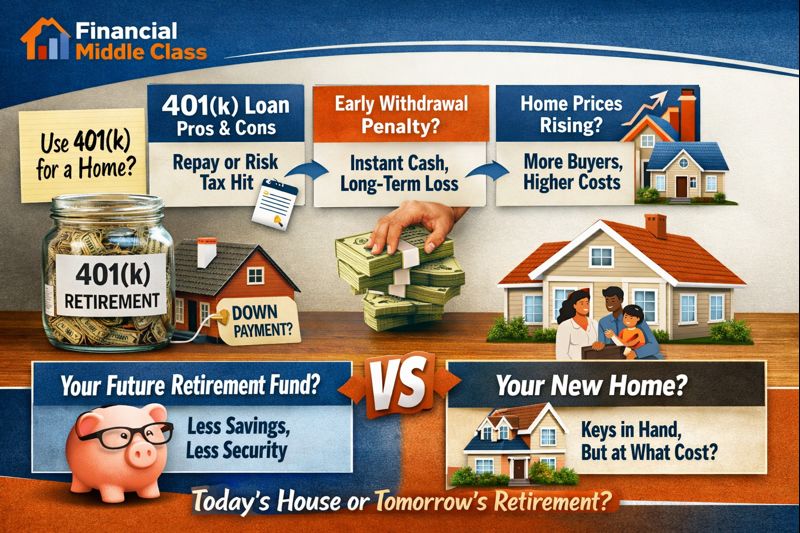
Trump’s 401(k) Down Payment Plan: A House Today, a Retirement Tomorrow?
By Article Posted by Staff Contributor
The estimated reading time for this post is 915 seconds
Skip to table of contents
Skip to article
Last updated
January 19, 2026 — Public reporting describes a plan in development; key details (caps, eligibility, loan vs. withdrawal rules) were not fully published at time of writing.
Key takeaways
- “Use your 401(k) for a down payment” can mean a loan or a withdrawal. Those are two different financial animals.
- This idea can help some households cross the down payment gap, but it can also create retirement leakage and job-change tax surprises.
- In tight markets, giving more buyers down payment firepower can push prices higher if supply doesn’t respond.
- If policymakers want this to help—not harm—the middle class, the guardrails matter: caps, targeting, and a real path to rebuild retirement.
A down payment today, a retirement tomorrow
On paper, the middle class is “doing fine.” In real life, you’re doing math at the kitchen table. You’re watching rent climb like it’s training for a marathon, you’re watching houses sell like concert tickets, and you’re staring at the one pile of money that looks big enough to change your situation: your 401(k).
That’s why the reported Trump housing idea—allowing Americans to use 401(k) money for down payments—lands so hard. The pitch is simple: if the down payment is the wall, let people climb it with retirement money. The question is what that ladder is made of. Wood, or glass.
This post is written for the people living the middle-class reality: you want stability, you don’t want financial heroics, and you don’t want to wake up at 62 realizing you traded your future for a closing date.
What’s been reported about the Trump 401(k) down payment plan (and what’s still unknown)
As of this update, public reporting describes the administration developing a housing plan that would allow Americans to use funds from their 401(k) retirement accounts toward down payments, with additional details expected during the President’s remarks at Davos. The White House has also suggested it’s trying to avoid harming retirement savings, but the fine print that determines whether this is a lifeline or a trap has not been fully published.
Those missing details are not small. They decide everything: whether there are caps, whether this is limited to first-time buyers, whether it’s mainly a loan expansion or a new withdrawal exception, and whether there’s any built-in mechanism that forces or incentivizes people to rebuild their retirement account after they buy.
Until those specifics are on the table, the only honest way to evaluate the plan is to focus on how 401(k) money can be accessed under existing rules, and what would change under the most realistic policy designs.
Why this idea is showing up now
The down payment has become the modern choke point. It’s not always the monthly payment that kills the deal. It’s coming up with tens of thousands of dollars while paying today’s rent, today’s insurance, today’s groceries, and today’s everything.
Recent housing research has shown that typical down payments rose sharply compared with the pre-pandemic period, with widely cited estimates placing the “typical” down payment around the $30,000 range in 2025 versus far lower numbers in 2019. That gap is big enough to change behavior. When you don’t have the cash, you start looking for cash.
At the same time, the housing market has been stuck in a weird limbo. Existing home sales were still near multi-decade lows in 2025, affordability remained strained, and inventory constraints didn’t magically disappear. In a market like that, policymakers reach for demand-side ideas because they feel immediate. The danger is that demand-side fixes can sometimes become price-side consequences.
You can already use a 401(k) for a home in many cases
Most people hear “401(k) for a down payment” and assume it means cashing out retirement. But many workplace plans already allow a different pathway: the 401(k) loan. Not every employer plan offers loans, but many do, and they come with strict limits and repayment rules.
Under IRS rules, the maximum loan is generally the lesser of $50,000 or 50% of your vested account balance, with limited exceptions depending on plan terms. And there’s a crucial housing carveout: a plan loan used to purchase a principal residence can be allowed to run longer than the typical five-year repayment window.
So the “new” part of this policy debate is not that retirement money can touch housing. The new part is whether the government wants to make accessing that money easier, broader, and more normalized—possibly through penalty relief on withdrawals or expanded loan flexibility.
How the plan could work: three realistic designs
When someone says “let people use their 401(k) for a down payment,” that can mean three very different policy structures. The differences are not technical trivia. They determine whether this is a bridge or a leak.
| Possible design | What you’d actually do | Why it sounds helpful | Where it can bite |
|---|---|---|---|
| Expanded 401(k) loan access | Borrow from your account and repay on schedule | Gets down payment cash without a “withdrawal” headline | Job changes and missed payments can turn into taxable trouble |
| Penalty relief for early withdrawals | Take money out for the down payment | Fast cash; fewer barriers at closing | Taxes may still apply; compounding loss is permanent |
| Withdrawal with a repayment/rebuild channel | Withdraw now, recontribute later under special rules | Reduces “leakage” if repayment is real | Complex rules, timing risk, and compliance traps |
If the administration truly wants to avoid harming retirement savings, the safest version is the one that either keeps money in the system via loans with strong guardrails, or creates a clear repayment/rebuild requirement that’s simple enough for normal humans to follow.
401(k) loan vs 401(k) withdrawal: same money, different consequences
This is the part most people gloss over because the headlines don’t make room for nuance. A 401(k) loan and a 401(k) withdrawal come from the same account, but they behave like completely different financial products.
A loan is you borrowing from your retirement and agreeing to pay it back. A withdrawal is you taking the money out and changing the future of that account permanently. Withdrawals can trigger income taxes and, if you’re under 59½, an additional early-distribution tax unless an exception applies. Loans typically avoid that immediate tax hit if they stay compliant, but they come with their own trap doors.
| Feature | 401(k) loan | 401(k) early withdrawal | IRA first-time homebuyer rule |
|---|---|---|---|
| Repayment required | Yes | No | No |
| Immediate tax bill | Usually no (if compliant) | Often yes (taxable income) | Often yes (depends on IRA type/basis) |
| Extra early tax under 59½ | Not if it remains a true loan | Often yes unless an exception applies | Possible exception up to $10,000 for qualified first-time homebuyer |
| Housing-related special rule | Principal residence loans may have longer terms | No automatic home carveout | Explicit first-time buyer carveout exists (limited) |
| Biggest middle-class risk | Job change and default/offset risk | Permanent loss of compounding and future security | Small limit; still reduces retirement assets |
That last row is the heart of the issue. If the plan encourages withdrawals, the risk is slow-motion retirement erosion. If the plan encourages loans, the risk is the “life happens” moment that turns a tidy spreadsheet idea into a tax problem.
Will this put retirement in jeopardy?
It can, and the reason is simple: compounding is not a motivational quote. It’s physics.
When you pull money out of retirement, you don’t just lose that amount. You lose what that money would have become over the years when you were finally supposed to stop sprinting. For younger households, the damage hides because there’s time. For older households, the damage is louder because there’s less time to rebuild.
This matters because the “typical” middle-class 401(k) isn’t a bottomless well. Many households in their prime earning years have balances that look meaningful but aren’t large enough to raid without consequences. If the down payment is $30,000 and your retirement balance is not far above that, you’re not “using a little.” You’re changing the shape of your future.
And there’s a behavioral problem nobody likes to admit: once you normalize retirement accounts as a life-event piggy bank, they become the family ATM. First it’s the house. Then it’s the kitchen remodel. Then it’s the “temporary” cash gap. Meanwhile, retirement doesn’t ask whether you meant well. It only asks whether you saved enough.
The job-change trap nobody plans for
Even if this policy is loan-heavy, the biggest hidden risk is what happens when you stop being the “stable employee” this kind of plan quietly assumes you are.
A 401(k) loan works best when your life is predictable. The moment your life gets unpredictable—job change, layoff, illness, relocation—the loan can become fragile. If the loan stops meeting rules, it can trigger tax consequences that feel like a surprise because nobody reads IRS guidance for fun. The middle class isn’t allergic to responsibility; it’s allergic to traps.
If policymakers want 401(k)-for-down-payment to be a legitimate tool, they have to design around reality: people change jobs. People lose jobs. People get squeezed. A plan that assumes perfect continuity is a plan that will fail the people it claims to help.
Will using 401(k) money for down payments inflate home prices?
Possibly, especially in markets where inventory is tight. Here’s the clean economic point: giving buyers more down payment firepower is a demand-side boost. If supply can’t expand fast enough, sellers gain leverage and prices can absorb some of that extra buyer capacity.
Housing supply constraints have been a persistent problem for years. Multiple credible analyses argue the U.S. has been short millions of units, even though estimates vary depending on methodology and geography. In a shortage environment, demand-side help can become seller-side profit.
| If supply is… | And down payment access expands… | Likely market reaction |
|---|---|---|
| Loose (inventory available; building responds) | More buyers can compete | More transactions; smaller price pressure |
| Tight (inventory scarce; construction slow) | More buyers can compete | Sellers gain leverage; price pressure increases |
| Tight + rates falling | More buyers rush in together | Competition intensifies quickly; price pressure can spike |
So yes, your instinct is grounded. A policy like this can help some households buy sooner, while also risking a world where the next group of buyers faces a higher price tag—especially if supply policy isn’t part of the package.
Who benefits, who gets burned
Every policy like this has a distributional story. The headline says “help buyers.” The reality is “help which buyers?”
Households with stable income, strong retirement balances, and the ability to rebuild contributions can use 401(k) access like a bridge. Households with small retirement balances and thin monthly margins are the ones most likely to turn this into permanent leakage, because rebuilding is not just a decision—it’s a capacity.
There’s also a fairness question the middle class feels in its bones: if more buyers can tap retirement funds, and that nudges prices upward in tight markets, households without meaningful retirement savings don’t just miss the benefit. They absorb the cost.
| Household situation | What expands with 401(k) access | Risk profile |
|---|---|---|
| Stable job, solid 401(k), consistent savings | Access can function as a bridge and be rebuilt | Lower risk if disciplined |
| Stable job, modest 401(k), thin margin | Access may help close the gap | Medium risk: rebuilding is hard |
| Job volatility, inconsistent contributions | Access exists, but repayment continuity is fragile | High risk: loan traps and leakage |
| Very low retirement savings | Little practical benefit | High downside if prices rise |
If this policy becomes real, the only defensible version is one that acknowledges these differences and builds guardrails for the households most likely to get hurt.
What you should do with this information right now
If you’re tempted, don’t start by asking whether it’s “allowed.” Start by asking whether it’s a loan or a withdrawal, because the consequences are fundamentally different. Then get specific with your own life, not the average household on the internet.
You need to know your job stability for the next 18 to 24 months, because job changes are where loan strategies crack. You need to know whether you can rebuild whatever you use on a real timeline, not a hopeful one. And you need to know whether you’re buying a fairly priced home you can hold for a long time, or whether you’re trying to win a bidding war with retirement money.
Finally, if this policy rolls out, treat guardrails like a litmus test. Caps, targeting, and a real pathway to rebuild retirement are not “nice to have.” They are the difference between help and harm.
The Bottom Line
A healthy economy shouldn’t force the middle class to choose between homeownership and retirement security. A stable society shouldn’t ask people to pledge their future just to get a front door key.
This 401(k) down payment idea might help some households cross the line. It might be a bridge for the right family with the right guardrails. But if it becomes an easy, normalized tap, it teaches a dangerous lesson: solve today’s housing problem by borrowing from tomorrow’s aging problem.
And that’s the Financial Middle Class reality in one sentence. You keep getting offered stability—paid for with your future.
Timeline: how this policy could roll out
Phase 1 — Announcement & initial details
Public remarks and a policy outline arrive first, followed by clarifications on who qualifies, whether this is loan-based or withdrawal-based, and what caps apply.
Phase 2 — Implementation mechanics
Rules have to translate into reality: plan administrators, payroll systems, and tax guidance. This is where timelines slip and fine print appears.
Phase 3 — Market response
Buyers react quickly. Sellers react faster. In tight markets, any new buyer cash can be felt in negotiations, pricing, and concessions.
Phase 4 — Long-term outcomes
The real scorecard shows up later: whether households rebuilt retirement balances, whether defaults rose, and whether prices outpaced income in the markets most affected.
FAQ: 401(k) down payments, retirement risk, and home prices
Is using a 401(k) for a down payment the same as cashing it out?
No. A loan (if your plan allows it) is different from a withdrawal. Loans require repayment and can create problems if you change jobs; withdrawals can trigger taxes and permanently reduce retirement compounding.
Could this policy push home prices higher?
It can, especially in supply-constrained markets. If more buyers suddenly have down payment power while housing supply remains tight, sellers often gain leverage and prices can absorb some of that extra demand.
Who is most at risk if this becomes popular?
Households with smaller retirement balances, thin monthly margins, or unstable employment. Those are the households most likely to experience permanent retirement leakage or loan complications after a job change.
What guardrails would make this less dangerous?
Clear caps, strong targeting (for example, toward first-time buyers), a simple pathway to rebuild retirement balances, and supply-side housing measures so demand doesn’t just turn into higher prices.
What should I check before doing anything?
Confirm whether your plan allows loans, what the loan limits are, how repayment works, what happens if you leave your employer, and whether a withdrawal would trigger taxes or penalties in your situation.
Tell me what you think
If you had the option to use your 401(k) for a down payment, would you do it—or is that crossing a line? What guardrails would you demand before calling it “help”?


RELATED ARTICLES
How Wealth Is Passed Across Generations in the United States: Mechanisms, Evidence, and the Policy Debate
How wealth passes between generations—trusts, taxes, and the debate. Get the facts, figures, and tradeoffs. Read now.
The S&P 7,000: How Wall Street Disconnects from Main Street
S&P 7,000 can rise while wages, benefits, and towns fall behind. See why the market isn’t the economy—read now.
Leave Comment
Cancel reply
Gig Economy
American Middle Class / Feb 18, 2026
How Wealth Is Passed Across Generations in the United States: Mechanisms, Evidence, and the Policy Debate
How wealth passes between generations—trusts, taxes, and the debate. Get the facts, figures, and tradeoffs. Read now.
By FMC Editorial Team
American Middle Class / Feb 16, 2026
The S&P 7,000: How Wall Street Disconnects from Main Street
S&P 7,000 can rise while wages, benefits, and towns fall behind. See why the market isn’t the economy—read now.
By MacKenzy Pierre
American Middle Class / Feb 16, 2026
The “Resilient Consumer” Is Real—But So Is the Interest Bill
Credit card balances are rising as savings fall. See what it means—and the 30/60/90 plan to escape 25% APR debt.
By Article Posted by Staff Contributor
American Middle Class / Feb 09, 2026
What To Do If You Get Fired With an Outstanding 401(k) Loan
Fired with a 401(k) loan? Avoid taxes, offsets, and deadline traps with this step-by-step checklist. Read now.
By Article Posted by Staff Contributor
American Middle Class / Feb 09, 2026
The Real Math of Money in Relationships
Split finances without resentment. Any couple, any income ratio. Use the worksheet + rules—start today.
By Article Posted by Staff Contributor
American Middle Class / Feb 03, 2026
Investing or Paying Off the House?
Invest or pay off your mortgage? See a $500k example with today’s rates, dividends, and peace-of-mind math—then choose your plan.
By Article Posted by Staff Contributor
American Middle Class / Jan 30, 2026
Gold, Silver, or Bitcoin? Start With the Job—Not the Hype
Gold, silver or Bitcoin? Learn what each is for—and how to size it—before you buy. Read the framework.
By Article Posted by Staff Contributor
American Middle Class / Jan 29, 2026
Florida Homeowners Pay the Most in HOA Fees
Florida HOA fees are surging. See what lawmakers changed, what’s next, and how to protect your budget—read before you buy.
By Article Posted by Staff Contributor
American Middle Class / Jan 29, 2026
Why So Many Homebuyers Are Backing Out of Deals in 2026
Why buyers are backing out of home deals in 2026—and how to avoid costly surprises. Read the playbook before you buy.
By Article Posted by Staff Contributor
American Middle Class / Jan 28, 2026
How Money Habits Form—and Why “Self-Control” Is the Wrong Villain
Learn how money habits form—and how to rewire spending and saving using behavioral science. Read the framework and start today.
By FMC Editorial Team
Latest Reviews
American Middle Class / Feb 18, 2026
How Wealth Is Passed Across Generations in the United States: Mechanisms, Evidence, and the Policy Debate
How wealth passes between generations—trusts, taxes, and the debate. Get the facts, figures, and tradeoffs....
American Middle Class / Feb 16, 2026
The S&P 7,000: How Wall Street Disconnects from Main Street
S&P 7,000 can rise while wages, benefits, and towns fall behind. See why the market...
American Middle Class / Feb 16, 2026
The “Resilient Consumer” Is Real—But So Is the Interest Bill
Credit card balances are rising as savings fall. See what it means—and the 30/60/90 plan...