
Where Home Values Are Poised to Rise in 2026 (And How to Spot the Next Ones Before Everyone Else Does)
By Article Posted by Staff Contributor
The estimated reading time for this post is 692 seconds
Last updated
January 1, 2026 — Forecasts shift with rates, jobs, and inventory. Use this as a map, not a crystal ball.
“Where do home values go up in 2026?” sounds like a simple question. It’s not. What you’re really asking is: Where will demand stay stubborn? and Where is supply still too thin to stop prices from climbing?
Because housing doesn’t rise on vibes. It rises on math: people want to live there, they can still qualify to buy, and there aren’t enough homes priced for the people who actually live there.
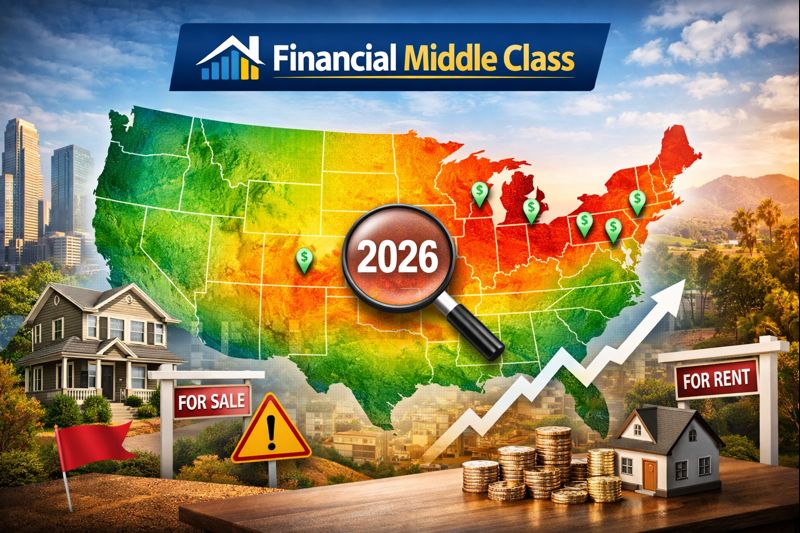
Here’s the 2026 twist: a lot of the strongest upside signals show up in “refuge/value” metros—often in the Northeast and Midwest—while a separate set of “hot spots” pop up for buyers where affordability and listings may improve. The trick is knowing which list you’re using and why.
FMC reality check: the “fastest appreciation” market isn’t always the “best market for you.” Your monthly payment is the market.
Key Takeaways (Read This Before You Scroll)
1) 2026 is expected to be a modest-growth national year. Local fundamentals matter more than headlines.
2) Many “winners” are refuge/value metros near expensive hubs with tight inventory.
3) Watch inventory + price cuts monthly. They tell you who has leverage.
4) Don’t shop only the list price—insurance, taxes, HOA can wreck affordability.
5) Use the checklist in this article to spot upside in your state, not just someone else’s Top 10.
The 2026 baseline: “low-drama” doesn’t mean “no opportunity”
Most 2026 outlooks are not calling for a national housing boom. They’re calling for a slow grind: modest price growth, rates that still sting, and sales that improve without turning into a frenzy.
That matters because when the national story is boring, the local story becomes the whole game.
| What matters | What you should expect in a “modest” year | What it means for you |
|---|---|---|
| Prices | Small national gains; local winners still exist | Stop chasing “the market” and start tracking your metro. |
| Rates | Still high enough to cap demand | Payment sensitivity rules everything. |
| Inventory | Some improvement, not a flood | In tight markets, prices can keep rising even with “more listings.” |
How this list was built (so you know it isn’t vibes)
When I say “poised,” I’m not promising anything. I’m talking best odds based on (1) widely cited forecasts and (2) the fundamentals that keep prices from falling.
This article blends two types of lists:
- Price-growth leaning list: markets expected to see strong price + sales momentum (think “values going up”).
- Opportunity leaning list: markets flagged for buyers where conditions could improve (think “better shot to buy without losing your mind”).
Then I apply the FMC filter: tight supply + stable demand + relative value is the recipe for price resilience.
What would change the forecast? (If X, then Y)
| Scenario | What changes | What it usually does |
|---|---|---|
| Rates fall faster | More buyers qualify | Competition returns; tight markets firm up quickly. |
| Rates stay stubborn / rise | Demand stays capped | Softer markets cut prices; tight markets “hold” more often than they drop. |
| Local job shock | Income confidence takes a hit | Prices flatten or dip locally—even if the national narrative stays calm. |
| Insurance/tax spike | Monthly cost jumps | Demand weakens even if prices “should” rise on paper. |
The 2026 market map in plain English
In 2026, a lot of appreciation momentum is less about the trendiest zip code and more about the value hubs where demand keeps showing up—because the “cool city” got priced out of reach.
That’s why so many projected leaders are clustered in Northeast/Midwest metros that still feel like a bargain compared to nearby high-cost hubs.
Refuge markets: why they win in “boring” years
A refuge market is the “best seat you can afford” effect. Buyers who can’t afford the superstar metro buy the next metro over—still connected to jobs, airports, and opportunity, but cheaper per square foot.
If supply stays tight in those metros, prices don’t need a boom to rise. They just need enough buyers and not enough homes.
The A-List: projected price-growth leaders (Realtor.com-style snapshot)
These are the “values going up” candidates—metros often cited as having strong combined price + sales momentum. Read them like a watchlist, then validate with your local data (inventory + price cuts).
Hartford, CT
- Signal: value near pricey corridor
- Watch: inventory stays tight
Rochester, NY
- Signal: affordability + steady demand
- Watch: job stability
Worcester, MA–CT
- Signal: pressure valve for Boston-area costs
- Watch: commuter demand
Toledo, OH
- Signal: big upside narrative
- Watch: local economic drivers
Providence, RI–MA
- Signal: value near expensive coastal hubs
- Watch: inventory vs demand
Richmond, VA
- Signal: shows up across lists
- Watch: entry-level supply
Grand Rapids, MI
- Signal: stable demand + value
- Watch: new builds vs resale
Milwaukee, WI
- Signal: affordability + livability
- Watch: price cuts trend
New Haven, CT
- Signal: corridor demand
- Watch: insurance/taxes
Pittsburgh, PA
- Signal: affordability cushion
- Watch: neighborhood-level demand
Note: These cards are a readable “market map.” Use the checklist later in this article to validate any metro before you act.
Metro mini-profiles: the common thread (and the risk)
The common thread isn’t “everyone is moving there.” It’s that these metros often function as value alternatives to pricier hubs, while supply stays limited enough to keep pressure on prices.
The risk is always the same: if the monthly payment breaks (rates up, insurance spikes, taxes jump) or jobs wobble locally, a “poised” market can turn into a “paused” market fast.
The B-List: NAR-style “hot spots” (buyer opportunity watchlist)
These “hot spots” tend to be framed as places where buyer opportunity could improve (think: affordability + listings + demand conditions), not necessarily where prices will spike the fastest.
Charleston, SC
Charlotte, NC–SC
Columbus, OH
Indianapolis, IN
Jacksonville, FL
Minneapolis–St. Paul, MN–WI
Raleigh, NC
Richmond, VA
Salt Lake City, UT
Spokane, WA
The home payment reality check: appreciation doesn’t pay your mortgage
A market can be “poised to rise” and still be a terrible decision for you if the payment is suffocating. Here’s a clean example (principal + interest only):
| Home price | Down payment | Rate | Approx monthly P&I |
|---|---|---|---|
| $400,000 | 10% ($40,000) | 6.0% | ~$2,159 |
| $400,000 | 10% ($40,000) | 6.5% | ~$2,276 |
| $400,000 | 10% ($40,000) | 7.0% | ~$2,395 |
Now add taxes, insurance, and HOA. This is why a small rate move can change the entire market’s behavior.
Hidden costs that quietly ruin “great markets”
| Hidden cost | Why it matters | Fast check before you offer |
|---|---|---|
| Homeowners insurance | Can jump fast and break affordability | Get a quote before you bid |
| Property taxes | Reassessments can spike payments | Look up reassessment history |
| HOA fees | Often rise; special assessments hurt | Ask for reserves + budget |
| Climate risk | Hits insurance + resale demand | Check flood/wind zones |
| Deferred maintenance | Old systems = “second mortgage” | Roof/HVAC age; sewer scope |
How to spot a 2026 winner in your own state (without becoming a housing economist)
Green flags vs red flags (the FMC checklist)
| Green flags | Red flags |
|---|---|
| Inventory stays tight in entry-level tiers | Inventory rising fast + listings sitting |
| Few price cuts; homes move with normal negotiation | Price cuts spiking; sellers chasing buyers |
| Diverse job base + stable employers | Single-employer or shaky industry town |
| Limited new-build flood | Oversupply of similar new builds |
| Ownership costs predictable | Insurance/taxes/HOA climbing rapidly |
If you track only two things monthly: inventory and price cuts. They tell the truth.
First-time buyer playbook for 2026: how to win without overpaying
Your advantage isn’t “timing the market.” It’s being ready when a good house shows up: strong pre-approval (or pre-underwriting), clean documents, realistic targets, and the discipline to walk away from a bad deal.
In tight refuge markets, you win with speed and certainty. In softer markets, you win with concessions, inspection leverage, and patience.
Current homeowners: stay, move, or remodel?
| Option | When it makes sense | The trap |
|---|---|---|
| Stay | Your payment is great and life is stable | Calling stagnation “strategy” |
| Move | Life change is real (job, family, schools) | Payment shock blows up your budget |
| Remodel | You’re staying 5+ years and can fund it safely | Over-improving for the neighborhood |
Investors: appreciation markets vs cash-flow markets (stop mixing them up)
Appreciation is a bonus, not a business model. If insurance, taxes, repairs, and vacancy eat your cash flow, “values going up” won’t save you. Underwrite for survival first; treat appreciation as gravy.
Red flags: markets that look hot but aren’t
- Inventory surge + homes sitting longer
- Price cuts everywhere (seller stress)
- Oversupply of new builds competing with resale
- Ownership-cost shock (insurance/taxes/HOA)
- Hype with no fundamentals (buying the comment section)
Timeline: how leverage tends to shift through the year
Q1 (Jan–Mar): the “quiet leverage” window
Fewer shoppers, fewer bidding wars, more room to negotiate—especially if sellers are testing the market.
Q2 (Apr–Jun): competition returns
More listings and more buyers. Good homes move fast. Your advantage is being organized and decisive—without being reckless.
Q3 (Jul–Sep): the “price-cut truth serum” period
If listings sit, sellers start cutting. This is when the market tells the truth about what homes are really worth.
Q4 (Oct–Dec): reset and reposition season
Demand cools. Motivated sellers show up. Negotiation power often returns for prepared buyers.
How to track this yourself (so you’re not dependent on headlines)
| Metric | What it tells you | What to watch for |
|---|---|---|
| Active listings | Supply pressure | Rising fast = buyers gaining leverage |
| Days on market | Demand strength | Longer DOM = pricing power fading |
| Price cuts | Seller stress | More cuts = market turning |
| Pending sales | Real demand | Pending up + inventory flat = prices hold |
Sources & further reading
- Realtor.com Research (forecasts + market rankings)
- Zillow Research (housing predictions)
- Redfin News (market predictions + rent trends)
- National Association of REALTORS® (reports + hot spots)
Note: Link directly to the specific forecast pages you referenced in your published version for best credibility.
FAQ
Will home prices drop in 2026?
Some local markets can decline—especially where inventory rises fast or affordability breaks. Many forecasts expect modest national movement overall, but your metro matters more than the headline.
Should I wait for mortgage rates to fall?
If a small rate drop is the difference between “affordable” and “no chance,” waiting can be rational. Just remember: lower rates can also bring more buyers, which pushes prices up in tight markets.
What’s the #1 metric to watch monthly?
Inventory plus price cuts. Inventory tells you supply pressure. Price cuts tell you seller stress. Together they tell you who has leverage.
Are “hot spots” the same as “best appreciation” markets?
Not always. Some lists reflect buyer opportunity (inventory + affordability). Others reflect price-growth potential. A market can be a strong buying opportunity without leading appreciation.
Should investors chase these markets?
Only if the cash-flow math survives insurance, taxes, maintenance, and vacancy. Appreciation is the bonus—not the plan.
Comment
What’s the one metro (or neighborhood) you think people are sleeping on in 2026—and why?
Drop your “signal” too: inventory falling, fewer price cuts, new employers, better schools, insurance changes, etc.


RELATED ARTICLES
How Wealth Is Passed Across Generations in the United States: Mechanisms, Evidence, and the Policy Debate
How wealth passes between generations—trusts, taxes, and the debate. Get the facts, figures, and tradeoffs. Read now.
The S&P 7,000: How Wall Street Disconnects from Main Street
S&P 7,000 can rise while wages, benefits, and towns fall behind. See why the market isn’t the economy—read now.
Leave Comment
Cancel reply
Gig Economy
American Middle Class / Feb 18, 2026
How Wealth Is Passed Across Generations in the United States: Mechanisms, Evidence, and the Policy Debate
How wealth passes between generations—trusts, taxes, and the debate. Get the facts, figures, and tradeoffs. Read now.
By FMC Editorial Team
American Middle Class / Feb 16, 2026
The S&P 7,000: How Wall Street Disconnects from Main Street
S&P 7,000 can rise while wages, benefits, and towns fall behind. See why the market isn’t the economy—read now.
By MacKenzy Pierre
American Middle Class / Feb 16, 2026
The “Resilient Consumer” Is Real—But So Is the Interest Bill
Credit card balances are rising as savings fall. See what it means—and the 30/60/90 plan to escape 25% APR debt.
By Article Posted by Staff Contributor
American Middle Class / Feb 09, 2026
What To Do If You Get Fired With an Outstanding 401(k) Loan
Fired with a 401(k) loan? Avoid taxes, offsets, and deadline traps with this step-by-step checklist. Read now.
By Article Posted by Staff Contributor
American Middle Class / Feb 09, 2026
The Real Math of Money in Relationships
Split finances without resentment. Any couple, any income ratio. Use the worksheet + rules—start today.
By Article Posted by Staff Contributor
American Middle Class / Feb 03, 2026
Investing or Paying Off the House?
Invest or pay off your mortgage? See a $500k example with today’s rates, dividends, and peace-of-mind math—then choose your plan.
By Article Posted by Staff Contributor
American Middle Class / Jan 30, 2026
Gold, Silver, or Bitcoin? Start With the Job—Not the Hype
Gold, silver or Bitcoin? Learn what each is for—and how to size it—before you buy. Read the framework.
By Article Posted by Staff Contributor
American Middle Class / Jan 29, 2026
Florida Homeowners Pay the Most in HOA Fees
Florida HOA fees are surging. See what lawmakers changed, what’s next, and how to protect your budget—read before you buy.
By Article Posted by Staff Contributor
American Middle Class / Jan 29, 2026
Why So Many Homebuyers Are Backing Out of Deals in 2026
Why buyers are backing out of home deals in 2026—and how to avoid costly surprises. Read the playbook before you buy.
By Article Posted by Staff Contributor
American Middle Class / Jan 28, 2026
How Money Habits Form—and Why “Self-Control” Is the Wrong Villain
Learn how money habits form—and how to rewire spending and saving using behavioral science. Read the framework and start today.
By FMC Editorial Team
Latest Reviews
American Middle Class / Feb 18, 2026
How Wealth Is Passed Across Generations in the United States: Mechanisms, Evidence, and the Policy Debate
How wealth passes between generations—trusts, taxes, and the debate. Get the facts, figures, and tradeoffs....
American Middle Class / Feb 16, 2026
The S&P 7,000: How Wall Street Disconnects from Main Street
S&P 7,000 can rise while wages, benefits, and towns fall behind. See why the market...
American Middle Class / Feb 16, 2026
The “Resilient Consumer” Is Real—But So Is the Interest Bill
Credit card balances are rising as savings fall. See what it means—and the 30/60/90 plan...