The Interest-Free Installments Economy: A Macro Perspective
The Brazilian government has been attempting to curb revolving credit card rates to ease the burden on low-income Brazilians for years. However, these rates have skyrocketed to an astonishing 417.4% per year, making it the most expensive type of credit available to individuals.
Revolving credit card rates are the interest consumers must pay when they cannot cover their credit card bills in full, pushing unpaid amounts into future installments.
The exorbitant rates force companies and consumers to adopt a new form of financing strategy—Interest-Free Installments.
In the world of macroeconomics, the financing strategies countries adopt often serve as indicators of larger economic trends, societal behaviors, and consumer preferences.
Among these financing strategies, the concept of “interest-free installments” has emerged as a fascinating topic, especially in countries like Brazil. This method of payment is both a reflection of and a response to specific economic conditions.
Understanding the Interest-Free Installments Economy
Interest-free installments allow consumers to make purchases by agreeing to pay the total price divided over several months, typically ranging from 3 to 12 months, without any additional interest charged.
This arrangement sounds like a win-win for consumers, but understanding the underlying mechanisms is crucial.
The retailer typically absorbs the cost of financing, often in partnership with a financial institution, viewing it as a marketing expense to attract and retain customers.
The financial institution charges the retailer a fee for providing this service, which is often passed on to the consumer as a slightly higher purchase price.
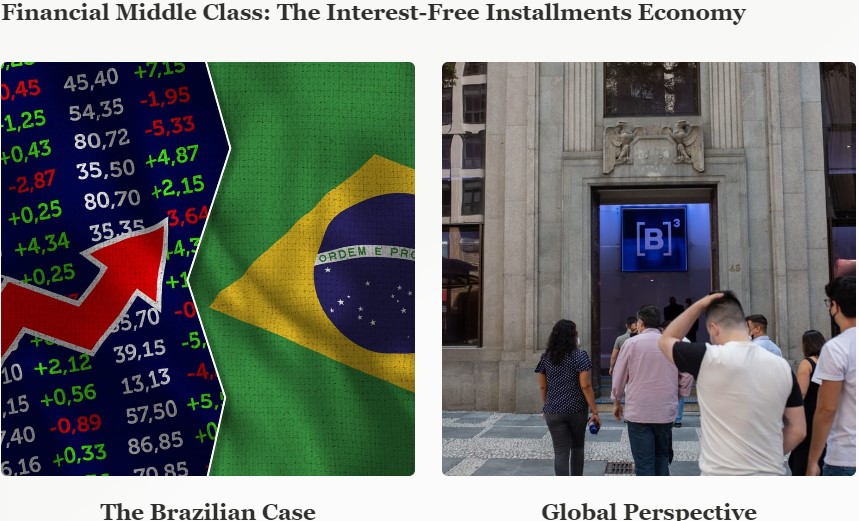
The Brazilian Case
Brazil is one of the most prolific users of this payment system. Here’s why:
- Credit Access: Despite the modernization of Brazil’s banking system, a significant portion of the population remains either underbanked or unbanked. More than 34 million Brazilians do not have access to banking services according to Payments Journal. With less access to traditional credit systems, interest-free installments can provide a lifeline.
- High-Interest Rates: Historically, Brazil has experienced high nominal interest rates. The Selic rate (Brazil’s central bank interest rate) was set at 13.75% in July 2023, which is relatively high by global standards. For example, the U.S. Federal Reserve interest rate currently ranges from 5.25% to 5.50%, and the benchmark rate in the euro area is about 3.75%. This tremendously high Selic rate makes traditional credit expensive, pushing people towards alternative financing methods like interest-free installments. The Selic rate impacts credit card debts, auto loans, and mortgages. The higher the rate, the higher the consumers’ financing costs.
Economic Implications
- Boosting Consumption: By breaking down payments, consumers can manage their finances better and possibly purchase more expensive items they wouldn’t have afforded with a one-off payment. This can boost consumption in the short term.
- Risk Management: For retailers and lenders, this system might appear risky. However, since the payments are often automatically deducted from the consumer’s paycheck or bank account, default rates remain controlled.
- Price Inflation: Some argue that the prices of goods and services may be marked up in markets where such payment schemes are common. After all, there’s no such thing as a “free lunch.” The costs of providing interest-free credit might be passed onto consumers through higher prices.
Global Perspective
While Brazil stands out, it’s not alone. Other emerging economies, facing challenges like inflation, access to credit, and high-interest rates, have adopted similar strategies. Turkey, for instance, has also seen widespread usage of interest-free installments, especially in the consumer electronics sector.
The Layaway system, which allows a customer to make payments on merchandise held by a retailer, and the emergence of “Buy Now, Pay Later” companies such as Klarna, Affirm, and Afterpay in America and other rich countries, show that the middle class in wealthy nations is starting to feel the financial squeeze, and that the world economy is becoming more like the Brazilian economy.
Digital innovations and the rise of fintech solutions and digital platforms are further facilitating interest-free installment payments, allowing for greater flexibility and integration with other services.
Global adoption of Interest-Free Installments is inevitable. As e-commerce continues to grow, and global retailers tap into emerging markets, the interest-free installment model may become more widespread, adapting to each country’s unique economic conditions.
Final Thoughts
The interest-free installment economy is the norm in Brazil—Latin America’s largest economy based on the gross domestic product (GDP).
It is not merely a response to exorbitant revolving credit card rates, which have skyrocketed to an astonishing 417.4% per year, but a significant macroeconomic trend that holds implications for both developed and emerging economies alike.
Rooted in the realities of high interest rates, limited access to traditional banking, and innovative fintech solutions, interest-free installments have evolved from a niche financial strategy to a global phenomenon.
The Brazilian case offers a microcosm of the drivers and potential consequences of this system, from boosting consumption to potentially inflating prices.
The trend’s expansion to other countries, including the involvement of digital platforms, suggests a democratization of financing methods that may have lasting impacts on consumer behavior, retail strategies, and macroeconomic policies.
As the middle class in rich nations continues to be under pressure from stagnant growth and rising inflation, the interest-free installment model appears poised to redefine the contours of global finance, heralding a new era of inclusivity and flexibility in personal financial management.