
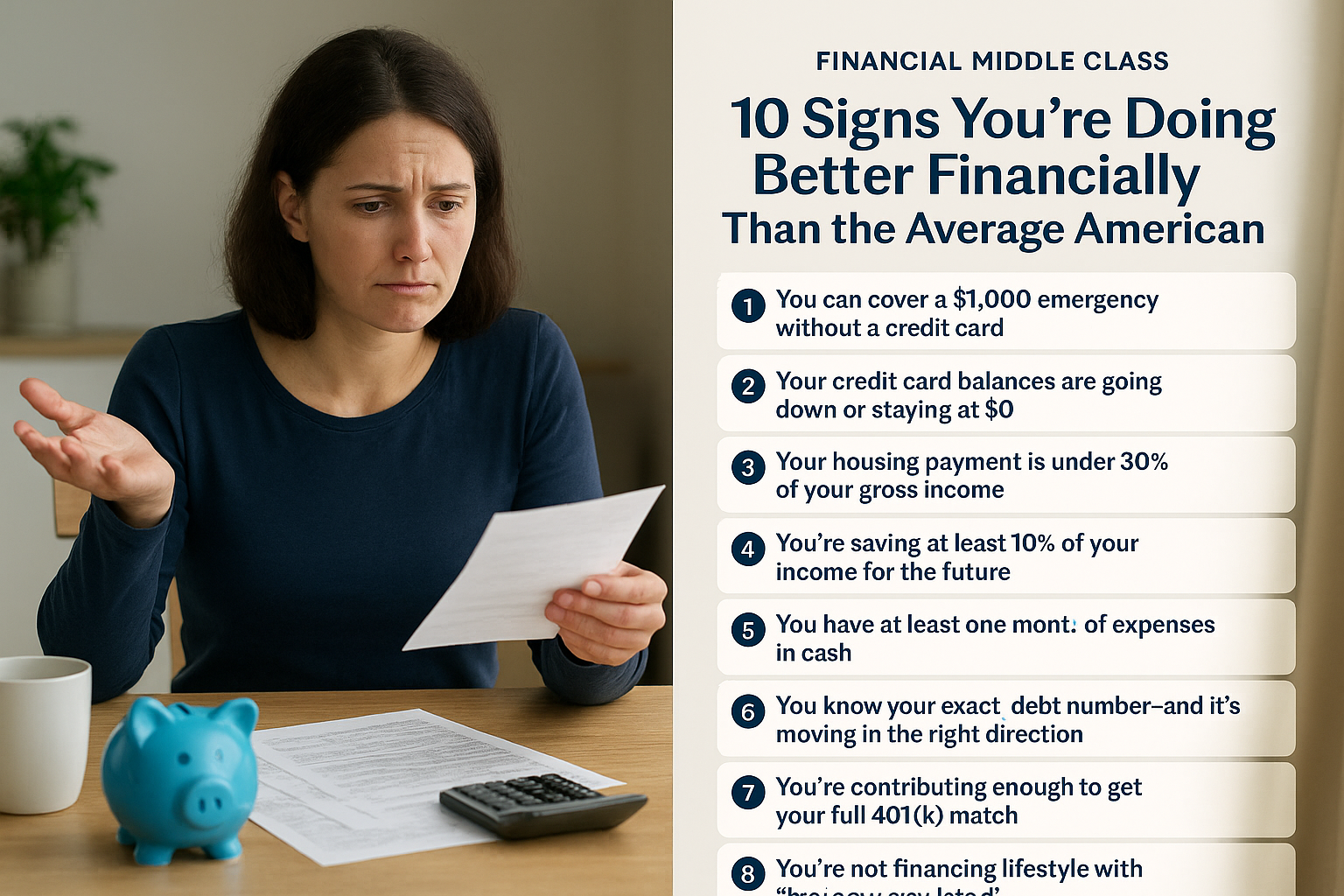
10 Signs You’re Doing Better Financially Than the Average American (Even If It Doesn’t Feel Like It)
By Article Posted by Staff Contributor
The estimated reading time for this post is 537 seconds
Middle-class Americans are going through it right now.
The affordability crisis is real. Inflation is real. Groceries, childcare, rent, car insurance—everything feels like it’s quietly raising its hand for a pay raise from your wallet. Your dollar is stretching thin, and if you scroll headlines long enough, you start to feel like everyone is drowning and you’re somehow the only one who didn’t get the manual.
But here’s the problem: consumer sentiment is often more pessimistic than the actual numbers. You can feel broke in a country where almost everything is financed, leased, or put on a payment plan. You can feel behind even while you’re actually doing better than the “average.”
So let’s reset the lens.
Here are 10 signs you’re doing better financially than the average American—even if your brain is telling you otherwise.
1. You can cover a $1,000 emergency without a credit card
Start here, because this is the quiet line between constant crisis and basic stability.
If your car needs a $900 repair, your dog needs an emergency vet visit, or your kid breaks a pair of glasses and you can handle it without:
- Swiping a credit card and carrying the balance, or
- Borrowing from family and friends,
…you’re already ahead of a huge slice of the country.
That doesn’t mean you’re rich. It just means you’ve built something most people never get around to: a real, functioning emergency cushion. Even if it’s “only” $1,500 sitting in a boring savings account, that’s not a small thing. That’s a shock absorber for your life.
If you’ve got this covered, that’s Sign #1 you’re not as behind as you think.
2. Your credit card balances are going down or staying at $0
Credit cards are not evil. But credit card interest is absolutely a wealth leak.
Look at your last 12 months. Are your balances:
- Lower now than they were a year ago?
- Or at $0 most months because you pay in full?
If yes, you are quietly beating the game.
Millions of people are using credit cards just to survive the month—groceries, gas, utilities—and then carrying the balance for years. If you’re either holding the line (no new debt) or slowly shrinking what you owe, that’s a sign of discipline in a very undisciplined system.
You don’t have to be debt-free to be on the right track. You just have to be moving in the right direction.
3. Your housing payment is under 30% of your gross income
Housing is eating the middle class alive.
If your rent or mortgage payment is under about 30% of your gross income, you have something most people don’t: room to breathe.
For example, if your household brings in $6,000 a month before taxes and your rent is $1,600, that’s roughly 27%. It might still feel high, but in an economy where people routinely pay 40–50% of their income to landlords and lenders, you’re doing better than you think.
That gap between what you could be paying and what you are paying is where your savings, investing, and sanity live.
Is 30% a magic number? No. But if you’re under it—or even working your way down toward it—you’re in more stable territory than a lot of middle-class households.
4. You’re saving at least 10% of your income for the future
Here’s the part that feels impossible when everything is expensive: consistent saving.
If you are:
- Contributing to a 401(k), 403(b), or TSP at work,
- Putting money into an IRA, HSA, brokerage account, or
- Automatically moving money to a “future you” savings account…
…and that total adds up to around 10% or more of your income, you’re not average—you’re intentional.
Most people plan to start saving “when things calm down.” Spoiler: things never really calm down. So if you’ve figured out how to save in the middle of chaos, that habit is a superpower.
You might not see the payoff yet. But your future self will absolutely thank you.
5. You’ve got at least one month of expenses in cash
If you lost your job tomorrow, how long could you keep the lights on without a paycheck?
If the answer is at least one month, in actual cash (not credit), you are not behind.
Is one month enough? No, the ideal is three to six months. But a lot of people don’t even have one week. So if you’ve got:
- Rent or mortgage
- Utilities
- Groceries
- Car payment/insurance
…covered for 30 days without borrowing, you’ve built a foundation most households are still wishing for.
The real win? One month proves you can save. Going from one to two, then three, is just repetition—not reinvention.
6. You know your exact debt number—and it’s shrinking (even slowly)
Most people carry their debt as a feeling, not a number:
“Too much.”
“A mess.”
“A couple cards and a loan.”
If you can say, “I owe $18,400 total, down from $22,000 last year,” you’re in a different category.
Knowing your exact debt number means:
- You’ve looked it in the face,
- You’ve stopped pretending it’s fog, and
- You have some kind of plan (even if it’s not perfect).
If that total is moving in the right direction—$50, $100, $200 at a time—that’s real progress. You still might feel “in debt,” but numerically, you’re trending away from the average American, not toward it.
7. You’re getting your full 401(k) match at work
If your employer offers a match and you’re contributing enough to get every free dollar, that’s one of the most “above-average” moves you can make.
Example:
If your employer matches 50% of your contributions up to 6% of your salary, and you’re putting in the full 6%, you’re getting an automatic 3% raise in the form of retirement savings.
A surprising number of people leave this money on the table, either because they don’t understand it or feel they “can’t afford” to contribute.
If you’re grabbing the match, you’ve done what many never do: lined up your money with the benefits that already exist around you.
You don’t have to max out your 401(k). That’s a great goal, but if you’re at least capturing the match, you’re not behind—you’re building.
8. You’re not financing your lifestyle with “buy now, pay later”
We don’t talk about this enough: “buy now, pay later” is just debt hiding behind friendlier branding.
If Klarna, Afterpay, Affirm, in-store payment plans, and “0% for 6 months” offers are rare in your life—or you use them only for true big-ticket necessities and pay them off on time—you’re avoiding one of the fastest-growing traps.
The average American is surrounded by little monthly payments:
- $19.99 for a subscription here
- $43 bi-weekly for a gadget there
- Four payments of $29.75 for sneakers, clothes, or decor
Individually, they feel small. Together, they quietly lock in a lifestyle you can’t afford.
If most of your day-to-day spending is on things you can pay for today—not split into four—your money is healthier than you realize.
9. Money conversations in your home are honest—even if they’re uncomfortable
Here’s a financial metric nobody charts but everyone lives:
Can you talk about money with the people in your house without it turning into a disaster?
If you and your partner (or you and yourself) are:
- Checking in about bills and income,
- Agreeing on what gets paid first,
- Talking about goals (debt payoff, a house, retirement, kids’ activities),
…you’re already in a stronger position than couples and households that avoid money talks completely.
Avoidance is expensive. Late fees, overdrafts, surprise balances, missed opportunities—those are all the price of “we’ll deal with it later.”
If you’ve shifted from avoidance to honesty, you’re not just above average financially—you’re building financial resilience.
10. Your net worth is positive—or steadily becoming less negative
Net worth sounds like something only rich people have, but everyone has one.
It’s simply:
What you own – what you owe
If you add up:
- Cash
- Retirement accounts
- Savings
- Equity in your home or car
…and subtract:
- Credit cards
- Personal loans
- Student loans
- Auto loans
…and the number is positive, that’s a big deal. You may not feel wealthy, but mathematically, you’re ahead of many households that look “successful” on the outside.
Even if your net worth is still negative, but that negative number is shrinking year over year, that’s another sign you’re doing better than you feel. You’re moving toward stability instead of drifting away from it.
The key isn’t perfection. It’s direction.
Why It Still Feels Like You’re Losing
So you’re checking several of these boxes, but emotionally you feel broke. Why?
Because you’re living in:
- A high-cost economy
- A comparison culture (social media, lifestyle content, flex culture)
- A constant news cycle screaming crisis
You’re comparing your real life to other people’s highlight reels and to an economy that was very different 20–30 years ago.
The point of this list isn’t to gaslight you into feeling “lucky” when you’re tired and stretched. It’s to remind you that progress and stability don’t always feel dramatic.
Sometimes “doing better than average” looks like:
- Saying no to a trip you can’t afford
- Driving the older car that’s paid off
- Living in the smaller apartment that lets you save
- Paying down debt $75 at a time
- Choosing boring index funds over shiny get-rich-quick schemes
Those choices are not signs of failure. They’re signs you’re playing the long game.
What to Do If You Only Check 2–3 of These Boxes (So Far)
If you read through this and only saw a few wins, that’s not a reason to spiral. It’s a roadmap.
Pick one or two moves you can work on over the next 6–12 months:
- Build a $1,000 starter emergency fund.
- Get your full 401(k) match.
- Kill one credit card balance and stop using it.
- Get your housing cost down at your next renewal.
- Start tracking your net worth four times a year, even if it’s negative.
You don’t fix a middle-class affordability crisis by skipping lattes. But you also don’t build financial stability by doing nothing because “everything is rigged.”
You focus on the levers you can pull, in your house, with your numbers.
And if you’re already checking most of these boxes? Give yourself credit. You’re not just surviving a tough economy—you’re quietly building the kind of financial life most people wish they had, even if they don’t say it out loud.


RELATED ARTICLES
Cash Strategy: Put Every Dollar in the Right Place
Your checking account, emergency fund, short-term savings, and investments should not be managed the same way. This cash strategy helps assign every dollar to the right financial job.
Best HYSA: How to Choose Beyond the Highest APY
A competitive interest rate matters, but it is only one part of choosing a high-yield savings account. Compare insurance, fees, access, transfer speed, and promotional conditions.
Leave Comment
Cancel reply
Gig Economy
Business / Aug 08, 2026
The Missing Middle in Black Entrepreneurship
Black entrepreneurship has expanded dramatically. The next challenge is helping more Black-owned businesses move from self-employment to employer firms and sustainable scale.
By FMC Editorial Team
Personal Finance / Aug 01, 2026
Cash Strategy: Put Every Dollar in the Right Place
Your checking account, emergency fund, short-term savings, and investments should not be managed the same way. This cash strategy helps assign every dollar to the right...
By Article Posted by Staff Contributor
Personal Finance / Aug 01, 2026
Best HYSA: How to Choose Beyond the Highest APY
A competitive interest rate matters, but it is only one part of choosing a high-yield savings account. Compare insurance, fees, access, transfer speed, and promotional conditions.
By Article Posted by Staff Contributor
Personal Finance / Aug 01, 2026
High-Yield Savings vs. CDs, Treasury Bills, and Other Safe Places for Cash
High-yield savings accounts are excellent for accessible cash, but they are not always the best choice. Compare HYSAs, CDs, Treasury bills, money market accounts, and I...
By Article Posted by Staff Contributor
American Middle Class / Aug 01, 2026
High-Yield Savings Accounts: A Safer Home for Your Cash
A high-yield savings account can pay several times the national savings rate while keeping qualified deposits federally insured. Here is how it works, what to watch...
By Article Posted by Staff Contributor
Real Estate / Jul 30, 2026
Mortgage Lock-In Is Freezing the Housing Market
Millions are trapped by 3% mortgages. Learn how mortgage lock-in worsens affordability—and why homeowners are renovating instead.
By FMC Editorial Team
Real Estate / Jul 26, 2026
Is South Florida More Expensive Than New York? The Complete 2026 Relocation Guide
Is South Florida more expensive than New York? Compare housing, taxes, insurance and 104 municipalities before you move.
By Article Posted by Staff Contributor
Personal Finance / Jul 25, 2026
The Time Value of Life Experiences: What Compound Interest Leaves Out,
Money compounds, but life experiences do too. Explore what compound interest leaves out—and how to balance saving with living.
By MacKenzy Pierre
American Middle Class / Feb 18, 2026
How Wealth Is Passed Across Generations in the United States: Mechanisms, Evidence, and the Policy Debate
How wealth passes between generations—trusts, taxes, and the debate. Get the facts, figures, and tradeoffs. Read now.
By FMC Editorial Team
American Middle Class / Feb 16, 2026
The S&P 7,000: How Wall Street Disconnects from Main Street
S&P 7,000 can rise while wages, benefits, and towns fall behind. See why the market isn’t the economy—read now.
By MacKenzy Pierre
Latest Reviews
Business / Aug 08, 2026
The Missing Middle in Black Entrepreneurship
Black entrepreneurship has expanded dramatically. The next challenge is helping more Black-owned businesses move from...
Personal Finance / Aug 01, 2026
Cash Strategy: Put Every Dollar in the Right Place
Your checking account, emergency fund, short-term savings, and investments should not be managed the same...
Personal Finance / Aug 01, 2026
Best HYSA: How to Choose Beyond the Highest APY
A competitive interest rate matters, but it is only one part of choosing a high-yield...