
Mortgage Lock-In Is Freezing the Housing Market
By FMC Editorial Team
The estimated reading time for this post is 1075 seconds
The 3 percent mortgage protected millions of American homeowners from rising interest rates. It also helped create a country in which owners are rich in equity, poor in mobility, and increasingly inclined to renovate rather than move.
Consider a household that bought or refinanced its home during the pandemic.
The owners owe $300,000 on a 30-year mortgage carrying an interest rate of 3%. Their monthly principal-and-interest payment is approximately $1,265. They have paid the mortgage on time. Their home has appreciated. Their salaries may have increased. On paper, they are considerably wealthier than they were five years ago.
But the house no longer fits quite as well.
Perhaps a second child has arrived. Perhaps an aging parent needs a bedroom downstairs. Perhaps the owners want to live closer to work. Perhaps the children have moved away, leaving two people in a house built for five. Or perhaps the problem is less consequential but more immediate: The kitchen is cramped, the cabinets are dated, and everyone is tired of walking around the same badly placed island.
The family begins looking at other houses. Then it looks at mortgage rates.
As of July 23, 2026, the average rate on a 30-year fixed mortgage was 6.58%. At that rate, financing the same $300,000 over 30 years would produce a principal-and-interest payment of approximately $1,912. At 7%, it would be about $1,996. Merely replacing the old interest rate—not buying a more expensive home—would add roughly $650 to $730 a month.
That calculation excludes moving expenses, commissions, closing costs, property-tax changes, and homeowners insurance. It also assumes that the family could find another suitable house for the same price and borrow exactly the same amount.
The owners close the real-estate app.
Perhaps the kitchen can be fixed.
Across the United States, millions of households are making some version of this decision. Individually, it is sensible. Collectively, it has produced a powerful form of mortgage lock-in that is reshaping housing supply, homeownership, geographic mobility, and household finances.
People who already own homes have strong reasons to remain where they are. People trying to purchase those homes confront high prices, high borrowing costs, and a limited selection.
The country does not simply have a shortage of houses. It also has a shortage of houses whose owners are financially willing to sell.
Mortgage Lock-In and the Contract Hidden Inside the House
During portions of 2020 and 2021, the United States experienced the lowest mortgage rates recorded in Freddie Mac’s long-running survey. Homebuyers obtained unusually inexpensive financing, while millions of existing owners refinanced.
Those borrowers did more than reduce their monthly expenses. They converted a temporary moment in financial markets into a benefit that could last as long as 30 years.
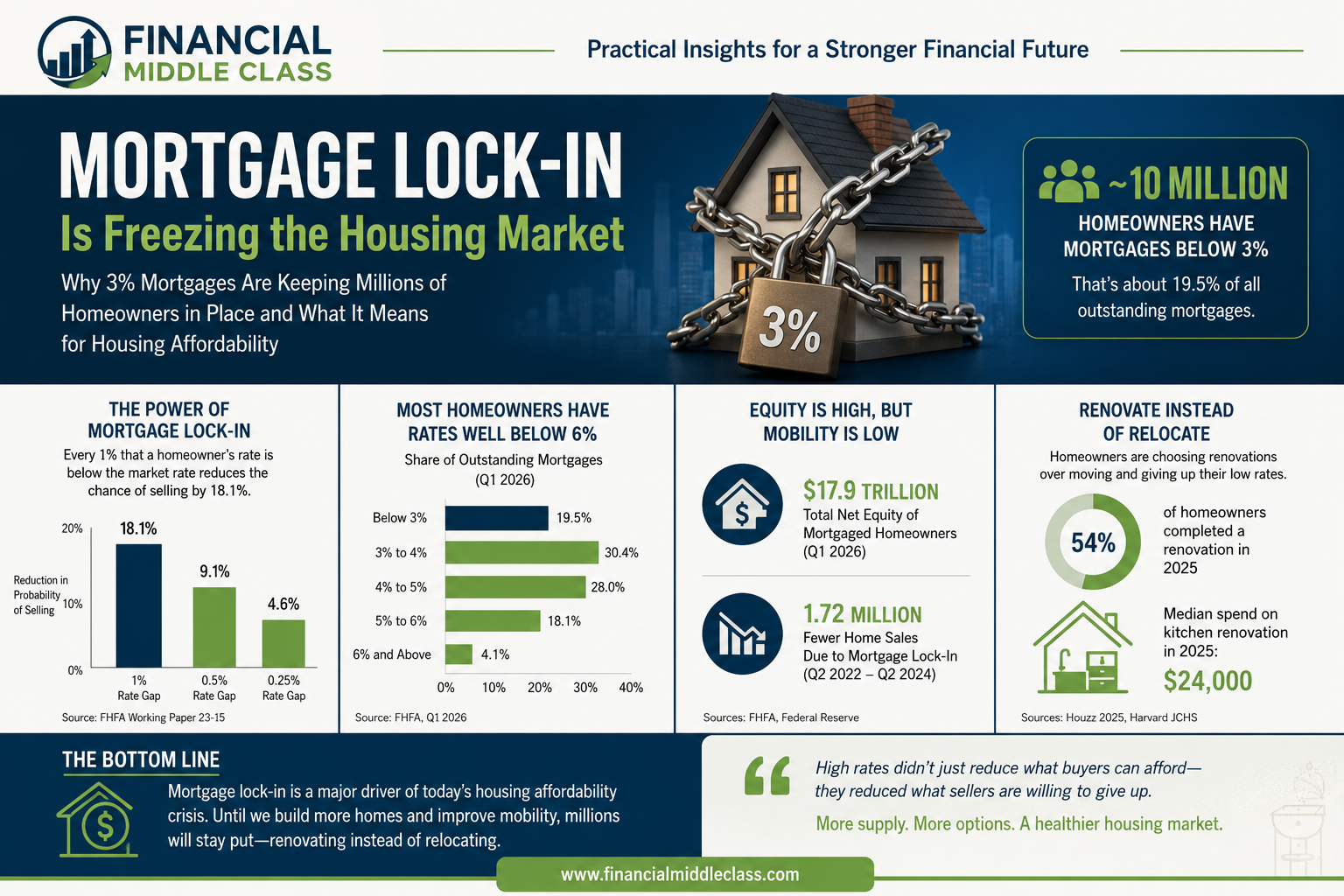
The latest available mortgage-distribution data illustrate the scale. In the first quarter of 2026, approximately 19.5% of outstanding mortgages carried rates below 3%. Another 30.4% had rates between 3% and 4%. Altogether, 49.9% were at 4% or below, and 77.9% were below 6%.
The fixation on the “3% mortgage” therefore understates the phenomenon.
A homeowner with a 3.75% mortgage may not have received the cheapest possible loan, but surrendering it for one near 6.5% still represents a substantial increase in financing costs.
How many sub-3% mortgages remain?
The Federal Housing Finance Agency counted approximately 50.8 million outstanding first-lien mortgages in the first quarter of 2024. Using that figure as a benchmark, a 19.5% share would imply approximately 9.9 million sub-3% loans.
Because the total number of mortgages has changed since 2024, that is not an exact current count. But roughly 10 million active mortgages is a defensible description of the magnitude. It is a count of loans, not necessarily 10 million distinct people.
The more consequential number may be the approximately 25 million mortgages that, by the same rough calculation, carry rates of 4% or less.
For these owners, the mortgage has become an asset in its own right. It is a contractual right to use hundreds of thousands of dollars for decades at a price that the current market cannot replicate.
But that asset is generally attached to a particular property. Most homeowners cannot simply place the mortgage in a moving truck and transfer it to the next house.
The low payment protects the household. The inability to take it along restricts the household.
That is the essence of mortgage lock-in.
An Equity-Rich Country With a Mobility Problem
The present situation is almost the inverse of the housing crisis that followed 2008.
During the Great Recession, falling prices left millions of homeowners owing more than their properties were worth. They could not sell without bringing money to the closing table, negotiating with the lender, or defaulting. Their homes became financial traps because they lacked equity.
Today, many owners remain in place because they possess both substantial equity and exceptionally favorable financing.
Mortgaged homeowners collectively held approximately $17.9 trillion in net home equity during the first quarter of 2026. Across the properties measured, average borrower equity was approximately $310,500. Total equity held by all homeowners—including owners without mortgages—was estimated at roughly $34 trillion.
What the national data do not tell us is precisely how much of that equity belongs to the sub-3% cohort.
It is tempting to multiply 19.5% by $17.9 trillion and conclude that those borrowers hold about $3.5 trillion. But that would assume that equity is distributed proportionally across mortgage-rate groups. It may not be.
Borrowers differ in home values, purchase dates, down payments, principal balances, and regional appreciation.
The honest conclusion is less dramatic but more defensible: Borrowers with very low mortgage rates almost certainly control trillions of dollars in home equity, but the publicly available national figures do not allow us to measure that amount reliably.
Their equity can make moving possible. A homeowner selling an expensive property and purchasing a much cheaper one may need little or no new mortgage.
But that solution often requires leaving the community, employment market, school district, or family network that made the original location desirable.
For an owner who wants another house in the same metropolitan area, the equity may not solve the problem. The replacement home has probably appreciated too. The buyer must surrender the old mortgage, pay today’s price, and finance whatever balance remains at today’s rate.
The homeowner can therefore be wealthy in the accounting sense and constrained in the practical one.
How Mortgage Lock-In Creates a National Bottleneck
Housing markets depend on circulation.
A renter purchases a starter home. The seller uses the proceeds to buy a larger house. The owner of that larger house downsizes into a condominium. A worker relocates. An older household moves closer to family.
One transaction makes several others possible.
Mortgage lock-in interrupts that chain.
FHFA researchers found that, on average, every percentage point by which a homeowner’s existing rate falls below the prevailing market rate reduces the probability of a sale by approximately 18.1%.
The researchers estimated that lock-in prevented approximately 1.72 million home sales between the second quarter of 2022 and the second quarter of 2024.
“Prevented” in this context does not mean that researchers identified 1.72 million particular houses whose owners definitively refused to sell. It is a model-based estimate of transactions that likely would have occurred under less restrictive rate conditions.
The same FHFA research estimated that the resulting reduction in supply raised home prices by approximately 7%, partially counteracting the downward pressure that higher mortgage rates would ordinarily place on prices.
Federal Reserve researchers, using a separate approach, estimated that mortgage lock-in accounted for approximately 44% of the decline in mobility among mortgage borrowers from 2021 to 2022. Their model estimated that the rate shock reduced the amount of time homes spent on the market by 29% and increased prices by approximately 8%.
Importantly, they also concluded that these effects were unusually strong because the housing market was already tight. Under the more balanced conditions that existed in 2019, the same lock-in mechanism would have exerted much less pressure on prices.
The 7% and 8% estimates should not be added together. They come from different studies, models, and periods.
But both reach the same central conclusion: Higher rates did not merely reduce buyers’ purchasing power. They also discouraged owners from supplying homes to the market.
That is why the conventional promise that high mortgage rates would produce significantly cheaper houses has been only partly fulfilled.
A high rate causes one potential buyer to step back. But it can also cause one potential seller to remain in place. If buyers and sellers disappear together, transaction volume collapses without prices falling enough to restore affordability.
The market freezes rather than clears.
Housing Affordability and the Shortage Beneath the Lock-In Problem
Mortgage lock-in did not create America’s housing affordability crisis.
The country entered the pandemic after years of insufficient construction in many growing metropolitan areas. Local restrictions often limited apartments, duplexes, townhouses, accessory dwelling units, and smaller homes.
Labor, land, materials, financing, and regulatory delays raised the cost of whatever did get built.
Freddie Mac estimated that the country was short approximately 3.7 million housing units as of the third quarter of 2024. Other researchers have produced smaller and larger estimates because there is no universally accepted way to define the shortage.
Still, the broad conclusion is difficult to escape: In many regions, the United States does not have enough appropriately located, modestly priced housing for the number of households that need it.
Mortgage lock-in is therefore better understood as an amplifier.
In a well-supplied market, a decline in existing-home listings could be partly offset by new construction. In a market already short of homes, withholding existing properties exerts much greater pressure.
That distinction also matters politically.
Blaming current homeowners for refusing to sell would be both unfair and unproductive. They did not design the mortgage system or prevent communities from building housing. They are responding to incentives exactly as one would expect.
A household is not obligated to assume thousands of dollars in additional annual interest expense to improve the country’s listing inventory.
The public problem emerges from millions of reasonable private choices interacting with a system that failed to build enough alternatives.
The Housing Ladder Has Missing Rungs
A healthy housing market allows people to move through different types of homes as their lives change.
A young adult leaves a rental and purchases a condominium or starter home. The owner of that starter home later moves into a larger property. A family with older children eventually downsizes. The smaller home becomes available to another buyer.
Mortgage lock-in slows every part of that process.
A retired couple may remain in a four-bedroom house because purchasing a smaller condo with a higher mortgage rate, association fees, and insurance would not meaningfully reduce monthly expenses.
The family that might have purchased the four-bedroom home remains in its smaller property.
The first-time buyer who might have purchased that smaller property remains a renter.
Every household is making a financially rational decision. The combined result is a market that serves almost no one particularly well.
By the end of 2025, the estimated monthly cost of purchasing a median-priced home—including mortgage principal and interest, mortgage insurance, property insurance, and property taxes—had risen to approximately $3,120.
A household needed an estimated income of $120,800 to qualify under the methodology used by Harvard’s Joint Center for Housing Studies. Only about 32% of households met that threshold.
The shortage is particularly severe at the affordable end of the market.
In March 2026, only 23% of listed homes were considered affordable to households earning $75,000 or less, down from 49% in March 2019. The actual number of listings affordable to those households had fallen by more than 60%.
Meanwhile, the existing-home market has been operating at volumes associated with a much smaller country. Existing-home sales totaled approximately 4.1 million in 2025, their lowest annual level in roughly three decades and far below the 6.1 million recorded in 2021.
There are signs that conditions are becoming less restrictive in some regions. In June 2026, the market had approximately 1.56 million existing homes available, representing 4.6 months of supply.
But sales remained at an annualized pace of only 4.09 million, while the national median existing-home price reached a record $440,600.
The market is thawing unevenly, not returning to its old form.
Two Americas, Separated by a Mortgage Vintage
The result is a housing economy increasingly divided not only between owners and renters, but between people who obtained mortgages in different years.
One household may own a home purchased or refinanced in 2021 and carry a monthly principal-and-interest payment based on a rate near 3%.
Another household may buy a similar home on the same street at a rate above 6%. The recent buyer may pay hundreds or thousands of dollars more each month for essentially the same amount of shelter.
The difference is not necessarily income, discipline, or financial intelligence.
It may simply be timing.
For homeowners with older mortgages, inflation has increased the cost of groceries, utilities, insurance, repairs, and property taxes. But the principal-and-interest portion of the mortgage payment remains fixed.
For a new buyer, nearly every part of the housing calculation may have become more expensive at once.
The purchase price is higher. The mortgage rate is higher. Insurance premiums may be higher. Property taxes may reset after the sale. The down payment required to reach the same percentage of the purchase price is larger.
The 30-year fixed-rate mortgage, long considered one of the strengths of American housing finance, lies at the center of this division.
It has performed its intended job extraordinarily well. Existing borrowers are protected from rate increases. Their principal-and-interest payments do not reset merely because the Federal Reserve changes monetary policy.
But the adjustment must occur somewhere.
In countries where mortgage rates reset frequently, existing borrowers absorb more of the rate shock. In the United States, much of the shock falls on new buyers and on the relatively small number of owners who must move.
The system provides stability inside individual homes while contributing to rigidity across the larger market.
Home Renovation Trends: When the New Kitchen Replaces the New House
This is where the kitchen enters the story.
For an owner with a $300,000 mortgage at 3%, moving into an identical $300,000 loan at 6.58% would add approximately $647 a month in principal and interest.
Over three years, that difference would total more than $23,000.
The median amount spent on a kitchen renovation in 2025 was approximately $24,000, according to Houzz survey data. Major remodels were substantially more expensive, particularly in larger kitchens, but the comparison explains the household logic.
A renovation is a one-time project, although it may be financed. The mortgage-rate penalty continues month after month.
The homeowner may therefore ask a different question.
Instead of asking whether another house is nicer, the owner asks whether $25,000, $50,000, or $100,000 could make the existing house suitable enough to keep.
For some households, the answer is yes.
These home renovation trends represent more than a desire for attractive countertops or new appliances. In a locked housing market, remodeling can become an alternative to moving.
The national evidence supports the financial mechanism behind that decision, although it does not prove the motivation of every renovator.
Fifty-four percent of home-equity extraction during the first quarter of 2026 occurred through second liens rather than first-mortgage refinancing. Approximately 3.9 million homeowners whose primary mortgages originated from 2020 through 2022 had subsequently added a second lien.
This behavior makes economic sense.
A cash-out refinancing generally requires an owner to replace the existing first mortgage. A home-equity loan or home-equity line of credit can preserve the original mortgage and apply the current rate only to the additional amount borrowed.
An owner may tolerate a higher rate on $40,000 used for a kitchen or addition while refusing to pay that rate on a replacement mortgage of $400,000.
Average rates on second-lien HELOCs were about 6.6% in March 2026, although actual rates and terms vary, and many HELOCs carry variable rates that can change over time.
Home-renovation activity remains substantial. Houzz reported that 54% of surveyed homeowners undertook renovations in 2025. Harvard’s remodeling researchers projected that annual spending on homeowner improvements and maintenance could reach approximately $518 billion by the end of 2026.
None of those statistics tells us exactly how many owners renovated because mortgage lock-in discouraged them from moving.
People improve homes for many reasons: deferred maintenance, storm damage, changing tastes, aging, remote work, larger families, or the need to accommodate relatives.
But when remodeling activity, second-lien borrowing, and an unprecedented mortgage-rate gap appear together, it is reasonable to infer that some households are replacing the traditional move-up purchase with a stay-and-improve strategy.
The new kitchen has become, for at least part of the market, a substitute for the new address.
The Silver Lining—and Its Shadow
For existing homeowners, this can be a genuine silver lining.
A renovation may allow an older resident to age in place. It may create a home office, accommodate a child, give an aging parent privacy, or make a dated home enjoyable again.
It can support contractors, electricians, plumbers, cabinetmakers, designers, and local suppliers.
It can also be financially preferable to surrendering a low-rate mortgage.
But the private solution does not necessarily solve the public problem.
A new kitchen does not create another house. It may actually keep the property off the market longer by making the owners more satisfied with staying.
The same renovation that releases one household from feeling trapped may extend the shortage faced by buyers.
Certain projects offer a broader benefit.
An accessory dwelling unit, legal garage apartment, or basement conversion can create space for another household. An addition may permit multiple generations to live on one property. Converting an oversized single-family structure into multiple legal units can add effective housing supply without requiring undeveloped land.
These projects do not restore normal turnover, but they can increase the number of people housed.
That is the difference between remodeling the existing supply and expanding it.
A marble countertop may make the golden handcuffs more comfortable.
An accessory apartment may create another key.
When Staying and Renovating Makes Financial Sense
Remaining in the existing home may be the stronger financial decision when:
- The homeowner likes the neighborhood and community.
- The property can physically accommodate the household’s changing needs.
- The renovation costs less than the long-term cost of moving.
- The owner expects to remain in the home for several years.
- A second lien can be repaid without placing retirement savings or emergency reserves at risk.
Moving may still be appropriate when the house cannot solve the underlying problem.
A job relocation, divorce, disability, unsafe neighborhood, unmanageable insurance cost, school need, or major family change may outweigh the value of the low-rate mortgage.
The 3% mortgage should influence a household’s decision. It should not become a prison.
A homeowner should not spend decades in the wrong home solely to protect a favorable loan.
What Could Finally Thaw the Market?
Lower mortgage rates would help.
As the gap between existing and prevailing rates narrows, the cost of moving becomes less punishing. An owner who refuses to exchange 3% for 7% may accept 3% for 5%, particularly when another consideration—a job, marriage, divorce, birth, death, disability, or retirement—makes moving important.
But even 5% would not eliminate the penalty.
A $300,000 mortgage at 5% has a monthly principal-and-interest payment of approximately $1,610, about $345 more than the payment at 3%.
Many movers would also need to borrow more than their current balances because home prices have risen.
Life events will gradually release some properties. Mortgages will be paid off. Owners will die, relocate, or decide that remaining in the wrong house is no longer worth the savings.
The share of sub-3% mortgages will continue declining.
That process, however, may take years.
The more durable answer is to reduce the importance of every individual listing by creating more alternatives: smaller single-family homes, townhouses, condominiums, duplexes, apartments, manufactured housing, and accessory units.
That requires addressing zoning, permitting delays, infrastructure, and the cost of construction.
Financial innovations may also play a supporting role. Existing FHA and VA loans can sometimes be assumed by qualified buyers, although buyers may need substantial cash or secondary financing to cover the difference between the loan balance and the sale price.
Broader portability or assumability proposals would confront complex questions involving collateral, underwriting, and mortgage-backed securities.
They are worth studying, but they are not substitutes for increasing supply.
The country cannot finance its way out of a shortage of actual homes.
Nor can it expect homeowners to volunteer to worsen their personal finances for the sake of making the market function more smoothly.
The Invisible Room
The American house has always been more than shelter.
It is a savings account, an inheritance, collateral, a retirement strategy, and, for many households, the largest asset they will ever own.
The pandemic mortgage added another element: an invisible room made of exceptionally cheap debt.
Homeowners cannot sleep in that room or remodel it. But it may influence every other decision they make about the property.
It can determine whether they relocate, retire, build an addition, care for a parent at home, or finally replace the kitchen.
For the household, the low-rate mortgage is protection.
For the market, mortgage lock-in can become paralysis.
That tension helps explain why the housing economy feels so irrational.
Existing owners may have record equity and manageable payments but feel unable to move. Buyers may have good jobs and substantial savings but remain unable to purchase. Builders may add homes, yet not enough of the kind or in the places where demand is greatest.
No single homeowner created the housing affordability crisis. No individual decision will resolve it.
And so, in houses across the country, families adapt.
They remove a wall. They add a bedroom. They convert the garage. They replace the cabinets and install the island they once imagined finding in their next home.
They do not literally exchange a 3% mortgage for a new kitchen.
They choose the kitchen because mortgage lock-in has made exchanging the house too expensive.


RELATED ARTICLES
Is South Florida More Expensive Than New York? The Complete 2026 Relocation Guide
Is South Florida more expensive than New York? Compare housing, taxes, insurance and 104 municipalities before you move.
Investing or Paying Off the House?
Invest or pay off your mortgage? See a $500k example with today’s rates, dividends, and peace-of-mind math—then choose your plan.
Leave Comment
Cancel reply
Gig Economy
Business / Aug 08, 2026
The Missing Middle in Black Entrepreneurship
Black entrepreneurship has expanded dramatically. The next challenge is helping more Black-owned businesses move from self-employment to employer firms and sustainable scale.
By FMC Editorial Team
Personal Finance / Aug 01, 2026
Cash Strategy: Put Every Dollar in the Right Place
Your checking account, emergency fund, short-term savings, and investments should not be managed the same way. This cash strategy helps assign every dollar to the right...
By Article Posted by Staff Contributor
Personal Finance / Aug 01, 2026
Best HYSA: How to Choose Beyond the Highest APY
A competitive interest rate matters, but it is only one part of choosing a high-yield savings account. Compare insurance, fees, access, transfer speed, and promotional conditions.
By Article Posted by Staff Contributor
Personal Finance / Aug 01, 2026
High-Yield Savings vs. CDs, Treasury Bills, and Other Safe Places for Cash
High-yield savings accounts are excellent for accessible cash, but they are not always the best choice. Compare HYSAs, CDs, Treasury bills, money market accounts, and I...
By Article Posted by Staff Contributor
American Middle Class / Aug 01, 2026
High-Yield Savings Accounts: A Safer Home for Your Cash
A high-yield savings account can pay several times the national savings rate while keeping qualified deposits federally insured. Here is how it works, what to watch...
By Article Posted by Staff Contributor
Real Estate / Jul 30, 2026
Mortgage Lock-In Is Freezing the Housing Market
Millions are trapped by 3% mortgages. Learn how mortgage lock-in worsens affordability—and why homeowners are renovating instead.
By FMC Editorial Team
Real Estate / Jul 26, 2026
Is South Florida More Expensive Than New York? The Complete 2026 Relocation Guide
Is South Florida more expensive than New York? Compare housing, taxes, insurance and 104 municipalities before you move.
By Article Posted by Staff Contributor
Personal Finance / Jul 25, 2026
The Time Value of Life Experiences: What Compound Interest Leaves Out,
Money compounds, but life experiences do too. Explore what compound interest leaves out—and how to balance saving with living.
By MacKenzy Pierre
American Middle Class / Feb 18, 2026
How Wealth Is Passed Across Generations in the United States: Mechanisms, Evidence, and the Policy Debate
How wealth passes between generations—trusts, taxes, and the debate. Get the facts, figures, and tradeoffs. Read now.
By FMC Editorial Team
American Middle Class / Feb 16, 2026
The S&P 7,000: How Wall Street Disconnects from Main Street
S&P 7,000 can rise while wages, benefits, and towns fall behind. See why the market isn’t the economy—read now.
By MacKenzy Pierre
Latest Reviews
Business / Aug 08, 2026
The Missing Middle in Black Entrepreneurship
Black entrepreneurship has expanded dramatically. The next challenge is helping more Black-owned businesses move from...
Personal Finance / Aug 01, 2026
Cash Strategy: Put Every Dollar in the Right Place
Your checking account, emergency fund, short-term savings, and investments should not be managed the same...
Personal Finance / Aug 01, 2026
Best HYSA: How to Choose Beyond the Highest APY
A competitive interest rate matters, but it is only one part of choosing a high-yield...