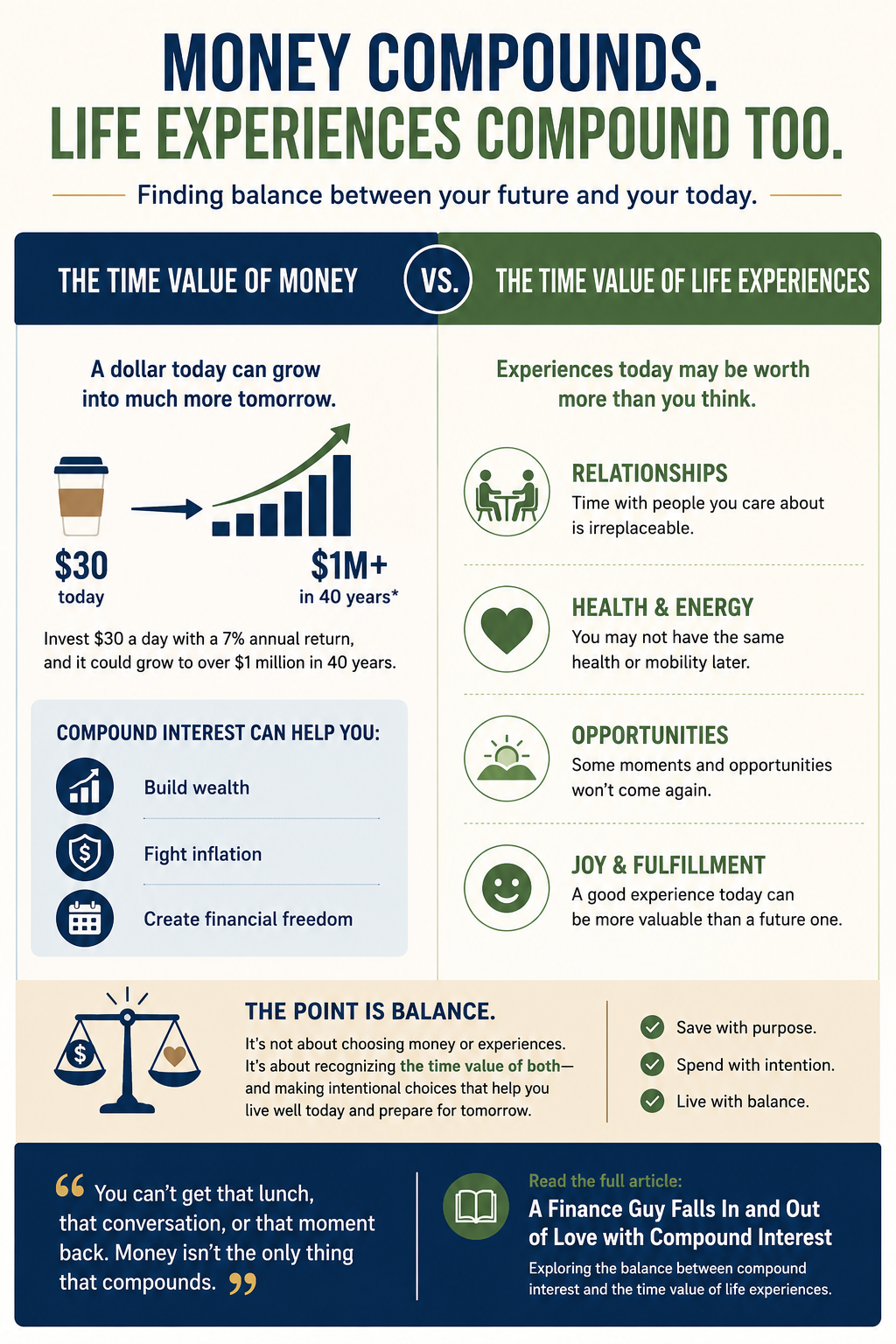
You hear it all the time from personal finance “gurus”: If you take the $30 you spend on coffee and lunch every day and invest it instead, you could be a millionaire in 40 years because of the eighth wonder of the world—compound interest.
To be frank, the basic point is true. However, it is also too simplistic because it does not ask the most important question: How much happiness do you get from spending that $30 a day on coffee and lunch?
The answer to that question can challenge the usual lesson about the wonder of compound interest. Yes, I could become a millionaire in 40 years, but would that be the result of strong willpower and an excellent job of delaying gratification, or would I have given up something more?
That “something more” might be the happiness I would have gained from spending quality time with friends, family members, and colleagues while enjoying a great cup of coffee or a good lunch. Those experiences have compounding effects as well. Although intangible, they still compound.
Besides, what happens when you reach 65 and become a millionaire? Will you still have the health and mobility to enjoy those millions? Would the money you spent on coffee in your 20s and 30s have been worth it?
And what about your own mortality? We live longer because of modern medicine and technology, and most Americans make it to 65. But there is no guarantee that every one of us will get there or remain healthy enough to enjoy the money we spent decades accumulating.
The time value of money has two sides, yet we often hear only one of them. A dollar today is generally worth more than a dollar in the future because of inflation and the opportunity to invest it.
The other side, which we do not hear about nearly as often, is the time value of life experiences—or happiness in general. A good experience lived today can be more valuable than a future experience.
One could argue that this side is even more important. With the time value of money, the basket of goods you can buy in the future may contain fewer items, but you will still have your money, and compound returns may help offset inflation.
The same cannot be said about the time value of life experiences. It is highly unlikely that you can go back and have that lunch with a trusted colleague.
This is why I am not a big proponent of the FIRE—financial independence, retire early—mindset. Working and saving aggressively come with their own set of problems. Yes, you may manage to retire early, but at what cost? What life experiences did you forgo to reach your FIRE goal, and what was the true value of those experiences?
I guess the point of this article is the old adage that life is best lived in moderation.
Instead of completely giving up coffee or lunch with your friends, why not cut your daily spending from $30 to $15 or cut back a couple of days a week?
Instead of working constantly and saving 90% of your disposable income so you can achieve FIRE, why not try living on 50% or 60% of your income and saving the rest?
Compound interest and compounding life experiences do not have to be mutually exclusive.