
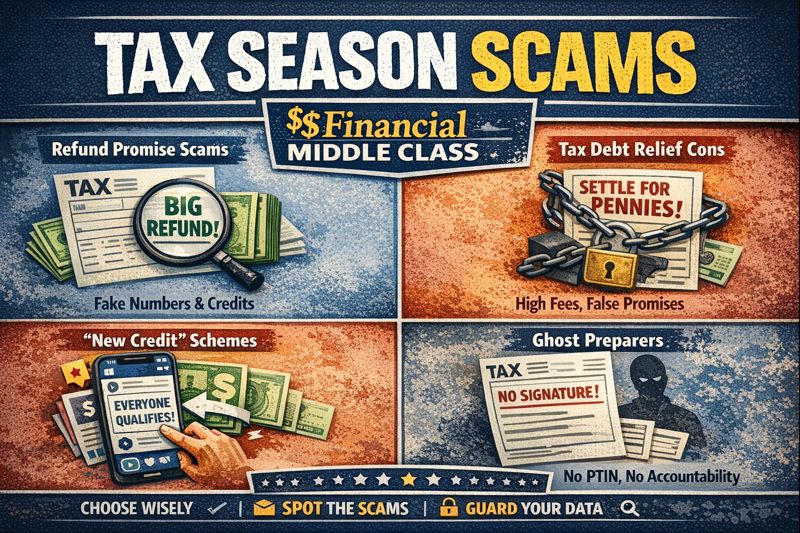
Tax Season Scams: The Refund Promise, the Debt Relief Pitch, and the ‘New Credit’ Trap”
By Article Posted by Staff Contributor
The estimated reading time for this post is 886 seconds
Tax Season Scams: Refund Promises, Debt Relief & “New Credit” Traps
If you’ve heard “guaranteed big refund,” “pennies on the dollar,” or “everyone qualifies,” pause. This is your plainspoken guide to tax scams, red flags, and clean next steps before you file.
In this article
Last updated: January 6, 2026. One-line truth: scams change costumes, not tactics—refund hunger, debt fear, and urgency are still the hooks.
Key takeaways (read this first)
The refund isn’t a prize. It’s reconciliation. Anyone selling you a “guaranteed big refund” is often selling risk, not skill.
Paid preparers must sign. If they won’t sign your return or won’t include a PTIN, that’s not “privacy.” That’s dodging accountability.
Debt relief isn’t a coupon. If someone promises “pennies on the dollar” without screening eligibility, you’re being sold hope with a fee schedule.
Your W-2 is identity gold. Treat tax documents like your credit card and your Social Security card had a baby. Protect it accordingly.
Timeline: how tax scams usually unfold (and where you can stop them)
Step 1: The hook (refund hunger, debt fear, or “new credit” hype)
It starts with a confident line: “Guaranteed refund,” “fresh start,” “everyone qualifies,” or an IRS-sounding message designed to spike your heart rate.
Step 2: The rush (they push you to move before you verify)
They push you to send documents fast, click a link, or “just sign” before you understand what’s being filed in your name.
Step 3: The control move (your refund routing, your login, or your data)
They try to control something valuable: your refund deposit, your IRS account access, your W-2, or your identity info. That’s where “annoying” turns into “expensive.”
Step 4: The fallout (refund delay, letters, penalties, stress)
Weeks or months later, the IRS asks for proof, your refund freezes, or you discover someone filed before you. The scammer disappears; the paperwork stays.
Step 5: The clean exit (verify, document, correct, protect)
When you slow down, get a full copy of what was filed, respond to notices, and protect your identity going forward, you stop the spiral and get back in control.
Why tax scams spike right now
Tax season turns grown adults into gamblers. Not because you’re reckless, but because you’re tired. Rent is up, groceries are disrespectful, and your car suddenly needs something expensive like it has a personal grudge against your checking account.
That refund starts to feel like oxygen. A once-a-year reset. Catch up on a card. Fix the car. Put something—anything—back into savings. Scammers understand that emotion, and they use it. Tax scams work because they press urgency on top of financial stress and call it “help.”
The ugly truth is simple: the scammer gets paid today. You get the consequences later.
The three seasonal pitches
Most tax scams come dressed as one of three pitches. Different outfits. Same hustle. If you can recognize the lane, you can recognize the trap before you hand over your W-2 and your peace of mind.
| The pitch | What it usually means | Your 10-second response |
|---|---|---|
| “I can get you a bigger refund.” | They may be planning to inflate numbers, misuse credits, or file something you can’t support once the IRS asks questions. | “Show me the fee schedule, and confirm you sign the return with your PTIN.” |
| “Settle your tax debt for pennies.” | They’re selling a dream version of tax relief without screening eligibility, often with big upfront fees. | “Explain why I qualify, in writing, before I pay a dime.” |
| “There’s a new credit everybody qualifies for.” | It’s usually a viral hack that collapses the second documentation shows up. | “If everyone qualifies, show me the official IRS guidance.” |
Refund promise scams
A legitimate preparer can estimate your return after reviewing your documents and asking real questions. A scammer flips the order. They lead with a number because the number is the hook.
This is the middle-class trap: when life is tight, “big refund” sounds like relief. But in scam-world, “big refund” often means “big risk,” because the fastest way to create a refund on paper is to file information that doesn’t match reality.
And here’s what people miss: even if somebody else typed it, the IRS doesn’t chase the barber, the cousin’s friend, or the “tax guy.” The IRS chases the taxpayer whose name is on the return.
Scam Translator: the phrases you should not ignore
“Guaranteed big refund.” Translation: “I’m selling you a result I can’t promise without bending the truth.”
“Everybody qualifies.” Translation: “I’m hoping you won’t ask what eligibility actually means.”
“Just sign. I’ll handle it.” Translation: “I don’t want you reading what’s being filed in your name.”
Here’s a composite example that’s painfully common. A W-2 parent hears, “My guy gets everybody back at least $6,000.” The preparer barely asks questions. They want a photo of the W-2, the kid’s info, and maybe your login details like that’s normal. Then the refund sits in “processing.” Then the letter shows up. That’s how it happens. Not with handcuffs. With paperwork.
Refund advances and “instant money”
Refund advances exist because bills don’t wait for the IRS timeline. They’re marketed like a lifeline: “Get your refund early.” But “early” often comes with rules, eligibility requirements, and fine print that people don’t read when the car is already making that noise.
The scam risk is that refund advances pair perfectly with bad actors who want control. If a preparer is steering you toward “instant money” while also controlling your filing, your bank info, or your refund routing, slow down. Fast-money marketing is where people surrender leverage without noticing.
If you choose any refund-advance product, keep one principle: you control the account, you control the filing, and you get a full copy of everything submitted in your name.
Ghost preparers: no signature, no accountability
This is the red flag that should end the conversation immediately. If someone is paid to prepare your return, they should sign it and include their PTIN. When they refuse, it’s not a “preference.” It’s a strategy.
A ghost preparer wants the benefit of your trust and your money without the liability of their work. If the return gets questioned, you’re left holding the bag while they claim they were never involved. That’s not business. That’s disappearing ink.
Word-for-word: the preparer interview script
Ask: “Will you sign my return as the paid preparer and include your PTIN?”
Ask: “How are your fees calculated—flat fee or based on complexity—and can I see that in writing?”
Ask: “How do you send and store documents securely?”
Ask: “Will I receive a complete copy of my return the same day it’s filed?”
If they dodge, get offended, or rush you, that’s your answer. A professional expects these questions. A hustler hates them.
“New credit” schemes and viral tax hacks
The internet loves a loophole. Especially one with a cash emoji. That’s why “new credit” scams spread so fast: they don’t feel like scams. They feel like “game.”
Real tax credits usually come with something boring: eligibility rules, documentation, and limits. The scam version skips all of that and jumps straight to “everybody qualifies” because it’s selling excitement, not accuracy.
If the pitch tells you to claim something that you can’t explain in one honest sentence—what it is, why you qualify, and what proof you have—assume the IRS will eventually ask the same question with much less patience.
Gig worker corner: real vs fantasy deductions
If you drive, deliver, freelance, resell, or run a side hustle, you are prime target material. Not because you’re careless, but because the rules are messier and the “write-off” culture is loud.
Here’s a plain standard that keeps you safe: legitimate deductions are tied to legitimate business activity and supported by records. Fantasy deductions are vibes, viral clips, and “my cousin said.”
| Sounds like this | Safer reality check |
|---|---|
| “Just write off your whole car.” | Business use is typically proportionate and record-based. If you can’t support the business portion with logs/records, it’s not a “write-off,” it’s a gamble. |
| “Everybody can claim this credit.” | Tax law rarely works like that. If the claim depends on “nobody checks,” assume someone will. |
| “Don’t worry about receipts.” | Receipts and logs aren’t paranoia. They’re self-defense if questions show up later. |
A gig worker doesn’t need to be perfect. You just need to be honest and organized. The goal isn’t to “win taxes.” The goal is to file something you can stand behind if the IRS ever asks you to explain it.
Tax debt relief cons (and “pennies on the dollar” ads)
If you owe the IRS, you’re already stressed. That’s why “pennies on the dollar” marketing is so effective: it’s selling relief before you’ve even processed the problem. And yes, some tax relief firms are legitimate. The issue is sales-first outfits that push one program on everyone because it’s profitable, not because it fits.
If someone promises outcomes without evaluating your situation, treat it like a car dealer promising you a loan “no matter what” before they even run your credit. That’s not confidence. That’s a funnel.
| Legit help tends to sound like | Salesy/mill behavior tends to sound like |
|---|---|
| “Let’s confirm what you owe, what notices you received, and what you can realistically pay.” | “Guaranteed settlement. Pay us today. We’ll handle everything.” |
| “Here’s why you may or may not qualify, and here’s what documentation is required.” | “Everyone qualifies. It’s a new program. It’s time-sensitive.” |
| “Here’s the fee schedule in writing, and what you can do directly with the IRS if you prefer.” | “Fees depend on how much we save you. Sign here.” |
If you’re exploring relief, keep it boring and official. Start with the exact notice number and your current IRS status. If someone won’t work from real documents, they’re not working from reality.
How IRS letters actually work (so you don’t get bullied)
Impersonation scams work because people are scared of the IRS. They don’t understand the process, so they panic when a message looks official. Panic is expensive.
Real IRS communication generally isn’t a dramatic phone call with threats. It’s usually a written notice, a request for clarification, or a documented process. That doesn’t mean the situation is fun, but it does mean you can respond like an adult with a plan instead of like a person being chased in a movie.
If a message demands immediate payment and pushes weird payment methods, you’re not looking at tax collection. You’re looking at someone trying to speed-run your fear into their bank account.
IRS impersonation, phishing, and message fraud
Some scams don’t even bother being “tax prep.” They pretend to be the IRS. The playbook is always the same: urgency, intimidation, and a link or callback number they control.
Your rule is simple. Don’t click, don’t reply, don’t “verify.” You initiate contact through official channels you trust. If the message is real, it will survive a calm verification step. If it’s fake, verification is exactly what the scam can’t tolerate.
Data privacy and identity theft basics
A tax return isn’t just paperwork. It’s your identity in spreadsheet form. Your W-2 and tax forms contain the data criminals love: name, address, Social Security number, employer details, and income figures.
If you want a strong layer of protection, consider an IRS Identity Protection PIN (IP PIN). It’s a six-digit number that helps prevent someone else from filing a return using your SSN. If you get one, treat it like a vault key: you don’t hand it out because someone asked nicely.
Also, be realistic about how you share documents. “Text me your W-2” is not a secure process. It’s convenience dressed up as normal.
Business and payroll scams (W-2 data theft)
If you run a business or you’re anywhere near payroll, tax season comes with a special scam: the email that looks like it’s from leadership requesting W-2s or employee data. The message is short, urgent, and “bossy” on purpose. It tries to turn your professionalism into a mistake.
Your best defense is not fancy software. It’s a habit. Verify W-2 requests out-of-band with a known phone number. Restrict access to payroll data. And treat any request for “everyone’s W-2s” as a high-risk event until proven otherwise.
The protection plan (how to file without getting played)
You don’t need paranoia. You need standards. When you apply standards, scammers self-select out of your life because you’re no longer an easy target.
Start with the basic rule: if you pay a preparer, they sign the return, include their PTIN, and give you a full copy of what was filed. If that’s a problem for them, it’s a bigger problem for you.
Next, decide whether you even need a preparer. If your return is simple, doing it yourself with reputable tools can be fine. If your return is complicated—multiple income streams, self-employment, multi-state issues, IRS notices—paying for a credentialed pro can be cheaper than paying later in penalties and stress.
| DIY is often fine when | Consider a credentialed pro when |
|---|---|
| One or two W-2s, standard situations, no confusing side income. | Self-employment income with real expenses, multiple 1099s, or messy records you need to clean up. |
| You can answer, clearly, where every number came from. | You received IRS notices, have prior-year issues, or need representation and strategy. |
| You’re not chasing a “bigger refund,” just accuracy. | Someone is selling you “guaranteed outcomes,” and you need a reality check. |
If cost is pushing you toward random “tax guys,” use official free help if you qualify. The IRS Free File program and VITA/TCE free preparation programs are designed for exactly this problem: people who want it done correctly without paying a premium for anxiety.
If you already filed something sketchy
First, don’t panic and don’t hide. IRS problems don’t die from neglect; they grow. If you already filed and now you’re worried the return was wrong, the clean move is to get a full copy of what was filed and start documenting.
Stop working with any preparer who won’t provide documents or refuses to sign their work. If you’ve received an IRS letter, respond promptly and keep copies of everything. If you suspect fraud or phishing, report it through official IRS reporting channels. If you participated in a scheme, the smartest move is to correct it before the IRS corrects it for you.
If you’re not sure what’s been filed in your name, a credentialed pro can help you triage without guessing.
FAQ
How do I know if a tax preparer is legit?
A legitimate paid preparer signs the return, includes their PTIN, gives you a complete copy of what was filed, and explains fees clearly before filing. If they refuse to sign or won’t share a PTIN, treat it as a red flag, not a quirk.
Is it normal for someone to guarantee me a bigger refund?
No. A preparer can estimate after reviewing your documents. “Guarantees” before seeing details often mean someone plans to invent numbers or claim things you can’t support.
What’s the fastest way to sanity-check a “new credit” I saw online?
Slow down and verify it through official IRS guidance or a credentialed tax professional. If the pitch is “everyone qualifies,” “no documentation,” or “just put it under withholding,” assume it’s a trap until proven otherwise.
Are tax debt relief companies always a scam?
No. Some are legitimate. The risk is sales-first firms that push one-size-fits-all programs and charge big upfront fees without confirming eligibility. Demand eligibility reasoning and fees in writing before paying.
What should I do if I already filed and now I’m worried it was wrong?
Get a complete copy of what was filed, stop working with any preparer who won’t provide documentation, respond to IRS mail quickly, and talk to a credentialed pro about correction steps. Ignoring letters is the worst move.
Your turn
What’s the wildest tax-season pitch you’ve heard—“big refund,” “new credit,” or “pennies on the dollar”? Drop the exact wording in the comments so others can learn the red flags in real time.
References (official IRS resources)
If you want to verify something quickly, start here:
IRS “Dirty Dozen” scam overview
Get an Identity Protection PIN (IP PIN)
Report fake IRS/tax emails and messages ([email protected])
W-2 data theft guidance for businesses
Offer in Compromise pre-qualifier tool


RELATED ARTICLES
Cash Strategy: Put Every Dollar in the Right Place
Your checking account, emergency fund, short-term savings, and investments should not be managed the same way. This cash strategy helps assign every dollar to the right financial job.
Best HYSA: How to Choose Beyond the Highest APY
A competitive interest rate matters, but it is only one part of choosing a high-yield savings account. Compare insurance, fees, access, transfer speed, and promotional conditions.
Leave Comment
Cancel reply
Gig Economy
Business / Aug 08, 2026
The Missing Middle in Black Entrepreneurship
Black entrepreneurship has expanded dramatically. The next challenge is helping more Black-owned businesses move from self-employment to employer firms and sustainable scale.
By FMC Editorial Team
Personal Finance / Aug 01, 2026
Cash Strategy: Put Every Dollar in the Right Place
Your checking account, emergency fund, short-term savings, and investments should not be managed the same way. This cash strategy helps assign every dollar to the right...
By Article Posted by Staff Contributor
Personal Finance / Aug 01, 2026
Best HYSA: How to Choose Beyond the Highest APY
A competitive interest rate matters, but it is only one part of choosing a high-yield savings account. Compare insurance, fees, access, transfer speed, and promotional conditions.
By Article Posted by Staff Contributor
Personal Finance / Aug 01, 2026
High-Yield Savings vs. CDs, Treasury Bills, and Other Safe Places for Cash
High-yield savings accounts are excellent for accessible cash, but they are not always the best choice. Compare HYSAs, CDs, Treasury bills, money market accounts, and I...
By Article Posted by Staff Contributor
American Middle Class / Aug 01, 2026
High-Yield Savings Accounts: A Safer Home for Your Cash
A high-yield savings account can pay several times the national savings rate while keeping qualified deposits federally insured. Here is how it works, what to watch...
By Article Posted by Staff Contributor
Real Estate / Jul 30, 2026
Mortgage Lock-In Is Freezing the Housing Market
Millions are trapped by 3% mortgages. Learn how mortgage lock-in worsens affordability—and why homeowners are renovating instead.
By FMC Editorial Team
Real Estate / Jul 26, 2026
Is South Florida More Expensive Than New York? The Complete 2026 Relocation Guide
Is South Florida more expensive than New York? Compare housing, taxes, insurance and 104 municipalities before you move.
By Article Posted by Staff Contributor
Personal Finance / Jul 25, 2026
The Time Value of Life Experiences: What Compound Interest Leaves Out,
Money compounds, but life experiences do too. Explore what compound interest leaves out—and how to balance saving with living.
By MacKenzy Pierre
American Middle Class / Feb 18, 2026
How Wealth Is Passed Across Generations in the United States: Mechanisms, Evidence, and the Policy Debate
How wealth passes between generations—trusts, taxes, and the debate. Get the facts, figures, and tradeoffs. Read now.
By FMC Editorial Team
American Middle Class / Feb 16, 2026
The S&P 7,000: How Wall Street Disconnects from Main Street
S&P 7,000 can rise while wages, benefits, and towns fall behind. See why the market isn’t the economy—read now.
By MacKenzy Pierre
Latest Reviews
Business / Aug 08, 2026
The Missing Middle in Black Entrepreneurship
Black entrepreneurship has expanded dramatically. The next challenge is helping more Black-owned businesses move from...
Personal Finance / Aug 01, 2026
Cash Strategy: Put Every Dollar in the Right Place
Your checking account, emergency fund, short-term savings, and investments should not be managed the same...
Personal Finance / Aug 01, 2026
Best HYSA: How to Choose Beyond the Highest APY
A competitive interest rate matters, but it is only one part of choosing a high-yield...