
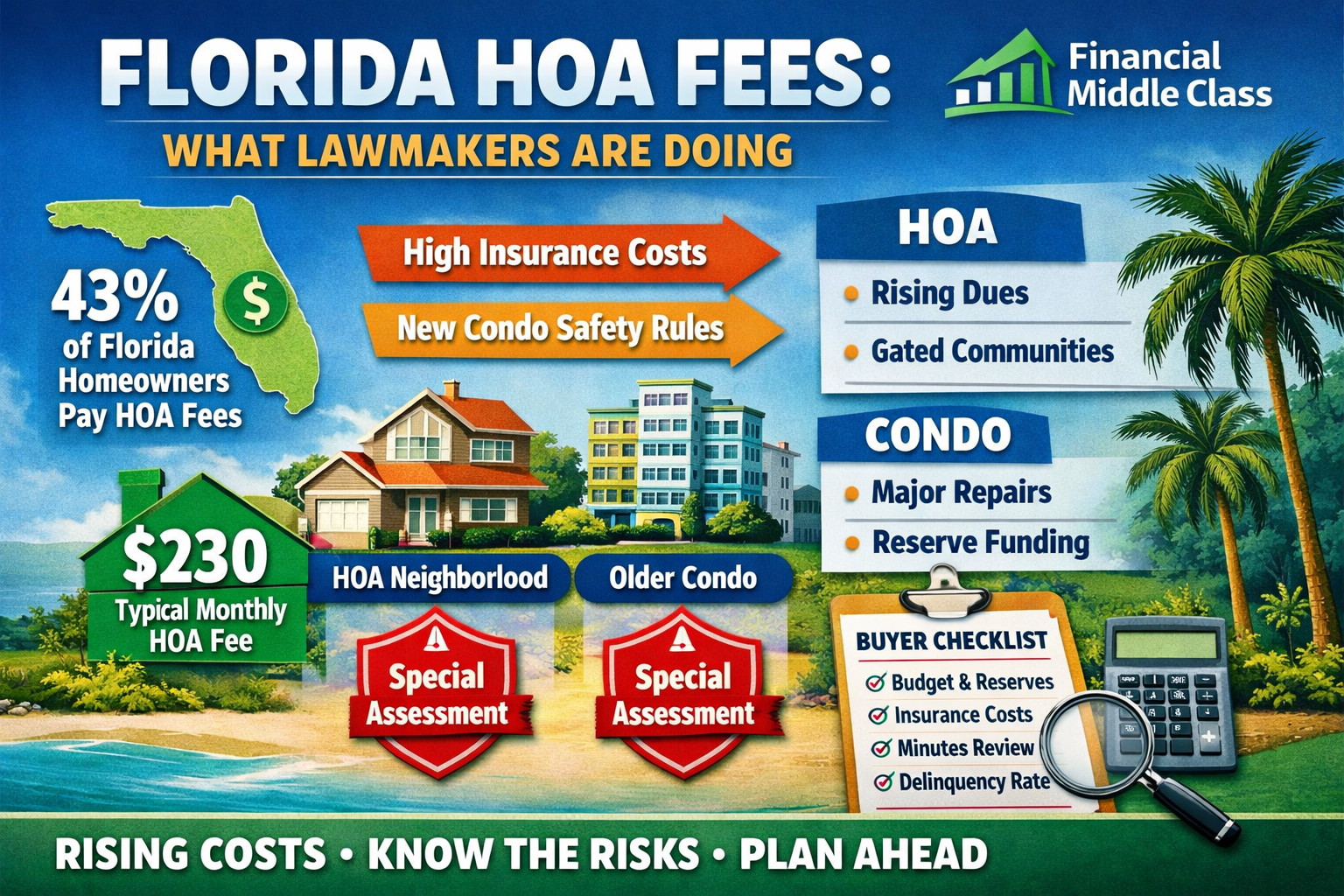
Florida Homeowners Pay the Most in HOA Fees
The estimated reading time for this post is 877 seconds
Florida Homeowners Pay the Most in HOA Fees
What Florida lawmakers are doing about it—and why your “fixed” housing cost still doesn’t feel fixed.

Timeline: how Florida got here
June 2021: Surfside collapse Safety became the headline
Surfside forced a hard conversation about deferred maintenance and what happens when repairs get postponed for years.
2022: Condo safety rules ramp up Inspections + reserves
Milestone inspections and reserve expectations tightened—especially for older buildings and high-rises.
2024: HOA reforms (HB 1203) Governance + fewer “gotcha” fines
Florida expanded HOA transparency requirements and limited some petty fine scenarios (like trash can timing and holiday decor after notice).
2025: Condo revisions (HB 913) More time + more flexibility
Florida extended the Structural Integrity Reserve Study (SIRS) deadline and added more flexibility in how associations fund and sequence reserve obligations.
2026: Proposed dispute reforms (HB 657) Faster lanes for conflicts
A proposal that would remove some presuit mediation requirements and allow judicial circuits to create community association court programs for certain disputes.
Intro
Florida has a way of selling the dream in clean math.
No state income tax. Sun. A mortgage payment that looks manageable on paper. You lock the rate, you close, you tell yourself this is the stability you’ve been chasing.
Then the HOA bill shows up. Monthly. Automatic. Non-negotiable.
Not shocking in the legal sense—because it was disclosed somewhere. Shocking in the real-life sense—because nobody talks about it like it’s part of the housing payment, even though it behaves like it.
Florida is an HOA market
In a lot of states, HOAs are something you can avoid if you really want to.
In Florida, avoiding them can feel like trying to avoid humidity.
Florida has a high share of condos, townhomes, master-planned communities, gated neighborhoods, and 55+ developments. That means a larger slice of homeowners pay HOA or condo fees—and they pay them month after month, whether their wages rise or not.
The Florida housing cost stack
Here’s the part that trips people up: a fixed-rate mortgage can still produce an unfixed lifestyle.
Your housing cost isn’t one bill. It’s a stack. And Florida’s stack is heavy.
| Cost | What it is | What it feels like |
|---|---|---|
| Mortgage (P&I) | The anchor payment | The one you planned around |
| Property taxes | Local government costs | Creeps up in the background |
| Homeowners / flood insurance | Coverage you can’t skip | Can jump hard at renewal |
| HOA / condo fees | Association operating costs | A second housing bill you don’t control |
| Special assessments | One-time (or “one-time”) extra charges | The bill that hits when your budget is already tight |
Why Florida gets hit harder
Most people blame HOA fees on the obvious stuff: the pool, the gate, the landscaping crew that seems to show up every other day.
That’s not where the biggest pressure comes from—especially in condos.
In Florida, the big drivers are usually boring and expensive: insurance, reserves, and repairs in aging buildings.
And after Surfside, there’s less tolerance for “we’ll deal with it later.” That’s the right direction for safety. It’s also the reason many owners are seeing higher monthly dues and more assessments.
Where fees hurt most
In some Florida metros, HOA fees aren’t just “another bill.” They’re a meaningful slice of the housing payment—big enough to change what a household can afford.
When an HOA fee starts consuming a quarter of what you pay toward principal and interest, it stops being a footnote. It becomes part of the mortgage story.
| Florida metro | Example HOA burden | Why it matters |
|---|---|---|
| Miami | HOA burden reported near ~27% of P&I | That’s not “amenities.” That’s a second payment. |
| Panama City / Naples / Cape Coral / Port St. Lucie | High HOA burden clusters | Even “affordable” areas can become tight once fees stack. |
Where the money goes
Most homeowners would calm down a little if they understood the budget.
What sets people off is paying hundreds a month and still feeling like no one can explain the numbers.
Here’s the reality: in many Florida associations, the biggest line items are not luxury. They’re risk and maintenance.
| Budget line | What it covers | Why it keeps rising |
|---|---|---|
| Insurance | Master policies (condos), liability, property | Premium hikes get passed through—fast. |
| Reserves | Saved money for major repairs | Post-Surfside expectations push “real funding,” not vibes. |
| Maintenance & repairs | Roofs, concrete, elevators, plumbing, paving | Aging inventory + higher labor/material costs. |
| Management & admin | Operations, bookkeeping, collections | Compliance and complexity cost money. |
| Legal | Disputes, contracts, enforcement | Conflict is expensive—even when everyone thinks they’re right. |
HOA vs. Condo
HOAs and condo associations can both squeeze you. They just squeeze you differently.
| HOA (single-family / townhome) | Condo association |
|---|---|
| Main drivers: landscaping, gates, private roads, amenities, management. | Main drivers: master insurance, structural repairs, reserves, elevators/roof/plumbing. |
| Typical pain: steady fee creep over time. | Typical pain: bigger jumps + higher assessment risk in older buildings. |
| Red flags: vague budgets, constant vendor turnover, high delinquencies. | Red flags: underfunded reserves, deferred maintenance, minutes full of looming repairs. |
Special assessments
This is where the middle class gets trapped.
Because you can plan for a monthly fee. You can adjust. You can cut back.
A special assessment doesn’t care about your plan. It shows up when the association needs cash now—and the reserves aren’t enough.
Mini case study #1: the HOA neighborhood
No high-rise. No elevator. Just a typical Florida community with private roads, gates, drainage, and a clubhouse.
Insurance renews higher. Vendors raise prices. The board “temporarily” raises dues.
Then the roof needs replacement, or the drainage fix becomes unavoidable. The assessment arrives. Everyone feels blindsided even though the warning signs were in the budget.
Mini case study #2: the older condo building
The building hits the age where repairs can’t be postponed without risk. The inspection finds issues. The reserve study shows a gap.
The master insurance premium jumps. The numbers stop fitting neatly into a fixed-income world.
Owners face a choice that doesn’t feel like a choice: pay the assessment, or face lien/collection pressure and the stress that follows.
What lawmakers are doing
Here’s the clean truth: Florida is not capping HOA fees.
What Florida is doing is tightening the rules around how associations operate, how transparent they must be, how condo safety and reserves are handled, and how disputes can move through the system.
HB 1203 (2024): more transparency, fewer petty “gotcha” fines
Florida’s HOA reforms expanded recordkeeping and online access requirements for larger HOAs. The law also addressed common homeowner complaints by limiting fines in certain everyday scenarios—like trash receptacles within a defined window and holiday decorations after notice and time to cure.
HB 913 (2025): condo reforms that try to reduce financial shock
After the post-Surfside safety rules triggered real cost spikes, Florida adjusted condo requirements.
A key change: the required Structural Integrity Reserve Study (SIRS) deadline was extended to give associations more time, along with added structure around funding plans.
This is Florida trying to hold two truths at once: safer buildings, and owners who aren’t getting crushed all at once.
HB 657 (2026, proposed): a new path for disputes
This proposal would remove certain presuit mediation requirements and allow judicial circuits to create community association court programs for certain disputes.
That doesn’t lower premiums or rebuild reserves. But it speaks to a real pain point: homeowners who feel stuck in slow, expensive conflicts with no clean resolution.
Buyer playbook
If you’re buying in Florida, don’t just buy the unit.
Buy the association’s financial health.
| Ask for this | What you’re trying to learn | Red flags |
|---|---|---|
| Current budget + last year budget | What’s rising and why | Big insurance spike, vague “misc.” lines |
| Reserve study / SIRS | Whether repairs are funded | Low reserves, outdated study, wishful assumptions |
| Meeting minutes (12–24 months) | What’s coming | Constant repair talk, looming assessments, lawsuits |
| Insurance summary | How exposed the community is | Carrier instability, major renewal jumps |
| Delinquency rate | Whether owners are paying | High delinquencies = pressure on everyone else |
| Special assessment history | Whether surprise bills are normal | “We do this every year now” |
If the association can’t provide documents—or acts offended that you asked—take the hint.
Homeowner playbook
If you already live in one of these communities, you don’t need to become a full-time activist.
You just need to stop being blind.
Read the budget. Track how much of it is insurance and reserves. Those are your pressure gauges.
Push for competitive bids on big contracts. Ask simple questions until the answers stop being slippery.
And show up before the assessment hits. After is too late. After is when everyone is angry and nobody is thinking clearly.
Retirees & fixed income
Florida has a lot of retirees. That matters here.
A big dues hike isn’t “annoying” when your income is fixed. It’s destabilizing.
If fees jump or an assessment lands, move early. Ask about payment plans. Ask what’s driving the increase and what the next two years look like.
Then run the stay-versus-sell math with honesty, not pride.
Equity is not a checking account. And draining your last liquid savings to stay put can turn a hard situation into an irreversible one.
The truth that hits home
Florida keeps selling stability like it’s a one-time purchase.
Buy the home. Lock the rate. You’re safe.
But for a huge share of households, the mortgage is only the first bill in the stack.
Insurance moves. Repairs move. Reserves move. And the HOA bill moves with them.
Your mortgage might be fixed. Your cost of staying housed in Florida often isn’t.
Sources & further reading
- Florida Senate — 2024 Bill Summary: HB 1203 (Homeowners’ Associations)
- Florida Senate — 2025 Bill Summary: HB 913 (Condominium & Cooperative Associations)
- Florida Senate — HB 657 (2026): Community Associations
- AP News — Florida lawmakers approve condo safety law changes
- DBPR — Condominium Inspections & SIRS overview
FAQ
Are HOA fees negotiable when I buy?
No. You can negotiate the sale price, but you can’t negotiate the association’s budget. Your leverage is choosing a healthier association before you close.
What’s the single most important thing to check before buying?
Reserves + insurance exposure + meeting minutes. Those three tell you what’s coming long before the listing does.
Why are special assessments happening more often?
When reserves don’t match the reality of aging roofs, concrete, plumbing, and insurance renewals, the “catch-up” arrives as an assessment—usually at the worst possible moment.
What did HB 913 change for condos?
It extended the SIRS deadline and added flexibility and structure around reserve planning—aimed at easing “all-at-once” financial shocks while keeping the safety direction intact.
What’s the point of HB 657 (proposed)?
It aims to reshape how HOA/condo disputes move through the system—potentially faster and more direct—so homeowners aren’t stuck in slow, expensive conflict loops.
Let’s talk
What’s the biggest HOA/condo fee jump you’ve seen in Florida—and did your association clearly explain where the money went?
<!– OPTIONAL JSON-LD (Some WordPress setups strip