Introduction
No credit history? You’re not alone. Millions of Americans live in a cash-first world, or simply haven’t used credit cards or loans enough to generate a real credit file. The problem is obvious: lenders rely heavily on credit reports and FICO scores. If you don’t have them, you often get shut out.
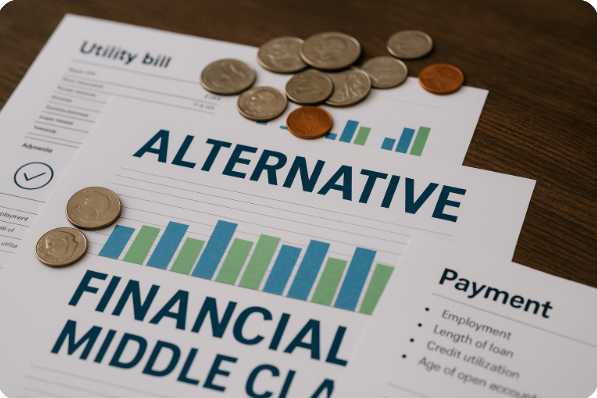
But here’s the shift: more and more lenders are now turning to alternative credit data — things like rent payments, utility bills, or even your streaming subscriptions — to judge whether you’re a reliable borrower. This change is giving people with “thin files” a real shot at financing their first car, home, or business.
Why Traditional Credit Shuts People Out
Credit scores were designed as a shortcut. Instead of digging into your whole life story, lenders can look at a three-digit number and decide: yes or no. But the catch is brutal — if you don’t have a score, you’re invisible.
Young adults, recent immigrants, and people who prefer cash or debit all face the same paradox: you need credit to build credit. Without a history of loans or credit cards, you’re stuck outside the system.
What Is Alternative Credit?
Alternative credit is any financial data that falls outside the traditional FICO formula. It’s how lenders get a fuller picture of your reliability when you don’t have a credit card or car loan history.
Examples include:
- Rent payments made on time.
- Utility bills (electric, water, gas, internet).
- Phone payments or insurance premiums.
- Bank account activity (steady deposits, no overdrafts).
- Even subscriptions like Netflix or Spotify.
Fintech tools like Experian Boost let you add this kind of data to your file, while models like FICO XD and VantageScore 4.0 already incorporate alternative sources.
Why Lenders Use Alternative Credit
- Expanding Access
Millions of Americans don’t have credit scores. Lenders don’t want to miss out on serving them.
- Risk Management
Seeing that you’ve paid rent on time for three years is better than seeing nothing at all.
- Regulatory Encouragement
Federal agencies like the OCC have nudged lenders to find ways to include underserved borrowers.
- Market Competition
Fintechs have proven there’s profit in lending to people overlooked by traditional credit models. Banks and credit unions are now catching up.
Types of Lenders Who Use Alternative Credit
- Fintech Lenders: Upstart, LendingPoint, and others use AI and broader data sets.
- Banks: Some traditional banks are experimenting with alternative credit in personal loans.
- Credit Unions: Community-focused, often willing to manually review rent or utility histories.
- Specialty/Subprime Lenders: Already accustomed to higher-risk borrowers; more open but often charge higher rates.
- Credit-Builder Products: Share-secured loans, credit-builder loans, and rent-reporting services that build credit from scratch.
State-by-State Examples
Florida
- Liberty Savings Bank in Sarasota-Manatee partners with Upstart for personal loans.
- CCU Florida has a First Time Borrower program designed for people with little to no credit.
- Credit unions like MIDFLORIDA and Space Coast Credit Union make local decisions and may accept alternative histories.
Texas
- Texans Credit Union and Texas Bay Credit Union both use Upstart’s AI lending platform.
- PeopleFund and LiftFund are nonprofit lenders providing flexible loans to small businesses and startups.
- State-backed Texas Homebuyer Programs sometimes allow nontraditional underwriting for first-time buyers.
California
- Golden 1 Credit Union, one of the largest in the U.S., often serves new borrowers.
- Mission Asset Fund (San Francisco) runs zero-interest community lending and helps people build credit through reporting.
- State programs offer first-time homebuyers more flexible underwriting.
New York
- SONYMA offers state-backed mortgages for first-time homebuyers.
- Hebrew Free Loan Society provides interest-free community loans outside the credit system.
- Local credit unions and matched savings programs (“Homebuyer Dream”) expand options.
Strengths and Limitations
Strengths
- Opens financial doors for people with no score.
- Helps separate responsible bill-payers from high-risk borrowers.
- Encourages wider financial inclusion.
Limitations
- Standards aren’t uniform — one lender may accept rent receipts, another may not.
- Larger loans (like mortgages) still lean heavily on traditional credit scores.
- Some alternative lenders charge high rates to offset risk.
How Borrowers Can Use This to Their Advantage
- Document Your Payments: Keep receipts or statements for rent, utilities, and insurance.
- Leverage Tools: Use Experian Boost or a rent-reporting service to get credit for bills you already pay.
- Start Small: Apply for a credit-builder loan or share-secured loan at a local credit union.
- Shop Around: Compare fintech lenders, banks, and credit unions — acceptance of alternative data varies.
- Be Cautious: Avoid payday lenders or subprime loans with sky-high rates.
Conclusion
No credit history doesn’t have to mean no opportunity. Thanks to fintech innovation and regulatory encouragement, lenders are looking at more than just your FICO score. Whether you’re in Florida, Texas, California, or New York, options exist to help you access credit and start building your financial footprint.
The takeaway? Don’t sit on the sidelines. Gather your alternative credit history, explore local credit unions, check out fintech lenders, and take advantage of state programs. The system is evolving — and you don’t need a traditional credit score to get your foot in the door.