Introduction: The Squeeze on the Middle Class
There was a time when being part of the middle class in America meant more than just paying the bills. It meant owning a home, taking vacations, sending kids to camp, and enjoying a few luxuries along the way. Today, that picture is fading. Middle class Americans are finding that the lifestyle their parents took for granted is now out of reach. Wages haven’t kept pace with inflation, and the costs of housing, healthcare, education, and leisure have soared.
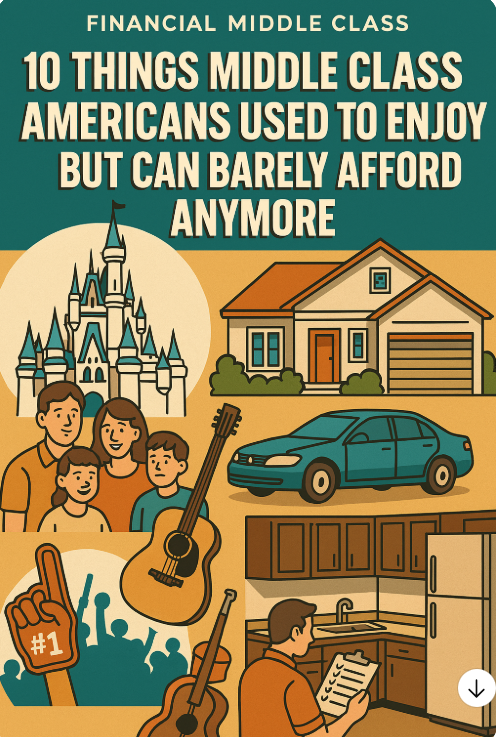
Here are ten things middle class Americans once enjoyed—but now struggle to afford—along with how the costs have changed.
1. Family Vacations
- Then (1990s–2000s): Disney tickets were about $40 each; a family of four could do a trip under $500.
- Now (2025): Tickets cost $150–$189 each, and a weeklong trip for four can hit $6,000–$8,000.
2. Owning a Home
- Then (1990s): Median home price was $120,000; mortgage payments under $1,000/month.
- Now (2025): Median price is $420,000+; payments often $2,800/month+, not including taxes or insurance.
3. College Without Crushing Debt
- Then (1990): In-state tuition about $3,500/year; part-time jobs covered much of it.
- Now (2025): In-state tuition nearly $11,000/year; private schools $42,000/year. Average graduate debt: $30,000–$40,000.
4. Extracurricular Activities for Kids
- Then: Local leagues cost $50–$100/season; music lessons $15–$20/hour.
- Now: Travel soccer $2,000–$5,000/season; private lessons $75–$100/hour.
5. Summer Camps
- Then: Sleepaway camps $250–$400/week; day camps under $100/week.
- Now: Sleepaway camps $1,500–$2,000/week; day camps $300–$600/week.
6. Dining Out Regularly
- Then: Family dinners at casual restaurants cost $35–$50.
- Now: The same meal is $100–$120. Even fast food combos have climbed from $3–$5 to $10–$15.
7. Tickets to Concerts and Sporting Events
- Then: MLB/NBA tickets $10–$20; concerts for major artists $25–$40.
- Now: Sporting events often $75–$100+; concerts $150–$400, before fees.
8. Home Renovations and Upgrades
- Then: Kitchen remodels $20,000–$25,000; decks $5,000–$7,000.
- Now: Kitchens $50,000–$75,000; decks $15,000+. Even bathrooms run $10,000+.
9. Affordable Healthcare and Retirement Planning
- Then: Family health insurance $300/month; pensions common.
- Now: Premiums $1,200–$1,600/month plus high deductibles. Pensions are gone, replaced with 401(k)s—only half of households contribute consistently.
10. Everyday Leisure and Fun
- Then: Bowling $2/game; skating $5–$7; movies $4–$6.
- Now: Bowling $8–$12/game; skating $15–$20; movies $15–$20 (before snacks).
Why This Matters
These aren’t just luxuries—they’re the everyday markers of stability that used to define middle class life. The fact that middle class Americans can no longer afford them shows how much the economic ground has shifted.
What Middle Class Americans Can Do
- Get Creative with Leisure – Road trips, state parks, and free community events can still create lasting memories.
- Reprioritize Budgets – Treat concerts, sports, or vacations as annual highlights instead of monthly expectations.
- Automate Savings – Even $50/month into retirement or an emergency fund adds up.
- Push for Change – Advocate for policies that address housing affordability, education debt, and healthcare reform.
Conclusion: Redefining the Middle Class Dream
The middle-class dream isn’t gone—it’s just harder to reach. Middle class Americans may no longer enjoy the same perks their parents did, but by adjusting priorities and pushing for systemic change, they can still build financial stability and security. The definition of “middle class” may be shifting, but the pursuit of balance and opportunity remains timeless.