
Student Loans and Bankruptcy: Can They Be Discharged?
By Article Posted by Staff Contributor
The estimated reading time for this post is 452 seconds
Table of Contents
- The short answer (and the part nobody tells you)
- Myths vs. reality
- Glossary: delinquent, default, discharge
- Federal vs. private loans
- Chapter 7 vs. Chapter 13 (what you actually care about)
- How student-loan discharge works in bankruptcy
- “Undue hardship”
- Timeline: what happens when
- Should you even try? A decision guide
- What to gather before you talk to a lawyer
- Cosigners, spouses, and family blowback
- Credit impact and the road back
- FAQ:
- The truth that hits home
Key Takeaways (Read this first)
Student loans can be discharged in bankruptcy—but usually only if you prove “undue hardship.”
It’s not automatic. Most borrowers must file an adversary proceeding (a case inside the bankruptcy case).
Federal vs. private matters. Federal loans now have a more structured process post-2022; private loans can be more lender-dependent.
The myth that “it’s impossible” keeps people trapped. The real question is whether your hardship is likely to persist and whether the numbers prove it.
The short answer (and the part nobody tells you)
It’s 11:47 p.m. and you’re doing the kind of math nobody puts on LinkedIn.
Mortgage. Car note. Groceries that somehow cost more every week. A credit card balance that used to be “temporary.” And then—like an unwanted subscription you can’t cancel—your student loan payment sitting there, bold as life.
So let’s say it clean: yes, student loans can be discharged in bankruptcy. But it’s usually not automatic. You typically have to prove repayment would cause undue hardship—a legal standard that varies by court and is often misunderstood.
Myths vs. reality
Myth: “Student loans can never be discharged.”
Reality: The law allows discharge if you prove undue hardship.
Myth: “Bankruptcy wipes student loans like credit cards.”
Reality: Student loans usually require an extra legal step (the adversary proceeding).
Myth: “Only disability qualifies.”
Reality: Disability can support a case, but courts consider broader life circumstances: income ceiling, caregiving, age, chronic health issues, and whether the hardship is likely to last.
Glossary: delinquent, default, discharge
Delinquent: You’re late. The clock is running.
Default: You’ve been delinquent long enough that the system treats the loan as seriously broken—and stronger collection tools can come out.
Collections / garnishment: The part where paychecks, tax refunds, or benefits can be targeted (especially for federal loans once collections resume).
Discharge: A court order that wipes eligible debt—legally. Not “paused.” Not “forgiven.” Done.
Federal vs. private loans (different battlefield)
This is the fork in the road. Same stress. Different rules.
Federal loans
These are loans owned or backed by the government (Direct Loans, many FFEL, Parent PLUS, Grad PLUS). Federal discharge requests are where the newer DOJ/Department of Education guidance can shape how cases are evaluated.
Private loans
These are from banks and private lenders. They can be more aggressive in litigation. And some “education debt” classification issues can get technical—meaning the lawyer you choose matters.
Chapter 7 vs. Chapter 13 (what you actually care about)
| What you care about | Chapter 7 | Chapter 13 |
|---|---|---|
| Timeline | Usually faster (months) | 3–5 year repayment plan |
| Payments | No long repayment plan for most unsecured debt | Monthly plan payments based on income/expenses |
| Best fit | When the budget can’t sustain repayment | When you need structure or are protecting certain assets |
| Student loans | Usually still require undue-hardship case | Same—but can create “breathing room” during the plan |
How student-loan discharge works in bankruptcy
Most people don’t fail because they don’t qualify. They fail because they never try—because they don’t know the “extra step.”
That step is called an adversary proceeding. Think of it as a lawsuit inside your bankruptcy case where you ask the court to discharge your student loans based on undue hardship.
It’s paperwork, yes. But it’s also your story—told with numbers.
“Undue hardship” in plain English
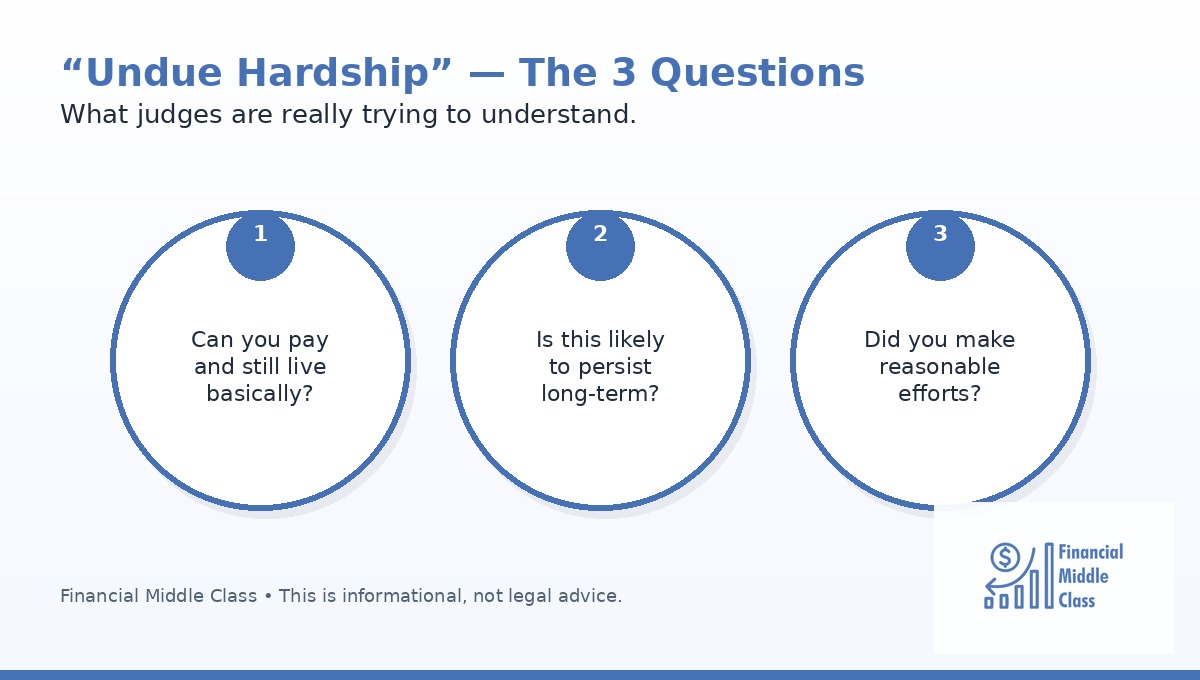
Courts are basically asking three questions:
1) If you pay, can you still maintain a minimal standard of living?
Not luxury. Not punishment either. Just: can you keep the lights on and the roof over your head?
2) Is your hardship likely to persist?
Some people aren’t “down this month.” They’re capped. Fixed income. Chronic illness. Caregiving. Older age with limited earning upside.
3) Have you made reasonable efforts in good faith?
Not “perfect payments.” More like: you tried. You communicated. You explored options. You didn’t just disappear.
Timeline: what happens when
Step 1 — You file Chapter 7 or Chapter 13
This starts the bankruptcy process and can stop many collection actions. It does not automatically erase student loans.
Step 2 — You (usually) file an adversary proceeding for the student loans
This is where you ask the court for discharge and present evidence of undue hardship. It’s the part most people never do—because nobody explained it to them.
Step 3 — Evidence, negotiation, and/or a court decision
Many cases resolve through agreement (sometimes partial, sometimes full). If not, a judge decides based on facts, documentation, and the legal standard in your jurisdiction.
Step 4 — Outcome: full discharge, partial discharge, or no discharge
Even partial discharge can be life-changing if it cuts the balance, lowers payments, or removes interest-heavy weight that keeps you stuck.
Should you even try? A decision guide
This isn’t about shame. It’s about odds.
Green light (stronger cases)
Fixed income. Chronic health issues. Disability. Caregiving obligations. Older borrower with limited earning runway. A long history of low earnings where the budget simply can’t sustain repayment without sacrificing essentials.
Yellow light (depends on facts)
Income is unstable but improving. You’re early in your career. Your repayment history is thin. You may still have a case, but documentation and the “likely to persist” question matter more.
Red light (harder to prove)
High income with high discretionary spending, or a pattern that suggests you didn’t engage with repayment options at all. Not a moral judgment—just how courts often read the story.
What to gather before you talk to a lawyer
Bring the receipts:
• Loan list (servicers, balances, interest rates, federal vs private)
• Current status (current, delinquent, default, collections)
• Income proof (pay stubs, benefits letters, 1099s)
• Essential expenses (housing, utilities, food, transportation, medical, childcare)
• Medical or caregiving documentation (if relevant)
• Repayment history (IDR attempts, forbearances, servicer emails/letters)
Cosigners, spouses, and family blowback
Middle-class debt is rarely solo. If someone cosigned a private loan, your bankruptcy doesn’t automatically erase their responsibility. If you’re married, household income and filing strategy can matter. This is where the emotional reality hits: student debt becomes a family weather system.
Credit impact and the road back
Bankruptcy can damage your credit. But so can years of juggling unpayable debt, stacking late payments, and living one emergency away from collapse.
Rebuilding is not magic. It’s boring discipline: on-time payments, low utilization, a small emergency fund, and a life that’s no longer run by panic.
FAQ: what people actually ask at 1 a.m.
Do student loans get wiped automatically in bankruptcy?
Usually no. Most borrowers must pursue an adversary proceeding and prove undue hardship.
Do I have to be disabled to qualify?
No. Disability can support a case, but courts consider broader circumstances: income ceiling, caregiving, age, chronic hardship, and whether the hardship is likely to last.
Can a court discharge only part of the loan?
Yes. Partial discharge is possible, and even partial relief can change your monthly reality.
What if my loans are in default?
Default increases urgency because collections tools can be aggressive. But discharge still depends on proving undue hardship.
What’s the biggest mistake people make?
Believing the myth that it’s impossible—so they never even ask whether their situation qualifies under today’s reality.
Related Reads:
APR vs. APY, Revolving Debt, and the Interest Games Lenders Play
The 10 strategies that actually lower your mortgage rate
The truth that hits home
Student loans don’t just take money. They take options.
They tell you what job you can’t quit. What city you can’t move to. What risk you can’t take. They make you “stable” on paper while your life is held together with duct tape and overtime.
And if you’ve been doing the responsible thing—paying what you can, juggling what you must—and it still feels like you’re sinking…
You’re not lazy. You’re not reckless. You’re living a middle-class life in an economy that charges luxury prices for basic stability.
That’s exactly it.


RELATED ARTICLES
How Wealth Is Passed Across Generations in the United States: Mechanisms, Evidence, and the Policy Debate
How wealth passes between generations—trusts, taxes, and the debate. Get the facts, figures, and tradeoffs. Read now.
The S&P 7,000: How Wall Street Disconnects from Main Street
S&P 7,000 can rise while wages, benefits, and towns fall behind. See why the market isn’t the economy—read now.
Leave Comment
Cancel reply
Gig Economy
American Middle Class / Feb 18, 2026
How Wealth Is Passed Across Generations in the United States: Mechanisms, Evidence, and the Policy Debate
How wealth passes between generations—trusts, taxes, and the debate. Get the facts, figures, and tradeoffs. Read now.
By FMC Editorial Team
American Middle Class / Feb 16, 2026
The S&P 7,000: How Wall Street Disconnects from Main Street
S&P 7,000 can rise while wages, benefits, and towns fall behind. See why the market isn’t the economy—read now.
By MacKenzy Pierre
American Middle Class / Feb 16, 2026
The “Resilient Consumer” Is Real—But So Is the Interest Bill
Credit card balances are rising as savings fall. See what it means—and the 30/60/90 plan to escape 25% APR debt.
By Article Posted by Staff Contributor
American Middle Class / Feb 09, 2026
What To Do If You Get Fired With an Outstanding 401(k) Loan
Fired with a 401(k) loan? Avoid taxes, offsets, and deadline traps with this step-by-step checklist. Read now.
By Article Posted by Staff Contributor
American Middle Class / Feb 09, 2026
The Real Math of Money in Relationships
Split finances without resentment. Any couple, any income ratio. Use the worksheet + rules—start today.
By Article Posted by Staff Contributor
American Middle Class / Feb 03, 2026
Investing or Paying Off the House?
Invest or pay off your mortgage? See a $500k example with today’s rates, dividends, and peace-of-mind math—then choose your plan.
By Article Posted by Staff Contributor
American Middle Class / Jan 30, 2026
Gold, Silver, or Bitcoin? Start With the Job—Not the Hype
Gold, silver or Bitcoin? Learn what each is for—and how to size it—before you buy. Read the framework.
By Article Posted by Staff Contributor
American Middle Class / Jan 29, 2026
Florida Homeowners Pay the Most in HOA Fees
Florida HOA fees are surging. See what lawmakers changed, what’s next, and how to protect your budget—read before you buy.
By Article Posted by Staff Contributor
American Middle Class / Jan 29, 2026
Why So Many Homebuyers Are Backing Out of Deals in 2026
Why buyers are backing out of home deals in 2026—and how to avoid costly surprises. Read the playbook before you buy.
By Article Posted by Staff Contributor
American Middle Class / Jan 28, 2026
How Money Habits Form—and Why “Self-Control” Is the Wrong Villain
Learn how money habits form—and how to rewire spending and saving using behavioral science. Read the framework and start today.
By FMC Editorial Team
Latest Reviews
American Middle Class / Feb 18, 2026
How Wealth Is Passed Across Generations in the United States: Mechanisms, Evidence, and the Policy Debate
How wealth passes between generations—trusts, taxes, and the debate. Get the facts, figures, and tradeoffs....
American Middle Class / Feb 16, 2026
The S&P 7,000: How Wall Street Disconnects from Main Street
S&P 7,000 can rise while wages, benefits, and towns fall behind. See why the market...
American Middle Class / Feb 16, 2026
The “Resilient Consumer” Is Real—But So Is the Interest Bill
Credit card balances are rising as savings fall. See what it means—and the 30/60/90 plan...