How Middle-Class Financial Health Affects Entrepreneurship in America
The estimated reading time for this post is 784 seconds
Table of Contents
What to remember before you “bet on yourself”
- Entrepreneurship isn’t only courage—it’s capacity. Your household stability decides your runway.
- Margin is the difference. If one slow month becomes a crisis, you’ll make desperate business decisions.
- Debt changes your choices. It raises the cost of mistakes and narrows your financing options.
- Side hustles aren’t “playing small.” For many middle-class families, they’re the safest launchpad.
- Cash flow beats vibes. A “busy” business can still be broke if money arrives after bills are due.
A realistic middle-class timeline (not the Instagram version)
Week 0: Runway check (before the logo, before the LLC)
Write down your fixed bills, minimum debt payments, and the number that keeps the lights on. That’s your baseline. No judgment—just clarity.
Weeks 1–4: Sell one offer to one audience (get paid fast)
One clear outcome. One price. One simple way to buy. Don’t hide behind “building.” Let the market answer with money or silence.
Weeks 5–8: Stabilize cash flow (systems over hustle)
Separate accounts. Track weekly. Set aside tax money immediately. Fix late-payment problems early—late payments turn into late rent real fast.
Weeks 9–12: Decide like a CEO (numbers, not ego)
Keep / kill / pivot based on profit trend and stress load. Protect the household while you iterate. A business is supposed to improve your life, not eat it.
How Middle-Class Financial Health Affects Entrepreneurship in America
Entrepreneurship gets sold like it’s a personality trait.
“You’re a builder.” “You’re a risk-taker.” “Bet on yourself.”
That sounds clean on a podcast. It sounds different when your mortgage is due on the 1st, your car insurance jumps for no reason, and your credit card balance keeps crawling upward even when you swear you’ve “cut back.”
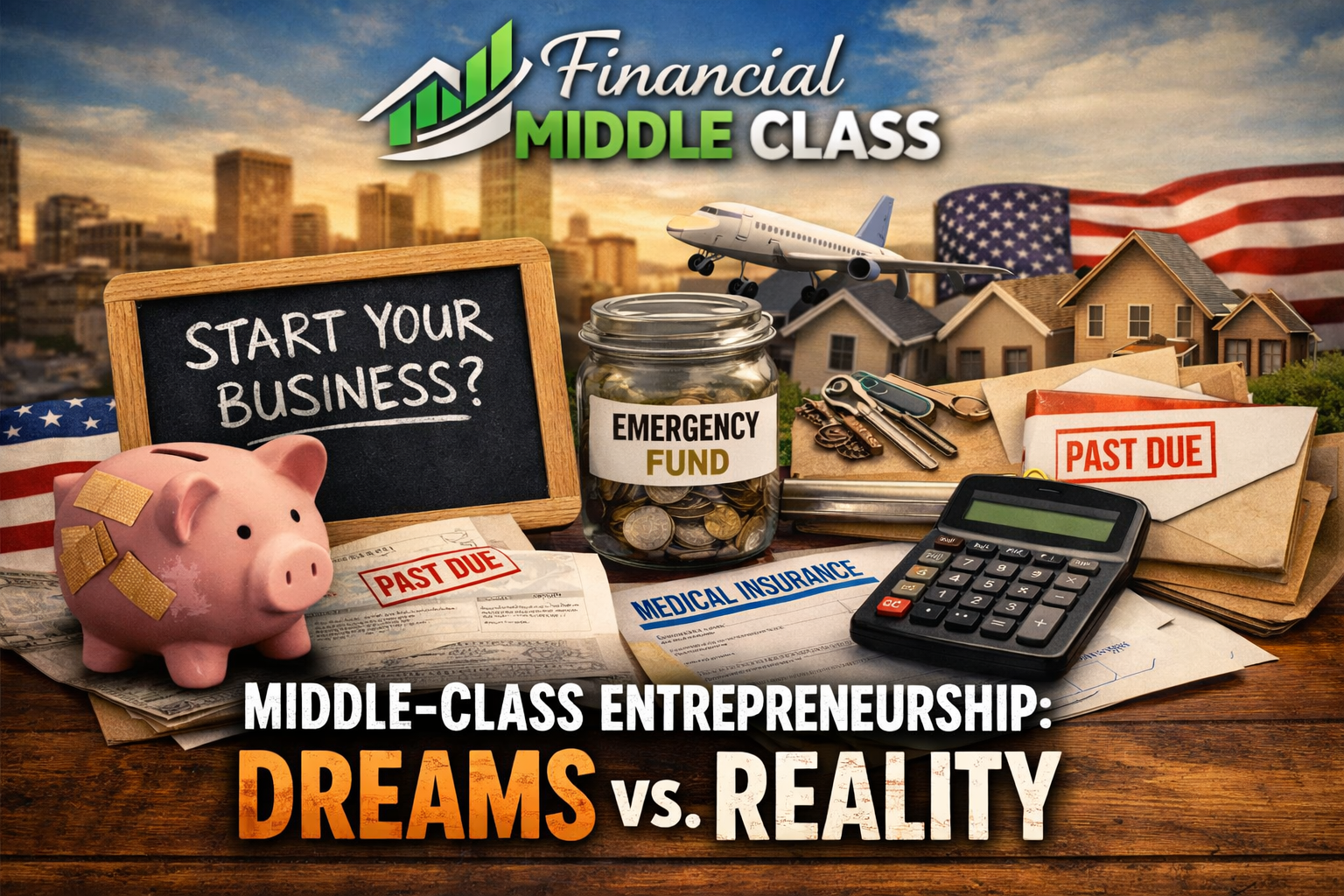
Here’s the truth the motivational crowd skips: entrepreneurship isn’t just courage. It’s capacity. And middle-class financial health decides how much capacity you have to take a swing—and how long you can stay in the fight when the first swing doesn’t land.

The Middle Class Isn’t Short on Ideas. It’s Short on Margin.
Middle-class life runs on timing. Paycheck hits. Bills hit. Something breaks. You patch it. Repeat.
And a lot of households don’t have much slack in the rope.
The Federal Reserve’s reporting on household well-being shows a hard truth: plenty of Americans can cover a small emergency, but millions can’t do it cleanly. That matters because entrepreneurship doesn’t ask you for one emergency. It asks you to survive a string of them—late payments, slow months, surprise expenses, tax bills, and “I didn’t see that coming” moments—without the household collapsing.
So when people say, “Why don’t more middle-class people start businesses?” the answer isn’t “lack of ambition.” It’s lack of margin. Margin is what lets you be wrong for a while without losing your stability.
Business Starts Are Up, But the Runway Isn’t
Yes, America is filing business applications. In November 2025, the U.S. Census Bureau reported 535,041 business applications (seasonally adjusted). That’s a lot of people trying to build something.
But “starting” on paper and “surviving” in real life are different jobs. Applications don’t automatically become businesses that pay a household, hire workers, and live through a slow season. The middle class knows this. That’s why so many launches are cautious, part-time, and built around an existing paycheck—because the bills don’t pause while you “find product-market fit.”
Debt Limits Options Before You Even Begin
Most middle-class entrepreneurs don’t start with venture capital. They start with personal credit, personal savings, and personal stress.
That means your household debt isn’t a separate issue. It’s the backdrop.
When debt is high, the cost of being wrong goes up. You can’t float a slow month. You can’t absorb an unexpected expense. You can’t take smart risks because every risk is attached to a real bill with a real due date.
Debt also changes your financing options. Lenders may look at your household obligations, your credit profile, and your cash flow and decide your business isn’t the risk—they decide you are. That’s not personal. That’s underwriting.
Runway: The Real Divider Between “Dream” and “Business”
People love the word “passion.” Passion doesn’t pay a note. Runway does.
Runway is how long your household can survive if business income is inconsistent—because early income is almost always inconsistent. Clients pay late. Sales slow down. You get sick. Your car decides it’s done cooperating.
If your runway is two weeks, every decision becomes a desperate decision. You underprice. You accept bad clients. You avoid necessary spending. You ignore taxes until taxes become a surprise punch to the ribs.
A quick runway reality check
If your business income dipped for 90 days, what breaks first?
Be honest: Does rent become a problem? Does the mortgage become a problem? Do minimum debt payments eat your margin? Are you relying on your job for benefits you can’t realistically replace?
If those questions feel heavy, that doesn’t mean you “can’t do it.” It means you need a safer strategy than the internet’s favorite line: “Just quit.”
Two comparisons the middle class actually needs
Side hustle vs. full-time leap
| Reality | Side hustle (keep your job) | Full-time leap (quit your job) |
|---|---|---|
| Income stability | Higher (paycheck covers essentials) | Lower (business must carry you fast) |
| Health insurance | Usually covered | Now your problem—monthly |
| Time | Limited (nights/weekends) | More time, but more pressure |
| Risk of one bad month | Lower | High |
| Reinvestment ability | Slower | Faster (if cash shows up) |
| Emotional cost | Burnout risk | Panic risk |
Lifestyle business vs. growth business
| Reality | Lifestyle business | Growth business |
|---|---|---|
| Goal | Stable profit, replace income, protect time | Scale revenue, hire, expand footprint |
| Capital needs | Lower | Higher |
| Hiring timeline | Later (or never) | Earlier |
| Marketing costs | Controlled | Often heavier |
| Risk level | Moderate | High |
| Year-1 “success” | Consistent cash flow | Momentum + systems (maybe not profit yet) |
Why Owners Keep Using Personal Money to Survive
At the early stage, the household and the business are roommates. Loud roommates.
When a business hits a rough patch, a lot of owners respond the way middle-class people respond to everything: they cover it themselves. Personal funds. Cash reserves. The “I’ll handle it” reflex.
This is why personal financial health matters so much. If the household is already stretched thin, the business doesn’t have a safety net. It has a tightrope.
Job Lock: Health Insurance and Benefits as Handcuffs
“Just quit” advice is usually written by someone who isn’t paying for a family plan.
In the real middle class, benefits are not a side note. They’re the foundation. Employer health insurance, disability coverage, retirement matching—those things are expensive to replace, and losing them turns “taking a leap” into a medical and financial gamble.
Researchers have called this “entrepreneurship lock”—the idea that tying affordable health insurance to employment can discourage people from starting businesses. If you’ve been building nights and weekends, and you feel behind, you’re not behind. You’re operating inside a system that charges you extra for volatility.
Funding Map: Real Options, Real Traps
If you’re middle class, the question isn’t “Can I get funding?” It’s “What funding won’t trap me?”
Microloans and smaller-dollar capital
SBA microloans can be a practical path when you don’t need a million dollars—you need enough to buy equipment, cover early inventory, or fund a small working-capital cushion. Microloans are capped at $50,000, and average much lower, which can fit real-life middle-class risk tolerance.
Community lenders and CDFI-style options
Traditional banks often want “clean and proven.” Community-based lenders sometimes understand “early and promising,” especially for entrepreneurs building in local communities.
Traps (said with love)
0% APR cards can be a tool, but they’re also a timer. If your business model needs you to carry balances, you’re building your dream on a countdown clock.
Merchant cash advances can feel like oxygen and act like a chokehold, especially with daily withdrawals that squeeze cash flow.
Friends and family money can cost more than interest. It can cost relationships.
Rule: if your plan requires perfect sales by month two to survive, that’s not a plan. That’s hope wearing business clothes.
Three Middle-Class Case Studies (Familiar on Purpose)
Case 1: Homeowner + daycare + a steady service business
Mortgage. Childcare. Car note. Real bills. They launch as a side hustle first—not because they’re scared, but because they respect the household. Their first milestone isn’t “quitting.” It’s consistent profit that reduces stress.
Case 2: Laid off with severance and a short runway
They have a few months of runway, which is enough time to be strategic but not enough time to “build a brand for six months.” They sell one clear offer to one clear audience fast. Their first win isn’t going viral. It’s getting paid twice by the same client.
Case 3: Renter with debt trying to go legit
The business isn’t the first problem—the debt is. They stop chasing scale and start chasing margin. They raise prices, tighten the service area, and pay down the highest-interest balance to free cash flow. Entrepreneurship begins when the household can finally breathe.
Why Businesses Fail (and How to Reduce the Odds)
Most middle-class businesses don’t fail because the owner lacks talent. They fail because cash flow meets fixed bills.
Underpricing. Late-paying clients. Tax surprises. Mixing household and business money. Growing too early. Those are the classic failure points, and none of them are “mindset.” They’re mechanics.
The fix isn’t perfection. It’s simple systems: separate accounts, a weekly money check-in, a tax set-aside from day one, and pricing that respects your time and your real costs.
A Realistic 30/60/90-Day Plan
First 30 days: prove demand
Pick one offer. One audience. One outcome. Sell it. Get paid. Don’t hide behind a logo and “research” when the market can answer you in a transaction.
Days 31–60: stabilize cash flow
Refine pricing. Improve delivery. Build repeat business. Create an outreach routine you can maintain without burning out. Start setting aside money for taxes the moment revenue comes in.
Days 61–90: decide like a CEO
Look at numbers without romance. Is profit becoming consistent? If yes, reinvest carefully. If not, pivot or pause without shame. Protect the household while you iterate.
FAQ: the questions middle-class entrepreneurs actually ask
When is it safe to quit my job?
When the business covers essentials and you still have runway for surprises. If quitting wipes out your buffer, that’s not freedom—it’s exposure.
Do I need an LLC right away?
Not always. But you do need clean separation of money and a plan for taxes and liability. The goal is clarity, not paperwork flexing.
What is “runway” in plain English?
Runway is how long you can cover household bills if business income is inconsistent. It’s the breathing room that keeps you from making desperate decisions.
What’s the difference between profit and cash flow?
Profit is what’s left on paper. Cash flow is whether money is in your account when bills hit. Businesses die from cash-flow problems long before they “look unprofitable.”
I’m debt-heavy. Should I start anyway?
You can start small, but be honest: high-interest debt shrinks your options and raises the cost of being wrong. Build in a safer lane: tighter offer, faster payment terms, and a plan to reduce the most expensive debt first.
Glossary (Quick Hits)
Runway: How long you can cover household expenses if business income is uneven.
Burn rate: How fast cash leaves your account each month.
Break-even: The point where revenue covers your essential costs.
Cash flow: Timing—money arriving before bills are due.
Margin: What’s left after costs; the space that keeps you stable.
The Truth That Hits Home
The middle class doesn’t lack hustle. You’ve been hustling.
What entrepreneurship actually requires is margin—the breathing room to be wrong for a while without your life falling apart.
That’s why this conversation matters: in America, entrepreneurship isn’t just about having a good idea. It’s about having enough financial oxygen to survive the messy middle between “starting” and “stable.”
If that sentence made you pause, it’s because you’ve lived it. Not as a theory. As a monthly reality.
Data references used in this post
If you want to verify the numbers and context, start here:
Federal Reserve (Economic Well-Being / $400 emergency expense):
Report page
and
$400 expense data viz.
U.S. Census Bureau (Business Formation Statistics, Nov 2025):
Press release.
New York Fed (Household Debt & Credit, Q3 2025):
News summary.
Small Business Credit Survey (Employer firms report):
Report hub.
What’s the one bill—or benefit—you’d need covered before you’d feel comfortable taking the leap?
Drop it in the comments. Real numbers and real life only—your answer will help somebody else plan smarter.