
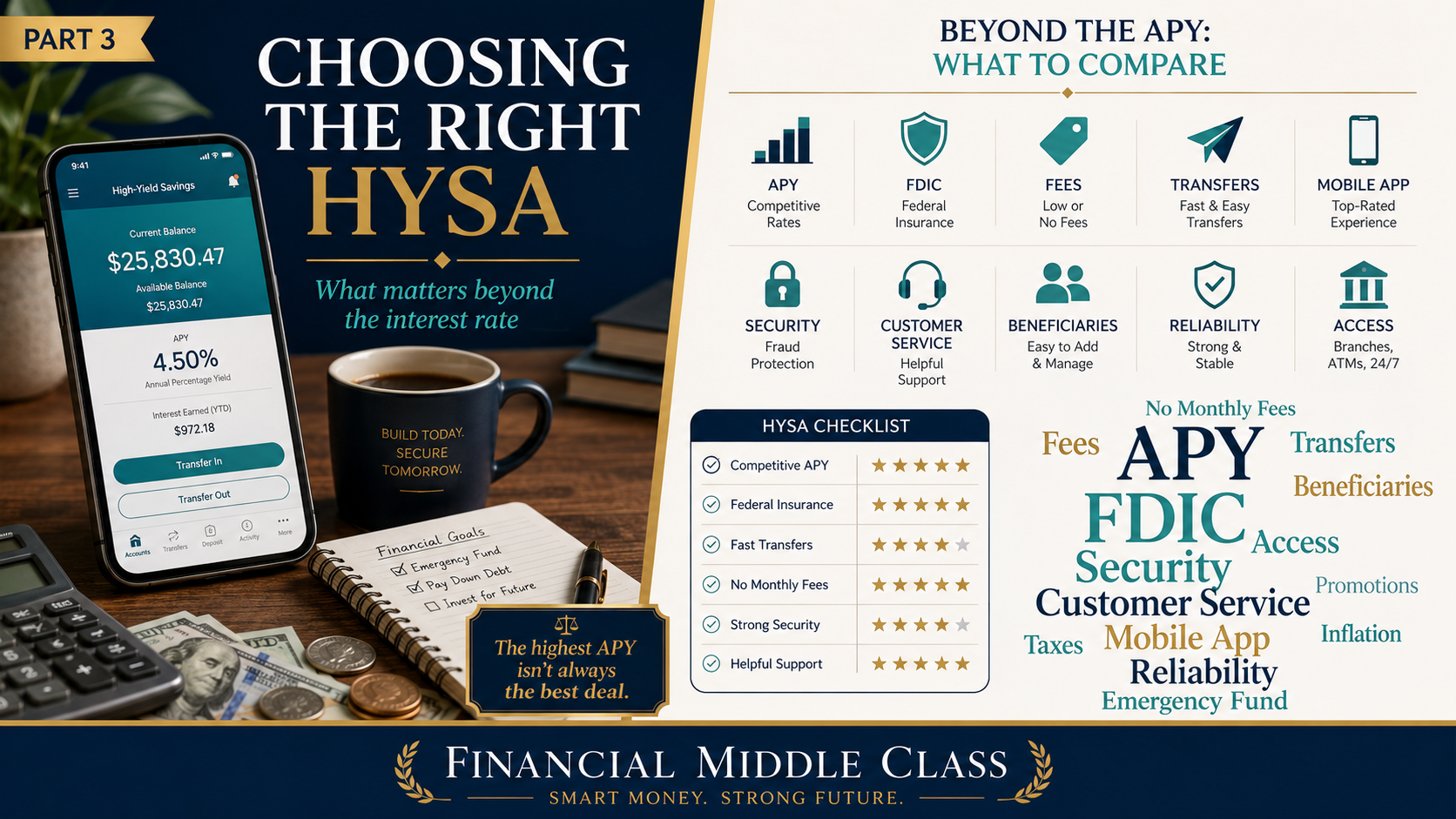
Best HYSA: How to Choose Beyond the Highest APY
By Article Posted by Staff Contributor
The estimated reading time for this post is 1133 seconds
Best HYSA: How to Choose Beyond the Highest APY
Part 3 of the Financial Middle Class High-Yield Savings Guide
Rates and account terms reviewed August 1, 2026. Savings rates are variable and can change at any time. Promotional terms, fees, balance requirements, and product availability may also change. Verify all information directly with the institution before opening an account.
Financial Middle Class Principle
Do not shop for a high-yield savings account the way you shop for gasoline.
Gasoline is largely interchangeable. Banking relationships are not.
The goal is not simply to find the highest number displayed on a comparison website this morning. The goal is to find an account that pays a competitive return, protects your deposits properly, gives you access to your money when you need it, and does not create unnecessary frustration.
That is what makes the best HYSA different from merely the highest-paying HYSA.
Suppose one account pays 4.15% APY and another pays 3.90%.
On a $25,000 balance, the difference is approximately $62.50 over one year before taxes, assuming the rates remain unchanged and no money is added or withdrawn.
That difference is real. It should not be ignored.
But it must be considered alongside:
- Transfer speed
- Monthly fees
- Balance requirements
- Promotional conditions
- Fraud controls
- Customer service
- Mobile and online access
- Beneficiary options
- Federal deposit insurance
On a $250,000 balance, the same 0.25-percentage-point difference would be approximately $625 before taxes. The larger the balance, the more important small rate differences become.
The correct approach is not to dismiss APY or worship it.
It is to calculate what the difference is worth and decide what you would be giving up to receive it.
Key Takeaways
- The best HYSA is not necessarily the account with the highest advertised APY.
- Standard rates, promotional rates, and conditional rates are not the same.
- A small APY difference may produce little additional income on a modest balance but considerably more on a large balance.
- FDIC or NCUA insurance should be verified before money is deposited.
- Transfer speed matters when the account holds emergency savings.
- Fees, balance tiers, qualification rules, and rate caps can reduce the value of an advertised offer.
- A test transfer can reveal access problems before an emergency occurs.
What APY Tells You—and What It Does Not
APY stands for annual percentage yield.
It represents the total amount of interest an account would earn over one year based on the interest rate and the effect of compounding, assuming the principal and interest remain in the account. The CFPB requires financial institutions to disclose APY so consumers can compare deposit products more consistently.
APY is important, but it does not tell you:
- Whether the rate is temporary
- Whether only part of your balance qualifies
- Whether direct deposit is required
- Whether you must open a checking account
- Whether the account charges fees
- How quickly money can be transferred
- Whether the institution offers useful customer support
- Whether the account is held directly at an insured bank
- Whether your total deposits remain within insurance limits
What is a rate difference actually worth?
The following estimates assume a constant balance for one year and illustrate the approximate difference in annual earnings before taxes.
| APY difference | On $10,000 | On $25,000 | On $100,000 | On $250,000 |
|---|---|---|---|---|
| 0.10 percentage point | $10 | $25 | $100 | $250 |
| 0.25 percentage point | $25 | $62.50 | $250 | $625 |
| 0.50 percentage point | $50 | $125 | $500 | $1,250 |
| 1.00 percentage point | $100 | $250 | $1,000 | $2,500 |
This table explains why two people can reasonably reach different conclusions about the same accounts.
A person with $5,000 may prefer a lower rate from an institution that provides faster access and better tools. A person holding $200,000 may decide that a meaningful rate difference justifies maintaining another banking relationship.
The balance determines the dollars at stake.
Nine Factors That Determine the Best HYSA
1. Federal deposit insurance
Federal insurance is not an optional feature.
Deposits held at an FDIC-insured bank are generally insured up to $250,000 per depositor, per insured bank, for each account ownership category. Federally insured credit unions provide comparable protection through the National Credit Union Share Insurance Fund.
That wording matters.
The limit is not necessarily $250,000 for each account you open. Multiple accounts held in the same ownership category at the same bank are generally combined when coverage is calculated.
For example, suppose you hold the following at one bank under your name alone:
- $150,000 in a high-yield savings account
- $75,000 in a CD
- $50,000 in another individual savings account
The combined balance in that ownership category is $275,000. Unless another rule or ownership category applies, $25,000 may exceed the standard insurance limit.
Use the FDIC’s Electronic Deposit Insurance Estimator or the NCUA’s share-insurance resources when your balance approaches the applicable limits.
Be careful with nonbank financial apps
A financial-technology platform may look and operate like a bank without being a bank itself.
The FDIC warns that nonbank companies are never themselves FDIC-insured. When a nonbank says customer funds are eligible for pass-through insurance through partner banks, coverage can depend on where the funds are held and whether applicable recordkeeping and ownership requirements have been satisfied.
Before depositing money through an app or financial platform, identify:
- The legal name of the insured bank
- When your money is deposited at that bank
- Whether the account records identify you as the beneficial owner
- Whether your other deposits at the partner bank affect your coverage
- What happens if the nonbank company—not the partner bank—fails
A familiar app interface is not a substitute for understanding where the money is legally held.
2. A competitive standard APY
The APY should be competitive with other nationally available accounts serving similar customers.
But identify exactly which rate you are comparing.
An account may display:
- A standard rate
- A new-customer rate
- An introductory rate
- A relationship rate
- A direct-deposit rate
- A balance-tier rate
- A temporary promotional boost
- An “up to” rate that applies only under specific conditions
The highest number on the page may not be the rate you will actually receive.
Ask:
- What is the standard APY?
- How long does the advertised rate last?
- Does it apply to my entire balance?
- What activity is required?
- What rate applies when the promotion ends?
- Can the bank change the rate at any time?
Most HYSA rates are variable. Even a nonpromotional rate is not permanent.
3. Balance requirements and rate caps
Some accounts require a minimum balance to earn the advertised APY.
Others apply the highest APY only to a limited portion of the balance.
Consider three possible structures:
Whole-balance tier: Your entire balance receives the rate associated with your balance level.
Portion-based tier: Different portions of the balance receive different rates.
Balance cap: The highest APY applies only up to a stated amount, and money above the cap receives a lower rate or no interest.
These structures can produce very different earnings.
A 4.50% headline rate on the first $5,000 may be less valuable to someone depositing $40,000 than a 3.95% rate applied to the entire balance.
4. No unnecessary monthly fees
A savings account should not quietly consume the interest it pays.
Look for:
- Monthly maintenance fees
- Paper-statement fees
- Excess-transaction fees
- Outgoing wire fees
- Account-closing fees
- Returned-deposit fees
- Dormancy or inactivity fees
- Fees for expedited transfers or official checks
A $5 monthly fee equals $60 annually.
On a $1,000 balance, a $60 annual fee would consume a substantial portion of the interest generated even by a competitive APY.
The correct question is not merely whether the account advertises “no monthly fee.” Review the complete fee schedule.
5. Transfer speed and reliable access
Liquidity is not just the legal right to withdraw money.
It is the practical ability to get the money where it needs to go in time.
An online savings account may require an electronic transfer to an outside checking account before the money can be spent. Transfer timing can depend on:
- The direction in which the transfer is initiated
- The receiving bank
- Weekends and federal holidays
- New-account holding periods
- Deposit type
- Fraud reviews
- Daily or monthly transfer limits
- Whether instant-transfer options are available
For an emergency fund, this matters.
A high APY provides little comfort if your mortgage, insurance deductible, or repair bill is due before you can access the money.
Conduct a test transfer
After opening the account:
- Transfer a modest amount into it.
- Wait until the deposit is fully available.
- Transfer part of the money back to your primary checking account.
- Record how long each step takes.
- Confirm any daily and monthly transfer limits.
- Save the bank’s customer-service number outside the app.
Do this before moving the entire emergency fund.
6. Useful security and fraud controls
No online system is risk-free, but a strong bank should provide practical tools for controlling account access.
Look for:
- Multifactor authentication
- Biometric login
- Transaction alerts
- New-device alerts
- Password and contact-information change alerts
- The ability to lock or restrict certain access
- Clear procedures for reporting unauthorized activity
- Secure messaging
- Account-recovery procedures
- A visible security and privacy center
Federal deposit insurance protects eligible deposits when an insured institution fails. It should not be confused with a guarantee against every form of fraud, identity theft, account takeover, fee, or customer error.
Account security therefore deserves separate consideration.
7. Customer service that works under pressure
Most savers will rarely contact customer service.
That is precisely why poor service can remain invisible until something goes wrong.
Before depositing a large balance, test the support system:
- Is telephone support available during the hours you may need it?
- Can you reach a person?
- Does the bank offer secure chat or messaging?
- Is support available on weekends?
- Are fraud and account-access problems handled by a specialized department?
- Can representatives clearly explain transfer holds and insurance coverage?
Do not rely solely on one app-store rating or one angry online review. Look for patterns across multiple sources and test the service yourself.
8. Beneficiaries and account ownership
A beneficiary is the person designated to receive the account after the owner dies.
Banks may describe this as:
- Payable on death
- POD
- Transfer on death
- Informal revocable trust
- Beneficiary designation
A beneficiary designation can affect estate administration and deposit-insurance treatment. Rules depend on how the account is titled, the number of owners, the number of eligible beneficiaries, and whether the institution’s records satisfy the applicable requirements.
Ask:
- Can beneficiaries be added online?
- Is a paper form required?
- Can multiple beneficiaries be named?
- Can percentages be assigned?
- Does the bank permit joint ownership?
- How does the ownership structure affect federal insurance?
Do not assume that listing a beneficiary automatically solves every estate or insurance issue. Large or complex accounts may warrant advice from an estate-planning or legal professional.
9. The broader banking relationship
Some people want a savings account and nothing more.
Others value:
- Checking and savings integration
- Immediate transfers between accounts at the same bank
- ATM access
- Cash deposits
- Physical branches
- Credit cards
- Investing
- Budgeting tools
- Savings buckets
- Joint accounts
- Business accounts
A stand-alone online savings account may pay more. A full-service institution may reduce administrative friction.
Neither model is automatically better.
The decision depends on whether the added convenience is worth any difference in yield.
Selected High-Yield Savings Accounts to Compare
The following table is a market snapshot as of August 1, 2026, not a permanent ranking or exhaustive list.
Rates can change without notice. Some are promotional, conditional, or limited to new customers. Verify the live APY and complete account disclosure before opening an account.
| Institution and account | Advertised APY | Important conditions | Possible reason to consider it | Important limitation |
|---|---|---|---|---|
| Axos ONE Savings | Up to 4.21% | Requires an Axos ONE checking account and qualifying monthly deposit and balance activity | High conditional rate with checking integration | Standard rate can be substantially lower when conditions are not met |
| Forbright Growth Savings | Up to 4.15% | Advertised rate includes a 0.30-point boost for most new customers; stated standard APY is 3.85% | Strong introductory yield without a minimum opening deposit | Highest rate depends on new-customer boost |
| Bread Savings HYSA | 3.95% | $100 minimum opening deposit | Straightforward, rate-focused savings | Limited broader banking ecosystem |
| EverBank Performance Savings | 3.90% | Advertised APY is for new accounts and may not apply to existing accounts | Competitive rate without a monthly account fee | New-account treatment should be confirmed |
| Axos Summit Savings | 3.75% | No stated minimum balance or monthly maintenance fee | Simpler alternative to a conditional bundled rate | Lower than Axos ONE’s conditional maximum |
| SoFi Checking and Savings | Up to 3.80% promotional APY | New-member promotion requiring eligible direct deposit or qualifying deposits; boost lasts up to six months | Integrated checking, savings, and broader financial platform | Complex qualification and promotional terms |
| Ally Savings | 3.40% | Variable rate; transaction policy applies | Savings buckets and integrated online banking | APY trails several rate-focused competitors |
| Marcus Online Savings | 3.40% | Variable rate; maximum balance limits apply | Simple savings product and 24/7 support | No checking account integration |
| Capital One 360 Performance Savings | 3.00% | Variable rate; no minimum balance or monthly cycle service charge | Digital banking plus limited physical locations | Lower APY than several online competitors |
Axos ONE currently advertises up to 4.21% APY on qualifying balances, but customers must satisfy checking-account deposit and balance requirements to unlock the boosted rate. Its standard rate is much lower when those conditions are not met.
Forbright currently advertises up to 4.15%, including a 0.30-point new-customer boost over its stated 3.85% standard APY.
Bread Savings advertises 3.95% APY with a $100 minimum opening deposit, while EverBank lists 3.90% for new Performance Savings accounts.
SoFi’s boosted APY requires qualifying activity and applies for a limited period. The standard rate and separate SoFi Plus terms must be reviewed independently.
Ally and Marcus list 3.40% savings APYs, while Capital One lists 3.00%. Ally emphasizes savings buckets, Marcus advertises daily compounding and 24/7 support, and Capital One charges no monthly cycle service fee or minimum balance on 360 Performance Savings.
What does this comparison really show?
The table does not reveal one account that is objectively best for everyone.
It reveals several different offers:
- A high rate tied to checking-account behavior
- A temporary new-customer boost
- A straightforward rate-focused account
- An integrated banking platform
- A lower-rate account with useful organizational tools
- A hybrid online and branch experience
The best HYSA depends on which tradeoff fits your life.
When Is Switching for a Higher APY Worth It?
Switching may make sense when:
- The dollar difference is meaningful
- The new rate applies to your full balance
- The new rate is not about to expire
- Qualification requirements fit your normal behavior
- The new account has no offsetting fees
- Your deposits will remain properly insured
- Access and transfer policies meet your needs
- You are comfortable managing another institution
Switching may not be worthwhile when:
- The difference amounts to only a few dollars
- The advertised rate is temporary
- The higher APY applies only to a small balance
- You must redirect payroll or manufacture transactions
- The bank’s transfer system is poorly suited to an emergency fund
- You will forget to monitor changing requirements
- The move creates insurance or recordkeeping complications
Use a switching threshold
Decide how much additional annual interest would make the effort worthwhile to you.
For example, you may decide that you would switch institutions for:
- An additional $25 a year
- An additional $100 a year
- An additional $500 a year
- A substantially better banking experience, even without additional interest
There is no universal threshold.
The important point is to make the decision using actual dollars rather than reacting emotionally to small percentage differences.
Beware of Promotional and Conditional Rates
Promotional offers are not inherently bad.
They become problematic when consumers misunderstand them.
Watch for language such as:
- “Up to”
- “For a limited time”
- “New customers only”
- “On qualifying balances”
- “With eligible direct deposit”
- “When combined with checking”
- “On balances up to”
- “For the first six months”
- “When you maintain qualifying deposits”
A 4.50% APY may sound superior to a 3.90% APY.
But the 4.50% rate could:
- Apply only to the first $5,000
- Require a paid membership
- Require direct deposit
- Require thousands of dollars in recurring monthly deposits
- Expire after several months
- Revert to a much lower rate
- Apply to only one savings account
- Be unavailable to existing customers
The word up to is not decoration.
It is a signal to read the conditions.
Standard does not mean permanent
A nonpromotional rate may be simpler and more durable than an introductory offer, but it is still usually variable.
The bank can raise or lower it after the account is opened.
Compare the standard rate, the promotional rate, the expiration date, and the post-promotion rate separately.
Ten Questions to Ask Before Opening an HYSA
- Is the account held directly at an FDIC-insured bank or federally insured credit union?
- Will my total deposits remain within the applicable insurance limits?
- Does the advertised APY apply to my entire balance?
- Is the rate standard, promotional, tiered, or conditional?
- What must I do to receive and retain the advertised APY?
- Does the account charge monthly or transaction-related fees?
- How long will an external transfer normally take?
- What security alerts and account-control tools are available?
- Can I add joint owners and beneficiaries easily?
- What happens to the APY when a promotion or qualifying period ends?
Do not open the account until you can answer all ten.
Seven Common HYSA Mistakes
Mistake 1: Chasing every small rate increase
Moving money repeatedly for an additional 0.05 or 0.10 percentage point may create more work than value.
Calculate the additional annual earnings first.
Mistake 2: Ignoring the size of the balance
The opposite mistake is assuming that every small rate difference is meaningless.
A modest percentage difference can become substantial when the balance is large.
Calculate the dollar amount rather than relying on instinct.
Mistake 3: Leaving money uninsured
Opening multiple accounts at the same bank does not necessarily increase coverage.
Insurance depends on the depositor, insured institution, ownership category, and account structure—not merely the number of account numbers.
Mistake 4: Assuming every financial app is an insured bank
A nonbank company may partner with insured banks without being insured itself.
Identify the bank holding the deposit and understand when pass-through insurance applies.
Mistake 5: Forgetting taxes
Interest from a high-yield savings account is generally taxable as ordinary income.
A bank generally files Form 1099-INT when reportable interest reaches the applicable reporting threshold, but taxpayers must report taxable interest even when they do not receive the form.
Mistake 6: Ignoring inflation
Federal insurance can protect eligible principal against bank failure.
It does not guarantee that your savings will maintain its purchasing power.
If inflation exceeds the account’s after-tax return, the money can lose purchasing power even while the numerical balance increases.
This is why emergency savings and long-term investments serve different purposes.
Mistake 7: Confusing saving with investing
Saving is primarily about:
- Stability
- Liquidity
- Near-term access
- Principal protection
Investing is primarily about:
- Long-term growth
- Accepting market risk
- Outpacing inflation over time
- Building wealth
They are not rivals.
A sound financial plan usually needs both.
What Happens If Your Bank Fails?
When an FDIC-insured bank fails, the FDIC generally resolves insured deposits in one of two ways:
- Another insured institution assumes the deposits.
- The FDIC pays the depositor directly up to the insured amount.
Historically, the FDIC has usually made insured deposits available within a few days, often by the next business day. When another institution assumes the deposits, customers typically receive access through the acquiring bank.
That protection applies only within the relevant insurance rules.
Balances above the insured amount may not be immediately available and may not be recovered in full.
Federal insurance does not cover everything
FDIC insurance does not cover:
- Stocks
- Bonds
- Mutual funds
- Crypto assets
- Annuities
- Life-insurance products
- Losses caused merely by declining interest rates
- The failure of a nonbank company itself
- Every form of fraud or account dispute
Confirm that the product is a deposit account held at an insured institution.
Frequently Asked Questions
What is the best HYSA right now?
There is no single best HYSA for every saver.
The best account is one that combines a competitive APY with federal insurance, low fees, reasonable access, manageable qualification requirements, and service that fits how you bank.
Rates change frequently, so current offers should be verified on the institution’s official website.
How much lower should an APY be before I choose another bank?
There is no universal cutoff.
Multiply the APY difference by your approximate balance to estimate the annual dollar difference. Then compare that amount with the value of better access, fewer requirements, stronger tools, or simpler account management.
Are online high-yield savings accounts safe?
They can be safe when the account is held at an FDIC-insured bank or federally insured credit union and the deposit remains within applicable insurance limits.
Verify the legal institution holding the money rather than relying only on the app’s branding.
Can a bank lower my HYSA interest rate?
Yes.
Most high-yield savings accounts have variable rates. The institution can generally change the interest rate and APY after the account is opened, subject to the account agreement and applicable disclosure rules.
How often is HYSA interest paid?
Policies differ by institution.
Many banks calculate or compound interest daily and credit it to the account monthly. Review the account disclosure to determine the balance-calculation method, compounding frequency, and crediting schedule.
Should I keep my emergency fund at a different bank?
Keeping the emergency fund separate from everyday spending may reduce the temptation to use it.
However, a separate institution can add transfer time. Test access before depending on the account and consider keeping a modest immediate-access buffer at your primary bank.
Should I have more than one HYSA?
Multiple accounts can help separate:
- Emergency savings
- Home savings
- Taxes
- Travel
- Insurance deductibles
- Repairs
- Other sinking funds
One account with savings buckets may accomplish the same purpose with less administration.
The better system is the one you can maintain consistently.
Financial Middle Class Bottom Line
The best HYSA should not be selected by interest rate alone.
APY matters.
But so do:
- The amount of money involved
- The conditions attached to the rate
- The speed of access
- The quality of the digital experience
- The fee schedule
- The ownership structure
- The institution holding the deposit
- The adequacy of federal insurance
Do not ignore an extra $62.50.
But do not sacrifice reliable access, proper insurance, or a workable banking relationship merely to earn it.
The right account is not necessarily the one paying the highest APY this morning.
It is the account whose return, access, safeguards, requirements, and service remain aligned with the job your money is supposed to do.
Financial Middle Class Action Step
Review your current savings account and write down:
- Its present APY
- Your approximate annual interest
- Every applicable fee
- How long an external transfer takes
- Whether the balance is fully insured
- Whether the rate has special conditions
- The dollar amount you could gain by switching
Then make the decision based on the complete picture—not the headline number.
Continue to Part 4
The final installment of the Financial Middle Class High-Yield Savings Guide will bring the strategy together with:
- The Financial Middle Class Cash Allocation Blueprint
- Step-by-step instructions for opening and funding an HYSA
- Sample cash allocations for different life stages
- A decision framework for choosing among HYSAs, CDs, Treasury bills, and investments
- Final guidance for conservative savers


RELATED ARTICLES
Cash Strategy: Put Every Dollar in the Right Place
Your checking account, emergency fund, short-term savings, and investments should not be managed the same way. This cash strategy helps assign every dollar to the right financial job.
High-Yield Savings vs. CDs, Treasury Bills, and Other Safe Places for Cash
High-yield savings accounts are excellent for accessible cash, but they are not always the best choice. Compare HYSAs, CDs, Treasury bills, money market accounts, and I bonds.
Leave Comment
Cancel reply
Gig Economy
Business / Aug 08, 2026
The Missing Middle in Black Entrepreneurship
Black entrepreneurship has expanded dramatically. The next challenge is helping more Black-owned businesses move from self-employment to employer firms and sustainable scale.
By FMC Editorial Team
Personal Finance / Aug 01, 2026
Cash Strategy: Put Every Dollar in the Right Place
Your checking account, emergency fund, short-term savings, and investments should not be managed the same way. This cash strategy helps assign every dollar to the right...
By Article Posted by Staff Contributor
Personal Finance / Aug 01, 2026
Best HYSA: How to Choose Beyond the Highest APY
A competitive interest rate matters, but it is only one part of choosing a high-yield savings account. Compare insurance, fees, access, transfer speed, and promotional conditions.
By Article Posted by Staff Contributor
Personal Finance / Aug 01, 2026
High-Yield Savings vs. CDs, Treasury Bills, and Other Safe Places for Cash
High-yield savings accounts are excellent for accessible cash, but they are not always the best choice. Compare HYSAs, CDs, Treasury bills, money market accounts, and I...
By Article Posted by Staff Contributor
American Middle Class / Aug 01, 2026
High-Yield Savings Accounts: A Safer Home for Your Cash
A high-yield savings account can pay several times the national savings rate while keeping qualified deposits federally insured. Here is how it works, what to watch...
By Article Posted by Staff Contributor
Real Estate / Jul 30, 2026
Mortgage Lock-In Is Freezing the Housing Market
Millions are trapped by 3% mortgages. Learn how mortgage lock-in worsens affordability—and why homeowners are renovating instead.
By FMC Editorial Team
Real Estate / Jul 26, 2026
Is South Florida More Expensive Than New York? The Complete 2026 Relocation Guide
Is South Florida more expensive than New York? Compare housing, taxes, insurance and 104 municipalities before you move.
By Article Posted by Staff Contributor
Personal Finance / Jul 25, 2026
The Time Value of Life Experiences: What Compound Interest Leaves Out,
Money compounds, but life experiences do too. Explore what compound interest leaves out—and how to balance saving with living.
By MacKenzy Pierre
American Middle Class / Feb 18, 2026
How Wealth Is Passed Across Generations in the United States: Mechanisms, Evidence, and the Policy Debate
How wealth passes between generations—trusts, taxes, and the debate. Get the facts, figures, and tradeoffs. Read now.
By FMC Editorial Team
American Middle Class / Feb 16, 2026
The S&P 7,000: How Wall Street Disconnects from Main Street
S&P 7,000 can rise while wages, benefits, and towns fall behind. See why the market isn’t the economy—read now.
By MacKenzy Pierre
Latest Reviews
Business / Aug 08, 2026
The Missing Middle in Black Entrepreneurship
Black entrepreneurship has expanded dramatically. The next challenge is helping more Black-owned businesses move from...
Personal Finance / Aug 01, 2026
Cash Strategy: Put Every Dollar in the Right Place
Your checking account, emergency fund, short-term savings, and investments should not be managed the same...
Personal Finance / Aug 01, 2026
Best HYSA: How to Choose Beyond the Highest APY
A competitive interest rate matters, but it is only one part of choosing a high-yield...