
Why Paying Off Debt Can Lower Your Credit Score—and Why That Isn’t Always Bad
By Article Posted by Staff Contributor
The estimated reading time for this post is 1275 seconds
Why Paying Off Debt Can Lower Your Credit Score—and Why That Isn’t Always Bad
An account with a zero balance can help your credit score, hurt it, or make almost no difference. The answer depends on the type of account, whether it remains open, and how credit-scoring models interpret your financial behavior.
Imagine making the final payment on your car loan after five years. You have never missed a payment, and the $500 that once disappeared from your checking account every month is finally yours to keep.
You expect your credit score to improve. After all, you have eliminated a debt, reduced your monthly obligations, and demonstrated that you can repay a substantial loan.
Instead, a few weeks later, your credit score drops.
You haven’t missed a payment, applied for new credit, or accumulated additional debt. Yet the system that measures your creditworthiness appears to have penalized you for doing exactly what responsible borrowers are encouraged to do.
The experience can be frustrating, particularly for people who have spent years trying to get out of debt.
But there is an explanation, and it reveals something important about the American credit-scoring system.
A credit score is not a measurement of your financial health. It is an estimate of your likelihood of repaying borrowed money as agreed.
Those two things often overlap, but they are not interchangeable.
A household with no car payments, a paid-off mortgage, and substantial savings may be financially stronger than a household managing several outstanding loans. Yet the second household could have a higher credit score.
That doesn’t necessarily mean the scoring system is malfunctioning. It means the system is answering a different question.
And nowhere is that distinction more apparent than in how credit scores treat accounts with zero balances.
Why Paying Off Debt Can Hurt Your Credit Score
Paying off debt does not automatically lower your credit score. In many circumstances, reducing balances helps.
The outcome depends largely on whether you are paying off a revolving account, such as a credit card, or an installment loan, such as an auto loan or mortgage.
It also matters whether the account remains open after the balance reaches zero.
Consider four situations that may appear nearly identical to someone reviewing their debts.
| Account situation | Typical scoring implications | What changes financially |
|---|---|---|
| Open credit card with a $0 balance | Generally favorable; preserves available credit | No outstanding card balance |
| Closed credit card with a $0 balance | Could lower scores if remaining utilization rises | Account can no longer be used |
| Open installment loan showing $0 | Usually a temporary reporting situation before closure | Loan has been repaid |
| Paid-off, closed installment loan | May reduce scores, especially if it was the only active installment loan | Monthly obligation is eliminated |
The distinction is more than technical.
With revolving credit, keeping an account open can help preserve available credit. With installment credit, paying off the account generally ends the loan relationship, and that closure can change the way some scoring models evaluate your credit profile.
The financial benefit of eliminating debt, however, remains real regardless of the scoring outcome.
What Credit Scores Actually Measure
Americans often treat credit scores as financial report cards.
A high score suggests responsibility. A lower score can feel like evidence of financial trouble. Consumers monitor their scores through banking applications, credit bureaus, and financial websites, sometimes reacting to changes of only a few points.
But credit-scoring companies generally do not measure your savings, retirement assets, disposable income, or household net worth.
Instead, they analyze information in your credit reports to estimate repayment risk.
FICO identifies five major categories in its general scoring framework.
| FICO scoring factor | General weighting | What it measures |
|---|---|---|
| Payment history | 35% | Whether obligations were paid as agreed |
| Amounts owed | 30% | Debt balances, credit utilization, and related measures |
| Length of credit history | 15% | Experience managing credit over time |
| New credit | 10% | Recently opened accounts and credit applications |
| Credit mix | 10% | Experience with different account types |
These percentages are general guidelines, not fixed weights that apply identically to every borrower or every FICO model.
The important distinction is that a credit score measures patterns associated with repayment risk.
A person can have substantial assets and no active installment loans. Another person can have little savings but an excellent record of managing several active credit accounts.
The second person might receive a higher score, even if the first has greater financial security.
Understanding that difference helps explain why eliminating debt does not always produce the scoring outcome consumers expect.
Revolving Credit vs. Installment Credit: Why the Difference Matters
Revolving and installment accounts operate differently, and credit-scoring models recognize those differences.
A credit card provides a reusable borrowing limit. You can charge purchases, repay the balance, and generally borrow again as long as the account remains open and in good standing.
An installment loan usually begins with a specified amount borrowed and a repayment schedule. The balance declines as principal is repaid, and the account normally closes once the debt is satisfied.
| Feature | Revolving credit | Installment credit |
|---|---|---|
| Examples | Credit cards, personal lines of credit | Auto loans, mortgages, student loans |
| Borrowing arrangement | Reusable credit line | Scheduled repayment of a loan |
| Important scoring measure | Balance compared with available credit | Balance compared with original loan amount |
| Can remain open at $0? | Generally yes | Usually closes after payoff |
| Main closure concern | Reduced available credit | Loss of an active installment account |
| Is interest necessary for a strong score? | No | No |
A zero-balance credit card can remain useful to your credit profile for years.
A paid-off auto loan generally cannot remain active indefinitely merely because keeping it open might benefit your score.
That difference explains much of the confusion surrounding zero-balance accounts.
Why an Open Credit Card With a Zero Balance Can Help Your Score
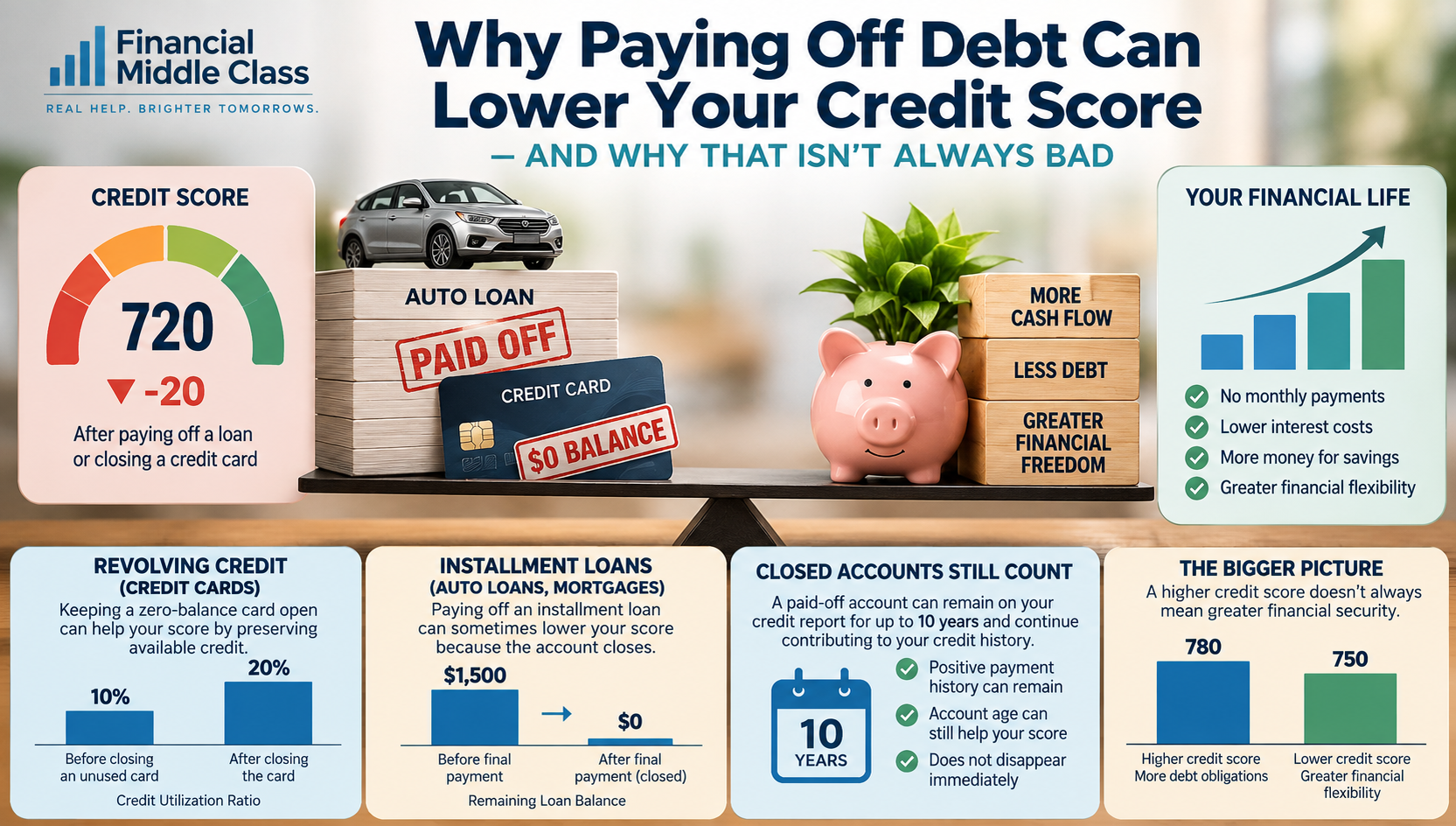
Consider a household with three credit cards and a combined credit limit of $20,000.
The household uses one card regularly and maintains zero balances on the other two.
| Credit card | Credit limit | Reported balance | Utilization |
|---|---|---|---|
| Card A | $10,000 | $0 | 0% |
| Card B | $5,000 | $0 | 0% |
| Card C | $5,000 | $2,000 | 40% |
| Total | $20,000 | $2,000 | 10% |
The household’s overall revolving credit utilization is 10%.
Credit utilization measures the proportion of available revolving credit currently being used.
In this example, the household owes $2,000 against $20,000 in available credit.
Now suppose the household closes Card A because it has not been used in several months.
Card A has no balance. Closing it does not create new debt, increase the household’s monthly payments, or change the amount owed on the remaining cards.
Nevertheless, the household’s overall utilization changes.
| Financial measure | Before closing Card A | After closing Card A |
|---|---|---|
| Reported credit card debt | $2,000 | $2,000 |
| Total available credit limits | $20,000 | $10,000 |
| Overall utilization | 10% | 20% |
| New debt incurred | $0 | $0 |
| Potential credit-score effect | Baseline | May decline |
The household’s utilization doubles, even though its debt has not increased.
That is why closing a zero-balance credit card can lower a credit score.
FICO considers revolving utilization an important indicator of credit risk, and the Consumer Financial Protection Bureau warns that closing an account can increase utilization and potentially reduce a score.
But closure does not always produce a decline.
If every revolving account reports zero, removing an unused credit limit does not by itself create a positive utilization ratio. Other factors may still matter, but the utilization effect in that situation is different.
The lesson is not that every credit card should remain open forever. It is that an unused credit limit can have value even when you owe nothing on the account.
The All-Zero Credit Card Paradox
There is another surprising feature of revolving credit scoring.
Having every credit card report a zero balance is not necessarily the arrangement that produces the highest possible FICO score.
FICO has explained that consumers with no reported revolving balances may present slightly greater statistical repayment risk than consumers with low reported revolving utilization.
That means a consumer whose credit cards all report zero might receive a slightly lower FICO score than an otherwise comparable consumer with one card reporting a small balance.
This does not mean the consumer should carry debt from month to month.
It means the distinction between a reported balance and an interest-bearing balance matters.
Suppose you purchase $100 in groceries using a credit card with a $5,000 limit.
Your billing statement closes with a $100 balance. That amount is reported to the credit bureaus.
You then pay the entire $100 by the payment due date.
If your account has an applicable purchase grace period and you meet its requirements, you generally avoid interest on that purchase.
Your credit report can show a small balance even though you have paid your statement in full.
| Credit card reporting situation | Reported utilization | Possible scoring implication |
|---|---|---|
| All cards report $0 | 0% | Some FICO models may apply a small all-zero disadvantage |
| One card reports $100 against $20,000 in total limits | 0.5% | Low utilization may score favorably |
| One card reports $2,000 against $20,000 in total limits | 10% | Still relatively low overall utilization; individual card utilization matters |
| Several cards report substantial balances | Varies | Higher utilization and more accounts with balances can increase scoring pressure |
Some credit enthusiasts call the practice of having all cards report zero except one the AZEO strategy, short for all zero except one.
It can be useful for consumers seeking to optimize a particular FICO score before an important loan application.
But it is not a requirement for good credit.
Nor is it a reason to pay interest.
For most middle-class households, paying bills on time, avoiding excessive balances, and paying credit card statements in full are more important than arranging every reported balance for a possible short-term scoring advantage.
Why Paying Off an Auto Loan Can Lower Your Credit Score
Installment loans introduce a different scoring calculation.
Suppose you borrowed $30,000 to purchase a vehicle.
After several years of payments, your outstanding balance has declined to $1,500.
You have repaid 95% of the original principal.
FICO considers installment balances relative to original loan amounts. According to the company, consumers with active installment loans that are substantially paid down have historically demonstrated lower repayment risk than consumers with no active installment loans.
Now you make the final payment.
The lender reports the loan as paid and closed.
Your monthly obligation disappears, and you no longer owe the remaining $1,500.
Yet your FICO score may decline because the model no longer sees an active installment loan with a low balance relative to its original amount.
| Measure | Before final payment | After final payment |
|---|---|---|
| Original loan | $30,000 | $30,000 |
| Remaining balance | $1,500 | $0 |
| Original principal repaid | 95% | 100% |
| Account status | Open | Closed |
| Future required payments | Yes | No |
| Possible score effect | Benefit from substantially repaid active loan | May lose some scoring benefit |
The effect may be more noticeable if the paid-off loan was your only active installment account.
FICO also explains that consumers with several installment loans may see a decline after paying off the most substantially repaid loan, because the remaining active loans have less favorable balance-to-original-loan ratios.
This is not a guaranteed outcome.
Some consumers see little or no score change. Others may experience a more noticeable decline.
The exact result depends on the complete credit profile, the scoring model, and other information reported around the same time.
Importantly, FICO confirms that consumers can achieve very high scores without active installment loans.
You do not need to remain in debt to have excellent credit.
Should You Keep a Loan Open Just to Protect Your Credit Score?
Imagine owing $1,500 on an auto loan charging 12% annual interest.
You have enough cash to eliminate the remaining balance, but you worry that paying off the loan will lower your credit score.
Should you keep making payments simply to preserve an active installment account?
For most consumers, that would be a questionable financial decision.
Keeping a loan open means continuing to owe money and potentially paying additional interest.
The amount of interest depends on the repayment schedule, remaining term, and loan agreement. But the underlying principle is straightforward: preserving a possible credit-score benefit is not automatically worth the cost of borrowing.
There are exceptions worth considering.
Someone preparing to apply for a mortgage might reasonably review the timing of a final loan payment, particularly if their credit score is near a lender’s pricing threshold.
But that decision should be based on actual financing costs, not speculation about how many points a score might change.
And consumers should not assume that taking out another installment loan will improve their scores. A new loan can introduce an inquiry, a new account, a high initial balance-to-loan ratio, and additional debt obligations.
The financial objective should be to reduce unnecessary borrowing costs, not to keep accounts active for the sake of an algorithm.
Does Closing a Paid-Off Account Erase Its Credit History?
One of the most persistent credit-scoring myths is that closing an account immediately erases its age and payment history.
That is generally incorrect.
Suppose you opened a credit card 18 years ago, maintained a positive payment history, and eventually decided to close it.
The account does not necessarily disappear from your credit report when it closes.
Accounts closed in good standing commonly remain on credit reports for approximately 10 years, although reporting practices and individual circumstances can vary.
While they remain reported, positive closed accounts can continue contributing to credit-history calculations under FICO scoring.
| Credit-history feature | Open account | Closed account in good standing |
|---|---|---|
| Positive payment history | Reported | Can remain reported |
| Historical account age | Included in applicable scoring calculations | Can continue contributing while reported |
| Available credit limit | Generally available for utilization calculations | No longer available |
| Ability to make new purchases | Yes, subject to account terms | No |
| Reporting duration | While reported as active | Commonly up to about 10 years after closure |
Eventually, when a closed account is removed from the credit report, the disappearance of its history may affect the age-related components of a score.
But that is different from an immediate loss of all historical credit information.
The same principle works in the opposite direction for negative history.
Paying off a delinquent account does not automatically erase previous late payments. Negative credit information can generally remain for up to seven years under applicable reporting rules.
A zero balance describes what is owed today. It does not necessarily describe how responsibly the account was managed in the past.
FICO vs. VantageScore: Why the Same Account Can Produce Different Results
Another source of confusion is the belief that every American has one credit score.
In reality, consumers can have multiple scores because different credit bureaus, scoring companies, and model versions may use different information or evaluate that information differently.
FICO and VantageScore are two major developers of credit-scoring models.
Both evaluate payment history, debt, credit utilization, and other aspects of credit behavior. But their precise formulas are proprietary, and their treatment of individual factors is not necessarily identical.
| Scoring consideration | FICO | VantageScore |
|---|---|---|
| Payment history | Major factor | Major factor |
| Revolving utilization | Important | Important |
| Installment balances | Evaluates outstanding balances relative to original loan amounts | Evaluates debt and balances using model-specific methods |
| Closed accounts | May continue influencing scores while reported | May continue influencing scores while reported |
| All-zero revolving balances | FICO documents a possible small disadvantage | Do not assume identical treatment across versions |
| Exact scoring calculation | Proprietary | Proprietary |
Different versions of FICO can also produce different scores for the same consumer.
That distinction has become increasingly important in mortgage lending as the industry introduces alternatives to older credit-scoring models.
For a closer examination of those developments, see FICO vs. VantageScore: What Changes for Homebuyers.
A score displayed in a consumer banking application is not necessarily the same score a mortgage lender or auto finance company will use.
The number may be useful for monitoring trends, but consumers should understand which model and credit bureau produced it.
When a Credit-Score Decline Actually Matters
A modest credit-score decline is not always financially significant.
If you have no immediate plans to borrow money, a change following the payoff of an installment loan may have little practical effect.
But the calculation changes when you are preparing to finance a home, purchase a vehicle, or refinance existing debt.
Lenders may use credit scores to help determine eligibility, interest rates, or loan pricing. A score change near a relevant threshold can sometimes affect borrowing costs.
That doesn’t mean every 10- or 20-point movement changes the rate a borrower receives.
The effect depends on the lender, loan product, scoring model, and the borrower’s broader financial circumstances.
| Financial situation | What deserves attention | Practical approach |
|---|---|---|
| No major borrowing planned | Long-term credit health and financial stability | Avoid unnecessary interest and fees |
| Mortgage application approaching | Credit profile stability and lender-specific scoring | Avoid unnecessary new accounts and card closures |
| Auto financing planned | Credit score version and total loan cost | Compare actual lender offers |
| High-interest installment loan nearly paid off | Interest savings and available cash | Evaluate the financial benefits of repayment |
| Unused credit card with a large limit | Effect on overall utilization | Consider keeping it open if costs and risks are low |
| Credit card with an annual fee | Ongoing cost versus benefits | Consider a no-fee product change or closure |
For example, someone preparing to apply for a mortgage in three months might reasonably postpone closing an unused credit card with a $15,000 limit.
If other cards report balances, eliminating that limit could increase overall utilization.
But the same borrower should not automatically continue paying high interest on an installment loan merely because the account is nearly paid off.
The financial consequences need to be compared.
A credit score matters most when it changes an actual financial opportunity or cost.
When Keeping a Zero-Balance Account Open Makes Sense
An older credit card with no annual fee, a substantial credit limit, and a positive payment history may be worth preserving.
It can provide available credit, contribute to an established credit profile, and remain useful for occasional purchases.
But keeping the account open also requires attention.
Consumers should monitor statements for unauthorized charges and unexpected fees. Issuers may close inactive accounts, and some households may find that having too many cards complicates their finances.
A card that encourages overspending can create more financial harm than its credit-score benefits justify.
For installment loans, the decision is usually simpler. A fully repaid loan normally closes, and that is generally a desirable outcome.
| Decision | Reasons to keep the account open | Reasons to close or repay |
|---|---|---|
| No-fee credit card | Preserves available credit and account history | Simplifies finances or reduces spending temptation |
| Credit card with annual fee | Valuable rewards or benefits may justify cost | Fees exceed benefits |
| Nearly paid-off auto loan | Timing may matter before major financing | Eliminates interest and monthly payments |
| Personal loan | No compelling reason to retain debt solely for scoring | Reduces borrowing costs and obligations |
| Mortgage | Loan terms, liquidity, and alternative uses of cash matter | Eliminates debt and potentially substantial interest costs |
The appropriate decision depends on the entire household balance sheet, not just the credit score.
The Bigger Problem: Confusing Creditworthiness With Financial Success
Credit scores serve a legitimate purpose.
Lenders need ways to estimate the likelihood that borrowers will repay their obligations. Scoring models can help make credit decisions more consistent and efficient.
But they are not comprehensive measures of economic well-being.
They do not tell us whether a household has an emergency fund, whether retirement savings are adequate, or whether income is sufficient to withstand an unexpected expense.
Consider two hypothetical households.
| Financial measure | Household A | Household B |
|---|---|---|
| Illustrative credit score | 780 | 750 |
| Auto loans | Two active loans | Both vehicles paid off |
| Mortgage | Active | Paid off |
| Credit cards | Several, managed responsibly | Two, with low reported balances |
| Emergency savings | One month of expenses | Twelve months of expenses |
| Monthly debt payments | Substantial | Minimal |
| Financial flexibility | More constrained | Greater |
The credit scores are hypothetical, not calculated predictions.
Household A has the higher score. But Household B may have greater financial resilience because it has fewer mandatory payments and more cash available to withstand an emergency.
We would need additional information about income, assets, expenses, and other obligations to make a complete assessment.
Still, the example illustrates the limitation.
A higher credit score does not necessarily mean greater financial security.
This distinction matters for middle-class households because the objective of financial management should be broader than access to borrowing.
Access to affordable credit is valuable. But so is the ability to live without needing credit to cover ordinary expenses.
Does the Credit-Scoring System Reward Debt?
It is tempting to conclude that credit-scoring companies want consumers to remain indebted.
After all, why would a borrower sometimes lose points after paying off a loan?
But that conclusion goes beyond what the available evidence establishes.
FICO’s explanation rests on statistical relationships between reported credit behavior and subsequent repayment risk.
Consumers with active, substantially repaid installment loans have historically demonstrated different risk patterns from consumers without active installment loans.
Similarly, FICO reports that consumers with low revolving utilization may present slightly different statistical risk from those with no reported revolving balances.
Those observations do not establish that carrying debt is financially beneficial.
Nor do they establish that scoring companies intentionally penalize debt freedom to encourage borrowing.
A predictive model can identify a relationship that is useful to lenders without that relationship representing an ideal financial strategy for consumers.
That is the distinction worth questioning.
The incentives embedded in a credit-scoring system are not necessarily the same as the priorities of an individual household.
A borrower can make a sound financial decision that does not immediately improve a credit score.
And a credit score can improve without a corresponding increase in savings, income, or wealth.
Both statements can be true.
How to Protect Your Credit Without Paying Unnecessary Interest
The most effective credit-management strategy is usually less complicated than consumers expect.
Pay obligations on time. Keep credit card balances manageable relative to available limits. Avoid opening accounts without a financial purpose. Review credit reports for inaccurate information.
Before closing a credit card, consider its credit limit, fees, age, and role in your overall credit profile.
Before paying off an installment loan, evaluate interest costs, liquidity, other debts, and upcoming financing needs.
If a loan payoff produces a score decline, determine whether the change reflects a closed installment account, another reported balance, or some unrelated development.
Don’t assume the payoff caused the entire change simply because the events happened around the same time.
Consumers can review their credit reports through AnnualCreditReport.com, the federally authorized website for obtaining reports from the three nationwide credit reporting companies.
A credit report is not the same thing as a credit score, but it provides the underlying account information used in scoring.
Checking that information can help identify unexpected balances, incorrect account statuses, and inaccurate payment histories.
The CFPB also recommends paying bills on time, keeping utilization low, limiting unnecessary applications, and monitoring credit reports.
These habits matter far more than trying to anticipate every small movement in a proprietary scoring formula.
The Bottom Line: Don’t Borrow Money Just to Prove You Can Repay It
There is something peculiar about a system in which eliminating a financial obligation can temporarily make a consumer appear less creditworthy under a particular scoring model.
But understanding that peculiarity can help us make better decisions.
An open credit card with a zero balance may preserve valuable available credit.
A closed credit card with a zero balance may increase utilization if other cards still report balances.
A substantially repaid installment loan may provide a scoring benefit while active, and paying it off can sometimes remove that benefit.
Meanwhile, positive closed accounts can remain part of a consumer’s credit history for years.
These distinctions matter, especially when preparing to borrow.
But they should not distract us from the larger purpose of managing money.
If paying off a car loan frees up $500 a month, that represents $6,000 a year in cash flow that can be redirected toward emergency savings, retirement contributions, or other priorities.
If closing a credit card helps a household stop overspending, that may be worth more than preserving a few possible scoring points.
And if eliminating an installment loan produces a temporary score decline, it doesn’t erase the financial progress represented by becoming debt-free.
For the American middle class, the goal should not be to arrange every financial decision around a credit-scoring algorithm.
The goal should be to build a life in which credit remains available when needed, debt remains manageable, and financial security does not depend on borrowing.
Your credit score should help you build financial independence. It should never become the reason you remain in debt.
Research and Source Notes
The article draws on publicly documented scoring principles and consumer guidance from the following sources:
- FICO — Why Did My FICO Score Drop After Paying Off a Loan? Explains the potential impact of closing an active installment loan and the role of credit mix.
- FICO — Can Paying Off Installment Loans Cause a FICO Score to Drop? Explains the relationship between installment balances and original loan amounts.
- FICO — How Do Revolving Accounts Impact My FICO Score? Documents utilization and the possible all-zero revolving balance effect.
- CFPB — Does It Hurt My Credit to Close a Credit Card? Discusses account closure and utilization.
- CFPB — What Is a Grace Period for a Credit Card? Explains when consumers can avoid purchase interest.
- CFPB — How Long Does Information Stay on My Credit Report? Explains positive and negative credit reporting.
- CFPB — Understand Your Credit Score Provides guidance on credit management and reviewing credit reports.
Financial examples and household comparisons are illustrative. Actual credit-score changes depend on the consumer’s full credit profile, the reporting bureau, and the scoring model used.
AI Assistance Disclosure: Artificial intelligence tools were used to assist with researching, drafting, editing, and refining this article for clarity, accuracy, structure, and readability. Financial Middle Class retains editorial responsibility for the final published content.


RELATED ARTICLES
The Problem With “Good Debt”
Mortgages, student loans, and business financing are often called good debt. But borrowing for the right reasons doesn't guarantee financial success. Explore how interest, hidden fees, limited savings, and unequal homeownership opportunities can turn supposedly good debt into a lasting...
The American Middle Class’s Guide to the 2026 Midterm Ballot Measures
The 2026 midterm elections will put major housing and tax proposals before American voters. From Florida's homestead exemptions to Massachusetts zoning reform and California's affordable housing initiatives, explore the potential effects on homeowners, renters, first-time buyers, and middle-class finances.
Leave Comment
Cancel reply
Gig Economy
American Middle Class / Oct 23, 2026
Why Paying Off Debt Can Lower Your Credit Score—and Why That Isn’t Always Bad
Paying off a loan or closing a credit card can sometimes lower your credit score. Learn how zero-balance accounts, credit utilization, and installment loans affect your...
By Article Posted by Staff Contributor
American Middle Class / Oct 22, 2026
The Problem With “Good Debt”
Mortgages, student loans, and business financing are often called good debt. But borrowing for the right reasons doesn't guarantee financial success. Explore how interest, hidden fees,...
By MacKenzy Pierre
American Middle Class / Oct 16, 2026
The American Middle Class’s Guide to the 2026 Midterm Ballot Measures
The 2026 midterm elections will put major housing and tax proposals before American voters. From Florida's homestead exemptions to Massachusetts zoning reform and California's affordable housing...
By Article Posted by Staff Contributor
Personal Finance / Oct 14, 2026
FICO Finally Has Competition. Will Homebuyers Get a Better Deal?
For decades, FICO dominated mortgage credit scoring. Now VantageScore 4.0 is challenging that dominance. Discover how new rules from federal housing regulators could affect mortgage approvals,...
By Article Posted by Staff Contributor
American Middle Class / Oct 13, 2026
Selling Affordability Through Installments
Americans are increasingly buying based on what they can afford each month rather than what something actually costs. From buy now, pay later services to longer...
By Article Posted by Staff Contributor
American Middle Class / Oct 12, 2026
Fair Capitalism: We Don’t Need to Abolish Capitalism. We Need to Fix It.
Fair capitalism means preserving entrepreneurship and profits while ensuring working Americans share more meaningfully in the prosperity they help create.
By MacKenzy Pierre
American Middle Class / Oct 12, 2026
The Sunday Scaries: How Financial Independence Can Help You Reclaim Your Weekend
The Sunday Scaries can begin long before Monday morning. Building emergency savings, lowering monthly expenses, and increasing financial independence may help you reclaim your weekend.
By Article Posted by Staff Contributor
Business / Aug 08, 2026
The Missing Middle in Black Entrepreneurship
Black entrepreneurship has expanded dramatically. The next challenge is helping more Black-owned businesses move from self-employment to employer firms and sustainable scale.
By FMC Editorial Team
Personal Finance / Aug 01, 2026
Cash Strategy: Put Every Dollar in the Right Place
Your checking account, emergency fund, short-term savings, and investments should not be managed the same way. This cash strategy helps assign every dollar to the right...
By Article Posted by Staff Contributor
Personal Finance / Aug 01, 2026
Best HYSA: How to Choose Beyond the Highest APY
A competitive interest rate matters, but it is only one part of choosing a high-yield savings account. Compare insurance, fees, access, transfer speed, and promotional conditions.
By Article Posted by Staff Contributor
Latest Reviews
American Middle Class / Oct 23, 2026
Why Paying Off Debt Can Lower Your Credit Score—and Why That Isn’t Always Bad
Paying off a loan or closing a credit card can sometimes lower your credit score....
American Middle Class / Oct 22, 2026
The Problem With “Good Debt”
Mortgages, student loans, and business financing are often called good debt. But borrowing for the...
American Middle Class / Oct 16, 2026
The American Middle Class’s Guide to the 2026 Midterm Ballot Measures
The 2026 midterm elections will put major housing and tax proposals before American voters. From...